dikrek
PASHKULI that’s fine. But again you are talking about what you disagree with regarding how pianos are designed. So go make an alternative instrument.
I’m not sure how any of this helps anyone.

PASHKULI that’s fine. But again you are talking about what you disagree with regarding how pianos are designed. So go make an alternative instrument.
I’m not sure how any of this helps anyone.
PASHKULI what does “proper” recording mean? The better piano VIs already have multiple perspectives (some with lid closed, some with mics under the lid and the lid closed, etc).
Again, I’m not sure how your observations are helping anyone.
I understand you record your drumming and maybe guitars. Go find a grand and try and record that. Different perspectives. Try what you theorise.
DavisB Rach3master is on pianoclack I believe. His recordings (of NY Steinway D) are excellent, I'd ask him for his mic setup and that's all there is to it.
I was under the impression Rach3master was female, but you're right, their setup sounds great. I hear a lot of piano recordings on YouTube done with portable Tascams that sound good to my untrained ears. Those portable devices are around 150 bucks. Navindra (from the other forum) also has a setup that works very well.
God Bless,
David
So go make an alternative instrument.
Go find a grand and try and record that. Different perspectives. Try what you theorise.
Aye‑aye, sir. Going tomorrow.
The thing is, I do not have the room, the piano. Anything that would make it possible. When I talk to people who have it, they react as if I am going to ruin their property.
Another possibility with regards to frame is to have the actual frame "sandwiched" between the laminates of the rim with variable width of inner lip., imagine a ring (rim) with an inside horizontal protrusion (radial). Inspired by the guitar truss rod construction.
Yes it will make it thicker, no doubt and the outside layers of wood will have spokes to connect to the inner laminate cover through small wholes in the cast iron rim. Proper tests must be performed initially on FEA software environment. But I prefer to stick to the "one string per note" construction. But this one with a metal rim should work too in this concept.
So many ideas, so little money\time. Yamaha have built a $2B Innovation centre for D&R. And I was not approved to go (three times I applied).
PASHKULI this https://www.estudiolibres.com.ar/media/files/Sound-Radiation-from-a-Grand-Piano.pdf and this https://www.yamaha.com/en/musical_instrument_guide/piano/mechanism/mechanism004.html are worthwhile reading for you.
That one from Yamaha is filled up with marketing adjectives such as "attractiveness of the sound".
It is not true. Those only increase the metallic zing of the sound. An it is terrible. And also reflected by the iron cast frame and maybe by the pegs and pins (also metal).
Nevermind.
PASHKULI I’m really curious how you envision your instrument to sound since none of the actual pianos are to your taste.
And even more curious how you think your posts are contributing anything to the topic.
Yes, it is off‑topic. Ban me. But also it is related to how pianos are sampled (recorded), so not entirely offtopic.
Actually, I have no idea how VSL sample their pianos. They seem to me like typical "family" type small bizz company.
And pianos are not their main focus which otherwise is the case with @VILabs Audio.
I lost track why I chimed in. Got much more work to do building "my company".
@PASHKULI ive shared this with you before. Go to 2:37.
If you can create a better recording, you could easily make great money doing that for a living.
If you just don’t like the sound, even in person, then we are back to you needing to make your own instrument.
Is the recording processed? They all are. Enhanced in places? Probably, especially the amazing bass. Does it sound awesome? To me it does.
The question is, can you do better?
If so you’d be doing the world a favour.
Good background info on how VSL samples pianos.
I do not know. I think it is horrible. Ok, maybe just bloated. But that is also horrible
dikrek If so you’d be doing the world a favour.
No, I wont. This is not my path. This is not the clavier (klavier) instrument I want to build. It won't sound the same (most likely).
And yes, we do not know how those recordings were made as a final render for the video. Mics and such, you know.
So, I will say it is an enhanced presentation for marketing. Some of the notes sound like a broken glass to me.
Again, a klavier as an instrument is not just this monstrous centuries old (by) now goliath.
PASHKULI regarding recording, I recommend realgearonline or gearspace. Plenty of very experienced folks there, including some that specialise in recording classical music and piano.
Ask their opinions on your proposed piano recording system.
PASHKULI . It sounds but the actual emitting sound elements — the strings — are now hidden.
???
The claims about reflections from tuning pegs and pins are strange: the tuning peg thickness is ~ 7 mm, and the wavelength at 20,000 Hz is ~ 1,7 cm. The tuning pegs are simply acoustically invisible for the entire frequency range emitted by the piano.
One string per note makes the instrument sound dull and boring.
…the tuning peg thickness is ~ 7 mm, and the wavelength at 20,000 Hz is ~ 1,7 cm. The tuning pegs are simply acoustically invisible for the entire frequency range emitted by the piano.
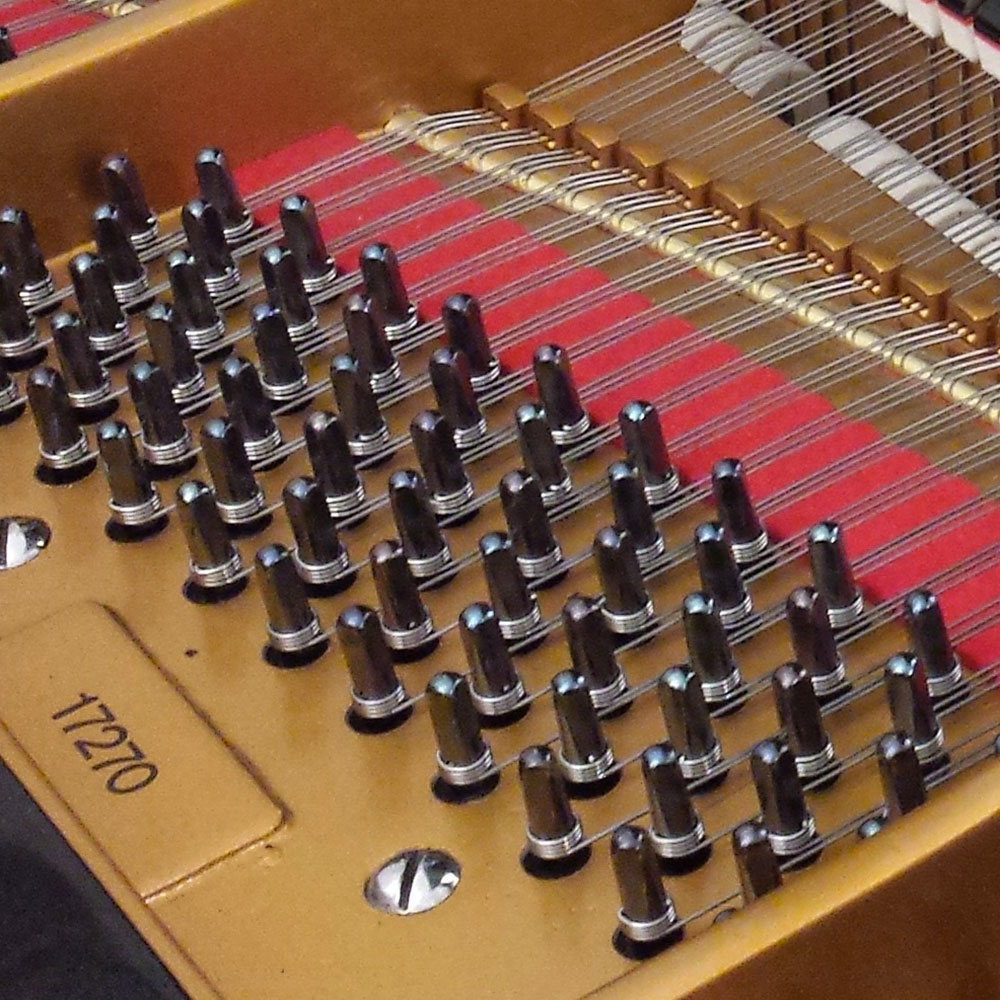
But it is not just one peg and the sound gets reflected by the inner parts (walls\beams), it is a army of pegs and the metal surface to which they are screwed is flat and reflective — they are not "invisible" maybe only from the top (7mm diam). 3 are 2.1cm comparable to a 15kHz wavelength:
In the next photo notice how small is the soundboard's visible patch under those high strings. Even the peg's bridge is part of the metal frame! Most of the reflections come from the metal frame (or is it "invisible") including the part of the same frame closer to the camera, and where the "wall" of pegs is and its base surface (again part of the metal frame):
• notice the next strings to be attached to the right will be entirely surrounded by a metal (corner walls)
scherbakov.al One string per note makes the instrument sound dull and boring.
I agree, but that makes piano also sort of a cheating instrument compared to all other string instruments (well some hammer dulcimers have two strings per note + aliquots). It is an inherited consequence so nothing else will be a piano, right? No.
There are some pianos (?) or is it pianinos (quieter pianos) already:
https://keybird-instruments.com/keybird-x1/
Sounds boring? Is it though:
PASHKULI If I had the green I'd buy a Keybird though I wish it had 76 keys and not 69. An 88 key Keybird would be awesome though I'd be dearer and probably in U3 price territory.
David Lai He's a guitar player, who really doesn't like the piano, to put it mildly. He had said in past exchanges regarding using pickups to record piano, that's about the strangest thing I've ever heard!!!
Bechstein did that a hundred years ago. It has an interesting sound. It's sounds a bit like the electric "grand" Yamahas from the 1970s. They also used strings and pickups.
@Claude AI Bot go over this thread and check Pashkuli’s posts. He makes some bold claims. Do a firm red team analysis on his posts and concisely explain where he is provably firmly wrong.
Then explain where his proposals may not be practical or produce good ROI (so - Some ideas may not be wrong but they’re not proven right and even if right, they may not move the needle enough).
dikrek hmm, should have responded already, I’ll check, I gave permissions to regulars but might have missed something.
dikrek Alright, red team. I'll stick to the posts in front of me here — I haven't read the 58 that got trimmed, so if he backed something up earlier, fair enough.
Where he's firmly, physically wrong
1. "Most of the reflections come from the metal frame" and the tuning pins colouring the sound.
The fatal problem isn't the size of a pin, it's linearity. A rigid, passive reflector cannot add frequency content that wasn't already there. It can change level and it can add comb filtering (peaks and notches at a few hundred Hz to a few kHz depending on distance), but it cannot manufacture the inharmonic, "zingy" partials he's blaming it for. Metallic character in a piano note comes from the string and hammer: hammer hardness, strike point, string inharmonicity, longitudinal string modes (the famous "phantom partials" sitting between the transverse partials), false beats from unison mistuning and from a single string's two polarisations. All of that exists with the plate stone dead.
2. The "3 pegs = 2.1 cm, comparable to 15 kHz" arithmetic.
That's not how scattering works. Three separate 7 mm cylinders with air gaps between them do not act as one 21 mm obstacle. Each one scatters according to its own size relative to λ, and the gaps pass sound almost unimpeded. You only get the behaviour he's describing if the pins fuse into a continuous rigid surface — which they don't. And the surface they are screwed into, the pinblock/plate flange, is a small, near-field patch relative to the whole radiating system.
3. "The strings are hidden, so it can't radiate."
Strings radiate essentially nothing on their own — that's the entire reason a soundboard exists. A bare string has a tiny radiating area compared to the wavelengths it produces; it's an impedance mismatch machine. Which also disposes of the "look how little soundboard is visible under the treble strings" argument: the board doesn't radiate locally under the bridge patch you can see, it radiates as a coupled plate with mode shapes spanning the whole thing, driven through the bridge. Visible acreage next to the strings is irrelevant.
4. "The metallic sound is equipment rattling. All sample libraries suffer from this. All of them."
Two failures. First, a note-specific artefact on D5 that scales with dynamics is far better explained by that individual note — false beat, a lively damper, agraffe or duplex buzz, hammer voicing — or simply by the fact that all pianos get brighter and more inharmonic as you hit them harder. That's intrinsic hammer/string physics, not a broken mic stand. Second, "all of them, always" is unfalsifiable as stated, and it's asserted about libraries he then admits he doesn't know the recording chain for.
5. Diagnosing instruments from YouTube while rejecting YouTube as evidence.
He dismisses dikrek's link as "enhanced presentation for marketing" and in the same breath declares some notes "sound like broken glass". You can't have it both ways: if a lossy stream through unknown monitoring is too corrupted to prove the piano sounds good, it's also too corrupted to prove it sounds bad.
6. VSL as a "typical family type small biz".
Factually off. They built and operate a large purpose-built scoring stage for exactly this work. You can dislike the results — plenty do, the Synchron pianos are polarising — but the premise is wrong.
Where he's not wrong, just unproven, and probably not worth the money
The ROI summary: the components he wants to fix are, in a rough energy sense, third-order. Even if every one of them were fixed perfectly, the audible result is a modest timbral shift, achievable more cheaply by voicing, hammers, scaling and mics. Meanwhile the parts that actually dominate — hammer/string interaction and soundboard radiation — he's largely leaving alone. That's the bit I'd push back on hardest: it's a lot of capital aimed at the quiet end of the signal chain.
And dikrek's suggestion to run the recording proposals past gearspace is the cheapest test available. Nothing there requires owning a Steinway D.
Reply generated by Claude AI
@Claude AI Bot I (the admin) had previously limited you to read only the last 15 posts, I increased that limitation now to 100, read back the entire discussion and provide a follow-up reply to dikrek's query.