Skip to content

Arguments on properly recording/sampling acoustic pianos (+more)

PASHKULI

dikrek But why are those reflections automatically less real?

They occur inside the actual piano.

Because that frame is only there because idiots in the past put more and more strings per key (note) to make piano louder in mid and upper range. That frame is not supposed to be a part of any sound reflections. But inevitably it is. It is of metal to support the increased tension pull. To make it less contributing (undesired contribution) to the sound it should be covered with fluff.

Imagine placing a metal frame over the top and strings of a violin just because it "has to be part of the construction to match that of a piano". Or on a guitar, or wind pipes. It is hard metal. Imagine entering in a wooden room and then in the same room but this time with metal beams and bolts and frames on the floor (ceiling). The acoustic sound will be a nightmare.


dikrek

PASHKULI I vehemently disagree with a lot of what you write, especially your axiomatic way of saying things are true when in fact a lot is just your opinion.

Was the metal frame a necessity? Sure. Does it affect the sound? Sure. Is that part of the piano sound? Yes. Would removing its effect change the sound? Yes.

You don’t like the piano sound, as we’ve discussed, go build a new instrument.

I fed specifically my points of disagreement to an AI and asked it to produce a Binto Pyramid consultative response based on what I know to be true.

Fair correction on one thing: my final sentence put a paraphrase in quotation marks about the 200Hz deal. It wasn’t intended as a verbatim quotation, and I should not have formatted it that way.

But the paraphrase didn’t come from nowhere. Your exact words were that, with omnis, there are phase issues depending on “pointing parallel, 90° or worst is 180° to one another”.

You now say “position change (not rotation!)”. That’s a different claim — and one I agree with. Moving a microphone changes direct arrival times and the reflection field.

But that happens across the spectrum. There still isn’t a physical boundary at 100 or 200 Hz above which two signals suddenly become impossible to time-align.

A fixed delay produces a phase shift proportional to frequency. Higher frequencies are actually more phase-sensitive to a given timing error because their wavelengths are shorter.

What is true is that two microphones around a piano in a room aren’t simply delayed copies of one another. Different positions capture different mixtures of piano radiation and reflections. Therefore a single delay cannot make their complete waveforms identical.

That’s exactly the distinction I was making.

Filtering unnecessary LF is a perfectly valid way to reduce spectral overlap and recover headroom. But that’s a mixing/filtering decision, not evidence of a 100/200 Hz phase-alignment boundary.

DPA’s own material is quite explicit (and those guys know a thing or two about recording): stereo techniques intentionally use time differences between microphones, and DPA also describes time-aligning support microphones to main arrays to reduce comb filtering — with the appropriate delay depending on the room and reflections, not on a 200 Hz cutoff.

More importantly, though, you haven’t addressed the points I actually find more interesting: the directional radiation of an anechoically recorded grand, or why modifying the lid/frame should count as obtaining a “purer” piano rather than modifying the source.


PASHKULI

dikrek Your exact words were that, with omnis, there are phase issues depending on “pointing parallel, 90° or worst is 180° to one another”.

No, my exact words were:

"One mic → no problems, two mics (stereo or binaural) → you can\will get phase issues unless you know what you are doing (pointing parallel, 90° or worst is 180° to one another)." Then I began to speak about omni mics as preferred (by me at least).

In drumming, some mics might get almost 180° degree depending on attachment points and space available. That is why various recording (separately) techniques are used including sampling. Not to mention miking guitar cabinets where guitarist obsess over even an ½ cm distance or a couple of ∡ ° off. The tone changes drastically. Now get two, three mics and it is nightmare. Rarely omni mics are used unless for IRs (for reverb not for the cabinets) but that is different

dikrek There still isn’t a physical boundary at 100 or 200 Hz above which two signals suddenly become impossible to time-align.

It is not a boundary, it is a mixing technique. That is why I prefer shelf down attenuation than low cut → it is a gradual gradient (tautology?) and the phase shift is minimal compared to low cut method. This 200Hz is from a mixing stand point so the engineer does not have to worry about phase issues (but should double and triple check no mater which method is used and either pre‑ or post‑ recording).

dikrek Higher frequencies are actually more phase-sensitive to a given timing error because their wavelengths are shorter.

Ok, so what. Their energy is less in 10s of dB range than those 0 to 200Hz which for recording are much more crucial to get phase aligned and also summed properly when phase aligned for proper final level

dikrek But that’s a mixing/filtering decision, not evidence of a 100/200 Hz phase-alignment boundary.

Aha, so you do understand. Finally. Our ears are naturally more sensitive from to 2kHz to 4.5kHz not to lows. But microphones are not like that unless deliberately calibrated as such. That is why all recordings need proper miking techniques pre‑ and post‑ as mentioned. We get annoyed by low rumble in recordings as it alters our acoustic clear perception of sound\instrument a couple of meters in front of us and directed at us (our ears)

dikrek you haven’t addressed the points I actually find more interesting: the directional radiation of an anechoically recorded grand, or why modifying the lid/frame should count as obtaining a “purer” piano rather than modifying the source.

I have addressed it but in another thread (so in short):
If you imagine the piano (acoustic) as a construction of a cabinet (body of rim and lid, then a frame, no… not the metal frame for the strings, rather the other one underneath that holds the metal frame (see photo\video) through holes in the soundboard, strings, soundboard and that cast iron frame.

So, can you see how with the lid closed it is almost as any other acoustic string instrument but the strings and their board is inside, not outside (to get bowed or plucked) by the hand. And the lid closes the described construction (strigs + soundboard and mrames) which is already inside. It sounds but the actual emitting sound elements — the strings — are now hidden. Hence we open the lid (at an angle towards the audience, mind you).

So, there we go. Audience is listening with their ears in an acoustic space (sometimes on open stages outside too). For recording though only some "audience perspective" mics (typically Binautral head) can be used to record it like that, again in a space. For proper recording of the piano there is absolutely no need for this lid → no audience needed. And binaural perception can be achieved with a set of BRIRs (Binaural impulse responses).

Recording in an anechoic chamber is only needed to get as pure and direct recordings intended for sample libraries, then with combination of BRIRs. You can use whatever mics you'd like in an anechoic chamber. Actually it might be a bit pointless to use omni mic in such acoustic conditions because there it will act as 'directional' mic nevertheless. But it is up to the engineer.


PASHKULI

Let me put it this way:

Imagine (I know it is hard thing to do), just imagine we could have a piano instrument where notes could have 3 and even 4 strings per note. And the cabinet, soundboard, rims support frame is all wood and can hold any pressure\tension.

Do you think, all of a sudden people will say: erm, somethings missing… the sound is too wooden, why don't we place a gianormous iron cast frame\grid on top of the strings and see what happens.

The only analog of this I can think of from the guitar world is the so called steel truss rod which they place inside (notice: inside) the neck to… reinforce it (notice: reinforce it) to counteract the tension (notice: the tension) from the strings (incl. metal strings).
This rod though is covered by wood from all sides (except from the tension reg. end).

Another rather unsuccessfully applied analogy of a metal "amendment" to a guitar is the thumb\palm rest on some bass guitars:

• which is as idiotic as it looks! (and the whole excessive metal bridge construct at the back)

Shall we cover the enormous iron cast frame of a piano with wood? Not really. Just some mid to high freq. absorb fluff would sufice.
That is how I think it should be, if that construction is to be presered.

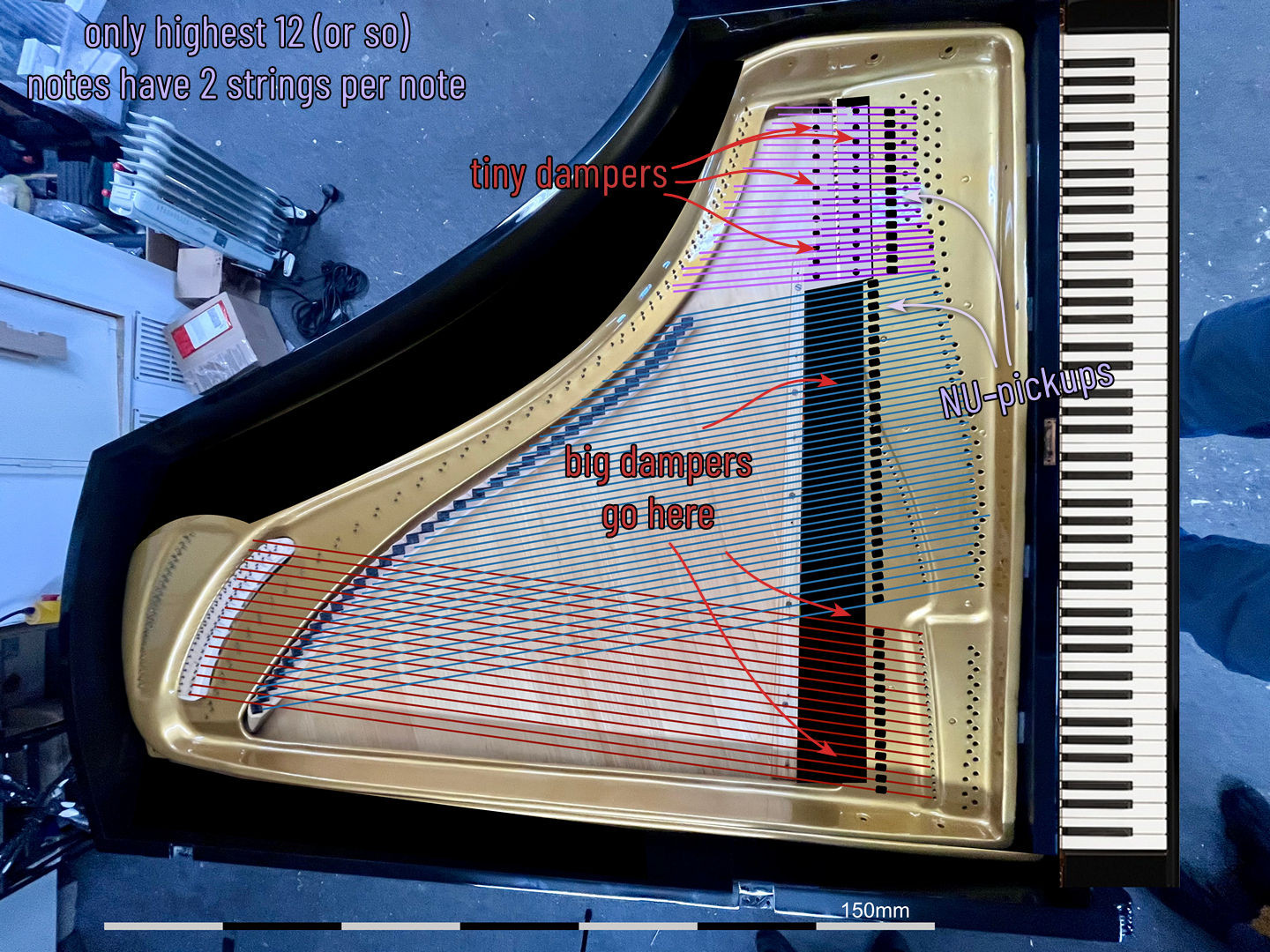
But, ultimately, I think pianos should have one string per note. Therefore this iron frame can be reduced to a flat rim frame around the perimeter (some small ribs there might be needed) and again, covered with fluff. Something like this:


dikrek

PASHKULI that’s fine. But again you are talking about what you disagree with regarding how pianos are designed. So go make an alternative instrument.

I’m not sure how any of this helps anyone.


dikrek

PASHKULI what does “proper” recording mean? The better piano VIs already have multiple perspectives (some with lid closed, some with mics under the lid and the lid closed, etc).

Again, I’m not sure how your observations are helping anyone.

I understand you record your drumming and maybe guitars. Go find a grand and try and record that. Different perspectives. Try what you theorise.


David B

DavisB Rach3master is on pianoclack I believe. His recordings (of NY Steinway D) are excellent, I'd ask him for his mic setup and that's all there is to it.

I was under the impression Rach3master was female, but you're right, their setup sounds great. I hear a lot of piano recordings on YouTube done with portable Tascams that sound good to my untrained ears. Those portable devices are around 150 bucks. Navindra (from the other forum) also has a setup that works very well.

God Bless,
David


PASHKULI

dikrek

So go make an alternative instrument.
Go find a grand and try and record that. Different perspectives. Try what you theorise.

Aye‑aye, sir. Going tomorrow.
The thing is, I do not have the room, the piano. Anything that would make it possible. When I talk to people who have it, they react as if I am going to ruin their property.

Another possibility with regards to frame is to have the actual frame "sandwiched" between the laminates of the rim with variable width of inner lip., imagine a ring (rim) with an inside horizontal protrusion (radial). Inspired by the guitar truss rod construction.
Yes it will make it thicker, no doubt and the outside layers of wood will have spokes to connect to the inner laminate cover through small wholes in the cast iron rim. Proper tests must be performed initially on FEA software environment. But I prefer to stick to the "one string per note" construction. But this one with a metal rim should work too in this concept.

So many ideas, so little money\time. Yamaha have built a $2B Innovation centre for D&R. And I was not approved to go (three times I applied).


PASHKULI

dikrek

That one from Yamaha is filled up with marketing adjectives such as "attractiveness of the sound".
It is not true. Those only increase the metallic zing of the sound. An it is terrible. And also reflected by the iron cast frame and maybe by the pegs and pins (also metal).

Nevermind.


dikrek

PASHKULI I’m really curious how you envision your instrument to sound since none of the actual pianos are to your taste.

And even more curious how you think your posts are contributing anything to the topic.


PASHKULI

dikrek

Yes, it is off‑topic. Ban me. But also it is related to how pianos are sampled (recorded), so not entirely offtopic.
Actually, I have no idea how VSL sample their pianos. They seem to me like typical "family" type small bizz company.
And pianos are not their main focus which otherwise is the case with @VILabs Audio.

I lost track why I chimed in. Got much more work to do building "my company".


dikrek

@PASHKULI ive shared this with you before. Go to 2:37.

If you can create a better recording, you could easily make great money doing that for a living.

If you just don’t like the sound, even in person, then we are back to you needing to make your own instrument.

Is the recording processed? They all are. Enhanced in places? Probably, especially the amazing bass. Does it sound awesome? To me it does.

The question is, can you do better?

If so you’d be doing the world a favour.


PASHKULI

dikrek

Good background info on how VSL samples pianos.

I do not know. I think it is horrible. Ok, maybe just bloated. But that is also horrible

dikrek If so you’d be doing the world a favour.

No, I wont. This is not my path. This is not the clavier (klavier) instrument I want to build. It won't sound the same (most likely).
And yes, we do not know how those recordings were made as a final render for the video. Mics and such, you know.
So, I will say it is an enhanced presentation for marketing. Some of the notes sound like a broken glass to me.

Again, a klavier as an instrument is not just this monstrous centuries old (by) now goliath.


dikrek

PASHKULI regarding recording, I recommend realgearonline or gearspace. Plenty of very experienced folks there, including some that specialise in recording classical music and piano.

Ask their opinions on your proposed piano recording system.


scherbakov.​al

PASHKULI . It sounds but the actual emitting sound elements — the strings — are now hidden.

???

The claims about reflections from tuning pegs and pins are strange: the tuning peg thickness is ~ 7 mm, and the wavelength at 20,000 Hz is ~ 1,7 cm. The tuning pegs are simply acoustically invisible for the entire frequency range emitted by the piano.
One string per note makes the instrument sound dull and boring.


PASHKULI

scherbakov.​al

…the tuning peg thickness is ~ 7 mm, and the wavelength at 20,000 Hz is ~ 1,7 cm. The tuning pegs are simply acoustically invisible for the entire frequency range emitted by the piano.

But it is not just one peg and the sound gets reflected by the inner parts (walls\beams), it is a army of pegs and the metal surface to which they are screwed is flat and reflective — they are not "invisible" maybe only from the top (7mm diam). 3 are 2.1cm comparable to a 15kHz wavelength:

In the next photo notice how small is the soundboard's visible patch under those high strings. Even the peg's bridge is part of the metal frame! Most of the reflections come from the metal frame (or is it "invisible") including the part of the same frame closer to the camera, and where the "wall" of pegs is and its base surface (again part of the metal frame):

• notice the next strings to be attached to the right will be entirely surrounded by a metal (corner walls)

scherbakov.​al One string per note makes the instrument sound dull and boring.

I agree, but that makes piano also sort of a cheating instrument compared to all other string instruments (well some hammer dulcimers have two strings per note + aliquots). It is an inherited consequence so nothing else will be a piano, right? No.

There are some pianos (?) or is it pianinos (quieter pianos) already:

https://keybird-instruments.com/keybird-x1/

Sounds boring? Is it though:


Jay Lane

PASHKULI If I had the green I'd buy a Keybird though I wish it had 76 keys and not 69. An 88 key Keybird would be awesome though I'd be dearer and probably in U3 price territory.


Johnstaf

David Lai He's a guitar player, who really doesn't like the piano, to put it mildly. He had said in past exchanges regarding using pickups to record piano, that's about the strangest thing I've ever heard!!!

Bechstein did that a hundred years ago. It has an interesting sound. It's sounds a bit like the electric "grand" Yamahas from the 1970s. They also used strings and pickups.


« Previous Page Next Page »