PASHKULI
You used AI agent to write that long response. Deny it and we will go on a giant off‑topic (it can be verified with antiAI although you might have touched the formatting here and there → reminds me of our private conversation). Cheeky.
I do not mind. AI is still learning.
dikrek The bit I disagree with most is “phase align” the six microphones.
Effing AI at it right there. So…

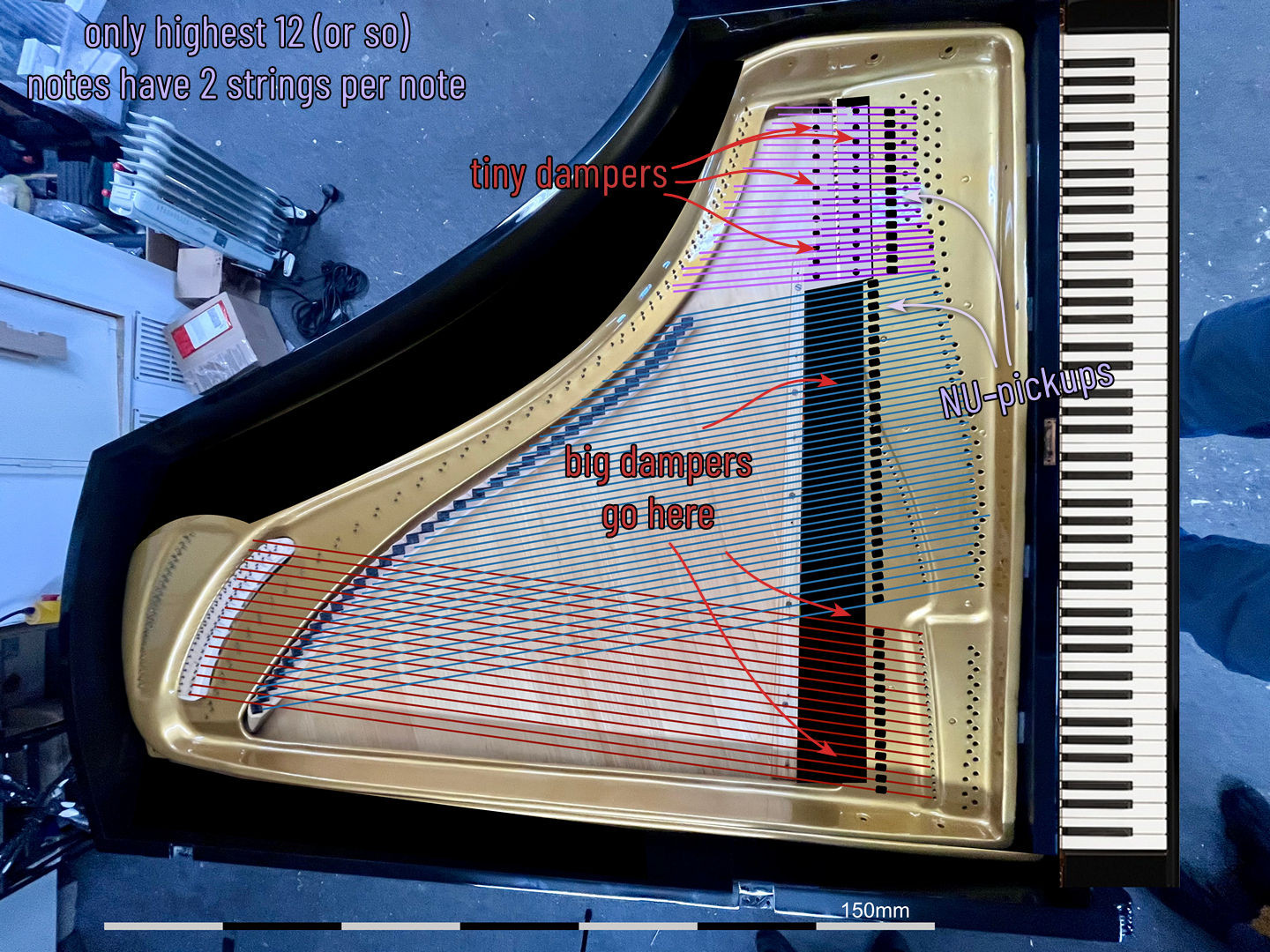
On piano, being a big musical instrument, you can place many, many mics. Ideally, I would have placed Nu‑multi pickups under each note's strign(s) and piezos on bridges. But we are restricting ourselves to microphones (typical acoustic recordings).
Ok, use 5 mics (close‑up) if you will. Or another one under the piano → that confined acoustic space also contributes to the overall sound.
Use 3 close ups (at least). Low, mid, highs, omni directional. One mic → no problems, two mics (stereo or binaural) → you can\will get phase issues unless you know what you are doing (pointing parallel, 90° or worst is 180° to one another). With omni mics it is expected and inevitable. More direct pattern mics, more individual ranges but heavier setup. Hence → better is with individual pickups.
It is cringe that I have to write this self evident rant but we all learn at some\any point.
The lid. Ok, keep it closed. The only way the sound comes out of that "box" will be from underneath (and rumble resonance of cabinet and lid) → the opposite sound of the soundboard where the strings are blocked by it. This setup has nothing to do with any other string instrument. None. So, good luck.
Remove the lid. Expose the string and the soundboard. Dampen as much as possible reflections from metal frame. It is not and should not be a part of the acoustics → it is a structural reinforcement. But being metal and hard it reflects and shifts the real sound of string, soundboard and cabinet.
Phase aligning is only valid between 0 to 200Hz above which it becomes an impossible task to align denser freq. waves. That is why in audio mixes all instruments but bass (incl. synth bass) and kick drums are cut off either with deep shelf (as I prefer) or more generally with a 12 to 24dB even 36dB or 48dB (extreme) per renova ("octave") slope low cut. Mics capture it but it is not needed.
Hence on those piano mics I place, only the low and low mid will have info there (0 to 200Hz) → the other (2 or n) mics will get a shelf cut there. Phase alignment will be much facilitated that way.
The stereo (room\studio) pair does not need time alignment → it is distant for the reason to capture late reflection off studio room acoustics. But it will have low information below 100Hz at least which is not important. The bass strings from ≈30Hz to 120Hz have their fundamentals lower in dB than actual harmonics of new (well cleaned) strings (usually wound coiled too). So you do not need that rumble especially on distant mics which will only mess up the phase. Phase between each mic in the stereo pair should be checked and mics adjusted if need be.
dikrek For a natural solo grand recording I’d start almost exactly the other way around:
Find the position where a very good stereo pair already captures the piano as a coherent instrument in the room.
That is because you do not want to record the piano but the acoustic environment in which it is placed\used\emitting sound.
I am talking about recording the piano itself. And in fact would prefer to replace the room stereo pair with IR (impulse response) sets.
For the latter though the actual room should be close to anechoic (if too expansive — it is — to do all this in a proper anechoic one).
dikrek The fundamental difference is that I’d try to record the piano, whereas your (100% unproven) approach seems to record a collection of piano components and then try to reconstruct the piano afterwards.
F‑off AI.