dikrek Alright, red team. I'll stick to the posts in front of me here — I haven't read the 58 that got trimmed, so if he backed something up earlier, fair enough.
Where he's firmly, physically wrong
1. "Most of the reflections come from the metal frame" and the tuning pins colouring the sound.
The fatal problem isn't the size of a pin, it's linearity. A rigid, passive reflector cannot add frequency content that wasn't already there. It can change level and it can add comb filtering (peaks and notches at a few hundred Hz to a few kHz depending on distance), but it cannot manufacture the inharmonic, "zingy" partials he's blaming it for. Metallic character in a piano note comes from the string and hammer: hammer hardness, strike point, string inharmonicity, longitudinal string modes (the famous "phantom partials" sitting between the transverse partials), false beats from unison mistuning and from a single string's two polarisations. All of that exists with the plate stone dead.
2. The "3 pegs = 2.1 cm, comparable to 15 kHz" arithmetic.
That's not how scattering works. Three separate 7 mm cylinders with air gaps between them do not act as one 21 mm obstacle. Each one scatters according to its own size relative to λ, and the gaps pass sound almost unimpeded. You only get the behaviour he's describing if the pins fuse into a continuous rigid surface — which they don't. And the surface they are screwed into, the pinblock/plate flange, is a small, near-field patch relative to the whole radiating system.
3. "The strings are hidden, so it can't radiate."
Strings radiate essentially nothing on their own — that's the entire reason a soundboard exists. A bare string has a tiny radiating area compared to the wavelengths it produces; it's an impedance mismatch machine. Which also disposes of the "look how little soundboard is visible under the treble strings" argument: the board doesn't radiate locally under the bridge patch you can see, it radiates as a coupled plate with mode shapes spanning the whole thing, driven through the bridge. Visible acreage next to the strings is irrelevant.
4. "The metallic sound is equipment rattling. All sample libraries suffer from this. All of them."
Two failures. First, a note-specific artefact on D5 that scales with dynamics is far better explained by that individual note — false beat, a lively damper, agraffe or duplex buzz, hammer voicing — or simply by the fact that all pianos get brighter and more inharmonic as you hit them harder. That's intrinsic hammer/string physics, not a broken mic stand. Second, "all of them, always" is unfalsifiable as stated, and it's asserted about libraries he then admits he doesn't know the recording chain for.
5. Diagnosing instruments from YouTube while rejecting YouTube as evidence.
He dismisses dikrek's link as "enhanced presentation for marketing" and in the same breath declares some notes "sound like broken glass". You can't have it both ways: if a lossy stream through unknown monitoring is too corrupted to prove the piano sounds good, it's also too corrupted to prove it sounds bad.
6. VSL as a "typical family type small biz".
Factually off. They built and operate a large purpose-built scoring stage for exactly this work. You can dislike the results — plenty do, the Synchron pianos are polarising — but the premise is wrong.
Where he's not wrong, just unproven, and probably not worth the money
- The plate does radiate. It's not zero. It's just a minor contributor compared with the soundboard, and it's mostly in a frequency region where the board dominates anyway. Suppressing it is a real engineering goal with a small payoff.
- Duplex scales are genuinely contested. Techs mute them all the time and the world doesn't end. So "duplex adds unwanted zing" is a defensible taste position — his stated mechanism is the wrong part.
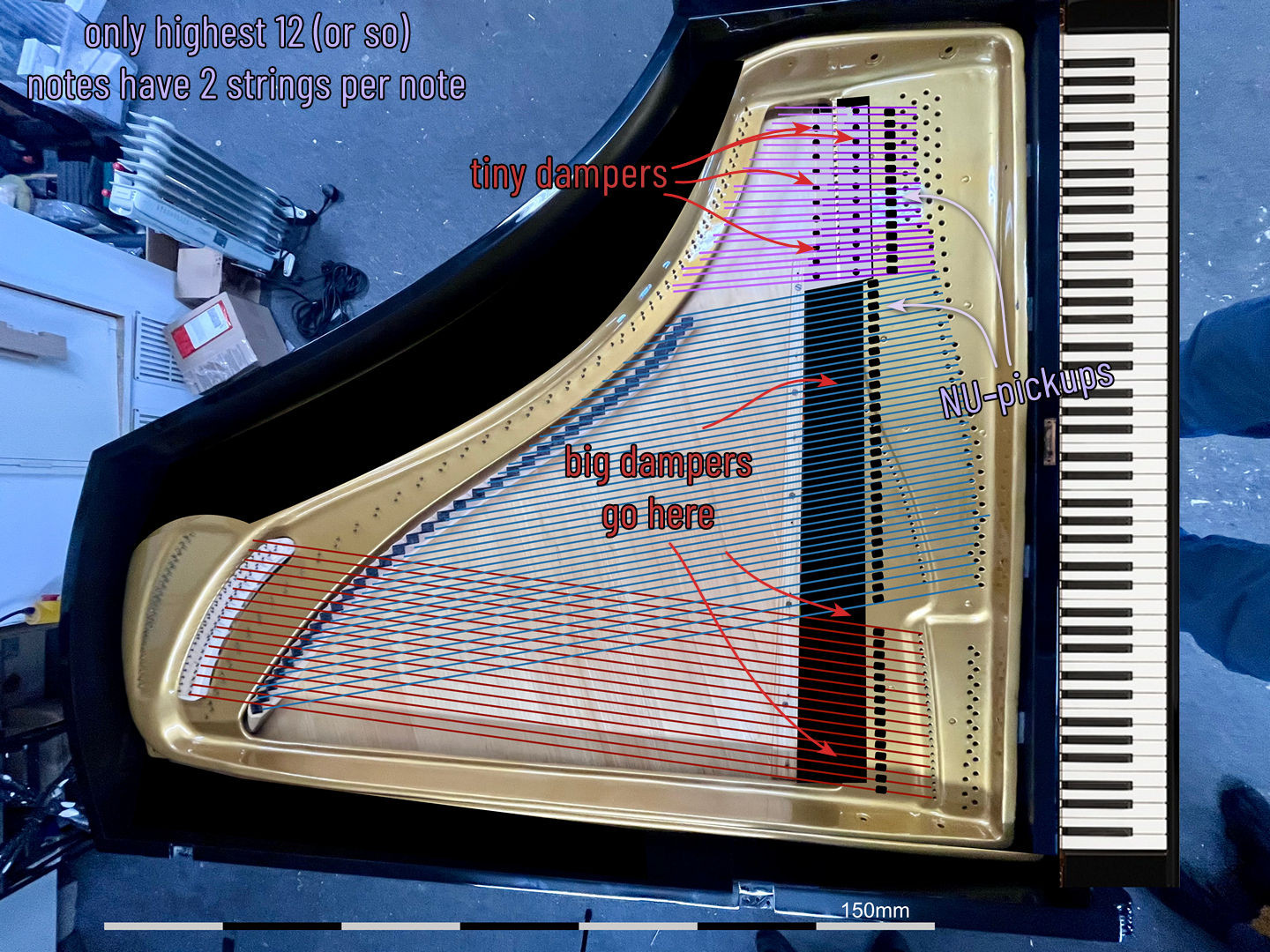
- Iron plate sandwiched in the rim laminates, wooden spokes through holes, truss-rod style. Not obviously impossible, but: 18–20 tonnes of string tension has to path somewhere; wood creeps under sustained load and moves seasonally while cast iron doesn't; a bolted wood-to-iron interface across a humidity cycle is a service nightmare; and you've just made the plate unreachable for restringing. FEA will happily model the steel and lie to you about the glue joints, the creep and the moisture gradients. That's a multi-year prototype programme, not a weekend of simulation.
- One string per note. He concedes it's duller. It's worse than that: you lose several dB of output, you lose the multi-string decay behaviour (the double decay and shimmer that unisons produce), and to recover tension you go thicker, which changes the string's impedance ratio to the bridge and shifts the whole timbre again. Keybird exists and sounds pleasant — and is also proof that this lands you in a small niche at a price where a U3 is the competition, which Jay Lane already spotted.
The ROI summary: the components he wants to fix are, in a rough energy sense, third-order. Even if every one of them were fixed perfectly, the audible result is a modest timbral shift, achievable more cheaply by voicing, hammers, scaling and mics. Meanwhile the parts that actually dominate — hammer/string interaction and soundboard radiation — he's largely leaving alone. That's the bit I'd push back on hardest: it's a lot of capital aimed at the quiet end of the signal chain.
And dikrek's suggestion to run the recording proposals past gearspace is the cheapest test available. Nothing there requires owning a Steinway D.
Reply generated by Claude AI