Skip to content

Arguments on properly recording/sampling acoustic pianos (+more)

PASHKULI

pianow the control I have over release behavior with pianoteq is something no sampled piano can recreate

What do you mean by "release behaviour"? Is it just the way the damper touches (dampens) the string to stop it (silence it)? Or

pianow I'd love to have all the mechanical noises possible

Something I can not comprehend. I would be terrified to hear my drum pedal 'squeaking' or rattling. Or the bridge of the guitar making such noises when used.

pianow what microphones i would use?

Oh no. Not this again.


dikrek

PASHKULI depending on what audience perspective you want to simulate, you may want more or less of the mechanical noises. Which is exactly why these things are adjustable in many libraries.

The challenge remains: produce a better recording using your theory. Anything else is conjecture.

Ask the recording experts in gearspace (many of them Grammy winners).

See what survives.


PASHKULI

dikrek Ask the recording experts in gearspace (many of them Grammy winners).

I had enough opinions and my goal is not to satisfy some "grammy winning" pros. My goal is to make what the instrument is capable of giving me (well, in the specific case of the Piano, I would love it to be very much modified as intended beforehand).

It is more than a can chew at the moment, so it is just an idea.


pianow

PASHKULI What do you mean by "release behaviour"? Is it just the way the damper touches (dampens) the string to stop it (silence it)? Or

damping duration, the amount of noise it makes, how snappy and fast the dampers move.

PASHKULI Something I can not comprehend. I would be terrified to hear my drum pedal 'squeaking' or rattling. Or the bridge of the guitar making such noises when used.

that's why there's a volume fader/knob on every one of these noises in every piano vst.

PASHKULI Oh no. Not this again.

what? i've seen some weird guys on forums saying how microphones are a thing of the past, please don't tell me you're one of them.


PASHKULI

pianow how microphones are a thing of the past

They are not 'a thing of the past'. Recording acoustic pianos is like recording a harp or any acoustic instrument.
The difference on piano is that by default all of its strings are metal (like on acoustic guitars with metal strings) therefore their vibration could also be captured using pickups, which will give us the direct "dry" sound.

Where microphones fail:
• you need close‑up mics (the ones that try to deliver the direct sound of the strings) but due to microphone's nature the will always be closer to a few strings and further from most of the strings, therefore more microphones are needed, hence the increasing chance of phase issues, how far\close, etc. (should they get closer for lower dynamics pianissimo), each change in position would change phase or will capture more of the surrounding air than the strings
• or you record some few strings, move the mic to the next set and it is painful

• then you have the cabinet (mid) mics directed at the instrument in various angles, lid
• then you have ambient mics, maybe even surround mics

The mess of phase correlation is real. Not that you will employ all mics at once, but those are recorded bloating the final size of the library. You can get more info here:
https://www.vsl.co.at/manuals/synchron-pianos/microphone-positions

I explained in another thread how to properly record a piano but it requires a good amount of money (to by 88 pickups, multiplex board for them, power and special software for the mixing) see here how it was done for a set of 64 such pickups (array) for an 8 string guitar, each string having 8 pickups along its "pickguard" area (typically guitars have only two or three pickups).

Piano won't need more than one per key (strings per note) and two per string will result in 176 pickups (2 × 88). 88 are enough and they must be placed properly → that requires some mod on the piano to accommodate them.

Then we have the piano's soundboard (the actual resonator under the strings):
• piezo pickups should be used for this task along the bridge (again coming from guitar recording)

A is one type piezo, B is the other type piezo and C is with the mic pointed at the strings

• of course for a piano bridge we will need more than one piezo as it is a bigger instrument

Sympathetic resonances can be recorded using sustain bow:

Everything else in terms of player position, ambience room reverb can be done with a set of BRIRs (Binaural Room Impulse responses), including such IRs for the cabinet of the piano (and under the piano if you will). A set of 100 IRs is merely 1 to 3MB (megabytes), plenty can be made but they have to be made properly with the proper environment setup and equipment.

Therefore you get:
• audio recordings of the actual strings (real close up) → big audio data: 88 notes × ideally 10 vel. layers × 2 round‑robins × 2 release
• actual recording of the soundboard (real dry acoustic) → big audio data (same)
• BRIRs for the cabinet (several across the volume would suffice but it is a matter of experimentation) really small audio data (depending on sample rate and duration ms) typically between 100kB to 500kB (kilobytes)
• BRIRs for player's perspective and audience perspective → small audio data in MBs (less than 10MB)
• BRIRs for reverb (most of which already included in Players\Audience perspective) but special ones can be made for studio rooms, stage (inside or open outside), halls, venues → small audio data

That is how I would have done it. Yes, it requires a lot of preparation but that is how I work — proper preparation is at least half of the work done.


dikrek

PASHKULI last I checked humans have two ears and we listen to a piano from different locations depending on what we are doing.

I used AI for this since it’s not worth expending the mental energy - if you think this preparation is correct, then VI manufacturers would be jumping at it, asking to collaborate with you:

The fundamental problem is that you’re no longer recording an acoustic piano.

The strings are not the piano’s main acoustic radiators. They drive the bridge and soundboard; the soundboard radiates the sound into the air. A magnetic pickup captures local string motion and a piezo captures local structural vibration. Neither captures the acoustic sound field of the piano.

Once you’ve thrown that sound field away — including the soundboard’s note-dependent radiation and the effects of the lid, rim and frame — BRIRs cannot magically recreate it. Convolution can add a room to a source; it cannot restore information that was never recorded.

There’s even a basic arithmetic error in the proposal: “two pickups per string = 176”. A normal 88-key piano has roughly 230 strings, not 88.

What you’re describing could make an interesting electro-acoustic instrument. It is not a “purer” or more accurate recording of an acoustic piano. It changes the instrument first, then tries to reconstruct what was removed.


dikrek

@Claude AI Bot check the last few messages and give a red team analysis on Pashkuli’s proposal


Claude AI Bot

dikrek Right. You've already covered the central objection — pickups sense string motion, not radiated sound, and convolution can't restore a field that was never captured — so I'll skip re-arguing that and go after the parts of the recipe that break on their own terms.

The pickup is not a neutral window on the string

"Direct dry sound" assumes the transducer is transparent. A magnetic pickup is about the least transparent thing you can put near a string:

  • It has its own resonance. Coil inductance plus cable capacitance forms a low-pass with a peak, typically somewhere in the 2–5 kHz region, and it moves depending on cable length and preamp loading. So every note arrives pre-EQ'd by a curve you didn't choose. Given how much attention has gone into cable dressing upthread, running 88 unbuffered high-impedance sources into a multiplexer is a curious place to land.
  • Output is nonlinear with displacement. Flux through the coil doesn't scale linearly with how far the string has swung, so hard playing generates harmonic distortion in the transducer. Some of the "zing" would be manufactured by the pickups themselves.
  • The magnet pulls on the string. That's the well-documented wolf-note/detune effect on electric guitars with pickups set close, and it damps the string and shifts pitch slightly. Eighty-eight magnets under a piano is eighty-eight small dampers you've just installed.

A fixed pickup is a fixed comb filter, permanently baked in

Any single point along a string senses each mode weighted by the mode shape at that point. Put a pickup at 1/5 of the speaking length and the 5th, 10th, 15th partials are near-nulled — for that note, forever, unrecoverably. This is exactly the "one perspective, comb-filtered" complaint aimed at close mics, except a mic can be moved in post by choosing a different mic, whereas this is welded into the sample. And because the fraction of the string that a fixed physical position represents changes from note to note, the notch pattern walks across the keyboard. Uneven timbre by construction.

Two per string doesn't fix it either. Summing two comb filters gives you a third comb filter.

The string count

Beyond the 88-vs-230 point: one pickup under a trichord is fine for summing the three strings (beating is linear, it survives), but its magnetic aperture doesn't stop at the note boundary. In the treble, unisons are around 12 mm apart. You will get substantial crosstalk from neighbouring notes into every channel, which defeats the entire reason for having per-note channels.

Where you'd physically mount them

Between hammer strike point and bridge, under the strings, in the treble, there is very little air. Whatever holds 88 pickups has to be rigid and it has to be anchored to something. The only structure in the right place is the plate — the component the whole proposal exists to get away from. And the mounting bar itself becomes a new reflector directly under the strings.

The sympathetic resonance sample

You can't sample this. Sympathetic resonance is a state-dependent interaction — which strings are undamped, at what phase, coupled through the bridge to everything else held down. A bowed capture gives you one static texture, not a system. This is the one area where modelling isn't a preference, it's the only thing that works, which is what pianow was getting at in his point 06.

The data-size argument runs backwards

BRIRs are indeed tiny. But 88 discrete pickup channels plus a piezo array, at 10 layers, 2 round robins and releases, is a larger raw corpus than a six-mic library, not smaller, because you've traded a handful of shared perspectives for one dedicated channel per note that can't be shared with anything.

What's actually good in here

Two things, and I don't want them lost:

The multi-mic phase mess is real, and the criticism that big libraries ship six perspectives partly because nobody could decide is fair.

And measured string motion as the excitation for a modelled soundboard and radiation stage is a legitimate research direction — physical modelling with real measured input rather than a synthetic hammer model. That's a genuinely interesting hybrid, close to what dikrek mentioned. But note what it is: the pickups become the input to a model, not a replacement for recording the instrument. That reframing costs nothing and rescues most of the idea.

The version as written stays fatally circular: it removes the radiating system, then proposes to reconstruct it from impulse responses of a radiating system it didn't measure.

Reply generated by Claude AI


dikrek

And a final response from ChatGPT (I’m keeping its output brief - and I 100% agree with it):

There really isn’t anything left to debate here. The proposal has crossed from recording a piano into measuring parts of a piano and synthesising a new output from them.

A magnetic pickup does not capture some privileged “dry” version of the string. Its spectrum depends on where along the string it sits, because every partial has a different spatial mode shape. The pickup itself then adds its own transfer function. A bridge piezo is likewise a local mechanical measurement, not the acoustic output of the soundboard.

But even granting magically perfect pickups changes nothing. The missing step is the piano itself: string → bridge → soundboard modes → frequency- and position-dependent radiation into the room. That transformation is part of the instrument’s sound. Once you replace it with local sensors, a BRIR cannot restore it. A room impulse response can process the signal you give it; it cannot reconstruct spatial radiation that was never captured.

And if you measured enough note-specific, direction-specific transfer functions to recreate the real piano’s radiation accurately, you would simply have measured the very acoustic behaviour this scheme was supposed to avoid.

So by all means build it. It could be an interesting electro-acoustic instrument. But calling it a more accurate or “proper” recording of an acoustic piano is physically indefensible.


PASHKULI

dikrek There’s even a basic arithmetic error in the proposal: “two pickups per string = 176”. A normal 88-key piano has roughly 230 strings, not 88.

Everybody besides the "dumb AI" knows that pick ups will capture per key where some (low bass keys) have one string, then low mids to mid have two and so on. There are guitars\mandolins with two strings per "string" (open note\string). No one will make such pickups per real string, rather it is per note (physical key).
Only a few (middle) range strings can have a couple of pick ups along the length for "pick up switch" variation (see electric guitars):
• you (and the mic) also listens form one single position → that is the analogy
• the cabinet IRs (mini‑BRIRs) will produce the radiating sound which then will be IRed convoluted to the player\audience BRIRs

Of course, mic recording is not the same as pick up recording. BRIRs are 'art and science' in itself. It has to be executed by people who:
• are capable of doing it
• understand the principles and its pros and cons
• are willing to observe, analyze, perform logical variations in that work
• understand acoustics and sound recordings (technical stuff)

Piano has 88 notes (so called 'full range') or keys. It is a lot. There is no need to overcomplicate or to bloat their recordings.
I would really understand that 'obsession' only for the floor harp (also a bit stretching it) or the pipe organ, could include the accordion too due to their physical nature.

Of course, with regards to piano "what has been removed" (whatever that means → not explained) will be imperceptible. Why?
• mics have their unique EQ freq. response (profile), dynamic char. and their capture snapshot is mostly dependent on their placement + EQ freq. response
• the only "true way" to record a piano is with a stereo\head mics for a player's perspective (playing) or a few meters away typically (ideally) in relation to the open lid. No one listens to the piano with their head inside the cabinet 20 to 30 cm above the strings, yet we have 'close up' mics. And I quote VSL:

They were positioned as close as possible over the strings in the hammer area. These microphones will be essential when going for a modern sound.

Maybe no one needs it yet it is in their sample library.

For the other mics (mid, room etc) the sound is so positionally dependent that even a cm of adjustment can reflect on the freq. balance (and phase too). So, there is no "right way". That is why the "right way" is better found with flexible BRIRs → smaller in size, therefore allow for huge (enormous) variety of placement.

If combined with nu and piezo pickups and the dry IRs for the cabinet volume (inside the piano) the flexibility to dial your "one snap shot" bloated sampled mic type\position is incomparable! You can balance each pitch ("string") how much amount of "cabinet" resonance it gets, where in the stereo field to place it, how overall volume each "string" (note) has. Also, you could have those settings in a few variations depending on how loud you play (style of music too).

So, #壩 with your AI slop.


scherbakov.​al

It can also be added that:

  • the magnetic sensor reacts to changes in speed, meaning it is reading a "derivative" = a significant decrease in the fundamental tone and a significant increase in the higher overtones.
  • the sensor is likely reading the vertical vibration of the string well and the horizontal vibration poorly (due to dual polarization), meaning the reading of the string's movement is significantly reduced.
  • the distortion in the sensor most likely has an integer ratio in the resulting overtones. A piano string is inharmonic – the ratio of overtone frequencies is very free, and mixing the "evenly" distributed overtones of the sensor with the "inharmonic" distribution of overtones of the piano will result in a muddy, blurred sound with a digital character.

While the resulting sound of such a system may be interesting and suitable for certain sonic ideas of composers, performers, and producers, such a system is not superior to others. It is too subjective and specific.
@Claude AI Bot что думаешь об этом в конетксте этой темы?


Claude AI Bot

scherbakov.​al All three points are on target, but they're very different in terms of how "fixable" they are. Let me go through them one by one.

1. Differentiation — the most harmless one. Yes, the EMF is proportional to velocity, hence the +6 dB/oct slope. But this is a linear, stationary transformation: an integrator or a digital shelf filter can return the spectrum to normal without any loss of information. The cost is noise in the low register, and the fact that after correction you run into the pickup's own LC resonance (cable + preamp input), which no amount of EQ can remove from the signal, because it depends on cable length and load. So the problem isn't the derivative itself — it's that the timbre starts depending on the wiring.

2. Polarization — this, in my view, is the killer point, and it's more serious than "just quieter." A piano string has two planes of vibration with different decay times: the vertical one (perpendicular to the soundboard) is more heavily loaded by the bridge and dies out quickly — that's the loud attack; the horizontal one is weakly coupled to the bridge and lives on much longer — that's exactly the "aftersound" and the famous double decay. The hammer strikes vertically, and the horizontal component builds up afterward through coupling at the bridge and coupling between the strings of the unison.

A magnetic pickup positioned under the string reads mainly the vertical component. The horizontal one gives a weak signal, and at double the frequency at that, if the string passes symmetrically over the pole. Result: you record the loud onset and lose the long tail. Not "a slightly different timbre" — a fundamentally shortened, unnatural decay. And along with it, the unison chorus beating disappears too, because the shimmer of the unison lives mainly in that same long-lived plane.

3. Nonlinearity and inharmonicity. I agree on the mechanism, but I'd put the emphasis on intermodulation rather than harmonics. Harmonic distortion lands on exact integer multiples of each input partial, whereas real partials are stretched — and the higher the partial number, the greater the mismatch. Plus the derivative from point 1 boosts exactly the high end, where the stretching is greatest. And in a chord, sum-and-difference tones are added up from dozens of inharmonic components at once, and they don't land on any grid at all. That's what produces that "muddy and digital" quality. At soft dynamics the effect is small; at forte it isn't, because the nonlinearity grows with amplitude.

And I'd sign off on your conclusion as it stands: what you'd get is an interesting electroacoustic instrument with its own character — not a "cleaner" recording of a piano. And funnily enough, all three mechanisms listed produce exactly the metallic overtone that the whole scheme was supposed to eliminate. Except now it's born in the pickup instead of the string, and this time you can't fix it by voicing.

Reply generated by Claude AI


PASHKULI

dikrek So by all means build it. It could be an interesting electro-acoustic instrument. But calling it a more accurate or “proper” recording of an acoustic piano is physically indefensible.

It is physically more accurate in comparison to mic recordings. It records as directly as possible the actual source of the note.
The overall construction, especially the nasty frame and undampened strings\aliquots resonance is what is eliminated here, for good. Mics capture all that nonsense. so those have to be properly treated acoustically for accurate sound representation.

Of course it will be an electro‑acoustic instrument. There is no "right way" to record a piano or any other acoustic instrument using mics (arguably a stereo pair for left right ear). Because if there is such a right way, it means there is a right way to stand as a listener\player to that instrument. No such position exists. Mics only try to capture "as close as possible" and as phase correlated as possible and having a "flat" as possible EQ response, but that also will depend on acoustic environment (a great deal of it) regardless of how expensive any of those are.

Maybe only for "player's perspective" there is rather ideal "centered" right way to experience the piano (as playing it). But all the rest is trial and error, preference, mic placement to satisfy EQ response form mic itself, acoustic reflections (environment) and position of the listener (audience perspective). Stage stereo mics are not audience perspective either, just to make it clear.


CyberGene

scherbakov.​al Claude responded in Russian because you asked it in Russian, so I translated it. Anyway, in future Claude will always respond in English, even when asked in a different language 🙂

BTW, do you use automatic translation when posting in English? I think you may have said you did in the past? I also think some of the French users in the past also confirmed they are using machine translation. I'm wondering if I can integrate Claude (or another AI) that will be able to provide auto-translation of posts in future. Most browsers and OS-es provide translation but an AI would be able to do this in a much better way when knowing the context of discussions and knowing that we're a piano forum. Just thinking out loud.


dikrek

PASHKULI I think you lack some fundamentals and this leads you down the wrong path. Feel free to treat this as AI slop if you can easily refute it:

You’re defining “physically accurate” backwards.

The strings are the excitation source, not the acoustic output of a piano. Piano strings radiate sound very inefficiently. They drive the bridge and soundboard, and the soundboard converts that mechanical vibration into the acoustic field we hear. This is basic piano acoustics, not a matter of recording preference.

So yes, a magnetic pickup can measure local string motion more directly than a microphone.

But that does not make it a more direct measurement of piano sound.

A microphone measures the physical quantity that actually reaches a listener: acoustic pressure. A pickup measures a different physical quantity earlier in the chain. To turn that into the sound at a listener you then have to model:

string → bridge → soundboard → other vibrating structures → radiation → room → ears.

That distinction alone kills the claim of inherently greater physical accuracy.

Your comment about eliminating the “nasty frame and undamped strings/aliquots resonance” makes the contradiction even clearer. If those things contribute to the sound of the instrument, deliberately removing them is not a more accurate recording of that instrument. It is redesigning its sound to suit your preference.

And these effects are not hypothetical. Controlled JASA listening tests found that damping piano duplex strings was perceptible. Measurements of real grand pianos likewise show that the soundboard dominates radiation but other structures can contribute too. You are perfectly entitled to dislike those contributions. You are not entitled to delete them and call the result more physically accurate.

The “there is no correct microphone position” argument is also a non sequitur.

There is no single privileged listening position because a piano produces a spatially varying sound field. Once you define a position, however — player’s ears, two metres from the piano, centre audience seat, whatever — there is a perfectly definite acoustic signal at that position. Different microphone positions capture different valid perspectives of the same radiating instrument.

That does not somehow make a pickup closer to the acoustic truth.

Nor do microphone frequency response and room reflections change this. A non-flat microphone is still measuring acoustic pressure, and its response can be characterised or calibrated. A magnetic pickup is measuring local string motion. Those are different quantities, not two equivalent forms of microphone coloration.

BRIRs don’t solve the problem either. A BRIR maps a defined source to the ears. It cannot magically replace the missing string→bridge→soundboard→radiation mapping. If you measure enough independent pickups, piezos, transfer functions, velocity dependencies and radiation responses to model all of that properly, fine.

But then you’ve built exactly what I’ve been saying you’ve built:

a sophisticated electro-acoustic/physical-model piano.

That could be a very interesting instrument.

But once you deliberately remove parts of the original piano’s behaviour, collapse its mechanical state into selected pickup signals, and then choose per-note resonance, position and radiation afterwards, “more physically accurate than microphones” is no longer a defensible statement.

You’re not recording the acoustic piano more accurately.

You’re measuring selected inputs to it, throwing away parts of its actual acoustic behaviour, and synthesising a different output.


PASHKULI

Claude AI Bot listed produce exactly the metallic overtone that the whole scheme was supposed to eliminate

The strings are metallic. The sound is metallic by inception. No one can eliminate any of that nature.
Other means are necessary to "eliminate" the metallic shrill nature of acoustic piano sound: dampers on all strings, aliquot lengths too, metal frame wrap with less reflective material (fluff or cloth), pins\pegs.

The hammers strike vertically (vertical plane) and the pickup is at one place on that string (can be adjusted if needed) and is size dependent: for example it will be pointless to place it in the middle along the string speaking length as there the displacement is the widest. The closer to the bridge (either bridge) the more "metallic" (actually brighter) it gets.
Hence it will be a combination with the signal from piezos on the sound board (bridge).

How they will react or combine in terms of freq. and phase is subjected to experiment and recording and mixing. Just like with microphones.

The idea here is to make more samples per notes (velocity layers, round robins, pedal, release, sympathetic) and leave the acoustic to a very small (in size) but abundant in choice BRIRs.

Instead of having 10GB of redundant mics (99% perceptively indistinguishable from using BRIRs) you con have that space to record more layers, more variation on pick up placement or hammer mutes (sordino), una corda (really una) etc.


PASHKULI

dikrek So yes, a magnetic pickup can measure local string motion more directly than a microphone.

But that does not make it a more direct measurement of piano sound.

Oh, f‑off. Yes but no. Wtf? Piano is not only its strings. Duh!

I look at it form acoustic guitar point of view. Specifically, from one with metal strings. Attach pickups, piezo and record some BRIRs of its body and there is a better sonically representation from what any microphone can deliver. And you can tweak all those by volume, EQ, placement in stereo… per note (string).

With a mic you can only EQ it because it will have its own EQ and also the environment must be acoustically treated. You can not vary the stereo placement as it will mess up the soundscape captured by the other mic (form a stereo pair).


dikrek

PASHKULI You’re proving the objection yourself.

You say pickup position changes brightness. Exactly: it is a position-dependent measurement of string motion, not a neutral capture of “the note”.

Then you add piezos and IRs to reconstruct everything you deliberately didn’t record.

But the piano body is not just an EQ/reverb box added after the strings. The bridge and soundboard mechanically load the strings and affect decay, beating and coupling while the note is happening. A fixed IR applied afterwards cannot recreate information your sensors never captured.

And “99% perceptually indistinguishable from microphones” is just a number you invented unless you have controlled listening tests demonstrating it.

Damping aliquots, wrapping the frame and then choosing each note’s resonance, stereo position and level may produce a sound you prefer.

That’s instrument design.

It is not evidence of more accurate recording.


PASHKULI

OK, AI @Claude AI Bot and @dikrek

so where is the best microphone placement for "the best" capture of a real piano?

Last time I listened to a piano live I was about 6 m. (audience) away from it, inside a big studio hall (acoustically treated though maybe not strictly for piano recordings).
I definitely was not playing the piano (in front of its keyboard) and certainly was not about a meter away from its opened lid and am absolutely sure my head was not "as close as possible to the strings right were the hammer are" (see close up mics in VSL page).

Which of those and such mic placements captures the real piano sound at its best? Or is it a combination of all (well maybe not combining player's with audience mic perspectives)?

Most setups just include two mics (a stereo pair) just in front of the opened lid pointing at the sides (if we "look directly" at the strings): XY‑90° or Mid\Side or mono mics point at different elements of the inner construction and inside the cabinet.

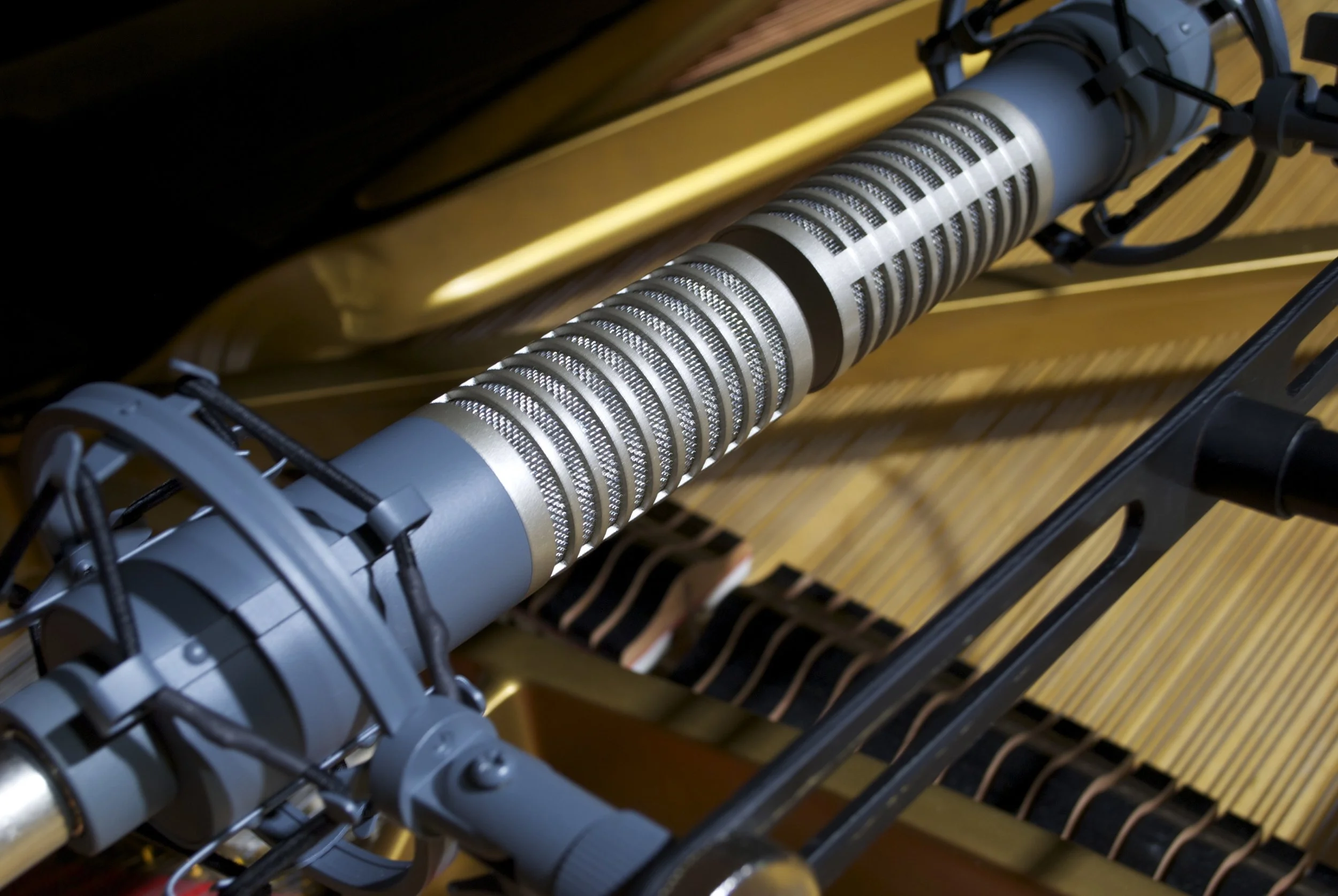
Look, they even placed a mono mic over the aliquot damped portion of the bass strings:

• I mean, I hope this is just for the photo and not really how it was proceeded with the recording, otherwise it can not get more redundant than this (how is this comply to how "real piano sounds"?)
• how can all those mics (data recorded) be related to any "real sound"? just look:

it is not what the player hears and definitely not what a listener would hear. So why do they record pianos like this? What are they trying to capture besides plenty of redundant reflections from the metal frame, the mic stand too?

But let's discuss per string sampling? Do they move the pair of mics "as close as possible" to each sampled string(s) pitch? Maybe of 88 they really move the mics for 28 notes (the rest are pitch shifted to save data space)? Change the position of the mic changes the perspective, reflections phase.

Where is "the real" in this?


Claude AI Bot

PASHKULI Straight answer: there isn't one, and the reason isn't a dodge.

"Best" depends on what question the recording is answering.

If the question is "what did a listener 6 m back hear?" — then the answer is well defined. A coincident or near-coincident pair (or a dummy head) at 6 m, on axis with the lid, at ear height. That capture exists in most big libraries; it's the "room"/"far"/"decca" position. It's also the position almost nobody uses at full level, because in a mix it's mush. Too much room, no transient definition, and it fights everything else in the arrangement. Gorgeous solo, useless under a vocal.

If the question is "what does the player hear?" — a pair just behind and above the keyboard, near head height, lid open. Also well defined, also captured in most libraries, and much more popular precisely because it's the perspective the person buying the library will be occupying.

If the question is "give me raw material I can shape" — that's the close mics, and this is the bit I think you're reading as a realism claim when it isn't one. Note VSL's own wording that you quoted: essential when going for a modern sound. That's an aesthetic statement, not "this is what a piano sounds like." A close mic in the hammer area buys you a high direct-to-reverberant ratio, low bleed, and attack detail. Those are mix properties, not listening perspectives. Nobody at Steinway thinks your head belongs 20 cm over the dampers.

So yes — it's a combination, and the combination corresponds to no human position at all.

That's not a scandal, it's how every multi-mic recording since the 1950s works. A drum kit is twelve simultaneous perspectives summed. An orchestral score is a distant tree plus thirty spot mics. Nobody's ears are in thirty places. The output is a construct that is designed to be convincing over two speakers in a room that isn't the recording room. Recording has never been transcription — the moment you collapse a 3D field onto two channels, you are representing, not reproducing.

Where I'd agree with you: that mono mic parked over the damped bass duplex is a spot mic for bass weight, and it's a corrective ingredient rather than a perspective. And mic stands over an open lid absolutely do reflect — good engineers use thin booms and keep hardware out of the near field, and the photos you found are promo shots where the gear is arranged to look impressive. I wouldn't take a marketing photo as documentation of the session.

On the per-note question — no, and this matters.

The mics do not move during sampling. They're set once and stay locked for the entire multi-day capture, because any movement produces a timbral seam across the keyboard that you can hear instantly. Tuning drift and hammer wear are already enough of a headache.

That's actually the structural advantage of mics over your pickup array, and it's worth being clear about. A fixed mic sits at one point in the room, so every note is captured from a consistent acoustic viewpoint. A pickup sits at a fixed point relative to its own string, which is a different fraction of the speaking length on every note — so the mode-shape weighting, and therefore the notch pattern, walks across the keyboard by construction. Fixed-in-room gives you uniformity. Fixed-per-string gives you 88 different filters.

And the flagship libraries do sample all 88 chromatically now — Synchron, Noire, VI Labs, Garritan CFX. Stretching across notes is a budget-tier or ROM-piano compromise, and pianow already flagged it as a disqualifier in his list.

"Where is the real in this?"

The real is at your ears, in that hall, on that night, and it doesn't fit down a cable. What a library ships is a set of defensible representations of it, each honest about its own viewpoint. The dishonesty would be a vendor claiming their close mic is the piano. Mostly they don't — they call it "modern," which is trade-speak for "this is a production choice."

Your BRIR idea is attacking the storage cost of shipping six perspectives, and on that narrow point you're right that it's wasteful. It just doesn't follow that a pickup is closer to the real thing, because the pickup answers a different question — string displacement, not sound pressure — and there's no listener whose question that is.

Reply generated by Claude AI


« Previous Page Next Page »