PASHKULI
dikrek Your exact words were that, with omnis, there are phase issues depending on “pointing parallel, 90° or worst is 180° to one another”.
No, my exact words were:
"One mic → no problems, two mics (stereo or binaural) → you can\will get phase issues unless you know what you are doing (pointing parallel, 90° or worst is 180° to one another)." Then I began to speak about omni mics as preferred (by me at least).
In drumming, some mics might get almost 180° degree depending on attachment points and space available. That is why various recording (separately) techniques are used including sampling. Not to mention miking guitar cabinets where guitarist obsess over even an ½ cm distance or a couple of ∡ ° off. The tone changes drastically. Now get two, three mics and it is nightmare. Rarely omni mics are used unless for IRs (for reverb not for the cabinets) but that is different
dikrek There still isn’t a physical boundary at 100 or 200 Hz above which two signals suddenly become impossible to time-align.
It is not a boundary, it is a mixing technique. That is why I prefer shelf down attenuation than low cut → it is a gradual gradient (tautology?) and the phase shift is minimal compared to low cut method. This 200Hz is from a mixing stand point so the engineer does not have to worry about phase issues (but should double and triple check no mater which method is used and either pre‑ or post‑ recording).
dikrek Higher frequencies are actually more phase-sensitive to a given timing error because their wavelengths are shorter.
Ok, so what. Their energy is less in 10s of dB range than those 0 to 200Hz which for recording are much more crucial to get phase aligned and also summed properly when phase aligned for proper final level
dikrek But that’s a mixing/filtering decision, not evidence of a 100/200 Hz phase-alignment boundary.
Aha, so you do understand. Finally. Our ears are naturally more sensitive from to 2kHz to 4.5kHz not to lows. But microphones are not like that unless deliberately calibrated as such. That is why all recordings need proper miking techniques pre‑ and post‑ as mentioned. We get annoyed by low rumble in recordings as it alters our acoustic clear perception of sound\instrument a couple of meters in front of us and directed at us (our ears)
dikrek you haven’t addressed the points I actually find more interesting: the directional radiation of an anechoically recorded grand, or why modifying the lid/frame should count as obtaining a “purer” piano rather than modifying the source.
I have addressed it but in another thread (so in short):
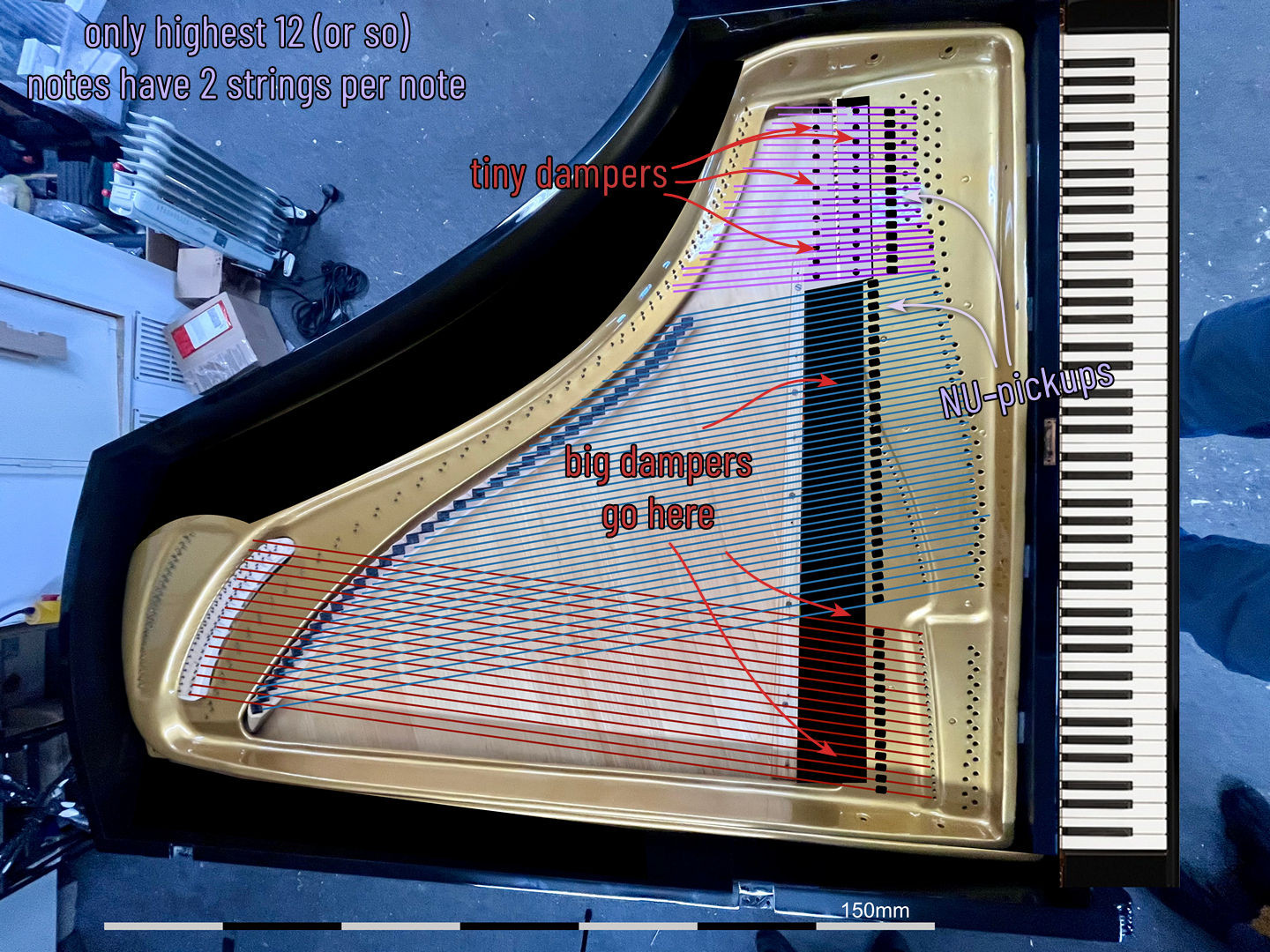
If you imagine the piano (acoustic) as a construction of a cabinet (body of rim and lid, then a frame, no… not the metal frame for the strings, rather the other one underneath that holds the metal frame (see photo\video) through holes in the soundboard, strings, soundboard and that cast iron frame.

So, can you see how with the lid closed it is almost as any other acoustic string instrument but the strings and their board is inside, not outside (to get bowed or plucked) by the hand. And the lid closes the described construction (strigs + soundboard and mrames) which is already inside. It sounds but the actual emitting sound elements — the strings — are now hidden. Hence we open the lid (at an angle towards the audience, mind you).
So, there we go. Audience is listening with their ears in an acoustic space (sometimes on open stages outside too). For recording though only some "audience perspective" mics (typically Binautral head) can be used to record it like that, again in a space. For proper recording of the piano there is absolutely no need for this lid → no audience needed. And binaural perception can be achieved with a set of BRIRs (Binaural impulse responses).
Recording in an anechoic chamber is only needed to get as pure and direct recordings intended for sample libraries, then with combination of BRIRs. You can use whatever mics you'd like in an anechoic chamber. Actually it might be a bit pointless to use omni mic in such acoustic conditions because there it will act as 'directional' mic nevertheless. But it is up to the engineer.