Skip to content

DIY digital piano: The Janko Layout

Mike Filip

RIP Now the problem is that we as adults have "forgotten" how to learn in this very physical, primitive way. But the answer is very simple: you just have to "goof around and enjoy what you are doing"

Kind of - in the case of learning on the computer keyboard its more along the lines of 'practice, practice, practice', usually with some kind of learn-typing program. Probably very similar to the lessons on the piano, where you spend 30 min each day playing out various chord progressions or even just 'improvising' with various chords / scales. Essentially you bank on the fact that if you play all the way a major chord can be shaped (and all the minor, and augmented, and…), after a while you stop thinking about how to position your hands to play a G minor chord and instead just do it.

My counter point is just that its easier to get to this point if all the minor chords feel the same - so each time you play and improvise on a minor chord (no matter which root note), you internalize and 'practice' not just the specific G minor chord you are practicing with today, but all minor chords.

Just to finish off on this 'learn until you stop thinking about it': we do it as adults as well - when we learn to drive we need to think about which pedal to press or which direction to turn the wheel, but after some time you stop thinking in terms of 'which pedal or which way' and start thinking about 'Shit - the car in front is breaking hard! I need to slow down NOW, and swerve a bit to the side!' without thinking about what you actually need to do this. Learning to play games with a controller is much the same way - at first you are moving the joystick to move your character, but after a while you no longer think about the joystick - you essentially feel like you are moving the character directly.

So its not about the internalization of your memories, but more about if the Janko layout makes it easier to get to the point where you stop thinking about which buttons to press and just press them.

RIP As such, I was not surprised that I know nobody that mastered fluent Italian speaking as an adult. Yet, Italian kids learn to speak fluently with this "holy mess" of rules when they are about 2 years old, no problem.

That… kind of proves my point? Yes - if you start learning piano at a young age your mind just soaks up the lessons and you essentially have no issues with playing. All the 'rules', no matter how complex, get internalized and you dont have to think about it. If you as an adult are thrown into Italy and learn Italian by immersion you can also get close to this - you practice enough that it stops being something you think about.

But from the perspective of a tourist - someone who doesnt have the time to fully immerse themselves in a language having a simpler set of 'rules' without so many exceptions makes things easier - so they can get to the point where they can talk and ask questions without as many mistakes if the language is on the 'easier' side. On the piano side this translates to having an easier time learning. Though yes - mastery in both cases is an issue of dedication (though I could argue that an 'easier' language is… easier to master as well).

Unfortunately for me I started playing piano in university and have no proper piano lessons. I also dont plan on making music my full-time commitment, as I do have a job outside the DIY piano making and piano playing that I try to dedicate some left over time for. This means that in my case (and I cant be the only one), I dont have the time to dedicate to learning a complex language when there is an easier alternative.

From that one can also make the argument that even for those aiming towards music full time, why would they want to go towards a more complicated 'language' when they can pick an 'easier' one? Well, besides the obvious reasons (lack of teachers, lack of instruments, etc.) - after all it doesnt matter if ancient greek is a super easy language (not saying it is - just imagine for a sec) if there is no one around to teach it to you.

Now if the 'more complicated' language had something to offer that the easier one doesnt (ex: some chords that cant be played on a janko that can on a classical, or the ability to accurately play very fast notes that is hampered by the janko layout, etc), then one can say that "sure, you can learn the easier layout, but you will not be able to do X or Y, and will have a hard time with Z".

The arguments we have right now basically summarize as X,Y,Z on the janko's side is the "simplicity of learning, less memorization, ease of transposition, ability to play longer intervals…", while on the classical piano's side is your argument of "ease of orientation on the keyboard, not becoming lost in the 'sameness' of an isomorphic layout, and that the janko layout is actually more complicated due to having to decide between which of the 3 keys to actually press for a given note"


RIP I don't. Phil has nice text material on his website which gives you a glimpse into the "general idea", if you are interested (I can tell you which ones are best for this purpose, if you prefer)

yes please! Not sure about the 'online lesson' though. I get the general gist of it - essentially practice and improvise until you internalize the motions, but my concern is more along the lines of "wont I be able to do that on the janko as well, just learn faster at the same time?" (assuming of course in both cases I dont have a dedicated teacher)

RIP On that you are also more advanced than me. 3 of my teachers told me that I would start to see such familiar patterns, but it never happened. For me it was always walking in the dark and slamming into walls.

But - doesnt that just point towards the direction that having a 'common' shape that denotes a specific interval or chord would make it easier to stop walking in the dark?

An example of the 'familiar patterns' I am talking about would be something like a C-G#-C chord (essentially an augmented chord without the middle note but with a root-octave). I saw this pattern in many places, but it took me a while to realize that this shape (white-black-white) that works for the keys B, C, D, F, and G can also be found for the other keys, but in a different shape such as the E-B-E (white-white-white) or D#-A#-D# (black-black-black). I played all three variations in different pieces (and several of them in the same piece even!), and yet it took me noticing that they sound similar and actually mapping it out to figure out that they are essentially the same. On a Janko or another isomorphic keyboard I would have 'felt' the similarity right from the start and thus learned to associate the sound to the shape to the notes much earlier.
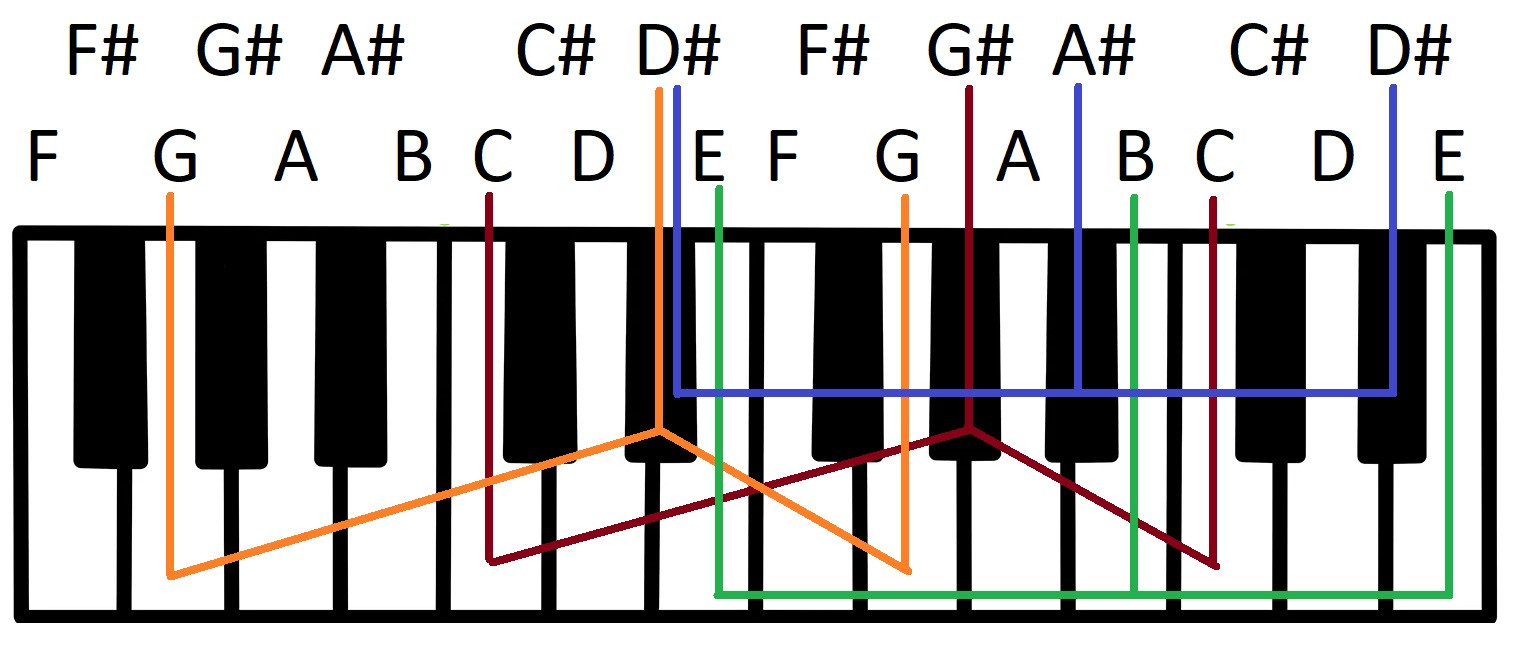
Biggest issue is really when I try to use this shape / chord while just playing around on the piano - its fine in most cases (five of the 7 white keys), but if I switch to a 'wrong' key (A for example), I all of a sudden try to press on a black key that doesnt exist. Sufficient practice will naturally help me get to the point I dont even have to think about moving my finger to press the white key instead, but thats the point - practice. Time that I could have spent learning a new song, or practicing something else entirely.


RIP

Mike Filip My counter point is just that its easier to get to this point if all the minor chords feel the same

I argue not, but at this point we are just repeating ourselves, so I won't.

Mike Filip Del Vento As such, I was not surprised that I know nobody that mastered fluent Italian speaking as an adult. Yet, Italian kids learn to speak fluently with this "holy mess" of rules when they are about 2 years old, no problem.

That… kind of proves my point?

Quite the contrary. You said that Janko being simpler will make learning faster. I said that simpler does not mean faster, but "learning as a kid" means faster, and provided the example with a super-complicated language that is learned as fast as the simpler one. You even went further and proved my point better with adults learning as a kid (goofing around and having fun) with complicated videogames! So I stand my ground: if you put yourself in the right attitude, learning the "complicated" piano keyboard is easy and natural.

Mike Filip The arguments we have right now basically summarize as X,Y,Z on the janko's side is the "simplicity of learning, less memorization, ease of transposition, ability to play longer intervals…", while on the classical piano's side is your argument of "ease of orientation on the keyboard, not becoming lost in the 'sameness' of an isomorphic layout, and that the janko layout is actually more complicated due to having to decide between which of the 3 keys to actually press for a given note"

This summarizes our positions pretty well, but I disagree with all the advantages you stated for Janko, because as discussed in the previous paragraphs "simplicity of learning and less memorization" are a moot point if you are doing it right. I guess that could be an advantage if you are trying to learn music wrong, but I argue that you would have other severe gaps in your musicianship so you will not be fluent anyway and knowing the notes/chords will be useless.

Ability to play longer intervals, compared to regular piano yes (assuming you have a regular or small hand like I do). But I am comparing it to reduced octave, so that's a break even.

So the only remained advantage is "ease of transposition" which I would rephrase with "ease of transposition earlier in the learning process": when you are completely fluent, transposition won't be a big deal on the regular piano either, but admittedly you can reach that stage earlier in Janko.

Mike Filip Unfortunately for me I started playing piano in university and have no proper piano lessons. I also dont plan on making music my full-time commitment, as I do have a job outside the DIY piano making and piano playing that I try to dedicate some left over time for. This means that in my case (and I cant be the only one), I dont have the time to dedicate to learning a complex language when there is an easier alternative.

You say you agree but then continue to insist on this. This applies only if you are willing to learn the "complex language" wrong. If you learn it right (as the kid learning Italian or the adult learning a videogame) the speed of learning is unrelated to the complexity of the language. It's related only to the enthusiasm put into it.

Mike Filip Del Vento I don't. Phil has nice text material on his website which gives you a glimpse into the "general idea", if you are interested (I can tell you which ones are best for this purpose, if you prefer)

yes please!

At the URL below, you can download the "15-steps" for a comprehensive summary of everything, or the "concise model" if you want a quick summary of everything. Given your insistence on keyboard (which comes after rhythm in this course and in my opinion even before I started) you may want something more in-depth on the keyboard. Step 3 is nice, but pretty basic. Step 4 and 5 may be illuminating since they are about what I described here, but in the form of "lessons". Since you are interested more in the keyboard layout than in the musicianship per se wrt this course, you can download only the learn-and-map and improvise versions, rather than the sight-reading versions (which would probably be startling if you expect anything close to traditional). These cover the foundation on which the subsequent ones build, so if you don't get these the subsequent ones will be as clear as hieroglyphics

Mike Filip Not sure about the 'online lesson' though.

Not sure what you are not sure about. Having Phil to explain that to you will be much better than you trying to figure it out on your own. Because he will talk to you and observe you playing and will immediately figure out what's wrong and concentrate on that. If you do it on your own, you risk concentrating on what you already understand and do well, ignoring the blind spot of whatever problem you may have.

Mike Filip "wont I be able to do that on the janko as well, just learn faster at the same time?" (assuming of course in both cases I dont have a dedicated teacher)

Sorry if I sound as a broken record but no: if you learn it right, no. The speed of learning does not depend on the complexity of the language, but only on the enthusiasm you put into it.

Also, to circle back to my first message, I think that the lack of black keys bumps will make it harder. As a scientist I have to stress that it's just my opinion, I don't have any hard data proving this statement, nor first hand experience since I never played a Janko keyboard. But it's a pretty strong opinion based on how now I orient myself on the keyboard (at this point I could only repeat myself again, but I won't).

As I told to that other guy, if one is really sold to the isomorphic keyboard and nothing will make them change their mind, I'd suggest to go with the PASHKULI which at least it's at the same time isomorphic and not-isomorphic depending on how you play it (the thread is now private so I'll be linking that down there too for making it easier for you to find that rabbit hole).

Mike Filip An example of the 'familiar patterns' I am talking about would be something like a C-G#-C chord

Mike Filip Biggest issue is really when I try to use this shape / chord while just playing around on the piano - its fine in most cases (five of the 7 white keys), but if I switch to a 'wrong' key (A for example), I all of a sudden try to press on a black key that doesnt exist

I see where you are coming from. It's what I (unsuccessfully) tried to do for decades (and which piqued my curiosity for Janko). I dare to say that this is all wrong. But "right or wrong", the "patterns" and "orientation" I am talking about have nothing to do with this and are much, much simpler and more intuitive.

https://playpianofluently.com/shop/

https://pianoclack.com/forum/d/1828-pianos-keys-are-badly-designed


Mike Filip

RIP The speed of learning does not depend on the complexity of the language, but only on the enthusiasm you put into it.

I think this right here is the biggest difference in our opinions. I believe that the complexity of the language has a huge impact on the speed of learning, to the point that making strides to simplify the process should be at the very least considered.


I guess it doesnt help that I also got into music from the side of guitar playing, which in a way is more of an isomorphic instrument. Sure there is that annoying G-B major-third interval between the third and second strings while the rest of the strings have perfect fifth intervals… but being able to hold a given chord shape and just slide down the neck of the guitar to get the same chord in a different key was very nice.

When I switched to piano I at first thought it was the better layout, but that was due to the way I was reading notation - the way there are 7 'normal' notes in notation (A to G), and look - there are 7 white keys on the piano! there is no such thing as E# (well, its F but you know what I mean), and therefore there isnt a black key on the piano either. It was only later when I started noticing that every chord has to be memorized multiple times that I started feeling something was off.


I guess its just - if the isomorphism of an instrument is an issue, then what about the isomorphic instruments that already exist? Pretty much all stringed instruments are essentially isomorphic. The Bayan (russian accordion) was in a way my very first introduction to music (I didnt play it, but I saw it being played live several times when I was… very young), and it features an isomorphic layout, and whats more is played with the keys facing away from you, so you have to learn to rely on just 'knowing' where you are.


RIP

Mike Filip I think this right here is the biggest difference in our opinions.

👍️

Mike Filip Pretty much all stringed instruments are essentially isomorphic.

Only some like the guitar, where you can use a barre or a capo -- you don't do either on a violin and instead you use completely different fingerings. And only approximately because the higher-pitched notes are closer together than the lower ones (as you know well). Of course for a fretted guitar you can still call it "sort of" isomorphic, but not so on the unfretted instruments (my daughter plays violin at an early advanced level, so I'm very familiar with it)

Mike Filip if the isomorphism of an instrument is an issue, then what about the isomorphic instruments that already exist

I didn't say it's impossible to play an isomorphic instrument (or if I did, I misspoke). I said (or meant) that in my opinion it's harder to reach fluency, and that is especially true on the piano with its beautiful (*) non-isomorphic keyboard.

(*) not in the cosmetic sense, but in the way that it leads one to learn harmony, polyphonic voicing and improvisation


Mike Filip

On a completely different but still related note - you mentioned you went down the Janko layout path previously before returning to the classical piano layout (I assume after reading up / watching the piano series by Phil Best?).

Did you get to actually making a Janko layout and trying it, or did you end up switching back before that?

(mainly because - if you did, what were your thoughts playing it)


RIP

Mike Filip Did you get to actually making a Janko layout and trying it, or did you end up switching back before that?

At that time I was not much into DIY yet, especially not into something as complicated as a full Janko. I was looking to purchase one, and I did not find any, but kept looking while continuing regular piano lessons. So no, I was never able to try it. And then….

Mike Filip I assume after reading up / watching the piano series by Phil Best?

I gradually lost interest and when I started lessons with him I gradually appreciated more and more the genius of the regular keyboard and what allow me to do so I slowly changed my mind.


Mike Filip

RIP

Interesting. If it wasnt for the fact I got into 3D printing (and CAD design, and some firmware + electronics…) at work to the point I got a 3D printer and started playing around with it at home I would have likely dropped the Janko layout a year ago after finding out that getting one isnt really possible on a commercial level (and no, searching e-bay for a 'chromatone' keyboard doesnt really count).


Ive been kind of binge listening to Phil Best's "teaching and learning fluent piano skills" playlist as I work on the piano (so around 5 hours of listening), and while its a rather interesting take on things with much greater focus on 'just keep improvising and dont focus too much on the theory' kind of learning (that in some way sounds more like a meditation session/lesson than one talking about learning piano - 'breathe in, breathe out, just let go)… I cant find anything specific to the classical piano layout that wouldnt also apply to a Janko layout or really any layout (or heck - any instrument) in general. There is talk about picking a tonal block and playing around with it, improvising with those notes and getting familiar with them, but nothing linking that to the classical piano layout.

The closest was his mention about how 'beautiful' the classical piano layout is. If I was to be asked what he meant by that I might say it has something to do with him stating that the basic tonal blocks are the 12 major, 12 minor, 2 whole-tone, 3 diminished - in which case 24 of them fit 'naturally' to the diatonic key placement of the piano, but thats just me putting words in his mouth.

But there isnt anything specific. He advocates for playing different tonal groups (sort of like chords but not quite) and getting familiar with them, learning how they interact and trying to involve them within a sort of 'natural' progression of music with a heavy focus on getting 'fluent' such that you 'speak' the song instead of trying to make sense of it as you play.

But once again - nothing of this is specific to the classical piano layout, or even the piano in general. In the end I dont see anything in his style of teaching that would go against an isomorphic keyboard. Perhaps that part is in the paid section or within the one-on-one lessons?


PS: wow apparently there is a very hot topic about piano keys / pashkuli that I didnt notice that started 6 days ago and doesnt seem to be stopping. Think I will read up on that post and see if it helps out.

From there, you mentioned how due to the split of the keyboard into two groups (2B+3W || 3B+4W) leads it symmetry and brings the number of scales/arpeggios from 24 to 3. Could you expand on that?


Mike Filip

Mike Filip Think I will read up on that post and see if it helps out.

Not as close to the topic of isomorphic layouts vs classical layout as I would have liked. I think the closest it came was your comment about the symmetry of the classical layout and the way it can bring the number of scales/apeggios from 24 to 3.

Also - a very good example in terms of using the backs of the black keys to orient on the keyboard. Is that what you meant about the classical layout allowing you to intuitively know where you are? Are you 'mentally' splitting the keyboard into two groups based on the two black keys and three black keys, and then navigating by placing your hands between the black keys?


DavisB

Imagine if you're with blindfolds on, and you put your hands on the keyboard somewhere:

  1. On Janko keyboard, you have no way to tell which notes your fingers are on, only the intervals between them.
  2. On traditional piano, black keys adjacent to your fingers enable you to (uniquely?) locate where you are within the scale.
    Not only do they enable you to locate where you are, on diatonic layout, it is of utmost importance to know where you are, as depending on the location within the scale you will have to adjust to different "geometric shapes" to play the chord or a series of intervals you intend.

From a certain point of view, it matters less on a Janko keyboard where you are, because the geometric shapes you have to play won't change to play the same music.

Those tactile bumps and textures as found on Daskin Janko MIDI controller (for which they have a patent which has already expired) probably address this (shortcoming?) - ie. they let you know where each finger is within the scale at all times.


Mike Filip

DavisB

Ok - I will agree with you here. Having the keys not be an ordered set does allow one to 'locate' themselves on the keyboard better if they are not capable of looking at the keyboard (ex: sight reading). I am not sure how important this is, but this is a positive on the side of the classical keyboard.

I am going to hold out that visually, the fact that the Janko layout keeps the diatonic coloring of the notes (7 white and 5 black keys in the C major pattern) it provides as good as a classical piano layout for orientation (though once again - only visually).


One thing that you mentioned in the previous thread that we cant overlook though is the 'back of the black keys' being used for alignment - to the point that removing them along the backs of the keys is detrimental.

This is a very good point and something I went to my piano and tested just now - played a few pieces and just focused on how I place my fingers. So… yea - I use the sides of the black keys to sort of lean or perhaps hold my fingers against in order to help with alignment on the keys. How much of a detriment not having the ability (or necessity?) of playing between the keys (white between black) on a Janko piano is to be seen.

I went back to look at photos and videos of the acoustic Janko pianos and a few of them had very dome-like keys (more like a cylinder dropped on its side, with the axis facing forward). I did round out the corners of the keys of my DIY piano, so maybe that would help with alignment; if not I can also try a fully rounded keys more akin to the original Janko piano, but it might turn out that having that option / necessity of playing between the black keys is actually a boon for the classical piano instead of a disadvantage I initially saw it as (ie: there are a couple passages in the pieces I play which are a bit uncomfortable due to playing mostly on the whites between blacks)

On the other hand, playing on the Janko keys should feel more akin to playing with only the black keys on the classical piano - there is no 'alignment' to be done outside of 'feeling' that you are centered on the key. Guess only trying it out will solve this question.


RIP

Too much for me to digest during a business day. I'll try to get back to this next weekend, but I think we have exhausted each other points and reached the full understanding of each other to the final "agree to disagree" view.

Mike Filip But there isnt anything specific.

True because

Mike Filip Perhaps that part is in the paid section or within the one-on-one lessons?

Yes, his YT videos are not lessons nor descriptions of his course. Rather they are very tiny tidbits of things that can be applied / used outside of his framework. In fact

Mike Filip nothing of this is specific to the classical piano layout, or even the piano in general.

True, he also teaches voice (singing) which is arguably the most different instrument from piano. I think he once mentioned that he was teaching somebody with some other instrument (clarinet?) but don't quote me on that.

Yet for piano he does use the "keyboard map" very strongly to teach one always knowing where they are, what they are doing, what nearby notes are part of the chord that one is playing in that instant (and what role each of those note has), what nearby notes are part of the diatonic "scale" that one is playing in that instant, what nearby notes are part of the chromatic "scale" that one is playing in that instant. So improvising is not passively playing a random lick (sort of "human Mellotron"), but rather making conscious choices among this completely clear palette of sound at your disposal. With extremely simple harmonic progressions I can already do this. It's liberating, illuminating and exhilarating! With an isomorphic keyboard it would be extremely more complicated because the three/four groups I mentioned above (chord/role-within-the-chord, diatonic and chromatic) are only "virtual" and not physical.

Mike Filip From there, you mentioned how due to the split of the keyboard into two groups (2B+3W || 3B+4W) leads it symmetry and brings the number of scales/arpeggios from 24 to 3. Could you expand on that?

No but I can give you a (very small and incomplete) clue. Start with chords. Loop over all the 24 chords. Look only on the 2B 5-note group and ignore all the rest. Maybe make a graph of that. Repeat with the 3B 7-node group ignoring the rest. See the pattern?

Mike Filip This is a very good point and something I went to my piano and tested just now - played a few pieces and just focused on how I place my fingers. So… yea - I use the sides of the black keys to sort of lean or perhaps hold my fingers against in order to help with alignment on the keys.

Alright, so this is a glimpse of what I meant, reinforcing my initial claim that we now "full understand each other" -- other than I'm learning piano with Phil Best of course, so you can't fully understand that unless you also are taking lesson with him


DavisB

Mike Filip
Whether the concern regarding "finding your way around piano" (ie. finding where you are within the scale from tactile feedback) turns out to be a valid issue, or a complete non-issue or just a minor one that can be addressed with textured patterns - I think it's almost impossible to give an accurate and fair assessment of, not without having your hands on a complete Janko piano and spending weeks or months playing it.

There's one fundamental issue that most alternative isomorphic keyboards tend to have - velocity sensitivity.
Keyboards like lumatone and similar technically speaking are velocity sensitive, but from every demo video i've seen, it does seem like velocity sensitivity has a very limited resolution (or the dynamic range is hard to control). In some videos it's almost as if somebody's playing on computer keyboard with a MIDI mapper on!

It's not an inherent quality of isomorphic layouts per-se, just how such instruments often tend to manifest themselves.
Your Janko piano seems to have an exceptionally well designed action (especially for a DIY project), so I'll assume it's a non issue. That clears a massive, major hurdle that most other isometric keyboards would already fail at. That's very, very rare!

Intuitively it seems like it should be better for improvisation and enables faster learning speed, as it has one less "layer of indirection", one less intermediary translation step and a direct mapping between shape and sound. Plus, Janko was designed from the get go with an explicit goal to be suited for regular human hand, and not oversized XXL by default.

So technically speaking it - in theory, on paper, it should be a much better instrument. It needs the experiment however!

I love your work and I hope you don't get discouraged! It's such a fascinating and largely unexplored territory!


Mike Filip

RIP No but I can give you a (very small and incomplete) clue. Start with chords. Loop over all the 24 chords. Look only on the 2B 5-note group and ignore all the rest. Maybe make a graph of that. Repeat with the 3B 7-node group ignoring the rest. See the pattern?

I mean… I could break up the board into into groups of 5/7 based on the black key positions and say that for major and minor chords (or as you call them - tonal blocks: aka all notes on the piano that 'fit' the 3 from a chord?) form patterns;

  • the third note is always on the same row as the first (and have the same 'span' that you feel)… as long as its not A#, B
  • the middle note is on the same row as the first (major) or different row (minor) if it lands in the same 'group' of 5/7 as the first note, and is on the different row (major) or same row (minor) otherwise.
  • the last note is played 'sort of' on the same key as the first note if you 'ignore' the first 2 notes of the 7 group… again - as long as its not A# or B

Which like - yes, that makes sense. You can also say that the second note 'should' be on the same row as the first, but if there is a 'missing' black key between the two notes, then its on a different row. The third note 'should' be on a different row as the first, but if there is a 'missing' black key between the notes then its on the same row; and if there are 2 'missing' black keys between the notes then its once again on a different row.

You can probably find other similar patterns (such as the spacing between the middle and first note, or middle and last note based on their position relative to each other in the 5/7 blocks)… but in the end its just the relationship between the setup of the chord (1st note, skip 3, 2nd note, skip 2, 3rd note) and the way the keyboard is laid out.

RIP I'm learning piano with Phil Best of course, so you can't fully understand that unless you also are taking lesson with him

I guess this is why you cant share the 24 to 3 pattern explanation - because its kept behind the lock-and-key of the course? If so, could you tell me which section I need to buy to become initiated in it? I assume it would be under the "step 3 - introduction to keyboard mapping"?


I guess its just I dont see the 'positive' from having different chord shapes (and yes, I come back to that like a broken record).

Why would C major to G major be a simple shift of the C and E note one down to B and G, but a similar perfect fifth progression from G major to D major involve shifting B to A (one note down again), but G to F# (diagonally to a black key)? Why should the fact that I started the first 'song' from C before making a I->V jump not feel the same way as if I started the song at G? And more importantly - what benefit does having these two progressions not feel the same provide?


well, im off to grab the 15 step guide and the keyboard mapping 'lesson plan' from play piano fluently. Hope that clears some things up.


Mike Filip

DavisB

Thanks!

Thinking back on it now I probably should have started with a simpler glue-on converter for classical piano -> Janko just so I could at least get my feet wet and get familiar with the layout before diving fully into the full-custom-piano… but nothing I can do about it now.

DavisB Intuitively it seems like it should be better for improvisation and enables faster learning speed, as it has one less "layer of indirection", one less intermediary translation step and a direct mapping between shape and sound.

This is pretty much my stance on the Janko vs Classical layout. In both cases you need to practice enough to become so familiar with the keyboard that you stop thinking about which key to press for which note (or chord or whatever) and instead start thinking / feeling with just the music, being able to play wherever the flow takes you instead of being taken out of it when you have to think about the shape this particular chord needs to take.

@RIP is of the opposite opinion - that the inherent diatonic nature of the classical layout lends itself better to understanding the way music transitions/flows between chords/tonal-groups, to the point that on a chromatic layout (such as the Janko) you would get lost - thus breaking you out of the flow when you need to think about where you are, and what you need/want to play next.


RIP

Mike Filip If so, could you tell me which section I need to buy to become initiated in it?

I think I wrote that above, didn't I?

Mike Filip what benefit does having these two progressions not feel the same provide?

Knowing where you are. Like being in a city where every corner looks like every other corner (I've been there, and it's an eerie sense of being lost), rather than every corner being its own. Important when you start doing modulation and/or complex "far" harmonies when from the starting key signature to move off to somewhere else (as it's done in some styles of Jazz, such as by Chick Corea). If when you move to a different key signature it "feels" exactly like before just "a bit to the right", I think it'd be extremely hard to keep track of what you're doing.

Maybe this example is clearer than the ones I gave before.

Mike Filip @Del Vento is of the opposite opinion

Yes, you got it.

For the sake of the casual reader of this thread (I think you, Mike, understand this pretty well), let me just stress that (like everything I say) this is simply my opinion, which I formed with experience and I strongly believe in. But if you feel my opinion is crap and doesn't worth a penny, that's fine, I won't get offended and I'm totally cool with your disagreement. In fact I wish you all the best with your (musical) endeavor. If it feels like in this thread I'm repeating my opinion in different ways that's only because you are pressing me to do so for the sake of the argument and to understand each other better. Also (as you know) I'm happy to collaborate with you on other aspects (such as the Hickman action which would work fine for both Janko and traditional layout).


PASHKULI

RIP
I was never able to try it. (Jankò layout)
Knowing where you are.

To be able to assess any new instrument tool or even information (such as instructional manual) one needs to spend time doing it. Let alone to get good at it!

Del Vento, how many amount of time have you spent on a "normal" piano?
Count from the first day you had it under your fingers to the day you could play… let's say… 8 bars of an etude or maybe "Fur elise" using both hands confidently and acknowledged by a second listener (socond opinion, not yours only)?

Let me guess… at least a month. Or a few days if done by ear from hands on instructions by another pianist without the immediate necessity to read (learn) from a score (which would require much more time).

Unless you are willing to invest that time with a new instrument then your opinion is superficial, biased and one sided.
You admit you've never tried it so it is quite self explanatory.

To make it clear, because you might become defensive of your opinion:
• Jankó contsruction is not great (especially the staircase\waterfal rows of keys)
• the above means Drischke's layout is a bit better, but… it has 'flat surface' keys, where Janko's are rounded (crowned)

All Jankó derivatives I have seen online dismissed this rounded shapes (which Janko probably have taken from some of Renaissance organs and portatives)! And that was a big mistake. The same mistake Drechske made with his keys (before Janko), but he never build a keyboard so it is understandable.

And let's face it: for the Halberstadt ("standard") keyboard and layout there are hundreds of thousands works written and still being written to this day. I have seen only instructional material on how to play Jankó\Dreschke and not a single work (original) for it! Adapted piaces have been made by Daskin (Paul Vandervoort) and Muto (Wataru Ohkawa) on their YouTube and Facebook channels but that's it really.

No one can teach you really. And that is why your opinion is a bit inconclusive to say the least.


Khuja Wangtishvili

PASHKULI No one can teach you really. And that is why your opinion is a bit inconclusive to say the least.

You are far more pathetic than I ever thought...


« Previous Page