Mike Filip
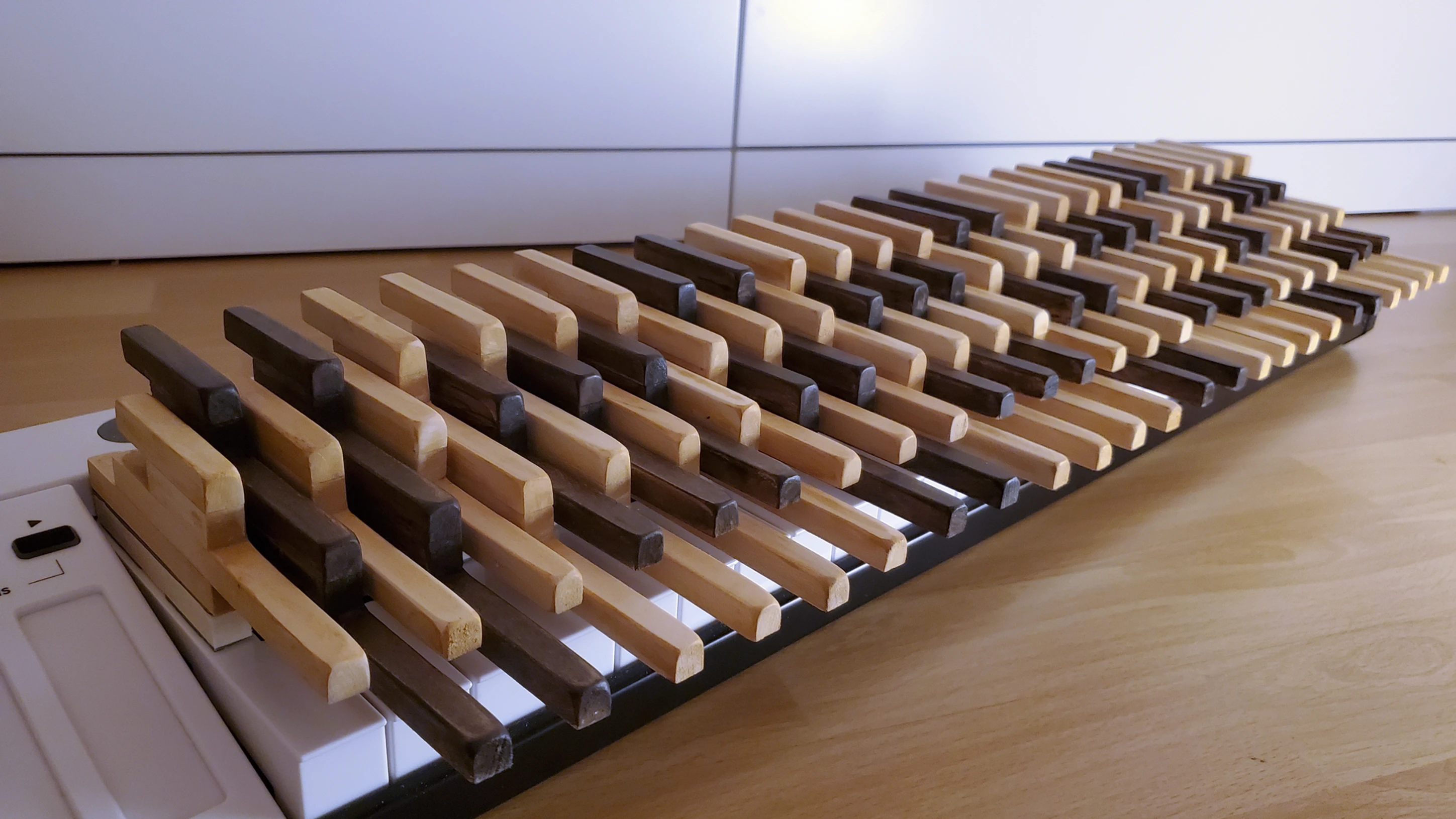
So this is an off-shoot of the main thread. To summarize: I am working on a fully DIY digital piano with a custom key layout different from the traditional 7+5 of the regular piano. In the main thread and other sub-threads I will cover the custom action, electronics, assembly, firmware, etc. However in this thread I will talk/discuss the Janko layout specifically. Here is the video of me discussing the layout.
So - the classical piano layout (or the 7+5 layout as I call it) is what everyone basically thinks about when asked to picture the piano keys. You have your 7 white keys with 5 black keys, set up in groups of 2 black keys, space, then 3 black keys. This layout allows for an easy C major scale as the 7 notes of that scale are all 'white' keys.
Unfortunately the classical layout isnt isomorphic - aka: the same finger shape does not correspond to the same 'sound'. Perhaps the best way to show this would be to compare the C major and D major chords:
C major:
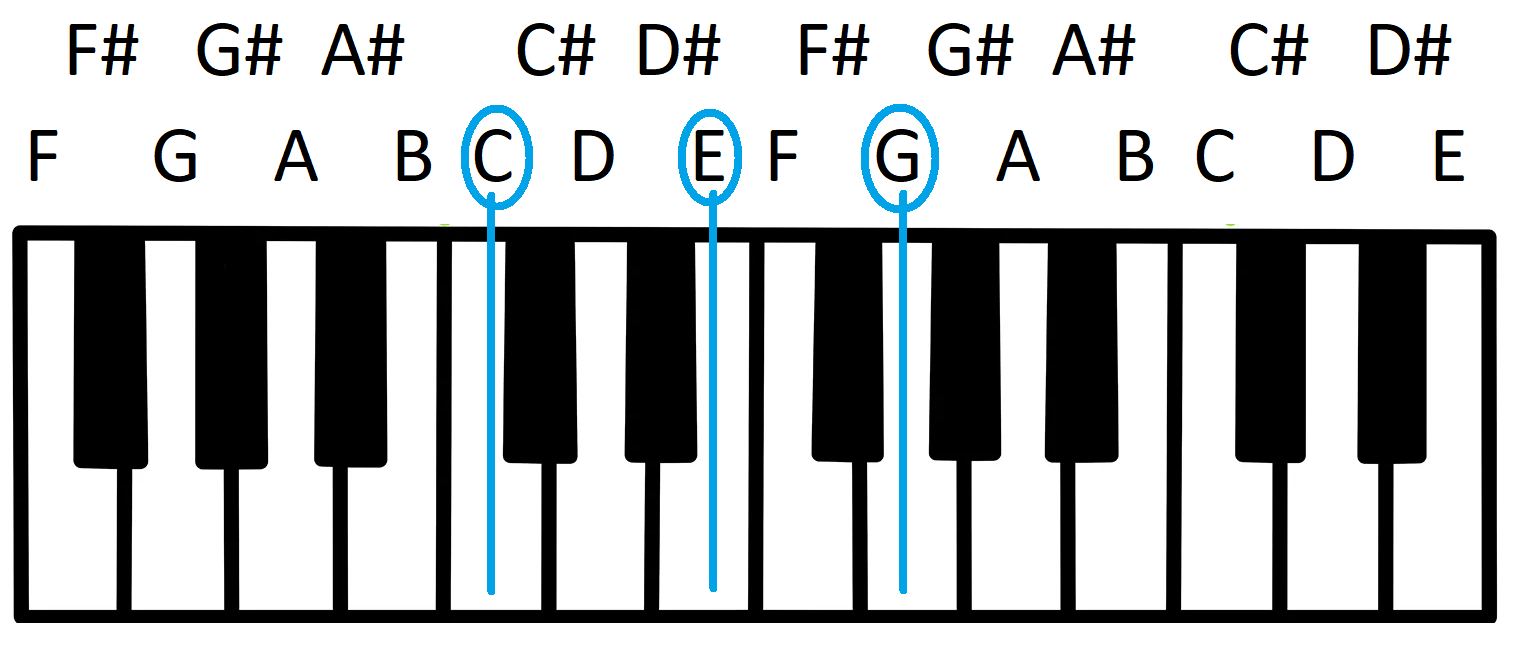
Now, just looking at the chord and going off of intuition I would expect this to be the D major chord:

But its not! Its the D MINOR chord! The reason for this is the 'missing' black key between E and F, leading to this being the actual D major chord:
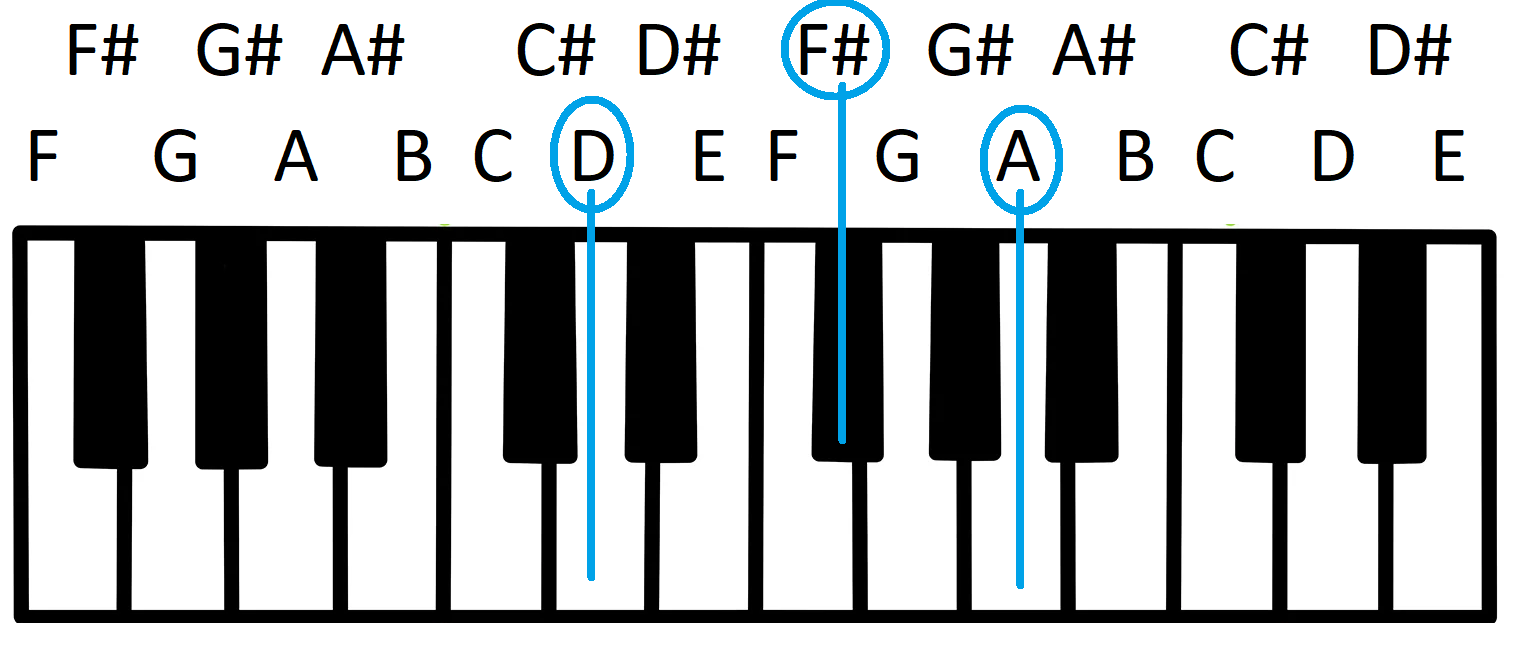
Which leads to the idea of isomorphism (or same-shape if translated). Basically the classical piano layout isnt isomorphic because the same interval can take different shapes - two adjacent notes are exactly 1 semi-tone apart (the shortest interval), but this can take the shape of white-to-black (C to C#), black to white (C# to D), or white-to-white (E to F).
The various isomorphic keyboards, of which the Janko is one, are an attempt to 'fix' this issue.
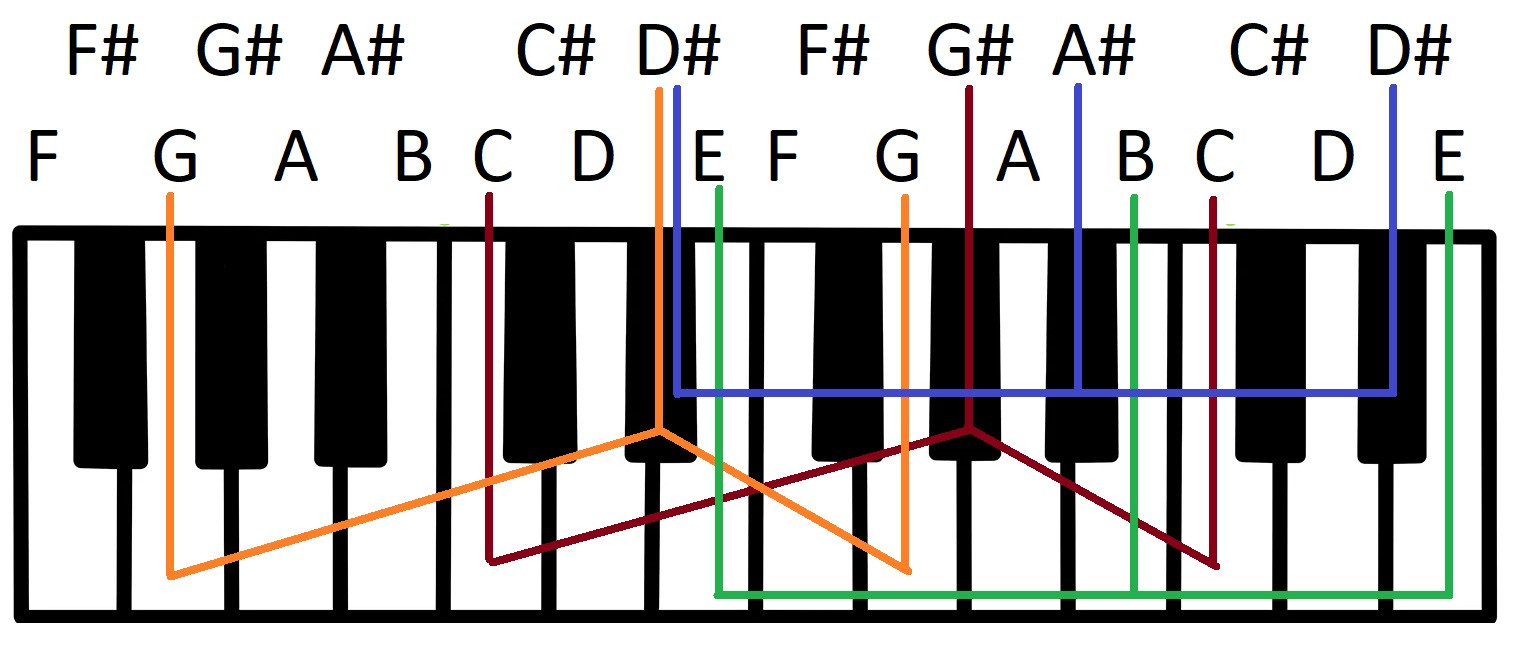
Lets see the same example on the janko keyboard (should probably provide a bit of an explanation, rows I, III, V are the same, with keys C,D,E,F#,G#,A#, C again and so on; and rows II, IV, VI with the keys C#, D#, F, G, A, G C# again… why multiple rows? you need at least 3 for true isomorphism and having 6 allows for more ergonomic finger placement as you can decide where to place your fingers instead of having to contort them to the required buttons):
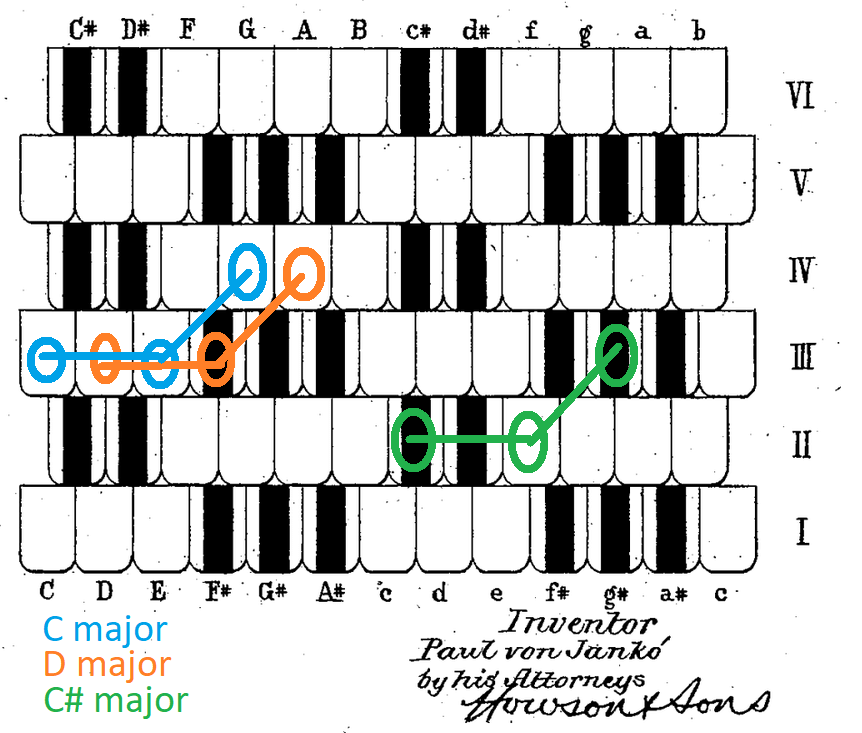
Blue is the C major, orange is the D major, and green (just to give one more example) is the C# major (which would require black-white-black shape on a regular piano, which is once again different from the other two.
So this is the layout I went with. To summarize, here are the upsides:
- Same shame for similar chords (or scales, or passages, etc.) making you need to memorize 6x+ less patterns to be able to play from memory.
- Pieces can be transposed just by starting from a different note while keeping all fingering the same.
- Jazz licks and similar sections become much easier to learn as you just learn one pattern and you can play it for any key, especially nice if you wish to repeat the same base lines just with a set chord progression - just move your starting note for every chord change and you are good!
- Many songs contain passages that are essentially the same passage just transposed, which makes it easier to learn & master when you can memorize it once instead of having to memorize different finger patterns for each transposition.
- (yes, all of the above can be summarized as 'transposition is easy on the janko layout')
- The octave is 5.1 inches instead of 6.5 of the regular piano, making long stretches (especially those over an octave) easier, even for those of us with Rachmaninoff size hands.
- This is more on the 'technical' side, but the way the keys are made they have the same 10mm of key dip no matter where you press, so you dont have to worry about pressing harder to play the same volume of note when playing at the back of the piano as on the front.
As for the downsides, I couldnt find any objective ones (at least in terms of the actual design) as most of the people seem to dismiss the idea off-hand, or even worse go the "stop whining! just learn the regular piano! its not that hard!" route. Still, here are the downsides I found (or thought of):
- Good luck finding a teacher. Classical piano? sure - unless you live in Antarctica you are probably a call (and some $$$) away from getting piano lessons. Janko? yea - not happening.
- Very limited instructions even after you give up on a teacher. Essentially you are down to like 5 books (half of which are in German and all of which are in horribly-scanned quality) that discuss the Janko layout and provide lessons. Sure, you can use the learning books for regular piano, but probably not when you are just starting - so its more along the lines of "learn classical piano then transition", which isnt that great…
- If you are hoping to get into music professionally, Janko isnt an option. Lets just leave it here.
- Going to a friend's house or a public venture? You might find a classical piano, but a Janko? definitely not. So for me I am just going to have to get used to lugging my digital piano around if I want to play it somewhere else.
In general the Janko layout seems to be in that unfortunate case of a 'small local shop' trying to compete with 'Amazon'. Its just not happening unless there is a truly good reason for it. Lumatone and similar? They offer micro-tonal playing which make it interesting for those on the 'cutting edge' of music. Janko? not so much.
Anyway - Anyone have any comments on the janko layout or isomorphic keyboards in general? I would love to get a conversation going about this.
@RIP You mentioned being interested in Janko layout before and deciding on why the classical layout is better. Why? Would love to hear your thoughts.