RIP Now the problem is that we as adults have "forgotten" how to learn in this very physical, primitive way. But the answer is very simple: you just have to "goof around and enjoy what you are doing"
Kind of - in the case of learning on the computer keyboard its more along the lines of 'practice, practice, practice', usually with some kind of learn-typing program. Probably very similar to the lessons on the piano, where you spend 30 min each day playing out various chord progressions or even just 'improvising' with various chords / scales. Essentially you bank on the fact that if you play all the way a major chord can be shaped (and all the minor, and augmented, and…), after a while you stop thinking about how to position your hands to play a G minor chord and instead just do it.
My counter point is just that its easier to get to this point if all the minor chords feel the same - so each time you play and improvise on a minor chord (no matter which root note), you internalize and 'practice' not just the specific G minor chord you are practicing with today, but all minor chords.
Just to finish off on this 'learn until you stop thinking about it': we do it as adults as well - when we learn to drive we need to think about which pedal to press or which direction to turn the wheel, but after some time you stop thinking in terms of 'which pedal or which way' and start thinking about 'Shit - the car in front is breaking hard! I need to slow down NOW, and swerve a bit to the side!' without thinking about what you actually need to do this. Learning to play games with a controller is much the same way - at first you are moving the joystick to move your character, but after a while you no longer think about the joystick - you essentially feel like you are moving the character directly.
So its not about the internalization of your memories, but more about if the Janko layout makes it easier to get to the point where you stop thinking about which buttons to press and just press them.
RIP As such, I was not surprised that I know nobody that mastered fluent Italian speaking as an adult. Yet, Italian kids learn to speak fluently with this "holy mess" of rules when they are about 2 years old, no problem.
That… kind of proves my point? Yes - if you start learning piano at a young age your mind just soaks up the lessons and you essentially have no issues with playing. All the 'rules', no matter how complex, get internalized and you dont have to think about it. If you as an adult are thrown into Italy and learn Italian by immersion you can also get close to this - you practice enough that it stops being something you think about.
But from the perspective of a tourist - someone who doesnt have the time to fully immerse themselves in a language having a simpler set of 'rules' without so many exceptions makes things easier - so they can get to the point where they can talk and ask questions without as many mistakes if the language is on the 'easier' side. On the piano side this translates to having an easier time learning. Though yes - mastery in both cases is an issue of dedication (though I could argue that an 'easier' language is… easier to master as well).
Unfortunately for me I started playing piano in university and have no proper piano lessons. I also dont plan on making music my full-time commitment, as I do have a job outside the DIY piano making and piano playing that I try to dedicate some left over time for. This means that in my case (and I cant be the only one), I dont have the time to dedicate to learning a complex language when there is an easier alternative.
From that one can also make the argument that even for those aiming towards music full time, why would they want to go towards a more complicated 'language' when they can pick an 'easier' one? Well, besides the obvious reasons (lack of teachers, lack of instruments, etc.) - after all it doesnt matter if ancient greek is a super easy language (not saying it is - just imagine for a sec) if there is no one around to teach it to you.
Now if the 'more complicated' language had something to offer that the easier one doesnt (ex: some chords that cant be played on a janko that can on a classical, or the ability to accurately play very fast notes that is hampered by the janko layout, etc), then one can say that "sure, you can learn the easier layout, but you will not be able to do X or Y, and will have a hard time with Z".
The arguments we have right now basically summarize as X,Y,Z on the janko's side is the "simplicity of learning, less memorization, ease of transposition, ability to play longer intervals…", while on the classical piano's side is your argument of "ease of orientation on the keyboard, not becoming lost in the 'sameness' of an isomorphic layout, and that the janko layout is actually more complicated due to having to decide between which of the 3 keys to actually press for a given note"
RIP I don't. Phil has nice text material on his website which gives you a glimpse into the "general idea", if you are interested (I can tell you which ones are best for this purpose, if you prefer)
yes please! Not sure about the 'online lesson' though. I get the general gist of it - essentially practice and improvise until you internalize the motions, but my concern is more along the lines of "wont I be able to do that on the janko as well, just learn faster at the same time?" (assuming of course in both cases I dont have a dedicated teacher)
RIP On that you are also more advanced than me. 3 of my teachers told me that I would start to see such familiar patterns, but it never happened. For me it was always walking in the dark and slamming into walls.
But - doesnt that just point towards the direction that having a 'common' shape that denotes a specific interval or chord would make it easier to stop walking in the dark?
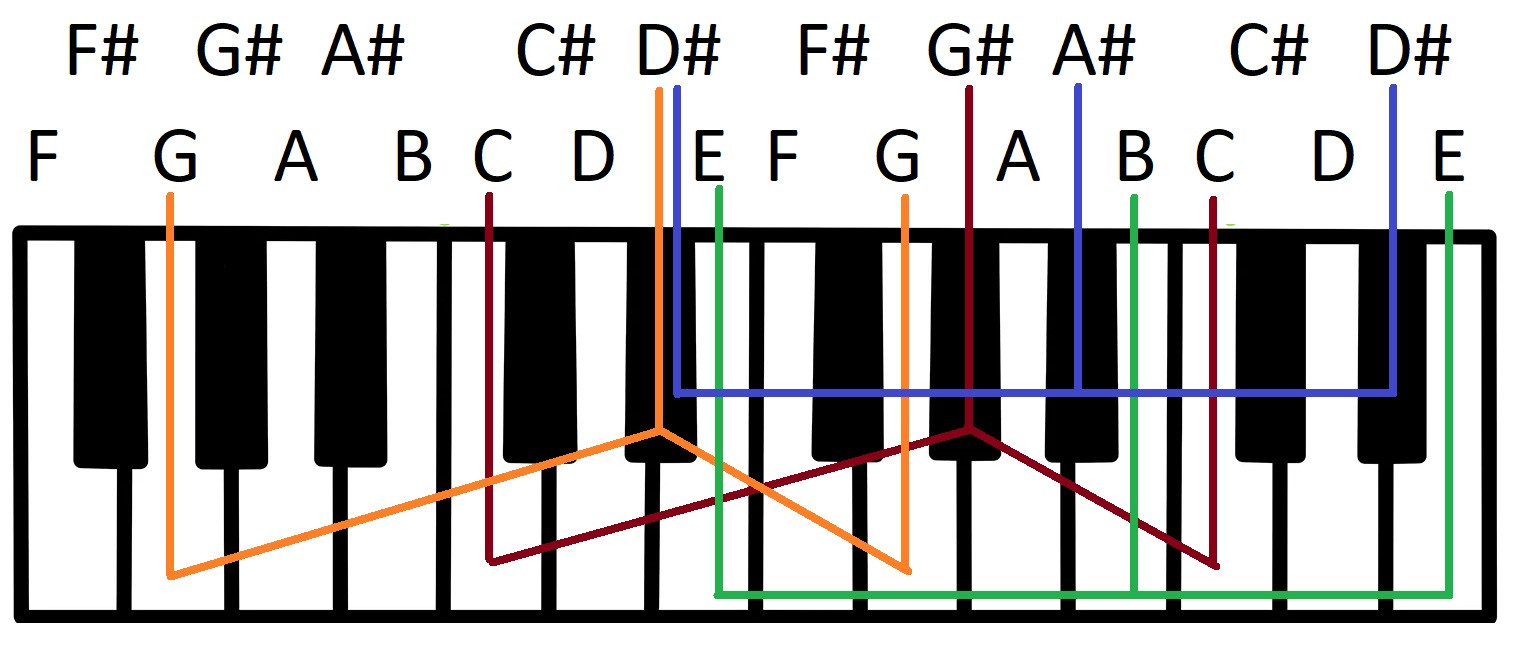
An example of the 'familiar patterns' I am talking about would be something like a C-G#-C chord (essentially an augmented chord without the middle note but with a root-octave). I saw this pattern in many places, but it took me a while to realize that this shape (white-black-white) that works for the keys B, C, D, F, and G can also be found for the other keys, but in a different shape such as the E-B-E (white-white-white) or D#-A#-D# (black-black-black). I played all three variations in different pieces (and several of them in the same piece even!), and yet it took me noticing that they sound similar and actually mapping it out to figure out that they are essentially the same. On a Janko or another isomorphic keyboard I would have 'felt' the similarity right from the start and thus learned to associate the sound to the shape to the notes much earlier.
![]()
Biggest issue is really when I try to use this shape / chord while just playing around on the piano - its fine in most cases (five of the 7 white keys), but if I switch to a 'wrong' key (A for example), I all of a sudden try to press on a black key that doesnt exist. Sufficient practice will naturally help me get to the point I dont even have to think about moving my finger to press the white key instead, but thats the point - practice. Time that I could have spent learning a new song, or practicing something else entirely.