Mike Filip
CyberGene Having multiple ways/keys to play the same note is to me a disadvantage, rather than advantage. I prefer having a single fixed key for each note, so that I internalize it and not have to think for variants while playing
That is a very good point, and yes - it is most definitely a disadvantage. Sure you can get a more 'ergonomic' hand position if you have more options, and on a regular piano I have had to contort my fingers in a few positions in order to play a passage (especially with multiple white keys that have to be played 'between' the black keys), but there is never really a question of 'which button to press', just 'which finger should I use'.
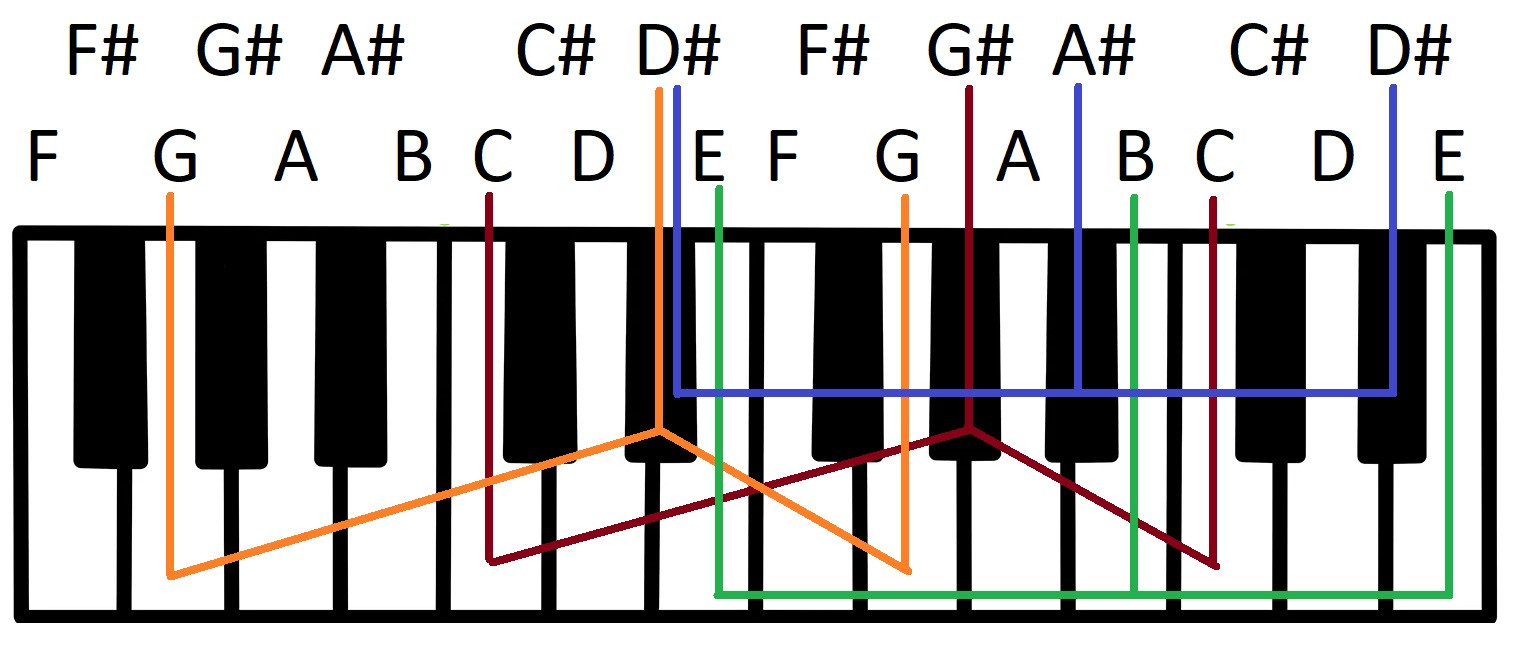
Personally I try to look at the janko piano as less of rows of separate keys and more of a set of columns - so essentially the 3 buttons are the 'same key' - this combined with a few 'basic rules' makes things simpler (at least until you become 'proficient enough' to start breaking them):
- your thumb plays only on the first two rows. There is no choice here, as each note only has a single button.
- the 6th row is completely ignored. Its only use is if you wish to transpose an entire piece to a key that requires moving up a row, so essentially you can 'hide' the 6th row and forget about it. I have seen some videos of Janko players what have a 'felt cover' that they place over the 6th row purely for this reason.
- your pinky depends on your thumb - it should always be on one of the two rows above the row your thumb is on - so if your thumb is on the 2nd row, your pinky is on the 3rd or 4th (or 2nd and 3rd if thumb is on the 1st). This is quite natural and doesnt require any thought - any other row requires contorting your wrist.
- The rest of your fingers (index, middle, ring) either have a single option (if they are playing a note whole-tone intervals away from the thumb, they have to play on the row +2 above the thumb) or two options (playing a note that isnt a whole-tone interval set away), but in the later its pretty obvious as one of the two options is either too far or too cramped.
Now yes - this is quite a bit more complicated than on the classical piano, and is definitely a mark against the Janko piano. I will only really be able to tell how much of an issue it is once I try playing it, but still.
Personally I believe it still an acceptable sacrifice to have an isomorphic keyboard, but it comes down to the question of 'does having each group of chords/arpegios/progressions have the same shape decrease the learning curve enough to warrant an increased complexity in figuring out which keys to press'.
There have been attempts to remedy this, such as the… slim key janko (by Rico Raven).
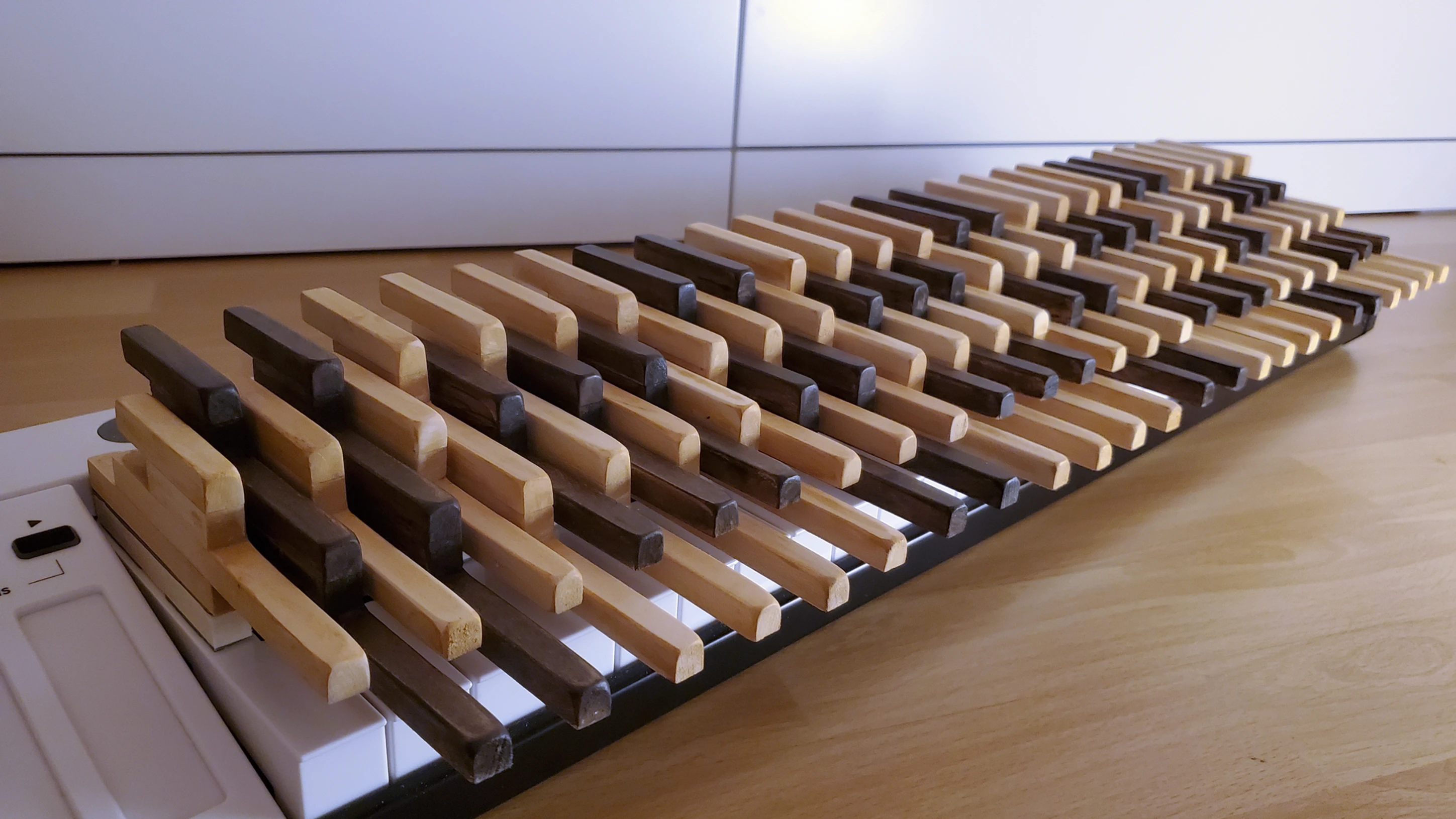
It removes the 'separation' between the buttons of the same note, allowing you to play 'between' the keys if you want - so in a way there shouldnt be a question of 'which row to play on', as you have the entire length of the key much as in the classical piano layout.
It has its own set of issues (biggest of which is the visual 'clutter' that makes it hard to tell which key to press at a glance, and the fact that the octave span remains as 6.5 as in the classical piano in order to allow you to play 'between the keys'), but still.
CyberGene When I play the piano, regardless of whether I'm improvising jazz or playing classical music from a score, I need to have all the note pitches internalized so deeply inside me that I don't have to think at all but immediately know where that key is.
I think this is the big issue that isomorphic keyboards are trying to 'solve' - once you internalize all the notes and their patterns to the point you no longer think it matters not how the layout is positioned - you stop pressing keys and start playing notes. However the time it takes for a player to gain enough experience to get to this point is exceptionally long for a classical piano and (theoretically) shorter for a Janko piano, to the point that for people who arent aiming towards a musical career they may never get to such a point.
Are there people that can sight read a piece of music and play it in an entirely different key? Yes there are. But its exactly the fact that such feats are considered a show of amazing ability, of truly virtuous play, and dedication that makes me believe that the Janko layout is better - after all such a feat would just garner a 'yea, you can do that - so what' reaction on a Janko layout, much as if you just used the transpose function of an arranger keyboard to play the same song in a different key.
It allows you to parse the song as I-V-vi-IV progression (start from any key) instead of specifically a C - G - Am - F - which is different from an A - E - Fm - D progression on the classical piano; at least until you fully internalize the chords to the point you stop thinking about them as you play them.
(as always - caveat - I am arguing from a purely theoretical perspective right now. I have yet to try playing a Janko keyboard, so as always, take all of this with a grain of salt)