Mike Filip
@RIP
To counter point:
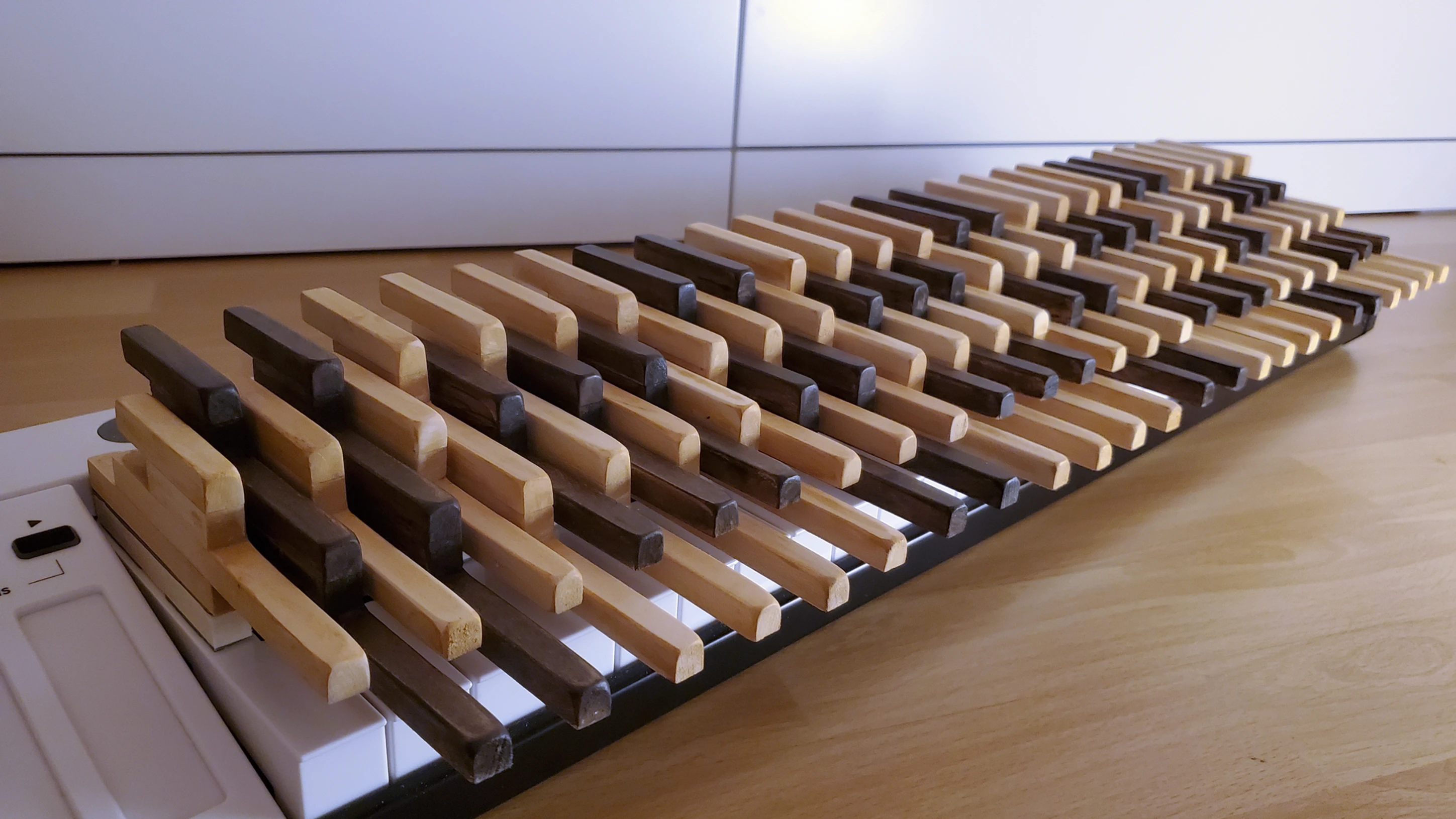
The parallelogram linkage (at least in my design) is definitely a point of friction, especially seeing as how instead of 4 points + key-pivot in the 'traditional' Janko setup I ended up with 8 points (though no key-pivot). I did know that this might be a problem from the get-go however so I made sure that each of the points are bushed extremely loosely. This would be an issue if done with bushings of a regular grand piano action, but for the parallelogram linkage of the keys its fine since all of the components are connected together in multiple places so provide rigidity; suffice it to say that at least in my case its not an issue.
I cant deny that the design is much more complicated than the regular lever-key of a classical piano, and definitely provides more friction than it. Still - this has more to do with the 'mechanics' of the design and less so with the Janko layout itself - I went with the 'no-cost-spared' approach with a fully realistic action, but a simpler MIDI controller might have separate action for each individual key and still use the Janko layout - so we should focus more on the layout and less on the mechanics.
Teacher problem: Yes. This is the HUGE issue, and one that I can only 'disregard' due to me not aiming towards a musical career and with the understanding that thus far I have been self-taught on piano, and will continue to be so.
I believe that quite a bit of the skills taught for classical piano can be transferred, such as the flowing motions of the hand for arpeggios, the hand-under and hand-over techniques, proper posture, etc. Still - it will not be a one-to-one application so I will have to watch the videos explaining such things and try to port it over to the Janko piano.
This combined with the unavailability of janko style pianos 'in the wild' (read: concert halls, public ventures, public piano installations, your friends house, etc) is enough to push away just about anyone who might be interested in non-classical piano layouts.
Not sure I agree with you about the curving-hills analogy. When playing on a regular piano I often glance down to locate the next note I need to move to if I have a long jump or similar, but when its just a small change I do it intuitively - mostly with muscle memory. Trying to 'locate' the right place for your hand by 'feeling out' the black keys is a huge mistake - you either know where your fingers are, or you need to look down to 'reorient' yourself (purely on color and patterns) so as to make your jump correct.
This is also why I decided to go with the same coloring of the keys as on a regular piano instead of trying something different such as 3-color, all white, or other more 'chromatic' options. This keeps the diatonic nature of the piano while moving to an isomorphic layout. Paying a C major scale? All whites starting from C, which is obvious at a glance. Playing the D major scale? one key to the right following the same pattern. You end up with 2 black keys as well, and its abundantly clear that the two scales follow the same pattern, and why there are 2 sharp notes in the D major scale.
Though perhaps its just because I havent had a proper piano teacher? I definitely have no experience in trying to sight read a new piece which would require playing 'new' notes without looking at the piano. Still, this seems like the 'get-good' argument from the opposite side - if you play with either keyboard enough you know enough about it to be able to move to the position you want to be at.
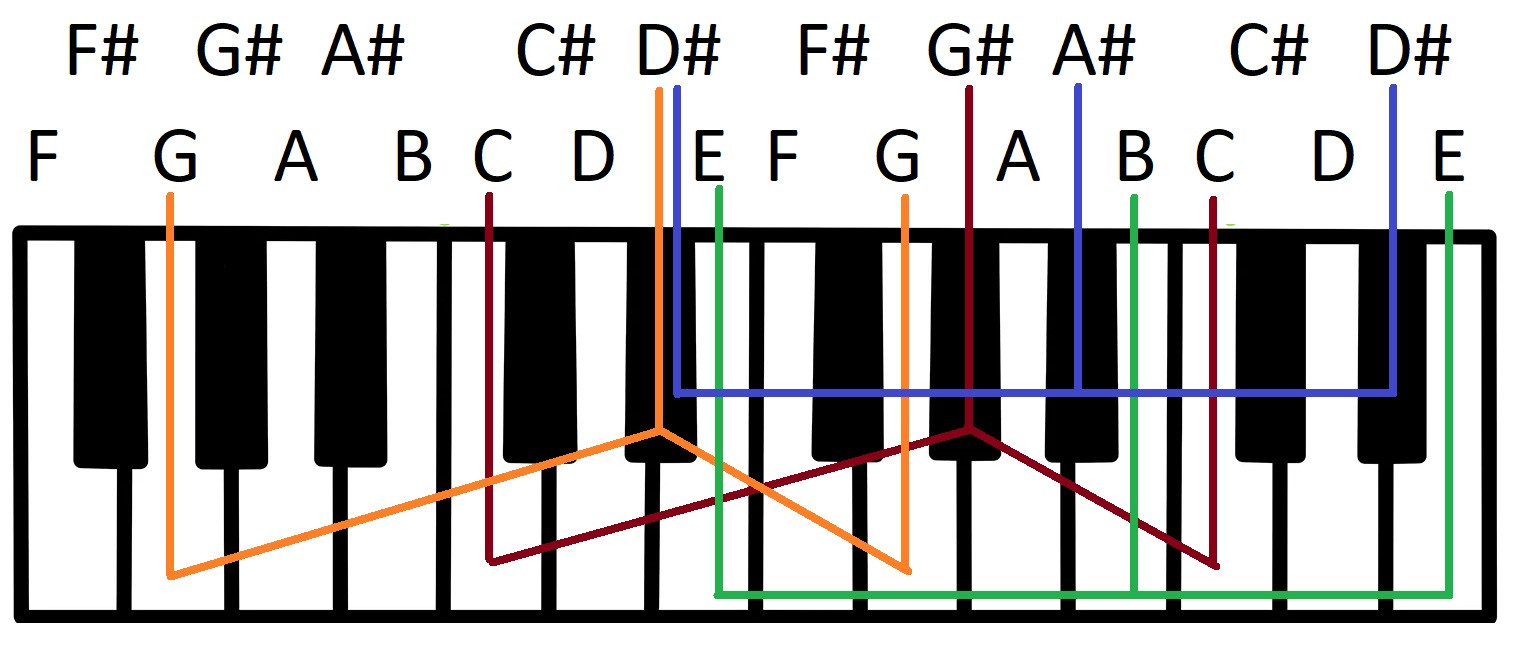
The big part I want to discuss is really the 'sameness' of an isomorphic layout which allows you to easily learn and memorize chords/arpeggios/melodies and then apply them to similar ones in a different key as opposed to having to learn identical sets of 6 to 12 based on the key. Yes - its not 24 positions, but 6 (ignore the inversions); still though - you have to memorize the mapping and be able to bring it up at a moments notice as you play.
I dont say its hard (though yes - I believe it is; anything that requires years of constant practice should be considered as such) - just that its harder than if you only had 1 position and not had to worry about it. You say yourself that that you cant transpose right now, but you see it as a possibility in the future. In much the same line of thought, there is a reason why something like this video showcasing a player playing maple leaf rag in 3 different keys (and then yes - a waltz) is such an amazing show of ability - because its hard! You need to learn not just the chord progressions, typical licks for the left & right hands, and so much more, but do it in multiple chords at the same time and be able to (on the fly!) switch between them. On the other hand, this video, though much less virtuous, shows clearly how the left hand plays essentially the exact same 8 note pattern, just shifting between starting notes. There is no need to decide which of the 6 patterns to play at the same time as you are already juggling the chord progression and trying to make the melody sound good. Personally, if I had to memorize that piece I might not even notice that the sections are essentially the same, since the keys would be different on a regular piano, but on a Janko keyboard its immediately evident.
One of the videos that really pushed me towards the Janko layout was this one here; the author shows how he is able to use a memorized piece (one of Bach fugues) and then just use the pieces / parts / structures of the piece to improvise on it, essentially putting a different spin on it, going to different keys and chord progressions, but still keeping it sounding as a Bach piece. And Yes! He mentioned that this is doable on a classical piano (his father was apparently able to do this), but the amount of effort (and time) required for this… You essentially have to dedicate yourself to the piano and practice until its no longer you pressing the keys, its you playing the notes. At that point it doesnt matter what order the notes are, they could be listed alphabetically, with 8 A notes an octave apart, followed by A# notes and so on (lets ignore the size of hands needed to play that…), and you would still be able to play well, assuming you learned to play on that layout.
Much the same way I am tying on the keyboard right now - I am not thinking where the letters are, I am not even thinking about moving my fingers or pressing buttons - instead I am thinking of the word and it shows up on the screen. In fact it is when I start to focus more on the movements of my hands that I start slowing down and potentially making mistakes. But this is something that required me typing out literally thousands of papers worth of text starting from middle school and continuing until now.