Skip to content

DIY digital piano: The Janko Layout

Mike Filip

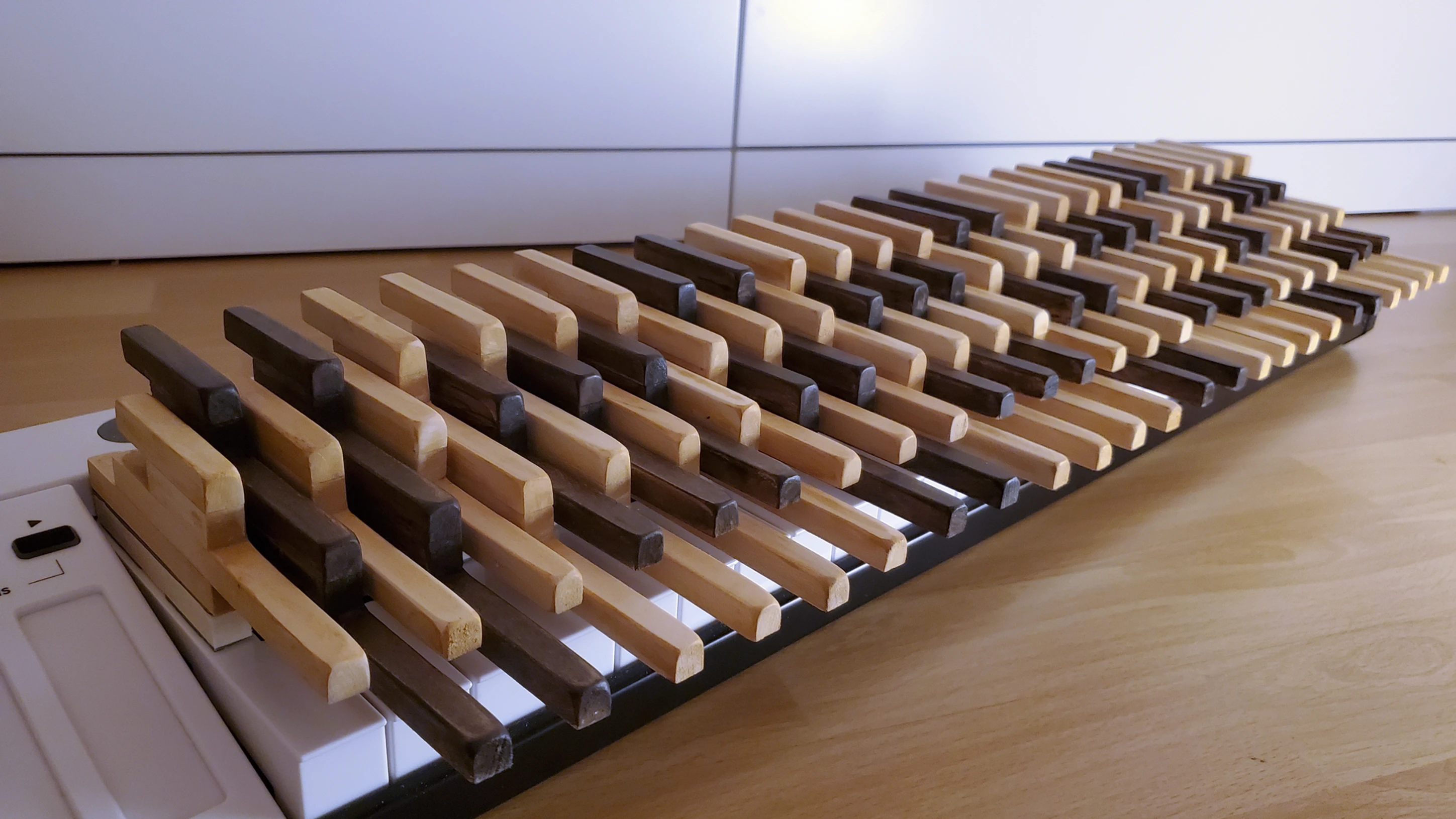
So this is an off-shoot of the main thread. To summarize: I am working on a fully DIY digital piano with a custom key layout different from the traditional 7+5 of the regular piano. In the main thread and other sub-threads I will cover the custom action, electronics, assembly, firmware, etc. However in this thread I will talk/discuss the Janko layout specifically. Here is the video of me discussing the layout.


So - the classical piano layout (or the 7+5 layout as I call it) is what everyone basically thinks about when asked to picture the piano keys. You have your 7 white keys with 5 black keys, set up in groups of 2 black keys, space, then 3 black keys. This layout allows for an easy C major scale as the 7 notes of that scale are all 'white' keys.

Unfortunately the classical layout isnt isomorphic - aka: the same finger shape does not correspond to the same 'sound'. Perhaps the best way to show this would be to compare the C major and D major chords:

C major:
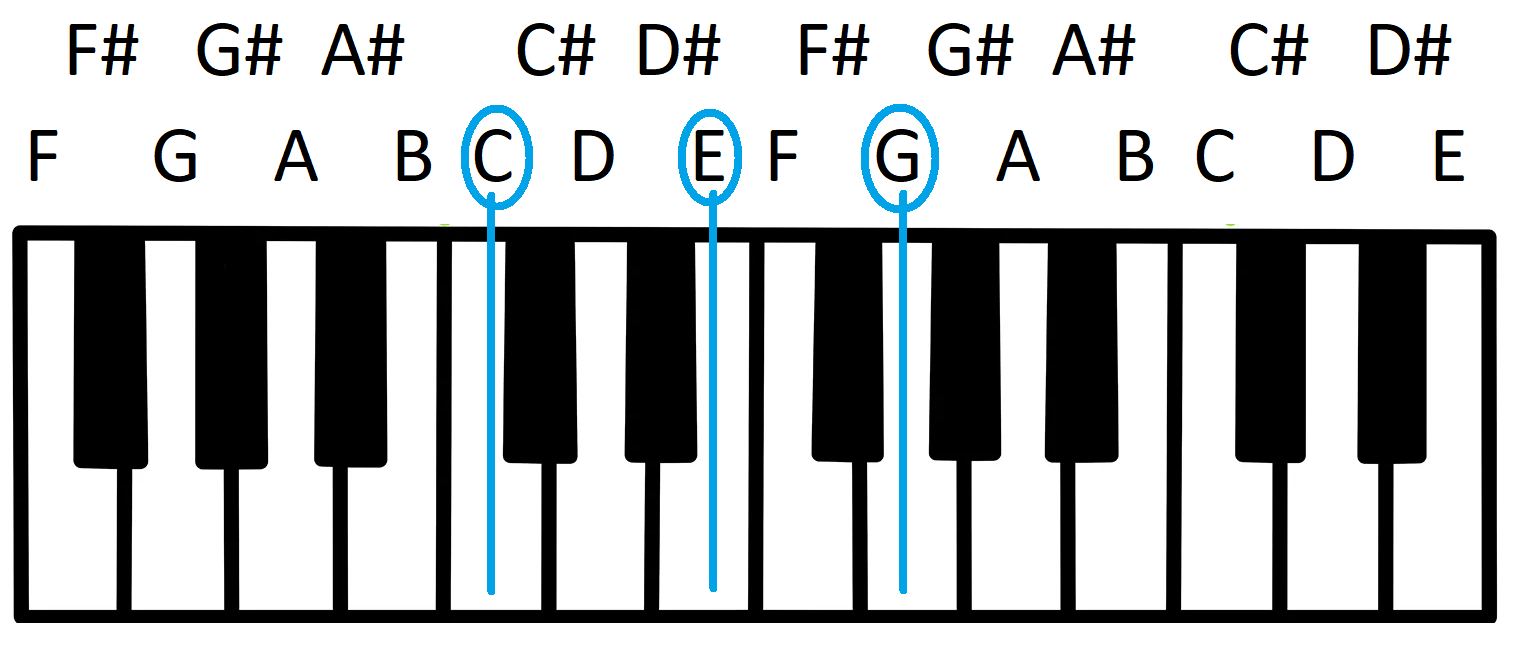
Now, just looking at the chord and going off of intuition I would expect this to be the D major chord:

But its not! Its the D MINOR chord! The reason for this is the 'missing' black key between E and F, leading to this being the actual D major chord:
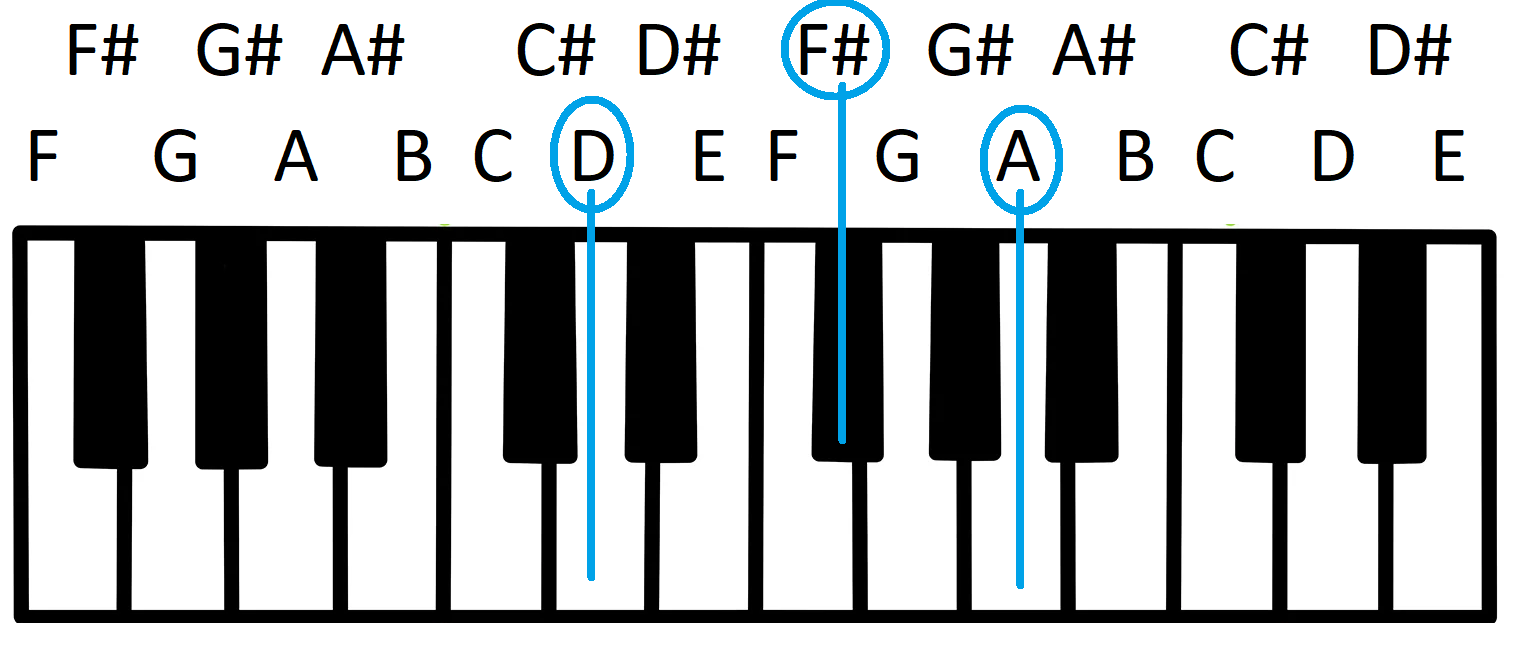
Which leads to the idea of isomorphism (or same-shape if translated). Basically the classical piano layout isnt isomorphic because the same interval can take different shapes - two adjacent notes are exactly 1 semi-tone apart (the shortest interval), but this can take the shape of white-to-black (C to C#), black to white (C# to D), or white-to-white (E to F).

The various isomorphic keyboards, of which the Janko is one, are an attempt to 'fix' this issue.

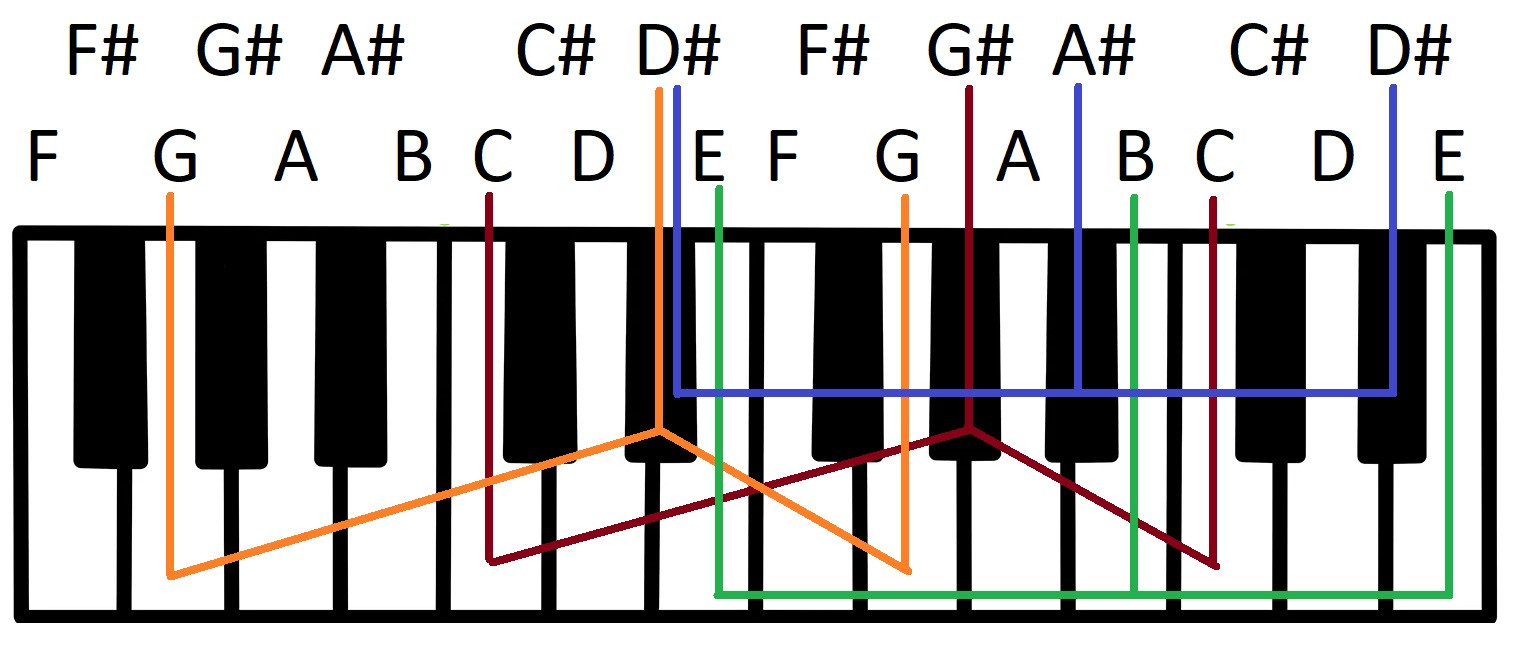
Lets see the same example on the janko keyboard (should probably provide a bit of an explanation, rows I, III, V are the same, with keys C,D,E,F#,G#,A#, C again and so on; and rows II, IV, VI with the keys C#, D#, F, G, A, G C# again… why multiple rows? you need at least 3 for true isomorphism and having 6 allows for more ergonomic finger placement as you can decide where to place your fingers instead of having to contort them to the required buttons):
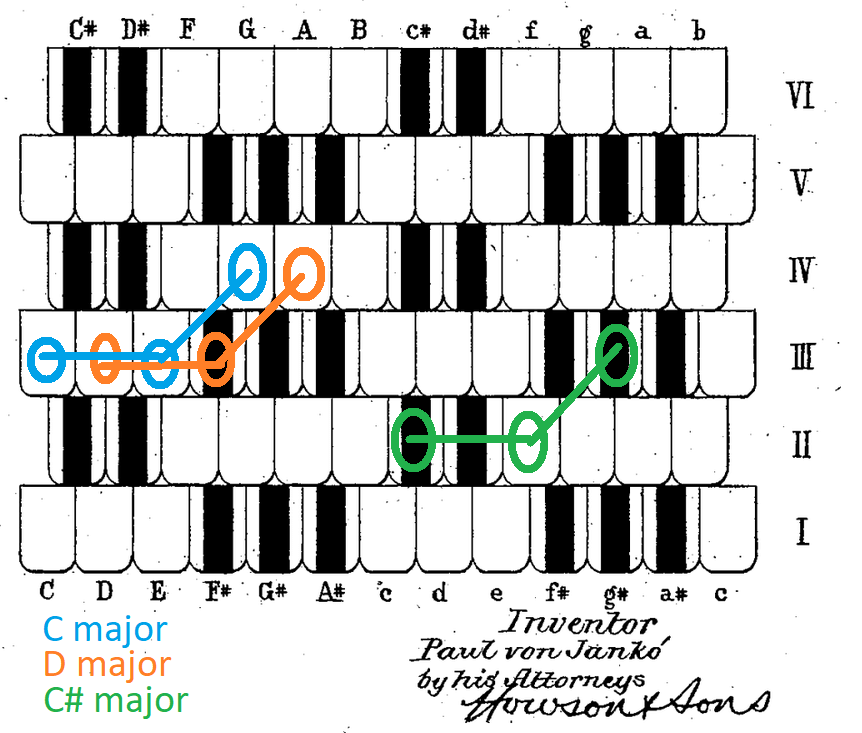
Blue is the C major, orange is the D major, and green (just to give one more example) is the C# major (which would require black-white-black shape on a regular piano, which is once again different from the other two.


So this is the layout I went with. To summarize, here are the upsides:

  • Same shame for similar chords (or scales, or passages, etc.) making you need to memorize 6x+ less patterns to be able to play from memory.
  • Pieces can be transposed just by starting from a different note while keeping all fingering the same.
  • Jazz licks and similar sections become much easier to learn as you just learn one pattern and you can play it for any key, especially nice if you wish to repeat the same base lines just with a set chord progression - just move your starting note for every chord change and you are good!
  • Many songs contain passages that are essentially the same passage just transposed, which makes it easier to learn & master when you can memorize it once instead of having to memorize different finger patterns for each transposition.
  • (yes, all of the above can be summarized as 'transposition is easy on the janko layout')
  • The octave is 5.1 inches instead of 6.5 of the regular piano, making long stretches (especially those over an octave) easier, even for those of us with Rachmaninoff size hands.
  • This is more on the 'technical' side, but the way the keys are made they have the same 10mm of key dip no matter where you press, so you dont have to worry about pressing harder to play the same volume of note when playing at the back of the piano as on the front.

As for the downsides, I couldnt find any objective ones (at least in terms of the actual design) as most of the people seem to dismiss the idea off-hand, or even worse go the "stop whining! just learn the regular piano! its not that hard!" route. Still, here are the downsides I found (or thought of):

  • Good luck finding a teacher. Classical piano? sure - unless you live in Antarctica you are probably a call (and some $$$) away from getting piano lessons. Janko? yea - not happening.
  • Very limited instructions even after you give up on a teacher. Essentially you are down to like 5 books (half of which are in German and all of which are in horribly-scanned quality) that discuss the Janko layout and provide lessons. Sure, you can use the learning books for regular piano, but probably not when you are just starting - so its more along the lines of "learn classical piano then transition", which isnt that great…
  • If you are hoping to get into music professionally, Janko isnt an option. Lets just leave it here.
  • Going to a friend's house or a public venture? You might find a classical piano, but a Janko? definitely not. So for me I am just going to have to get used to lugging my digital piano around if I want to play it somewhere else.

In general the Janko layout seems to be in that unfortunate case of a 'small local shop' trying to compete with 'Amazon'. Its just not happening unless there is a truly good reason for it. Lumatone and similar? They offer micro-tonal playing which make it interesting for those on the 'cutting edge' of music. Janko? not so much.


Anyway - Anyone have any comments on the janko layout or isomorphic keyboards in general? I would love to get a conversation going about this.


@RIP You mentioned being interested in Janko layout before and deciding on why the classical layout is better. Why? Would love to hear your thoughts.
RIP

Mike Filip You mentioned being interested in Janko layout before and deciding on why the classical layout is better. Why? Would love to hear your thoughts.

Happy to comply. Let's start with the benefits

Mike Filip (yes, all of the above can be summarized as 'transposition is easy on the janko layout')

This is definitely a benefit, but not a large one (more on it later)

Mike Filip The octave is 5.1 inches instead of 6.5 of the regular piano, making long stretches (especially those over an octave) easier, even for those of us with Rachmaninoff size hands.

This can be obtained these days in other ways. I currently have a Korg microKEY which is nicer than you'd expect for a keyboard with synth action which such short keys (obviously you want the not-wide ones, otherwise that's a defect too). Also, there is the Athena piano too, which is currently sold only in 5.5" per octave, but they expect to have 6" and 5.1" in the future. Going to the DIY route, you can build whatever you want, and in fact I'm considering to repeat the Mybrid built at a smaller 5.5" per octave. So, while I consider the small octave size a great plus for a piano-like instrument, this is not an advantage of Janko compared to regular layout.

Let's me add a few more downsides in addition to yours, which I totally agree with:

  • The parallelogram linkage has four pivot points per key (rather than one) in addition to the ones in the action. This is one of (if not the ) reason why it never became popular: the mechanical implementation can be finicky, and friction is at least 4 times more than that of a single key (and probably more because these are rotational hinges rather than simple pins-seesaw-pivots). Apparently historically this was a big problem in the bass. With today's technology (and a digital action in which you really don't care about the hammers having specific velocities and/or mass to excite the strings for an acoustic piano) one can probably solve that, but it's going to be a lot of work. Maybe you've already solved this problem with your work, but it was something I did not feel comfortable embarking into….
  • For the same chord/arpeggio/melody, there are many competing ways of playing which at least partially negate the advantage of "same shape when transposing", and makes it much worse the "good luck finding a teacher" problem: how are you going to decide which of these many competing ways is the most appropriate one?
  • While studying how to solve the previous problem, I met Phil Best which opened my eyes. The regular piano keyboard it's not that ugly mess that I thought it was. The chords/arpeggios/melodies are not that random chaos that I saw. Instead, there are beautiful patterns and regularities. There are not 24 M/m things (each with 3 inversions!) to learn as I once thought, but only 6. Six!! Transposing is not difficult, once you learn the things (I'm not there yet, but I see how I could, one day, something that in my Janko days I thought it was impossible with traditional layout).
  • The 5+7 shape of the keyboard it's a wonderful pattern that now completely guides me while playing the piano. The isomorphic keyboards destroy this wonderful pattern and I am convinced that isomorphic makes a player lost in the keys. The best I can do to explain this is a silly example: imagine a winding road with lots of curves and hills. Arguably some could say that it's a difficult road to travel. Compare it with a featureless plane, completely flat as it is taught in geometry. The easiest way to move around right? No obstacles whatsoever…… I am now convinced that the latter is difficult and that the "curves and hills" are instead both beautiful and essential to orient oneself around. You'll certainly agree that on an infinite, featureless plane you are always lost, since every place is equivalent to every other you never know where you are. Admittedly, Janko is not featureless, but it's much closer to be featureless -- and in fact nudge the player to look to orient oneself, since the black keys cannot be felt by touch. In fact, in some implementation they made them with different surface texture to mitigate this problem! But I argue that even so, it allows you to orient yourself much worse (only once you feel the texture, if you have that). Whereas the "bumps" of the traditional black keys can be felt "at a distance" while playing other nearby keys, and once you become fluent with that, you immediately know where you are.

Now, I realize that some of these last things are not so clear-cut, so I am open to be proven wrong, but given the very small benefits, the serious drawbacks and the pretty big risk of additional drawbacks (particularly the last bullet), I gave up. To be clear, I am not saying that you should follow me on this decision and in fact I'm saying this only because you asked.

Hope this helps and happy to follow up if anything is not clear or if you have other questions!


Mike Filip

@RIP
To counter point:


The parallelogram linkage (at least in my design) is definitely a point of friction, especially seeing as how instead of 4 points + key-pivot in the 'traditional' Janko setup I ended up with 8 points (though no key-pivot). I did know that this might be a problem from the get-go however so I made sure that each of the points are bushed extremely loosely. This would be an issue if done with bushings of a regular grand piano action, but for the parallelogram linkage of the keys its fine since all of the components are connected together in multiple places so provide rigidity; suffice it to say that at least in my case its not an issue.

I cant deny that the design is much more complicated than the regular lever-key of a classical piano, and definitely provides more friction than it. Still - this has more to do with the 'mechanics' of the design and less so with the Janko layout itself - I went with the 'no-cost-spared' approach with a fully realistic action, but a simpler MIDI controller might have separate action for each individual key and still use the Janko layout - so we should focus more on the layout and less on the mechanics.


Teacher problem: Yes. This is the HUGE issue, and one that I can only 'disregard' due to me not aiming towards a musical career and with the understanding that thus far I have been self-taught on piano, and will continue to be so.

I believe that quite a bit of the skills taught for classical piano can be transferred, such as the flowing motions of the hand for arpeggios, the hand-under and hand-over techniques, proper posture, etc. Still - it will not be a one-to-one application so I will have to watch the videos explaining such things and try to port it over to the Janko piano.

This combined with the unavailability of janko style pianos 'in the wild' (read: concert halls, public ventures, public piano installations, your friends house, etc) is enough to push away just about anyone who might be interested in non-classical piano layouts.


Not sure I agree with you about the curving-hills analogy. When playing on a regular piano I often glance down to locate the next note I need to move to if I have a long jump or similar, but when its just a small change I do it intuitively - mostly with muscle memory. Trying to 'locate' the right place for your hand by 'feeling out' the black keys is a huge mistake - you either know where your fingers are, or you need to look down to 'reorient' yourself (purely on color and patterns) so as to make your jump correct.

This is also why I decided to go with the same coloring of the keys as on a regular piano instead of trying something different such as 3-color, all white, or other more 'chromatic' options. This keeps the diatonic nature of the piano while moving to an isomorphic layout. Paying a C major scale? All whites starting from C, which is obvious at a glance. Playing the D major scale? one key to the right following the same pattern. You end up with 2 black keys as well, and its abundantly clear that the two scales follow the same pattern, and why there are 2 sharp notes in the D major scale.

Though perhaps its just because I havent had a proper piano teacher? I definitely have no experience in trying to sight read a new piece which would require playing 'new' notes without looking at the piano. Still, this seems like the 'get-good' argument from the opposite side - if you play with either keyboard enough you know enough about it to be able to move to the position you want to be at.


The big part I want to discuss is really the 'sameness' of an isomorphic layout which allows you to easily learn and memorize chords/arpeggios/melodies and then apply them to similar ones in a different key as opposed to having to learn identical sets of 6 to 12 based on the key. Yes - its not 24 positions, but 6 (ignore the inversions); still though - you have to memorize the mapping and be able to bring it up at a moments notice as you play.

I dont say its hard (though yes - I believe it is; anything that requires years of constant practice should be considered as such) - just that its harder than if you only had 1 position and not had to worry about it. You say yourself that that you cant transpose right now, but you see it as a possibility in the future. In much the same line of thought, there is a reason why something like this video showcasing a player playing maple leaf rag in 3 different keys (and then yes - a waltz) is such an amazing show of ability - because its hard! You need to learn not just the chord progressions, typical licks for the left & right hands, and so much more, but do it in multiple chords at the same time and be able to (on the fly!) switch between them. On the other hand, this video, though much less virtuous, shows clearly how the left hand plays essentially the exact same 8 note pattern, just shifting between starting notes. There is no need to decide which of the 6 patterns to play at the same time as you are already juggling the chord progression and trying to make the melody sound good. Personally, if I had to memorize that piece I might not even notice that the sections are essentially the same, since the keys would be different on a regular piano, but on a Janko keyboard its immediately evident.

One of the videos that really pushed me towards the Janko layout was this one here; the author shows how he is able to use a memorized piece (one of Bach fugues) and then just use the pieces / parts / structures of the piece to improvise on it, essentially putting a different spin on it, going to different keys and chord progressions, but still keeping it sounding as a Bach piece. And Yes! He mentioned that this is doable on a classical piano (his father was apparently able to do this), but the amount of effort (and time) required for this… You essentially have to dedicate yourself to the piano and practice until its no longer you pressing the keys, its you playing the notes. At that point it doesnt matter what order the notes are, they could be listed alphabetically, with 8 A notes an octave apart, followed by A# notes and so on (lets ignore the size of hands needed to play that…), and you would still be able to play well, assuming you learned to play on that layout.

Much the same way I am tying on the keyboard right now - I am not thinking where the letters are, I am not even thinking about moving my fingers or pressing buttons - instead I am thinking of the word and it shows up on the screen. In fact it is when I start to focus more on the movements of my hands that I start slowing down and potentially making mistakes. But this is something that required me typing out literally thousands of papers worth of text starting from middle school and continuing until now.


Mike Filip

RIP While studying how to solve the previous problem, I met Phil Best which opened my eyes. The regular piano keyboard it's not that ugly mess that I thought it was.

Could you expand on this by the way? I agree that the classical piano keyboard is not exactly an 'ugly mess' - it has a very specific layout which by its very nature (aka: not completely random) forms patterns. The obvious being that instead of 12 patterns per chord you have only 6, or more to the point 3 patterns with the other 3 being mirror images of each other.

Still, I dont see how this is 'better' than the Janko layout. I could definitely be worse, but thats not really the argument here.

How does the C-major based classical piano lend itself to helping memorize pieces, guide you while playing, etc. It seems to be easier for pure-white (or mostly white) pieces, and in fact I have one specifically selected (heart asks for pleasure first) to see about comparing a piece that should be 'easier' on a classical keyboard when played on a Janko; but it seems like in every other case having an isomorphic layout is better.

I could push forward the idea that playing the C major scale and the triads (CEG, DFA, etc) gives you an understanding of the chords that make up the scale, and are thus easy to jump between (being all white keys of the same shape) to improvise a C major song, but once again - thats purely for C major. Doing the same with D major (for example) now requires you to incorporate the black notes and shift between the two rows - much as you would on a Janko.

I think a good way of stating this was that the classical piano is easy to play in C major (and to a certain extent ones like D# major - you know, 5 black note ones) with the others having varying difficulties, while on the Janko there isnt an 'easy' scale, but they are all the same difficulty, plus once you learn one you learned all.


RIP

Mike Filip suffice it to say that at least in my case its not an issue.

Fantastic! As we are discussing in the other thread, we might take advantage of your experience there for that other purpose (of regular keyboard).

Mike Filip Not sure I agree with you about the curving-hills analogy. When playing on a regular piano I often glance down to locate the next note I need to move to if I have a long jump or similar, but when its just a small change I do it intuitively - mostly with muscle memory.

It's not something you can agree with. You have to experience it yourself first person. I can't explain it much better than I have. I would only add that the strict definition of "muscle memory" is very bad. I've been there and minor things (like trimming the fingernails) broke it completely.

Mike Filip Trying to 'locate' the right place for your hand by 'feeling out' the black keys is a huge mistake

I agree completely. Like it would be trying to finding your way in that curving-hills trail by memorizing where the trees are. In fact I don't do that. But their existence is an essential reference for "something magic" to happen in your body to immediately know where you are. The only other comparison I can make is climbing a staircase. You can certainly climb staircases of different step heights, without looking. Why? It's the "magic" of how the brain controls the body. But it does need some minimal clues to orient. An isomorphic keyboard removes (or at least reduces) those clues, making it harder to play fluently.

Mike Filip or you need to look down to 'reorient' yourself

Most teachers agree that looking down is a mistake, even thought some might accept it, if you do rarely enough (but still cringe and think you should never do it). Some teachers are strict to the point of even holding some obstacles (such as magazines) between the eyes and the hands of their pupils at all the time.

Mike Filip The big part I want to discuss is really the 'sameness' of an isomorphic layout which allows you to easily learn and memorize chords/arpeggios/melodies and then apply them to similar ones in a different key

That's exactly what I see as a problem. You don't memorize anything, you just know. Similar to you not "memorizing" where your nose is, yet you know it. You have to learn like a 2 year old kid, which puts the information in a very different part of your brain.

Mike Filip key as opposed to having to learn identical sets of 6 to 12 based on the key. Yes - its not 24 positions, but 6 (ignore the inversions); still though - you have to memorize the mapping and be able to bring it up at a moments notice as you play.

You can definitely do that. I mean, do you have problems doing any other physical activity? The problem you are making (exactly as my former self) is thinking that you have to think. If I tell you touch your nose with your right thumb, you can certainly do it much faster than I can say that sentence -- and without any problem. And ditto if I told you ear, elbow, knee, left toe, eye or any other body part. The "six patterns" become part of you like your nose, ears, etc.

Mike Filip just that its harder than if you only had 1 position and not had to worry about it.

Quite the contrary. You do have to worry about it -- a lot. Because now you don't know in which place you are unless you constantly look, or unless you strictly muscle memory it, without any proprioception feedback. Like walking in the dark in your house: yes, you know that three steps forward and one step left there's a door that brings you in the hallway, and then two steps down on the left there's another door that brings you in the bathroom and you can probably even do that in the dark of the night (I can and often do to avoid awakening other people in the house who are very light sensitive) -- but you can do that only sloppily and only most of the time -- but any minimal distraction or difference, and boom you slam into a doorjamb! (ask me how I know it….)

Idiotic video share site are preventing me to share a video which I recorded years ago that exactly demonstrate that, but you probably won't have any shortage of people playing like that

Mike Filip There is no need to decide which of the 6 patterns to play at the same time as you are already juggling the chord progression and trying to make the melody sound good.

There is no need to make that decision on the piano keyboard either. Even more, I can switch between regular sized grand piano and Korg microKEY and immediately feel at home. Like one ramp of the staircase has tall steps and another short ones: no problem. Before learning this way, such a switch was impossible.

Mike Filip You essentially have to dedicate yourself to the piano and practice until its no longer you pressing the keys, its you playing the notes.

Exactly. Like when talking is not pulling certain muscles in the mouth, vocal chords or pushing air with the diaphragm. You just talk to convey a message. And it's much easier than you think.

At that point it doesnt matter what order the notes are, they could be listed alphabetically, with 8 A notes an octave apart, followed by A# notes and so on (lets ignore the size of hands needed to play that…), and you would still be able to play well, assuming you learned to play on that layout.

That's exactly the reverse of what I am saying and if anything, IMHO, it applies to isomorphic keyboards. In the regular layout, you just have to "know where you are" and the patterns appear magically. In isomorphic, the lack of patterns make it extremely hard.

Mike Filip Much the same way I am tying on the keyboard right now - I am not thinking where the letters are, I am not even thinking about moving my fingers or pressing buttons - instead I am thinking of the word and it shows up on the screen. In fact it is when I start to focus more on the movements of my hands that I start slowing down and potentially making mistakes.

Exactly.

Mike Filip But this is something that required me typing out literally thousands of papers worth of text starting from middle school and continuing until now.

Because the regular computer keyboard has no way to give you clues of where the fingers are and you have to memorize each one of its 104 keys. If you use a different keyboard (e.g. a laptop, or a smaller one for one of those old smartphones with a keyboard) you can't do it, even if the layout is same or almost same. It would be equally hard on Janko, I think, for the same lack of structure. You will spend quite a lot of time, and a minimal change in your position wrt the keyboard will "break" the magic (like on a computer keyboard)

Mike Filip Could you expand on this by the way? I agree that the classical piano keyboard is not exactly an 'ugly mess' - it has a very specific layout which by its very nature (aka: not completely random) forms patterns. The obvious being that instead of 12 patterns per chord you have only 6, or more to the point 3 patterns with the other 3 being mirror images of each other.

You're already almost there! Much closer than I was! On the structured piano keyboard, you have to simply know the 5-note and the 7-note groups, which you already know. And then you have to learn only the 6 patterns "plugged" into the note groups and done, you know everything. Nothing else to know. If you learn this way and try a larger or smaller keyboard, it'll be astonishing easy to migrate. You just have to play like a 2-years old having fun touching his nose, rather than like a grown-up reading a technical paper.

Mike Filip How does the C-major based classical piano lend itself to helping memorize pieces, guide you while playing, etc.

Again, that's exactly the reverse. The C-major is the death of the piano (so much so that the best teachers teach it last).

Mike Filip I could push forward the idea that playing the C major scale and the triads (CEG, DFA, etc) gives you an understanding of the chords that make up the scale, and are thus easy to jump between (being all white keys of the same shape) to improvise a C major song, but once again - thats purely for C major.

The problem is that you are thinking sequentially, hence you see the black keys are an impediment. You must think spatially (3D if you wish), so the black keys are your reference. Especially when you play in C major when you don't have any other reference. You must keep the 7- and 5-note groups (as whole, including black keys) always as part of yourself, like you always have all your body parts. You may not move your legs when seated (not playing some notes when in a certain key signature), but you know they're there. If you think spatially, F#minor is a certain pattern like "lift your left arm (i.e. play F# and A, on the left of the 7-note group) and left foot (C# on the 5-note group)", that has nothing to do with Eminor which is "lower your right arm (G and B on the 7-note group) and right foot (E on the 5-note one)". There are incredibly few patterns and when you forget about the linear thinking of the scale but embrace them spatially, you will learn what they are in a blink and recall them as fast as you can move your body, like in "touch your ear"

Mike Filip I think a good way of stating this was that the classical piano is easy to play in C major

That is false, in my experience (even before my current teacher).

Mike Filip plus once you learn one you learned all.

And that's irrelevant. There are so few things to learn and they are so easy to learn that you are having troubles to remember where your ears or nose or knees are (sorry to insist on this, but it's exactly like that)

Anyway, I'm not trying to convince you, if you want to do Janko, I wish you all the best and I'm looking forward to seeing/hearing what you are able to accomplish. I'm just answering since you are asking, and telling you what I experienced myself and how I changed my mind on this topic.

PS: I'm probably spending way more time with this than I should/would because I truly see you as my former self (including the choice of music that I assume you like since you linked / mentioned) and I wish I stopped doing/thinking what you are doing/thinking much sooner than I did

Anyway, maybe this will give you a few more clues/nudges in that direction. This is the only video in which he talks about the topic, because really there isn't much to say. Most of his other videos are instead about rhythm which is way more important in my opinion (I was convinced of that even before meeting him)

https://www.youtube.com/watch?v=r6lrXKCe73s


Mike Filip

@RIP

You bring up some very good points!

So in summary, its more along the lines of having the complexity of various passages being played differently (even though 'mathematically' if you will they are the same - as in, same set of intervals) leads to you being a better player, much as practicing many different exercises instead of focusing on the same one all the time is better.

In much the same way, its the difference in chord shapes that you say makes playing a piece easier since a momentary lapse of attention isnt as problematic since your fingers are in a 'unique' position, thus allowing you to realize you are on a certain chord (by comparing to which chords you are supposed to be playing - at least subconsciously).

Did I get that right?


RIP That's exactly what I see as a problem. You don't memorize anything, you just know. Similar to you not "memorizing" where your nose is, yet you know it. You have to learn like a 2 year old kid, which puts the information in a very different part of your brain.

I mean - its still memorization? Its just the difference between starting to learn a language where you are essentially deciding what to say, translating it, then saying it; and becoming fluent in it where you essentially start 'thinking' in the language.

In which case using an isomorphic keyboard will (theoretically) get you to the 'fluent' stage faster as you dont have to memorize quite so many different grammar rules, but once you become fluent it matters little as you dont have to think about it - you can just speak (or in the case of music, play).

It stops being a set of you->keyboard->music and becomes just you->music.

RIP You can definitely do that. I mean, do you have problems doing any other physical activity? The problem you are making (exactly as my former self) is thinking that you have to think

Yes - once you internalize the knowledge you stop thinking about it and can just act. So if you have a button in front of you and are told to press it, you can do so quickly and without thinking, likely even blindfolded after a try or two. But if there are 6 buttons in different colors you have to think before pressing the button when you are told the color, and memorize the order if you want to do it blindfolded (or fast). Its not impossible - probably after an hour or so (heck, 10 min) you can likely just react to hearing the color without a thought, but its that period of learning that takes time.

RIP There is no need to make that decision on the piano keyboard either. Even more, I can switch between regular sized grand piano and Korg microKEY and immediately feel at home. Like one ramp of the staircase has tall steps and another short ones: no problem. Before learning this way, such a switch was impossible.

Its less about the keyboard sizing (I use both a large pc keyboard, a smaller one on my laptop, and a positively tiny bluetooth one almost interchangeably), so much as the different chords shapes. In your staircase example its like trying to go up a staircase where every 12 steps the 5th and 12th steps are twice as steep. Its doable, but you are likely to stumble the first time you go along them because you expect them to be the same. And even if you memorize to the point you dont have to think about it how to go up and down, if all of a sudden you start from the 3rd step instead of the 1st you will stumble again as the 'non-regular-sized' steps arent where you expect them to be.

On the other hand yes, if we use an 88 step staircase where every 5th and 12th steps (in a 12 set) are twice as steep we can orient ourselves on where we are based on where those steeper steps are, but I am just not sure its as helpful as you make it out to be.


In any case, this is all a bit theoretical for me - I dont have either a janko keyboard (yet) to try it out and compare against a classical layout, nor enough skill in the classical piano to be able to see the benefits of a diatonic layout in terms of 'orientation' on the piano (definitely not enough to verbally spar about the pros and cons of an isomorphic layout on this topic).

Do you have a video describing this? I would love to listen in on a 30 min deep dive into how the different chord shapes help with orientation. The only ones I found basically just talk about how to 'find' chords that you havent yet memorized sufficiently based off of the way they are formed (so the 'root note, skip 3, second note, skip 2, third note' kind of things) where they provide these guides as almost a divine revelation, or as a 'you wont believe how easy this is!' despite the fact that when you see a chord on paper and need to play it you dont exactly have the time to count the keys on the piano - you have to instantly move your hand into the correct shape (and if you are fluent at this, not have to think about it); which just furthered my belief that an isomorphic layout with all-same-chords = all-same-shape is the better option..

Orientation on the piano for me right now is more about which section of the piano piece am I playing (no improvisation at all - just playing memorized pieces), and while I am starting to remember familiar patterns just from the way they keep appearing in various pieces, the way they differ based on starting note is off-putting and something I hope will be better on a Janko layout.


PS:

I checked out Phil Best's videos when you first mentioned him and couldnt exactly find one talking about music in general (they are definitely interesting, but less so on the purely 'technical' side of things such as scales, chords, etc which I am focused on in terms of piano layout), so the linked video was nice to see.

The parts where he improvises on a given chord (ex: using only CEG keys on the entire piano) was interesting, and perhaps thats what you mean by 'orientation'? As in once you internalize which keys to press for a given chord you can 'find' them on the piano easier because they are bound by the black keys in specific 'groups'? I expect the same would hold true on an isomorphic keyboard, though perhaps with less 'ease'?

Definitely agree that there is more to music on the piano than just hitting the right keys and memorizing the chords and stuff - rhythm is as (if not more) vital a part, and figuring out that its not just a sequence of notes but the 'flow' between them that makes the music was very much a defining moment for me - so much so that even when learning a new piece I now try to feel for how the notes connect together instead of just memorizing which buttons to press.


vagfilm

May I humbly say that this is becoming one of the best discussions ever on PianoClack? Keep it up guys…


CyberGene

@RIP has already expressed to a degree my concern with this type of keyboards. Having multiple ways/keys to play the same note is to me a disadvantage, rather than advantage. I prefer having a single fixed key for each note, so that I internalize it and not have to think for variants while playing. BTW, I have the similar issue with the guitar, I tried it for a while when I was a kid but quickly realized having multiple options to play the same pitch was confusing to me. The piano immediately clicked with me 🙂 But I think the Janko keyboard is a few degrees more complicated compared to a guitar in that regard. I often see guitarists using alternate tunings and can't for the life of me understand how they can not get perplexed by having to cope with learning where each note is on each tuning (with multiple options). It might have to do with how flexible one's music mind/ear is. When I play the piano, regardless of whether I'm improvising jazz or playing classical music from a score, I need to have all the note pitches internalized so deeply inside me that I don't have to think at all but immediately know where that key is. I envy musicians who can cope with these much more complicated layouts.


RIP

Mike Filip So in summary, its more along the lines of having the complexity of various passages being played differently (even though 'mathematically' if you will they are the same - as in, same set of intervals) leads to you being a better player, much as practicing many different exercises instead of focusing on the same one all the time is better.

In much the same way, its the difference in chord shapes that you say makes playing a piece easier since a momentary lapse of attention isnt as problematic since your fingers are in a 'unique' position, thus allowing you to realize you are on a certain chord (by comparing to which chords you are supposed to be playing - at least subconsciously).

Did I get that right?

I think so. It sounds somewhat abstract (and instead it's very concrete) but yes.

Mike Filip I mean - its still memorization?

For the lack of better word, yes. But it involves a very different part of the brain. Since you made the example of the QWERTY keyboard which you mastered, let me make an example that will probably resonate and it is very close. You have "memorized" the letter positions, but if I tell you "type APE" you will immediately type it without thinking "where is A? Ah, middle left. Where is P? Ah, top right. Where is E? third-from left on top". It's a very different than if I asked "when were you born?" even if you know the latter information immediately.

Now the problem is that we as adults have "forgotten" how to learn in this very physical, primitive way. But the answer is very simple: you just have to "goof around and enjoy what you are doing". Think of a pre-toddler learning to walk: excited that she can do it, not putting pressure on herself because of her falls, laughing all the time… She may be telling herself things like "ah, it's that one" but she is definitely not repeating herself "let me lift the left quadriceps just 80 degrees while I push the right calf up", which is instead what an uncouched adults would default to doing (or even young kid, I definitely did it so since I was ten until 2 years ago). Eventually with enough repetitions "somethings" kicks in in the brain and you "learn" it anyway, but as you experienced with your QWERTY keyboard experience it takes forever: it did not kick in for me at all in 40 years, with 5 different private teachers and half a dozen self-taught methods from book or online resources -- when online things "appeared" in my life; whereas it has kicked in in mere 2 years (still at a toddler level of "walking", but much better than my 40 years of crawling, and I'm confident that in another year or two I'll be running like a teenager).

Mike Filip In which case using an isomorphic keyboard will (theoretically) get you to the 'fluent' stage faster as you dont have to memorize quite so many different grammar rules,

That may be indeed true, at least for the "traditional" way of learning. Since you mentioned "grammar rules", let's go there. I'm originally from Italy and the Italian grammar is a mess. Even the determinate articles (which in English is just one, "the") have a gazillion of rules and there are six variation of them! Don't let me start with verbs, since even regular ones are a holy mess: in English a regular verb comes in three form, e.g. walk, walks, walked. If I wanted to enumerate the same list in Italian, that would be a full letter page! And even worse, there are three different cases. And do not let me start with the irregular ones, which yes, existing even in English, but they are just a few words, compared to hundreds of the Italian. As such, I was not surprised that I know nobody that mastered fluent Italian speaking as an adult. Yet, Italian kids learn to speak fluently with this "holy mess" of rules when they are about 2 years old, no problem. Sure, the brain does goes through a grow spurt at that age, but the key is that kids don't concentrate on rules, they concentrate on usage, excitement of discovery (if you wish "look! ma! I can talk!") and achieving an objective (e.g. getting what they want/need at first try, rather than having to cry for 30 minutes hoping that the adult understands).

Mike Filip It stops being a set of you->keyboard->music and becomes just you->music.

Exactly!

Mike Filip Do you have a video describing this? I would love to listen in on a 30 min deep dive into how the different chord shapes help with orientation.

No I don't. Phil has nice text material on his website which gives you a glimpse into the "general idea", if you are interested (I can tell you which ones are best for this purpose, if you prefer). But the very key is being able to improvise like a pre-toddler who can't walk and having fun with it. I could also put you in touch with him for a online lesson if you wish to try that.

Mike Filip Orientation on the piano for me right now is more about which section of the piano piece am I playing (no improvisation at all - just playing memorized pieces), and while I am starting to remember familiar patterns just from the way they keep appearing in various pieces,

On that you are also more advanced than me. 3 of my teachers told me that I would start to see such familiar patterns, but it never happened. For me it was always walking in the dark and slamming into walls.

Mike Filip so the linked video was nice to see

👍️

Mike Filip The parts where he improvises on a given chord (ex: using only CEG keys on the entire piano) was interesting, and perhaps thats what you mean by 'orientation'? As in once you internalize which keys to press for a given chord you can 'find' them on the piano easier because they are bound by the black keys in specific 'groups'? I expect the same would hold true on an isomorphic keyboard, though perhaps with less 'ease'?

Yes or "I think so" to all of this (I never played Janko so I can only guess). I think the difficulty for Janko would be twofold: one the guitar-problem as @CyberGene put it. Second the fact that the "orientation" clues are much more subtle and (in my opinion) hard to respond to.

vagfilm May I humbly say that this is becoming one of the best discussions ever on PianoClack? Keep it up guys…

Nice to hear, I thought we were boring the rest of the forum and that Mac3 would soon appear telling Mike to stop feeding me 🤣


Pete14

RIP Nice to hear, I thought we were boring the rest of the forum and that Mac3 would soon appear telling Mike to stop feeding me 🤣

😆


Mike Filip

CyberGene Having multiple ways/keys to play the same note is to me a disadvantage, rather than advantage. I prefer having a single fixed key for each note, so that I internalize it and not have to think for variants while playing

That is a very good point, and yes - it is most definitely a disadvantage. Sure you can get a more 'ergonomic' hand position if you have more options, and on a regular piano I have had to contort my fingers in a few positions in order to play a passage (especially with multiple white keys that have to be played 'between' the black keys), but there is never really a question of 'which button to press', just 'which finger should I use'.

Personally I try to look at the janko piano as less of rows of separate keys and more of a set of columns - so essentially the 3 buttons are the 'same key' - this combined with a few 'basic rules' makes things simpler (at least until you become 'proficient enough' to start breaking them):

  1. your thumb plays only on the first two rows. There is no choice here, as each note only has a single button.
  2. the 6th row is completely ignored. Its only use is if you wish to transpose an entire piece to a key that requires moving up a row, so essentially you can 'hide' the 6th row and forget about it. I have seen some videos of Janko players what have a 'felt cover' that they place over the 6th row purely for this reason.
  3. your pinky depends on your thumb - it should always be on one of the two rows above the row your thumb is on - so if your thumb is on the 2nd row, your pinky is on the 3rd or 4th (or 2nd and 3rd if thumb is on the 1st). This is quite natural and doesnt require any thought - any other row requires contorting your wrist.
  4. The rest of your fingers (index, middle, ring) either have a single option (if they are playing a note whole-tone intervals away from the thumb, they have to play on the row +2 above the thumb) or two options (playing a note that isnt a whole-tone interval set away), but in the later its pretty obvious as one of the two options is either too far or too cramped.

Now yes - this is quite a bit more complicated than on the classical piano, and is definitely a mark against the Janko piano. I will only really be able to tell how much of an issue it is once I try playing it, but still.

Personally I believe it still an acceptable sacrifice to have an isomorphic keyboard, but it comes down to the question of 'does having each group of chords/arpegios/progressions have the same shape decrease the learning curve enough to warrant an increased complexity in figuring out which keys to press'.

There have been attempts to remedy this, such as the… slim key janko (by Rico Raven).

It removes the 'separation' between the buttons of the same note, allowing you to play 'between' the keys if you want - so in a way there shouldnt be a question of 'which row to play on', as you have the entire length of the key much as in the classical piano layout.

It has its own set of issues (biggest of which is the visual 'clutter' that makes it hard to tell which key to press at a glance, and the fact that the octave span remains as 6.5 as in the classical piano in order to allow you to play 'between the keys'), but still.

CyberGene When I play the piano, regardless of whether I'm improvising jazz or playing classical music from a score, I need to have all the note pitches internalized so deeply inside me that I don't have to think at all but immediately know where that key is.

I think this is the big issue that isomorphic keyboards are trying to 'solve' - once you internalize all the notes and their patterns to the point you no longer think it matters not how the layout is positioned - you stop pressing keys and start playing notes. However the time it takes for a player to gain enough experience to get to this point is exceptionally long for a classical piano and (theoretically) shorter for a Janko piano, to the point that for people who arent aiming towards a musical career they may never get to such a point.

Are there people that can sight read a piece of music and play it in an entirely different key? Yes there are. But its exactly the fact that such feats are considered a show of amazing ability, of truly virtuous play, and dedication that makes me believe that the Janko layout is better - after all such a feat would just garner a 'yea, you can do that - so what' reaction on a Janko layout, much as if you just used the transpose function of an arranger keyboard to play the same song in a different key.

It allows you to parse the song as I-V-vi-IV progression (start from any key) instead of specifically a C - G - Am - F - which is different from an A - E - Fm - D progression on the classical piano; at least until you fully internalize the chords to the point you stop thinking about them as you play them.

(as always - caveat - I am arguing from a purely theoretical perspective right now. I have yet to try playing a Janko keyboard, so as always, take all of this with a grain of salt)


Mike Filip

RIP Now the problem is that we as adults have "forgotten" how to learn in this very physical, primitive way. But the answer is very simple: you just have to "goof around and enjoy what you are doing"

Kind of - in the case of learning on the computer keyboard its more along the lines of 'practice, practice, practice', usually with some kind of learn-typing program. Probably very similar to the lessons on the piano, where you spend 30 min each day playing out various chord progressions or even just 'improvising' with various chords / scales. Essentially you bank on the fact that if you play all the way a major chord can be shaped (and all the minor, and augmented, and…), after a while you stop thinking about how to position your hands to play a G minor chord and instead just do it.

My counter point is just that its easier to get to this point if all the minor chords feel the same - so each time you play and improvise on a minor chord (no matter which root note), you internalize and 'practice' not just the specific G minor chord you are practicing with today, but all minor chords.

Just to finish off on this 'learn until you stop thinking about it': we do it as adults as well - when we learn to drive we need to think about which pedal to press or which direction to turn the wheel, but after some time you stop thinking in terms of 'which pedal or which way' and start thinking about 'Shit - the car in front is breaking hard! I need to slow down NOW, and swerve a bit to the side!' without thinking about what you actually need to do this. Learning to play games with a controller is much the same way - at first you are moving the joystick to move your character, but after a while you no longer think about the joystick - you essentially feel like you are moving the character directly.

So its not about the internalization of your memories, but more about if the Janko layout makes it easier to get to the point where you stop thinking about which buttons to press and just press them.

RIP As such, I was not surprised that I know nobody that mastered fluent Italian speaking as an adult. Yet, Italian kids learn to speak fluently with this "holy mess" of rules when they are about 2 years old, no problem.

That… kind of proves my point? Yes - if you start learning piano at a young age your mind just soaks up the lessons and you essentially have no issues with playing. All the 'rules', no matter how complex, get internalized and you dont have to think about it. If you as an adult are thrown into Italy and learn Italian by immersion you can also get close to this - you practice enough that it stops being something you think about.

But from the perspective of a tourist - someone who doesnt have the time to fully immerse themselves in a language having a simpler set of 'rules' without so many exceptions makes things easier - so they can get to the point where they can talk and ask questions without as many mistakes if the language is on the 'easier' side. On the piano side this translates to having an easier time learning. Though yes - mastery in both cases is an issue of dedication (though I could argue that an 'easier' language is… easier to master as well).

Unfortunately for me I started playing piano in university and have no proper piano lessons. I also dont plan on making music my full-time commitment, as I do have a job outside the DIY piano making and piano playing that I try to dedicate some left over time for. This means that in my case (and I cant be the only one), I dont have the time to dedicate to learning a complex language when there is an easier alternative.

From that one can also make the argument that even for those aiming towards music full time, why would they want to go towards a more complicated 'language' when they can pick an 'easier' one? Well, besides the obvious reasons (lack of teachers, lack of instruments, etc.) - after all it doesnt matter if ancient greek is a super easy language (not saying it is - just imagine for a sec) if there is no one around to teach it to you.

Now if the 'more complicated' language had something to offer that the easier one doesnt (ex: some chords that cant be played on a janko that can on a classical, or the ability to accurately play very fast notes that is hampered by the janko layout, etc), then one can say that "sure, you can learn the easier layout, but you will not be able to do X or Y, and will have a hard time with Z".

The arguments we have right now basically summarize as X,Y,Z on the janko's side is the "simplicity of learning, less memorization, ease of transposition, ability to play longer intervals…", while on the classical piano's side is your argument of "ease of orientation on the keyboard, not becoming lost in the 'sameness' of an isomorphic layout, and that the janko layout is actually more complicated due to having to decide between which of the 3 keys to actually press for a given note"


RIP I don't. Phil has nice text material on his website which gives you a glimpse into the "general idea", if you are interested (I can tell you which ones are best for this purpose, if you prefer)

yes please! Not sure about the 'online lesson' though. I get the general gist of it - essentially practice and improvise until you internalize the motions, but my concern is more along the lines of "wont I be able to do that on the janko as well, just learn faster at the same time?" (assuming of course in both cases I dont have a dedicated teacher)

RIP On that you are also more advanced than me. 3 of my teachers told me that I would start to see such familiar patterns, but it never happened. For me it was always walking in the dark and slamming into walls.

But - doesnt that just point towards the direction that having a 'common' shape that denotes a specific interval or chord would make it easier to stop walking in the dark?

An example of the 'familiar patterns' I am talking about would be something like a C-G#-C chord (essentially an augmented chord without the middle note but with a root-octave). I saw this pattern in many places, but it took me a while to realize that this shape (white-black-white) that works for the keys B, C, D, F, and G can also be found for the other keys, but in a different shape such as the E-B-E (white-white-white) or D#-A#-D# (black-black-black). I played all three variations in different pieces (and several of them in the same piece even!), and yet it took me noticing that they sound similar and actually mapping it out to figure out that they are essentially the same. On a Janko or another isomorphic keyboard I would have 'felt' the similarity right from the start and thus learned to associate the sound to the shape to the notes much earlier.

Biggest issue is really when I try to use this shape / chord while just playing around on the piano - its fine in most cases (five of the 7 white keys), but if I switch to a 'wrong' key (A for example), I all of a sudden try to press on a black key that doesnt exist. Sufficient practice will naturally help me get to the point I dont even have to think about moving my finger to press the white key instead, but thats the point - practice. Time that I could have spent learning a new song, or practicing something else entirely.


RIP

Mike Filip My counter point is just that its easier to get to this point if all the minor chords feel the same

I argue not, but at this point we are just repeating ourselves, so I won't.

Mike Filip Del Vento As such, I was not surprised that I know nobody that mastered fluent Italian speaking as an adult. Yet, Italian kids learn to speak fluently with this "holy mess" of rules when they are about 2 years old, no problem.

That… kind of proves my point?

Quite the contrary. You said that Janko being simpler will make learning faster. I said that simpler does not mean faster, but "learning as a kid" means faster, and provided the example with a super-complicated language that is learned as fast as the simpler one. You even went further and proved my point better with adults learning as a kid (goofing around and having fun) with complicated videogames! So I stand my ground: if you put yourself in the right attitude, learning the "complicated" piano keyboard is easy and natural.

Mike Filip The arguments we have right now basically summarize as X,Y,Z on the janko's side is the "simplicity of learning, less memorization, ease of transposition, ability to play longer intervals…", while on the classical piano's side is your argument of "ease of orientation on the keyboard, not becoming lost in the 'sameness' of an isomorphic layout, and that the janko layout is actually more complicated due to having to decide between which of the 3 keys to actually press for a given note"

This summarizes our positions pretty well, but I disagree with all the advantages you stated for Janko, because as discussed in the previous paragraphs "simplicity of learning and less memorization" are a moot point if you are doing it right. I guess that could be an advantage if you are trying to learn music wrong, but I argue that you would have other severe gaps in your musicianship so you will not be fluent anyway and knowing the notes/chords will be useless.

Ability to play longer intervals, compared to regular piano yes (assuming you have a regular or small hand like I do). But I am comparing it to reduced octave, so that's a break even.

So the only remained advantage is "ease of transposition" which I would rephrase with "ease of transposition earlier in the learning process": when you are completely fluent, transposition won't be a big deal on the regular piano either, but admittedly you can reach that stage earlier in Janko.

Mike Filip Unfortunately for me I started playing piano in university and have no proper piano lessons. I also dont plan on making music my full-time commitment, as I do have a job outside the DIY piano making and piano playing that I try to dedicate some left over time for. This means that in my case (and I cant be the only one), I dont have the time to dedicate to learning a complex language when there is an easier alternative.

You say you agree but then continue to insist on this. This applies only if you are willing to learn the "complex language" wrong. If you learn it right (as the kid learning Italian or the adult learning a videogame) the speed of learning is unrelated to the complexity of the language. It's related only to the enthusiasm put into it.

Mike Filip Del Vento I don't. Phil has nice text material on his website which gives you a glimpse into the "general idea", if you are interested (I can tell you which ones are best for this purpose, if you prefer)

yes please!

At the URL below, you can download the "15-steps" for a comprehensive summary of everything, or the "concise model" if you want a quick summary of everything. Given your insistence on keyboard (which comes after rhythm in this course and in my opinion even before I started) you may want something more in-depth on the keyboard. Step 3 is nice, but pretty basic. Step 4 and 5 may be illuminating since they are about what I described here, but in the form of "lessons". Since you are interested more in the keyboard layout than in the musicianship per se wrt this course, you can download only the learn-and-map and improvise versions, rather than the sight-reading versions (which would probably be startling if you expect anything close to traditional). These cover the foundation on which the subsequent ones build, so if you don't get these the subsequent ones will be as clear as hieroglyphics

Mike Filip Not sure about the 'online lesson' though.

Not sure what you are not sure about. Having Phil to explain that to you will be much better than you trying to figure it out on your own. Because he will talk to you and observe you playing and will immediately figure out what's wrong and concentrate on that. If you do it on your own, you risk concentrating on what you already understand and do well, ignoring the blind spot of whatever problem you may have.

Mike Filip "wont I be able to do that on the janko as well, just learn faster at the same time?" (assuming of course in both cases I dont have a dedicated teacher)

Sorry if I sound as a broken record but no: if you learn it right, no. The speed of learning does not depend on the complexity of the language, but only on the enthusiasm you put into it.

Also, to circle back to my first message, I think that the lack of black keys bumps will make it harder. As a scientist I have to stress that it's just my opinion, I don't have any hard data proving this statement, nor first hand experience since I never played a Janko keyboard. But it's a pretty strong opinion based on how now I orient myself on the keyboard (at this point I could only repeat myself again, but I won't).

As I told to that other guy, if one is really sold to the isomorphic keyboard and nothing will make them change their mind, I'd suggest to go with the PASHKULI which at least it's at the same time isomorphic and not-isomorphic depending on how you play it (the thread is now private so I'll be linking that down there too for making it easier for you to find that rabbit hole).

Mike Filip An example of the 'familiar patterns' I am talking about would be something like a C-G#-C chord

Mike Filip Biggest issue is really when I try to use this shape / chord while just playing around on the piano - its fine in most cases (five of the 7 white keys), but if I switch to a 'wrong' key (A for example), I all of a sudden try to press on a black key that doesnt exist

I see where you are coming from. It's what I (unsuccessfully) tried to do for decades (and which piqued my curiosity for Janko). I dare to say that this is all wrong. But "right or wrong", the "patterns" and "orientation" I am talking about have nothing to do with this and are much, much simpler and more intuitive.

https://playpianofluently.com/shop/

https://pianoclack.com/forum/d/1828-pianos-keys-are-badly-designed


Mike Filip

RIP The speed of learning does not depend on the complexity of the language, but only on the enthusiasm you put into it.

I think this right here is the biggest difference in our opinions. I believe that the complexity of the language has a huge impact on the speed of learning, to the point that making strides to simplify the process should be at the very least considered.


I guess it doesnt help that I also got into music from the side of guitar playing, which in a way is more of an isomorphic instrument. Sure there is that annoying G-B major-third interval between the third and second strings while the rest of the strings have perfect fifth intervals… but being able to hold a given chord shape and just slide down the neck of the guitar to get the same chord in a different key was very nice.

When I switched to piano I at first thought it was the better layout, but that was due to the way I was reading notation - the way there are 7 'normal' notes in notation (A to G), and look - there are 7 white keys on the piano! there is no such thing as E# (well, its F but you know what I mean), and therefore there isnt a black key on the piano either. It was only later when I started noticing that every chord has to be memorized multiple times that I started feeling something was off.


I guess its just - if the isomorphism of an instrument is an issue, then what about the isomorphic instruments that already exist? Pretty much all stringed instruments are essentially isomorphic. The Bayan (russian accordion) was in a way my very first introduction to music (I didnt play it, but I saw it being played live several times when I was… very young), and it features an isomorphic layout, and whats more is played with the keys facing away from you, so you have to learn to rely on just 'knowing' where you are.


RIP

Mike Filip I think this right here is the biggest difference in our opinions.

👍️

Mike Filip Pretty much all stringed instruments are essentially isomorphic.

Only some like the guitar, where you can use a barre or a capo -- you don't do either on a violin and instead you use completely different fingerings. And only approximately because the higher-pitched notes are closer together than the lower ones (as you know well). Of course for a fretted guitar you can still call it "sort of" isomorphic, but not so on the unfretted instruments (my daughter plays violin at an early advanced level, so I'm very familiar with it)

Mike Filip if the isomorphism of an instrument is an issue, then what about the isomorphic instruments that already exist

I didn't say it's impossible to play an isomorphic instrument (or if I did, I misspoke). I said (or meant) that in my opinion it's harder to reach fluency, and that is especially true on the piano with its beautiful (*) non-isomorphic keyboard.

(*) not in the cosmetic sense, but in the way that it leads one to learn harmony, polyphonic voicing and improvisation


Mike Filip

On a completely different but still related note - you mentioned you went down the Janko layout path previously before returning to the classical piano layout (I assume after reading up / watching the piano series by Phil Best?).

Did you get to actually making a Janko layout and trying it, or did you end up switching back before that?

(mainly because - if you did, what were your thoughts playing it)


RIP

Mike Filip Did you get to actually making a Janko layout and trying it, or did you end up switching back before that?

At that time I was not much into DIY yet, especially not into something as complicated as a full Janko. I was looking to purchase one, and I did not find any, but kept looking while continuing regular piano lessons. So no, I was never able to try it. And then….

Mike Filip I assume after reading up / watching the piano series by Phil Best?

I gradually lost interest and when I started lessons with him I gradually appreciated more and more the genius of the regular keyboard and what allow me to do so I slowly changed my mind.


Mike Filip

RIP

Interesting. If it wasnt for the fact I got into 3D printing (and CAD design, and some firmware + electronics…) at work to the point I got a 3D printer and started playing around with it at home I would have likely dropped the Janko layout a year ago after finding out that getting one isnt really possible on a commercial level (and no, searching e-bay for a 'chromatone' keyboard doesnt really count).


Ive been kind of binge listening to Phil Best's "teaching and learning fluent piano skills" playlist as I work on the piano (so around 5 hours of listening), and while its a rather interesting take on things with much greater focus on 'just keep improvising and dont focus too much on the theory' kind of learning (that in some way sounds more like a meditation session/lesson than one talking about learning piano - 'breathe in, breathe out, just let go)… I cant find anything specific to the classical piano layout that wouldnt also apply to a Janko layout or really any layout (or heck - any instrument) in general. There is talk about picking a tonal block and playing around with it, improvising with those notes and getting familiar with them, but nothing linking that to the classical piano layout.

The closest was his mention about how 'beautiful' the classical piano layout is. If I was to be asked what he meant by that I might say it has something to do with him stating that the basic tonal blocks are the 12 major, 12 minor, 2 whole-tone, 3 diminished - in which case 24 of them fit 'naturally' to the diatonic key placement of the piano, but thats just me putting words in his mouth.

But there isnt anything specific. He advocates for playing different tonal groups (sort of like chords but not quite) and getting familiar with them, learning how they interact and trying to involve them within a sort of 'natural' progression of music with a heavy focus on getting 'fluent' such that you 'speak' the song instead of trying to make sense of it as you play.

But once again - nothing of this is specific to the classical piano layout, or even the piano in general. In the end I dont see anything in his style of teaching that would go against an isomorphic keyboard. Perhaps that part is in the paid section or within the one-on-one lessons?


PS: wow apparently there is a very hot topic about piano keys / pashkuli that I didnt notice that started 6 days ago and doesnt seem to be stopping. Think I will read up on that post and see if it helps out.

From there, you mentioned how due to the split of the keyboard into two groups (2B+3W || 3B+4W) leads it symmetry and brings the number of scales/arpeggios from 24 to 3. Could you expand on that?


Mike Filip

Mike Filip Think I will read up on that post and see if it helps out.

Not as close to the topic of isomorphic layouts vs classical layout as I would have liked. I think the closest it came was your comment about the symmetry of the classical layout and the way it can bring the number of scales/apeggios from 24 to 3.

Also - a very good example in terms of using the backs of the black keys to orient on the keyboard. Is that what you meant about the classical layout allowing you to intuitively know where you are? Are you 'mentally' splitting the keyboard into two groups based on the two black keys and three black keys, and then navigating by placing your hands between the black keys?


DavisB

Imagine if you're with blindfolds on, and you put your hands on the keyboard somewhere:

  1. On Janko keyboard, you have no way to tell which notes your fingers are on, only the intervals between them.
  2. On traditional piano, black keys adjacent to your fingers enable you to (uniquely?) locate where you are within the scale.
    Not only do they enable you to locate where you are, on diatonic layout, it is of utmost importance to know where you are, as depending on the location within the scale you will have to adjust to different "geometric shapes" to play the chord or a series of intervals you intend.

From a certain point of view, it matters less on a Janko keyboard where you are, because the geometric shapes you have to play won't change to play the same music.

Those tactile bumps and textures as found on Daskin Janko MIDI controller (for which they have a patent which has already expired) probably address this (shortcoming?) - ie. they let you know where each finger is within the scale at all times.


Next Page »