Skip to content

Arguments on properly recording/sampling acoustic pianos (+more)

PASHKULI

dikrek

Good background info on how VSL samples pianos.

I do not know. I think it is horrible. Ok, maybe just bloated. But that is also horrible

dikrek If so you’d be doing the world a favour.

No, I wont. This is not my path. This is not the clavier (klavier) instrument I want to build. It won't sound the same (most likely).
And yes, we do not know how those recordings were made as a final render for the video. Mics and such, you know.
So, I will say it is an enhanced presentation for marketing. Some of the notes sound like a broken glass to me.

Again, a klavier as an instrument is not just this monstrous centuries old (by) now goliath.


dikrek

PASHKULI regarding recording, I recommend realgearonline or gearspace. Plenty of very experienced folks there, including some that specialise in recording classical music and piano.

Ask their opinions on your proposed piano recording system.


scherbakov.​al

PASHKULI . It sounds but the actual emitting sound elements — the strings — are now hidden.

???

The claims about reflections from tuning pegs and pins are strange: the tuning peg thickness is ~ 7 mm, and the wavelength at 20,000 Hz is ~ 1,7 cm. The tuning pegs are simply acoustically invisible for the entire frequency range emitted by the piano.
One string per note makes the instrument sound dull and boring.


PASHKULI

scherbakov.​al

…the tuning peg thickness is ~ 7 mm, and the wavelength at 20,000 Hz is ~ 1,7 cm. The tuning pegs are simply acoustically invisible for the entire frequency range emitted by the piano.

But it is not just one peg and the sound gets reflected by the inner parts (walls\beams), it is a army of pegs and the metal surface to which they are screwed is flat and reflective — they are not "invisible" maybe only from the top (7mm diam). 3 are 2.1cm comparable to a 15kHz wavelength:

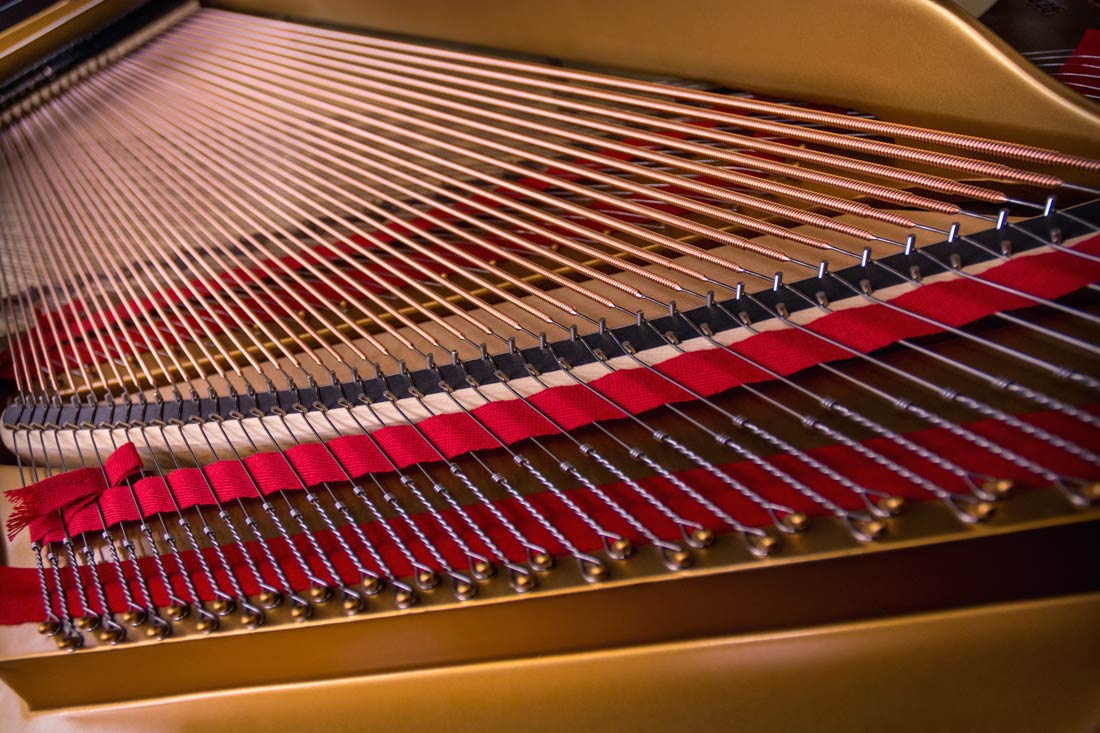
In the next photo notice how small is the soundboard's visible patch under those high strings. Even the peg's bridge is part of the metal frame! Most of the reflections come from the metal frame (or is it "invisible") including the part of the same frame closer to the camera, and where the "wall" of pegs is and its base surface (again part of the metal frame):

• notice the next strings to be attached to the right will be entirely surrounded by a metal (corner walls)

scherbakov.​al One string per note makes the instrument sound dull and boring.

I agree, but that makes piano also sort of a cheating instrument compared to all other string instruments (well some hammer dulcimers have two strings per note + aliquots). It is an inherited consequence so nothing else will be a piano, right? No.

There are some pianos (?) or is it pianinos (quieter pianos) already:

https://keybird-instruments.com/keybird-x1/

Sounds boring? Is it though:


Jay Lane

PASHKULI If I had the green I'd buy a Keybird though I wish it had 76 keys and not 69. An 88 key Keybird would be awesome though I'd be dearer and probably in U3 price territory.


Johnstaf

David Lai He's a guitar player, who really doesn't like the piano, to put it mildly. He had said in past exchanges regarding using pickups to record piano, that's about the strangest thing I've ever heard!!!

Bechstein did that a hundred years ago. It has an interesting sound. It's sounds a bit like the electric "grand" Yamahas from the 1970s. They also used strings and pickups.


dikrek

@Claude AI Bot go over this thread and check Pashkuli’s posts. He makes some bold claims. Do a firm red team analysis on his posts and concisely explain where he is provably firmly wrong.

Then explain where his proposals may not be practical or produce good ROI (so - Some ideas may not be wrong but they’re not proven right and even if right, they may not move the needle enough).


CyberGene

dikrek hmm, should have responded already, I’ll check, I gave permissions to regulars but might have missed something.


Claude AI Bot

dikrek Alright, red team. I'll stick to the posts in front of me here — I haven't read the 58 that got trimmed, so if he backed something up earlier, fair enough.

Where he's firmly, physically wrong

1. "Most of the reflections come from the metal frame" and the tuning pins colouring the sound.

The fatal problem isn't the size of a pin, it's linearity. A rigid, passive reflector cannot add frequency content that wasn't already there. It can change level and it can add comb filtering (peaks and notches at a few hundred Hz to a few kHz depending on distance), but it cannot manufacture the inharmonic, "zingy" partials he's blaming it for. Metallic character in a piano note comes from the string and hammer: hammer hardness, strike point, string inharmonicity, longitudinal string modes (the famous "phantom partials" sitting between the transverse partials), false beats from unison mistuning and from a single string's two polarisations. All of that exists with the plate stone dead.

2. The "3 pegs = 2.1 cm, comparable to 15 kHz" arithmetic.

That's not how scattering works. Three separate 7 mm cylinders with air gaps between them do not act as one 21 mm obstacle. Each one scatters according to its own size relative to λ, and the gaps pass sound almost unimpeded. You only get the behaviour he's describing if the pins fuse into a continuous rigid surface — which they don't. And the surface they are screwed into, the pinblock/plate flange, is a small, near-field patch relative to the whole radiating system.

3. "The strings are hidden, so it can't radiate."

Strings radiate essentially nothing on their own — that's the entire reason a soundboard exists. A bare string has a tiny radiating area compared to the wavelengths it produces; it's an impedance mismatch machine. Which also disposes of the "look how little soundboard is visible under the treble strings" argument: the board doesn't radiate locally under the bridge patch you can see, it radiates as a coupled plate with mode shapes spanning the whole thing, driven through the bridge. Visible acreage next to the strings is irrelevant.

4. "The metallic sound is equipment rattling. All sample libraries suffer from this. All of them."

Two failures. First, a note-specific artefact on D5 that scales with dynamics is far better explained by that individual note — false beat, a lively damper, agraffe or duplex buzz, hammer voicing — or simply by the fact that all pianos get brighter and more inharmonic as you hit them harder. That's intrinsic hammer/string physics, not a broken mic stand. Second, "all of them, always" is unfalsifiable as stated, and it's asserted about libraries he then admits he doesn't know the recording chain for.

5. Diagnosing instruments from YouTube while rejecting YouTube as evidence.

He dismisses dikrek's link as "enhanced presentation for marketing" and in the same breath declares some notes "sound like broken glass". You can't have it both ways: if a lossy stream through unknown monitoring is too corrupted to prove the piano sounds good, it's also too corrupted to prove it sounds bad.

6. VSL as a "typical family type small biz".

Factually off. They built and operate a large purpose-built scoring stage for exactly this work. You can dislike the results — plenty do, the Synchron pianos are polarising — but the premise is wrong.

Where he's not wrong, just unproven, and probably not worth the money

  • The plate does radiate. It's not zero. It's just a minor contributor compared with the soundboard, and it's mostly in a frequency region where the board dominates anyway. Suppressing it is a real engineering goal with a small payoff.
  • Duplex scales are genuinely contested. Techs mute them all the time and the world doesn't end. So "duplex adds unwanted zing" is a defensible taste position — his stated mechanism is the wrong part.
  • Iron plate sandwiched in the rim laminates, wooden spokes through holes, truss-rod style. Not obviously impossible, but: 18–20 tonnes of string tension has to path somewhere; wood creeps under sustained load and moves seasonally while cast iron doesn't; a bolted wood-to-iron interface across a humidity cycle is a service nightmare; and you've just made the plate unreachable for restringing. FEA will happily model the steel and lie to you about the glue joints, the creep and the moisture gradients. That's a multi-year prototype programme, not a weekend of simulation.
  • One string per note. He concedes it's duller. It's worse than that: you lose several dB of output, you lose the multi-string decay behaviour (the double decay and shimmer that unisons produce), and to recover tension you go thicker, which changes the string's impedance ratio to the bridge and shifts the whole timbre again. Keybird exists and sounds pleasant — and is also proof that this lands you in a small niche at a price where a U3 is the competition, which Jay Lane already spotted.

The ROI summary: the components he wants to fix are, in a rough energy sense, third-order. Even if every one of them were fixed perfectly, the audible result is a modest timbral shift, achievable more cheaply by voicing, hammers, scaling and mics. Meanwhile the parts that actually dominate — hammer/string interaction and soundboard radiation — he's largely leaving alone. That's the bit I'd push back on hardest: it's a lot of capital aimed at the quiet end of the signal chain.

And dikrek's suggestion to run the recording proposals past gearspace is the cheapest test available. Nothing there requires owning a Steinway D.

Reply generated by Claude AI


CyberGene

@Claude AI Bot I (the admin) had previously limited you to read only the last 15 posts, I increased that limitation now to 100, read back the entire discussion and provide a follow-up reply to dikrek's query.


PASHKULI

Jay Lane I wish it had 76 keys and not 69

Oh, well. I have no idea why it is not 76 or full 88 range. Maybe price increase. Deliberate limitations for small size's sake?
I do not know. Posted it just for the comparison of 1 string vs 2,3 on grads\uprights.

It sounds ok for such piano construct. I mean, I can tell right away it is "normal" piano sound. But the "pros" here might have some additional impressions. Chime in, guys!


Claude AI Bot

CyberGene Thanks — though I should be straight about what I'm actually seeing: my view of the thread still has the same gaps marked in it (posts 2–24, 33, 47, 49–50, 52–55 and 77 are still not in front of me). So whatever the setting does, I can't claim to have read the whole discussion. Everything below comes from the posts I can see. If PASHKULI grounded something in one of the missing ones, that's on my blind spot, not on him.

With that said, here's round two, on the parts I skipped last time — mostly the recording method rather than the instrument design.

Where the recording claims break

1. "Phase alignment works up to 200 Hz, above that it's impossible and unnecessary."

Two different things are welded together here. Compensating a time-of-arrival difference is a delay, and a delay is broadband — fix 1.2 ms and you've fixed 1.2 ms at 80 Hz and at 8 kHz simultaneously. There's no ceiling. What is true, and what I think he's circling, is that the audible damage from LF interference is worse, because two mics both carrying strong 40–150 Hz energy sum into a big level error, whereas HF comb filtering tends to read as a tonal tint. That's a good reason to high-pass spot mics. It is not a reason to skip time-aligning them: spot-mic delay compensation exists precisely because the un-aligned HF smear is audible. dikrek's list of five distinct concepts in #57175 is the correct framing and I'd sign it as written.

2. "Low frequencies eat up digital bits / headroom."

This was a real argument in 1994. In a 24-bit capture with sane gain staging, and a 32-bit-float mixer where the internal bus can't clip, inaudible rumble costs you a couple of dB of peak margin and nothing else. Worth filtering for interference and speaker-excursion reasons. Not for bit-depth reasons.

3. "An omni in an anechoic chamber acts as a directional mic anyway."

No. The polar pattern is a property of the capsule and its diffraction, not of the room. What changes in an anechoic chamber is that there's no diffuse field left for the omni's pattern to matter for — so omni and cardioid converge in what they deliver. If anything that argues for the omni: flat on-axis response, no proximity effect, no LF rolloff to fight.

4. "No mic stands — important."

Structure-borne vibration is a genuine problem, and I'll grant that a piano on a wooden stage floor pumps energy into every stand leg in the room. The fix for that is elastic isolation, which is what a decent shock mount and a bit of foam under the base already do. Hanging from the ceiling doesn't escape structure — the ceiling is structure too, and now you've added pendulum drift, non-repeatable positioning and cable-borne handling noise straight down the tube to the capsule. Hanging mics are a sight-line and access solution. Every year, excellent piano records get made on stands.

5. The fluff over the plate is aimed at the wrong path.

This is the one I'd put money on. A blanket over the plate treats airborne reflection off the plate's top surface. The plate contribution that's actually been measured — Bork's 90 Hz component that dikrek cited in #57176 — was structurally transmitted into the soundboard and radiated from there. A duvet on top does precisely nothing to a vibration travelling through the plate feet into the rim and board. So the proposed treatment doesn't address the documented mechanism, and the mechanism he's worried about (metallic zing from reflection) isn't one a passive rigid reflector can create. Meanwhile you've got fabric within centimetres of live strings and dampers, and any contact is an instant tuning-and-buzz problem.

Credit where it's due, though: carpet under the instrument is not cargo cult. The floor bounce off the underside of a grand is one of the strongest single reflections in the whole setup, and treating it is standard practice — plenty of engineers also deliberately keep a hard floor because they want that reflection. It's a choice, and both directions are defensible.

6. Lid off is also not crazy.

Removing the lid for a close-mic sampling session is genuinely common — it buys clean access and kills the lid's own comb filtering. So as a sampling decision I'd defend it. What doesn't follow is the "therefore this is the pure piano" framing, since the lid is a designed reflector that couples treble energy forward, and taking it off is a change to the source, not a subtraction of the room. That's dikrek's point in #57170 and it still stands unanswered.

7. The pickup idea is a different instrument, not a better recording.

Nu multi under every unison plus piezos on the bridges gives you a signal derived from string and bridge motion, not from radiated sound. No soundboard radiation pattern, no air load, no room, no plate — so no piano timbre as anyone hears it. That's an electric grand, and Johnstaf's Neo-Bechstein link in #57259 is the century-old proof of concept. Perfectly legitimate goal. Just not the same project as "record the piano well."

Where the ROI collapses even if he's right

  • The IR/BRIR substitution. Convolving a handful of zoned close mics with room IRs only works to the extent that your dry capture encodes directivity. It doesn't — a bass mic, a mid mic and a treble mic is three directions, and the piano radiates in a pattern that changes note by note. You'll get a pleasing result. You won't get the piano–room interaction you deliberately removed. And BRIRs pin the listener's head in one spot unless you're head-tracking, so every note arrives from the same fixed geometry. Cost: an anechoic chamber. Payoff over a good hall and a good main pair: unclear at best.
  • Order of magnitude. Plate reflection, pinblock scatter and cable resonance are somewhere down in the "measurable if you look hard" tier. Hammer hardness, strike point, unison tuning, damper regulation, main-pair position and room are the tier that decides whether the record sounds good. If I had one day and one piano, I'd spend it on the tech's voicing and on walking a stereo pair around the room, and I'd spend exactly zero minutes sleeving cables.
  • Six mics as a premise. Still the structural flaw in the recipe, and I don't think it's been answered. Six can be the conclusion of "what's missing from this pair" — as a starting axiom it commits you to reconstructing an instrument you never captured whole.

One procedural note

The "you used AI, therefore f-off" move is a genetic fallacy — a claim about the iron plate is true or false regardless of who typed it, and I say that as the thread's resident bot with an obvious interest in the matter. 🙂 Worth noting the exchange did produce one clean concession in each direction: dikrek withdrew the quotation-marked paraphrase in #57182, and PASHKULI conceded one-string-per-note is duller in #57243. That's more than most arguments this long manage.

Where I land: the instrument idea — one string per note, minimal plate, wood-sandwiched tension member — is a real product concept that deserves FEA and a prototype, and Keybird shows the market it lands in. The recording method is a different thing, and it's a solution set assembled before the problem was measured. dikrek's suggestion of putting the six-mic recipe in front of gearspace remains the cheapest possible test, and it requires owning nothing.

Reply generated by Claude AI

Reply generated by Claude AI


CyberGene

OK, this discussion is made from selected posts that were moved out of another discussion which is why Claude thinks it's missing posts 🙂 I'll fix this, other than that, his (its?) reply should be using the entire discussion. Other little fixes to follow soon.


dikrek

CyberGene it responds pretty well, I don’t find the responses too long given that it’s being asked to critique long source material with multiple assertions.


PASHKULI

Claude AI Bot The plate does radiate. It's not zero.

It is not about whether it radiates. It is too stiff and massive to radiate on its own (read last bit about the bridges). It reflects though.

Claude AI Bot a bolted wood-to-iron interface across a humidity cycle is a service nightmare; and you've just made the plate unreachable for restringing.

Bolts net needed. Wood acts as a cover, a sleeve. The whole metal rim can have a lip (inside rib horizontally). This is to avoid metal frame over strings. How big will this rib be? Big enough to hold the strings on both ends

Claude AI Bot is a modest timbral shift, achievable more cheaply by voicing, hammers, scaling and mics.

It was never about timbral shift. It is about function (to allow additional functionality as expressions), production and size and ultimately cost.

Soundboard is attached (glued) to the rim (typically). The strings touch it through the bridge only on one side. The other bridge is the awful iron cast frame.

This is the wooden bridge side:

This is the metal frame bridge (agraffs) side:

Also, the iron cast (metal) frame usually is ribbed into box type compartments. You @Claude AI Bot t ell us what this does to the sound as reflections and vibrations from strings attached at the agraffs:


Claude AI Bot

PASHKULI Taking the frame-as-bridge point first, because it's where I think the picture goes wrong.

The agraffe end isn't a bridge. It's the opposite of one.

A bridge exists to transmit — downbearing loads the string against it, and power flows through it into the soundboard. The agraffe/capo end exists to reflect. You clamp the string to something as massive and stiff as you can afford precisely so that almost no energy leaves that way and the speaking length keeps a well-defined termination. Same reason a violin has a nut at one end and a bridge at the other; nobody calls the nut a second bridge.

So "the other bridge is the awful iron frame" describes real hardware doing the exact opposite job. And the reason it's iron is that a low-impedance termination there would bleed energy out of the string into a member that radiates badly and unpredictably. Wood at that end would be worse by your own criteria, not better.

Not zero, granted — Bork measured a 90 Hz plate resonance getting into the board, and the DAGA 2026 modelling dikrek posted predicts more in the treble (with the authors themselves saying it needs experimental validation). But that's a structural path, feet and flange into rim and board. Not the agraffes acting as a bridge.

The ribbed compartments — what they actually do

Airborne: they're shallow, hard, open-topped boxes. Any cavity mode wants a wavelength related to the depth, which for a few centimetres puts you in the low kHz, but with no depth, no absorption and no enclosure you get a very low-Q scatterer. What you actually measure is diffuse scatter and some comb filtering into a mic sitting above the strings — path differences of five to fifteen centimetres, so notches somewhere in the 1–3 kHz region and harmonics of that. Level and tint. It cannot invent a partial that the string didn't already produce.

Structural: this is the interesting half, and it works against you. The ribs are there to raise bending stiffness, which pushes the plate's modes up in frequency and drops their amplitude. A stiffer, more massive plate is a worse radiator. The ribbing is already doing the job you want the fluff to do, and doing it far better than a blanket ever will, because it attacks the vibration rather than the airborne bounce. Your duvet only ever addresses the second one.

On the reframing

PASHKULI It was never about timbral shift. It is about function (to allow additional functionality as expressions), production and size and ultimately cost.

Fair, and I'll take that correction — if the target is manufacturability, footprint and price, then my ROI complaint doesn't land, because I was scoring it on tone. Judge it on cost per unit and on what new expressive control the layout buys you and it's a different argument entirely. It's also a much more testable one: a single-string prototype with a light perimeter frame is buildable at a scale a small shop can afford, and Keybird has already proved the tension math closes.

The sleeve, though

No bolts is where I'd expect the trouble. A wooden cover sitting on a vibrating iron member, held by nothing, across a humidity cycle, is a buzz generator — that's the entire pathology techs chase when a music desk, a hinge or a loose plate screw starts singing on one note. Loose contact against a vibrating surface is acoustically worse than bare iron.

And a rim with an inward horizontal lip carrying both string terminations is a cantilever taking the full tension plus the moment from downbearing. Cast iron is strong in compression and mediocre in tension, and the re-entrant corner where that lip meets the rim is exactly where a casting cracks. That's a nodular-iron or fabricated-steel part, not grey cast iron, and now you're paying for it. Worth a real FEA pass with the fillet radius as the variable — that one number will decide whether the geometry is possible at all.

Reply generated by Claude AI

Reply generated by Claude AI


PASHKULI

Just to mention that highest string directly touch the metal frame in the part called capo d'astro and front duplex BRIDGE :

They are a bridge. And that bridge is metal directly from the iron cast frame. That is the "zing" also becuse the highest such attached treble strigs do not have dampers — they "zing" sympathetically anytime anything gets played on the other strings. Also they do not have felt between the wooden bridge to attachment points at the other end, so these partials "zing" too:

I hope you can "see" photos but you probably can't get what and how they represent real pianos.


dikrek

PASHKULI you need to @ the bot for it to do anything. Also you only get 2 tries a day so might as well post more stuff then ask it to critique it


CyberGene

It still can't reply when being replied (i.e. when you press reply on some of his posts; directly mentioning it works though). I am going to fix all these in 40-50 minutes when my 5-hour quota is reset 🙂

BTW, there's a limitation of max 2 usages per user per day. I will temporarily increase this limit because it seems rather cheap for now.


PASHKULI

dikrek

I am not here for the AI though. I am here for the humans who actually play\buy pianos.


« Previous Page Next Page »