Queue99
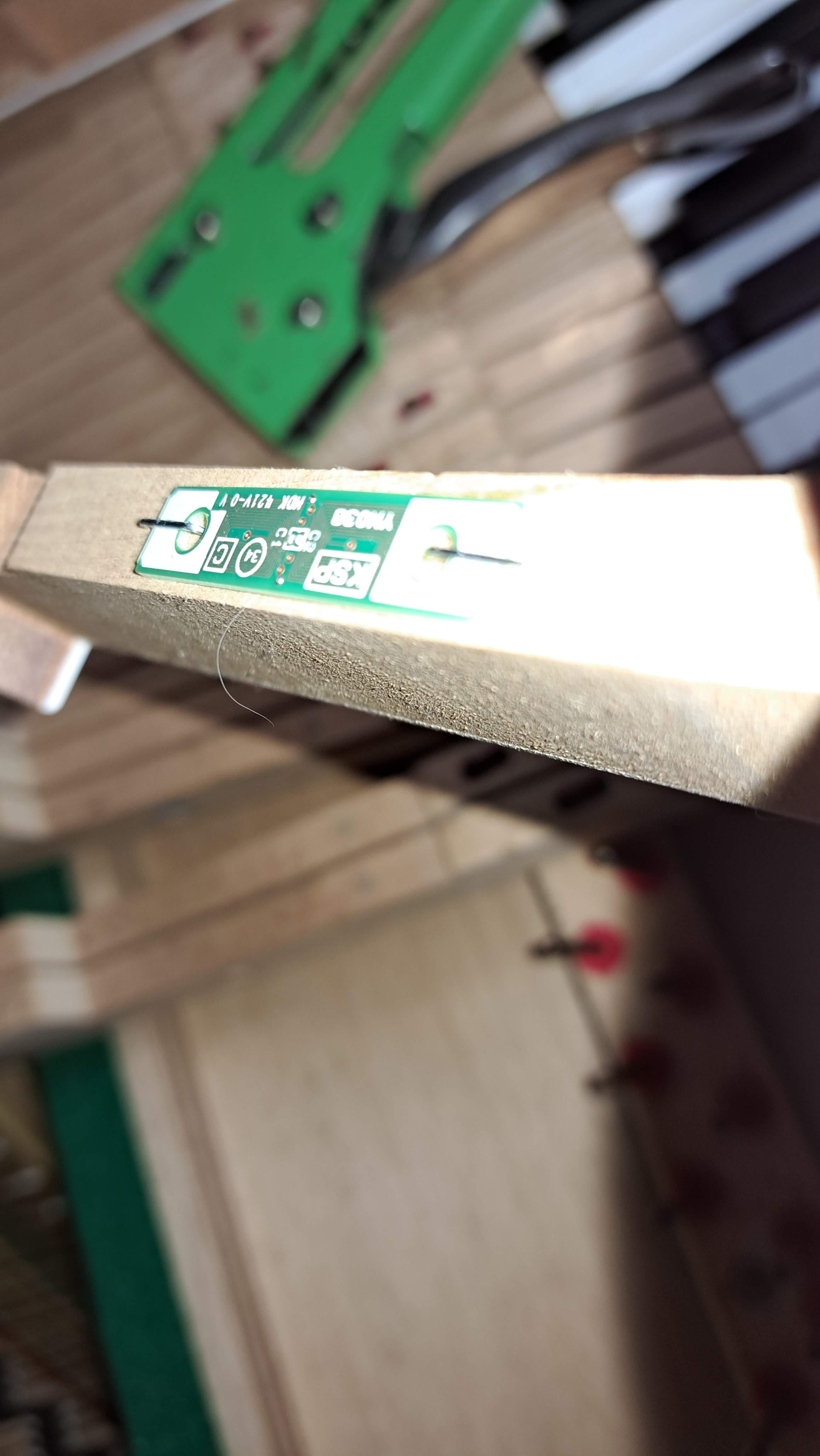
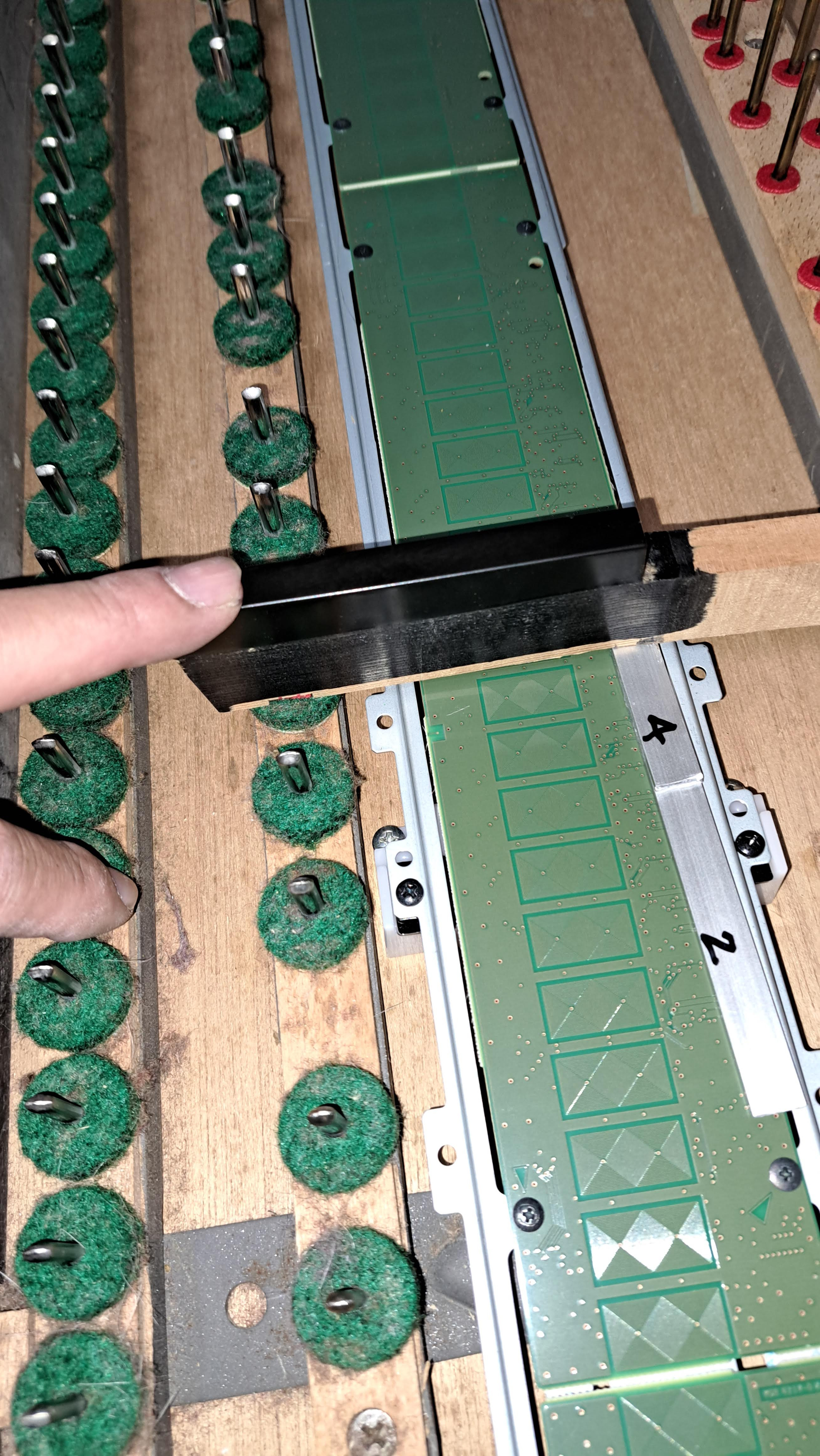
I installed the new retrofit silent unit yesterday.
The keyboard electromagnetic induction sensor is shown in the phot

I installed the new retrofit silent unit yesterday.
The keyboard electromagnetic induction sensor is shown in the phot
Layman here, but are those “magnets” stapled onto the keys?
For some reason, this “new & improved” system looks more like Yamaha cutting costs, but please correct me if I’m wrong!
So far, the only “improvement” Yamaha has claimed: ‘less prone to needing maintenance as compared to the outgoing optical sensors,’ but I know of optical-sensor GranTouch from 1998 that are still out there working perfectly, so it seems to me like the optical sensors are quite solid and built to last (decades).
Pete14 Layman here, but are those “magnets” stapled onto the keys?
They are indeed stapled. It's like the operation staples, or like putting horse shoe nails!
Hopefully highest quality rust proof 'fasteners'.
SouthPark They are indeed stapled.
In 2024, that doesn’t look very sophisticated to me.
Pete14 In 2024, that doesn’t look very sophisticated to me.
Fully agree. It's only one-short of duct taping heheheheh
SouthPark Fully agree. It's only one-short of duct taping heheheheh
Yes, and it makes me wonder if this switch (from optical to magnetic) was done in the name of cutting costs (I could be wrong).
There’s a CLP from the late nineties (I forgot the model #), and it used what I considered Yamaha’s best “digital” action. The action used solid, wooden sticks for both white & black keys that pivoted at the center (no folding), but come the “next-generation” Clavinova, and Yamaha ditched the more-complex action for a folded action, and never looked back.
Don’t get me wrong, the folded action is good, but I wonder, what if they’d stuck to that more-robust action?
There’s no question in my mind that this action “switch” (long-stick to folded) was done for cost savings…..
Pete14 It appears to be cost cutting. Or combined with exercise in … if we go down this path, then what could evolve from it in the design and engineering and materials etc area. Making us the guinea pigs!! Or maybe not all of us, such as you and me haha … as patience, and looking at enough reviews, and listening/testing etc. gets us over the line every time.
For the next P series ….. and if there are no issues reported from guinea pigs … eg. NU1XA users, then we may well get to tinker with the P-535 T (tank) range of piano, with the mag field detector devices. But no stapler please. Otherwise, it's baseball bat time in the yammy office.
With the magnetic field system, if dust or light emitter aging etc is an issue for selected cases with the optical systems, then mag can offer some benefits over the optical one. Although, at this stage, just have to wait to see if the mag system holds up well to aging, calibration etc. Or even staples coming loose etc.
Love the requisite and all-important dog/cat hair in the pic as well.
That’s the thing, the optical sensors have been proven highly reliable and low-maintenance; especially when compared to the “rubber-based,” contact-sensors used in the likes of Clavinova, slabs, etc…
Contact sensors are infamous for gathering dust; which lead to erratic behaviors, like “loud notes,” etc….sometimes as soon as a year or two into use (especially if you have a slab and don’t cover it up when not in use).
I rarely hear this to be the case with optical sensors, and perhaps that has to do with dust settling on the “key-bed,” not on the optical sensors (I assume), but certainly, optical sensors have proven reliable, durable, and low-maintenance, and the best proof is the GranTouch; still kicking ass after several decades……
The jury is out on the new magnetic sensors, but so far no one has shown us the “true” advantages over the optical, and the cynic in me + staples can’t help but think that these might not prove to be better in the long run (or perhaps even in the short run), but yes, I hope to be proven wrong.
Years ago Dave Horne (on PW) reported problems with dirt/dust/debris on the optical sensors of his N-model.
Exposed optics are always prone to such problems.
This is the first time I’ve heard of any issues with “dirt/dust/debris” affecting the “optical” sensors, and I wonder if Mr. Horne ever vacuumed his house!
Of course, dust can eventually get into anything; however, as far as Yamaha’s optical sensors go, it seems like the dust settles on the “key-bed,” but not on the optical sensors per se; that is, unless, you live in Mr. Horne’s un-vacuumed, filthy, moldy, dirty, filled-with-spiders-and-webs home!
Pete14 Contact sensors are infamous for gathering dust; which lead to erratic behaviors, like “loud notes,” etc….sometimes as soon as a year or two into use (especially if you have a slab and don’t cover it up when not in use).
I always keep her cozy when not fired up.
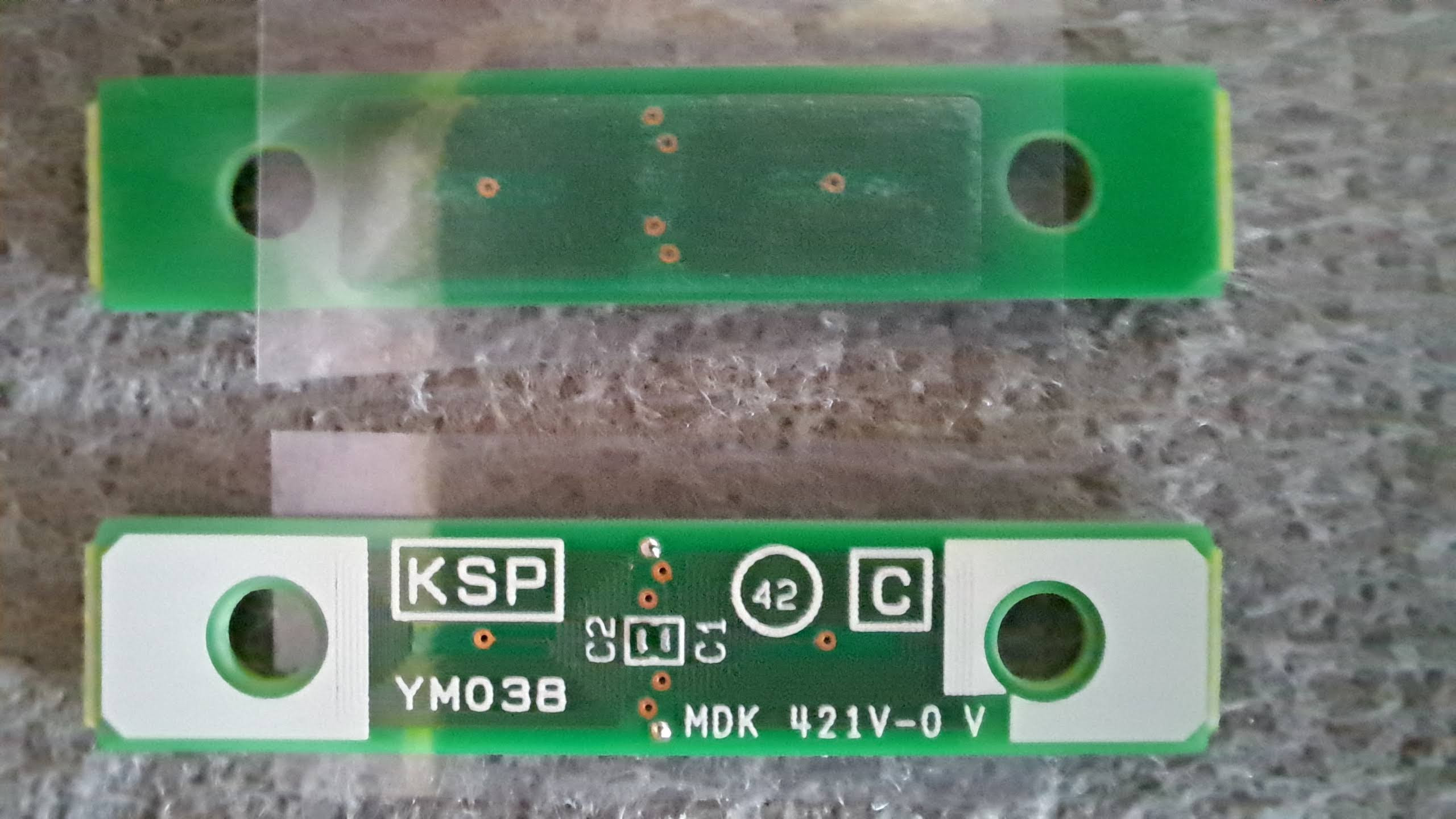
The KSP board is attached to the keyboard with double-sided tape
After that, it is fixed with a staple gun.
Calibration of the keyboard is the same method as SC3, but
Setting items differ depending on the size of the piano
Silent mechanism is the same as before.
Queue99 The KSP board is attached to the keyboard with double-sided tape
Double-sided tape & staples?
What is this, a Somalian DIY?
I’m sorry, but it all smells of heavy cost savings, so I’m sticking with the old optical!
Hi @Queue99,
Excuse me but the real and only question for me is : how did you manage to acquire and install this new Yamaha silent system ? 🤷🏻♂️
I thought it was exclusive to brand new Yamaha SH3 Silent pianos ?!
Yamaha has been selling retrofit Silent Units in Japan for over 25 years. Last year they launched the latest RSC3 retrofit Silent Unit.
They also launched the VSH3 unit to replace the existing GP/UP Silent Unit with the SH3
Okay, thank you.
I didn’t know that was possible. So I guess it’s only available in Japan and maybe only for professionals ?
Otherwise, do you have any link where it would be possible to buy this ? Thank you very much again !
I could send you a unit if you want, but it may be difficult to install without a hybrid piano technician.
Please contact me at PM for more details, but I don't know how to send and receive PM here.
Okay, thanks.
I have sent you a private message.
I guess you will be notified and just one click away from reading it…
Maybe check the bell icon in the top right corner.
Best
Hi all,
I have tested today several silent systems in a piano store. These were :
As there are barely no reviews of these systems, I post here my honest impressions.
I focus especially on the midi event accuracy (more than the sound engine) because this is the crucial pillar that can’t be worked around with tiers VST.
YAMAHA SC3 :
Incredible feeling of precision. The sound is generated exactly at the same time the hammer hits the string (you can test this, monitoring both through the headphones and acoustic). It takes into account this phenomenon where the hammer is a bit delayed on the key when playing forte. So when playing pp, the sound is generated early and, when playing fortissimo, generated while the key reach the bottom.
The repetition is top notch with no “hot notes” or unexpected sudden high velocities. If you repeat fast near the keybed, the velocity values stay quite low (as if energy transmitted from key to hammer could reach its full potential only when fully re-engaging the jack under the hammer butt - ie. lifting higher the key).
Overall, you have the feeling that the velocity is responding not only to the speed of your finger but also to the force applied. And this is always faithful to your intent. I had no way to measure the midi events to see how good the full 0-127 range was covered but I had the feeling it was good and very progressive.
Sound wise, this silent system is very good. I loved the sound of both CFX and Bösendorfer which seem to have been sampled in an equally good way. Contrary to the other silent systems, there was a prominent singing medium, which is perfect for my taste. The stereo imaging was so good that I had to remove the headphone to make sure I was not playing the acoustic. The resonance was also very good although I had no opportunity to tweak it further via the smart pianist app.
I love long sustains and measured the low C0 to sustain for approximately 15-20 sec, which is short compared to some VST but much longer than the other silent systems tested. Maybe it can be extended further in the settings accessible via the companion app…
KAWAI Anytime ATX4 :
Very good and precise, with no obvious flaws.
Compared to the Yamaha SC3, you don’t have the exact same feeling of precision however. The sound seems to be triggered at a fixed key press depth. You cannot repeat quickly like with the Yamaha without lifting the key higher. So impossible to repeat fast near the keybed. However, this behaves more like a real upright action and maybe this can be regulated further in the companion app (maybe it’s the same the other way for Yamaha, to behave less like a grand and more like an upright…). No hot notes during fast repetition. Midi velocity seems to be rendered very precisely, although maybe not as beautifully as the Yamaha system.
Sound wise, the frequency spectrum is very different from Yamaha. Where the Yamaha sound is singing with bold mediums and usable as-is for me without any tweaking, the Kawai tone is more like a full spectrum / flat response, with very present lows. Nothing critical here since I guess this could be EQed to match the Yamaha tone.
However the feeling of resonance is less present and surrounding as it is on the Yamaha system. The low C0 sustains for approximately 10-15 seconds, which is 5 sec less than Yamaha. Maybe this can be extended in settings via the companion app, I don’t know.
SCHIMMEL Twintone :
From now on, we are clearly stepping in the 2nd-tiers competitors area.
By 2000s standards, this would still be a good a precise system. But in today’s standard and compared to Kawai and Yamaha systems, there is no match.
Velocity value, as a function of key speed, starts to be noticeably inaccurate on some occurrences. Fast repeated notes can generate unexpectedly high velocity values (I would say 1 time out of somewhere between 5-10, depending on keys).
I would say this is okay in the learning phase of your music piece. But then, you would feel frustrated, not being able to render your skills or musical intentions the same way as with the acoustic counterpart.
Sound-wise, it’s okay but sub-par compared to Kawai sound (not to mention Yamaha’s). Resonances are tiny and probably basically sampled with the sustain pedal.
Low C0 sustain is very short (somewhere around 5 secondes, then fades out rapidly to totally disappear before 10 sec).
AdSilent (v1 Petrof edition) :
This seems to be the version 1 in the Petrof edition, which onboards sampled sounds from PianoTeq Ant. Petrof 275 model.
So no need here to elaborate further on the sound section as you already know what it is about (minus continuous 1-127 velocity layers, string resonances, long sustains, etc.).
Regarding midi precision, we are exactly on par with the Schimmel system. Same qualities, same flaws.
I should add that there is a new adSilent version 2 system that has been released back in November 2023. This new version has new sensors, 2x processing capabilities (so scanning rate) and a new algorithm to detect false hammer shank return (thus supposed to avoid the high unexpected velocity values, occurring mainly during fast repetitions). This should probably be a significant improvement over version 1 but I can’t imagine how it would be able compete with the Yamaha system.
Summary :
Conclusion :
I was simply blown away by the new Yamaha silent system. If you put aside the acoustic, vibrant feeling of playing a real piano, I felt there was no compromise as to play the silent system instead of the real acoustic counterpart.
For me, it was as having the best MIDI controller with a more than satisfying virtual piano sound while, at the same time, having the option to engage the acoustic piano and play alike in a seamless way.
Adding that the Yamaha action (it was “only” a B2 so, it could probably be even better on a Ux model) is super precise, I don’t see the point buying a digital piano aside an acoustic one to have the best of both worlds.
Well, that was my modest contribution to the huge desert of reviews made about silent piano systems.
I think I reported everything about my impressions but don’t hesitate if you have any interrogations and if I may help further.
Best !