Skip to content

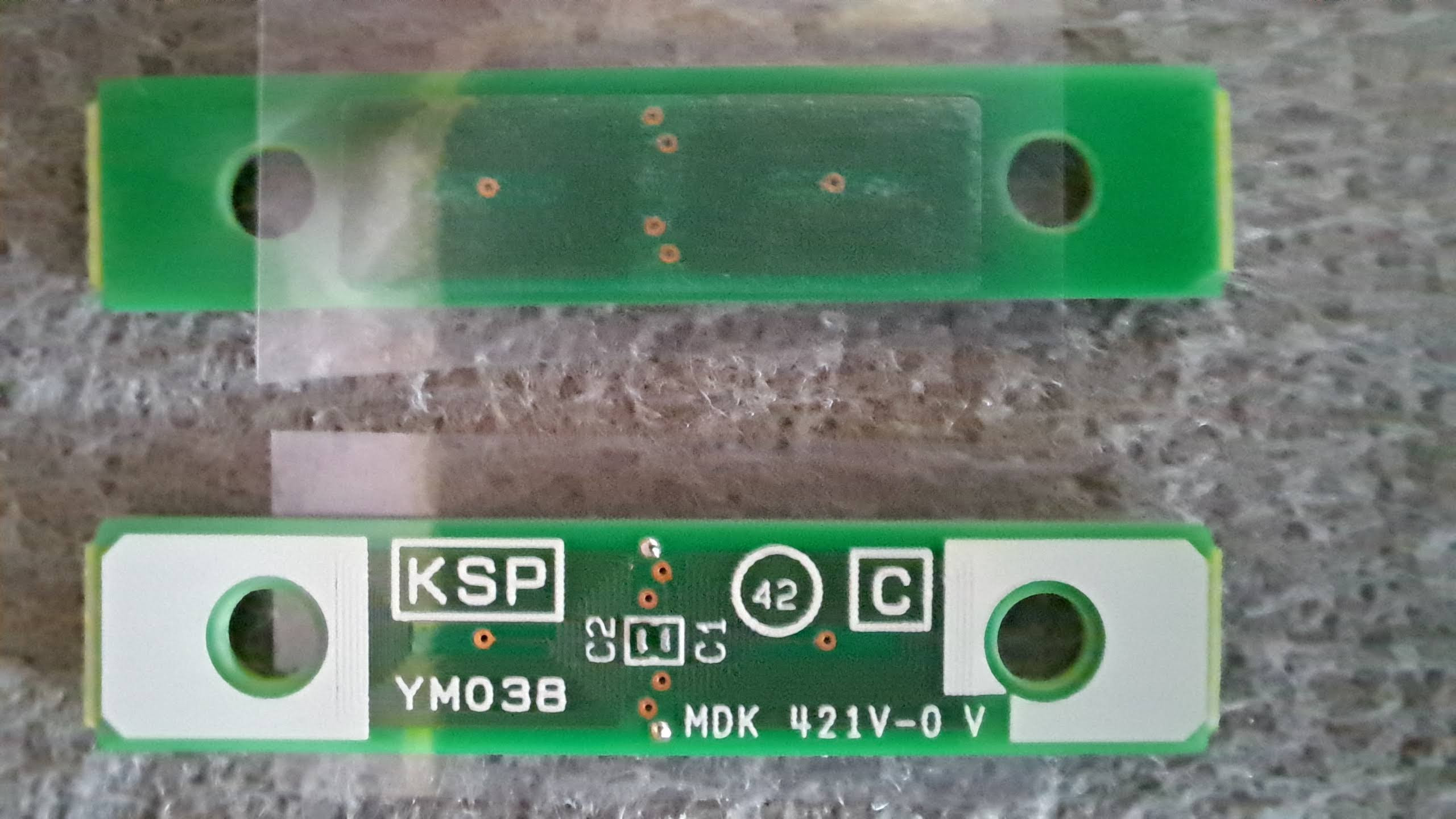
New Yamaha retrofit silent unit and grade up unit.

SouthPark

With the magnetic field system, if dust or light emitter aging etc is an issue for selected cases with the optical systems, then mag can offer some benefits over the optical one. Although, at this stage, just have to wait to see if the mag system holds up well to aging, calibration etc. Or even staples coming loose etc.

Love the requisite and all-important dog/cat hair in the pic as well.


Pete14

SouthPark

That’s the thing, the optical sensors have been proven highly reliable and low-maintenance; especially when compared to the “rubber-based,” contact-sensors used in the likes of Clavinova, slabs, etc…

Contact sensors are infamous for gathering dust; which lead to erratic behaviors, like “loud notes,” etc….sometimes as soon as a year or two into use (especially if you have a slab and don’t cover it up when not in use).

I rarely hear this to be the case with optical sensors, and perhaps that has to do with dust settling on the “key-bed,” not on the optical sensors (I assume), but certainly, optical sensors have proven reliable, durable, and low-maintenance, and the best proof is the GranTouch; still kicking ass after several decades……

The jury is out on the new magnetic sensors, but so far no one has shown us the “true” advantages over the optical, and the cynic in me + staples can’t help but think that these might not prove to be better in the long run (or perhaps even in the short run), but yes, I hope to be proven wrong.


MacMacMac

Years ago Dave Horne (on PW) reported problems with dirt/dust/debris on the optical sensors of his N-model.

Exposed optics are always prone to such problems.


Pete14

MacMacMac

This is the first time I’ve heard of any issues with “dirt/dust/debris” affecting the “optical” sensors, and I wonder if Mr. Horne ever vacuumed his house!

Of course, dust can eventually get into anything; however, as far as Yamaha’s optical sensors go, it seems like the dust settles on the “key-bed,” but not on the optical sensors per se; that is, unless, you live in Mr. Horne’s un-vacuumed, filthy, moldy, dirty, filled-with-spiders-and-webs home!


David B

Pete14 Contact sensors are infamous for gathering dust; which lead to erratic behaviors, like “loud notes,” etc….sometimes as soon as a year or two into use (especially if you have a slab and don’t cover it up when not in use).

I always keep her cozy when not fired up.


Queue99

The KSP board is attached to the keyboard with double-sided tape

After that, it is fixed with a staple gun.

Calibration of the keyboard is the same method as SC3, but

Setting items differ depending on the size of the piano

Silent mechanism is the same as before.


Pete14

Queue99 The KSP board is attached to the keyboard with double-sided tape

Double-sided tape & staples?

What is this, a Somalian DIY?

I’m sorry, but it all smells of heavy cost savings, so I’m sticking with the old optical!


Paulo164

Queue99

Hi @Queue99,

Excuse me but the real and only question for me is : how did you manage to acquire and install this new Yamaha silent system ? 🤷🏻‍♂️

I thought it was exclusive to brand new Yamaha SH3 Silent pianos ?!


Queue99

Yamaha has been selling retrofit Silent Units in Japan for over 25 years. Last year they launched the latest RSC3 retrofit Silent Unit.

 They also launched the VSH3 unit to replace the existing GP/UP Silent Unit with the SH3


Paulo164

Okay, thank you.

I didn’t know that was possible. So I guess it’s only available in Japan and maybe only for professionals ?

Otherwise, do you have any link where it would be possible to buy this ? Thank you very much again !


Queue99

Paulo164

I could send you a unit if you want, but it may be difficult to install without a hybrid piano technician.

Please contact me at PM for more details, but I don't know how to send and receive PM here.


Paulo164

Queue99

Okay, thanks.

I have sent you a private message.

I guess you will be notified and just one click away from reading it…

Maybe check the bell icon in the top right corner.

Best


Paulo164

Hi all,

I have tested today several silent systems in a piano store. These were :

  • Yamaha SC3
  • Kawai Anytime ATX4
  • Schimmel Twintone
  • adSilent (v1) Petrof edition

As there are barely no reviews of these systems, I post here my honest impressions.

I focus especially on the midi event accuracy (more than the sound engine) because this is the crucial pillar that can’t be worked around with tiers VST.

YAMAHA SC3 :

Incredible feeling of precision. The sound is generated exactly at the same time the hammer hits the string (you can test this, monitoring both through the headphones and acoustic). It takes into account this phenomenon where the hammer is a bit delayed on the key when playing forte. So when playing pp, the sound is generated early and, when playing fortissimo, generated while the key reach the bottom.

The repetition is top notch with no “hot notes” or unexpected sudden high velocities. If you repeat fast near the keybed, the velocity values stay quite low (as if energy transmitted from key to hammer could reach its full potential only when fully re-engaging the jack under the hammer butt - ie. lifting higher the key).

Overall, you have the feeling that the velocity is responding not only to the speed of your finger but also to the force applied. And this is always faithful to your intent. I had no way to measure the midi events to see how good the full 0-127 range was covered but I had the feeling it was good and very progressive.

Sound wise, this silent system is very good. I loved the sound of both CFX and Bösendorfer which seem to have been sampled in an equally good way. Contrary to the other silent systems, there was a prominent singing medium, which is perfect for my taste. The stereo imaging was so good that I had to remove the headphone to make sure I was not playing the acoustic. The resonance was also very good although I had no opportunity to tweak it further via the smart pianist app.

I love long sustains and measured the low C0 to sustain for approximately 15-20 sec, which is short compared to some VST but much longer than the other silent systems tested. Maybe it can be extended further in the settings accessible via the companion app…

KAWAI Anytime ATX4 :

Very good and precise, with no obvious flaws.

Compared to the Yamaha SC3, you don’t have the exact same feeling of precision however. The sound seems to be triggered at a fixed key press depth. You cannot repeat quickly like with the Yamaha without lifting the key higher. So impossible to repeat fast near the keybed. However, this behaves more like a real upright action and maybe this can be regulated further in the companion app (maybe it’s the same the other way for Yamaha, to behave less like a grand and more like an upright…). No hot notes during fast repetition. Midi velocity seems to be rendered very precisely, although maybe not as beautifully as the Yamaha system.

Sound wise, the frequency spectrum is very different from Yamaha. Where the Yamaha sound is singing with bold mediums and usable as-is for me without any tweaking, the Kawai tone is more like a full spectrum / flat response, with very present lows. Nothing critical here since I guess this could be EQed to match the Yamaha tone.

However the feeling of resonance is less present and surrounding as it is on the Yamaha system. The low C0 sustains for approximately 10-15 seconds, which is 5 sec less than Yamaha. Maybe this can be extended in settings via the companion app, I don’t know.

SCHIMMEL Twintone :

From now on, we are clearly stepping in the 2nd-tiers competitors area.

By 2000s standards, this would still be a good a precise system. But in today’s standard and compared to Kawai and Yamaha systems, there is no match.

Velocity value, as a function of key speed, starts to be noticeably inaccurate on some occurrences. Fast repeated notes can generate unexpectedly high velocity values (I would say 1 time out of somewhere between 5-10, depending on keys).

I would say this is okay in the learning phase of your music piece. But then, you would feel frustrated, not being able to render your skills or musical intentions the same way as with the acoustic counterpart.

Sound-wise, it’s okay but sub-par compared to Kawai sound (not to mention Yamaha’s). Resonances are tiny and probably basically sampled with the sustain pedal.

Low C0 sustain is very short (somewhere around 5 secondes, then fades out rapidly to totally disappear before 10 sec).

AdSilent (v1 Petrof edition) :

This seems to be the version 1 in the Petrof edition, which onboards sampled sounds from PianoTeq Ant. Petrof 275 model.

So no need here to elaborate further on the sound section as you already know what it is about (minus continuous 1-127 velocity layers, string resonances, long sustains, etc.).

Regarding midi precision, we are exactly on par with the Schimmel system. Same qualities, same flaws.

I should add that there is a new adSilent version 2 system that has been released back in November 2023. This new version has new sensors, 2x processing capabilities (so scanning rate) and a new algorithm to detect false hammer shank return (thus supposed to avoid the high unexpected velocity values, occurring mainly during fast repetitions). This should probably be a significant improvement over version 1 but I can’t imagine how it would be able compete with the Yamaha system.

Summary :

  • Yamaha SC3 : sensing 10/10, sound 10/10
  • Kawai ATX4 : sensing 8.5/10, sound 8/10
  • Schimmel Twintone : sensing 5/10, sound 5/10
  • AdSilent v1 : sensing 4.5/10, sound 6/10

Conclusion :

I was simply blown away by the new Yamaha silent system. If you put aside the acoustic, vibrant feeling of playing a real piano, I felt there was no compromise as to play the silent system instead of the real acoustic counterpart.

For me, it was as having the best MIDI controller with a more than satisfying virtual piano sound while, at the same time, having the option to engage the acoustic piano and play alike in a seamless way.

Adding that the Yamaha action (it was “only” a B2 so, it could probably be even better on a Ux model) is super precise, I don’t see the point buying a digital piano aside an acoustic one to have the best of both worlds.

Well, that was my modest contribution to the huge desert of reviews made about silent piano systems.

I think I reported everything about my impressions but don’t hesitate if you have any interrogations and if I may help further.

Best !


CyberGene

Paulo164 very helpful post, thanks! I will have to research the SC3. What’s the cheapest piano that has it?


Pete14

I wonder, does the SC3 use Yamaha’s new “magnetic sensors”?


Paulo164

CyberGene

Yamaha B1.

But you can also retrofit your upright with the RSC3 (I think “R” stands for “retrofit”), sold only in Japan market but that you can order and import thanks to Queue99.


Paulo164

Pete14

Yes it does. No real differences with the SH3 appart from MIDI legacy 5-PIN connector plus some additional sounds (25 vs 12). Maybe I forget other tiny marginal features…


Pete14

Thank you!

I’ve been on the fence about the new sensors, because, on the one hand, why would Yamaha even bother if not to improve on the old (optical) sensors?

But on the other hand, the cynic in me thinks this could’ve been done for costs savings; especially when I look at pictures showing double-sided tape and staples used for the new magnetic sensors.

The only claim Yamaha has made thus far is that the new sensors require less maintenance, but then the optical sensors have proven more-than-reliable; and still there are GranTouch from the 90s running fine on these sensors.

I wish they could give us more specifics in terms of what has truly been improved over the optical sensors…….


RIP

Paulo164 As there are barely no reviews of these systems, I post here my honest impressions.

Thank you very much for that! You really closed a gap!!!!

Given your generosity:

Paulo164 but don’t hesitate if you have any interrogations and if I may help further.

and Pete's wondering:

Pete14 The only claim Yamaha has made thus far is that the new sensors require less maintenance, but then the optical sensors have proven more-than-reliable; and still there are GranTouch from the 90s running fine on these sensors.

I say I have exact the same question: how this compares to (say) an N1 or similar? Have you ever had the opportunity to try one of those? If so, it would be good to know your impression and how the SC3 compares with that. I find it hard to believe that Yamaha was able to make a key-only sensing device that is better than the key+hammer sensors they had before.

Paulo164 But you can also retrofit your upright with the RSC3 (I think “R” stands for “retrofit”), sold only in Japan market but that you can order and import thanks to Queue99.

Are you considering that now? If it really performs so well, it might be an alternative to the various Cybrid options for people who would like a less challenging but still DIY alternative.


Paulo164

Okay, regarding the true intent of Yamaha behind this new technology, beyond the pure marketing move, here is what I would answer :

Maintenance :

Honestly, go to Pro-TAC website to have a look at his Google drive photos repository.

You can see the unboxing of the RSC2. There are tons of small pieces of hardware.

Every gray-scale flag needs to be glued, perfectly aligned in the center of the key. When pressing a key, this flag has to go inside another device (the sensor) without touching the sides. A bit like a slice of bread should enter the toaster without never ever touching the carter. Now, consider the lateral move a key can have when playing fast and forte an octave in the bass, applying a strong lateral force. You need to be sure the flag will not hit the sensor beneath. That gives you an idea of how precisely the flag should be glued and, with time going by and lateral move increasing, the problem of regulation that occurs. Add to this dust that can alter the reading of signal.

On the other side, the RSC3 : a flat sensor glued or stapled against the key, nearing a flat sensor in the keybed. So 2 flat pieces coming closer each other without ever the risk of damage by incidental hit. Dust ? No worry since everything is convey through the invisible electromagnetic field.

Looking at these pictures was enough for me to quickly convinced myself that this RSC2/SC2/SH2 system must induce a high level of maintenance and super qualified regulation skills.

Also : I understand now why the Yamaha silent system had to be installed in factory. Because it simply would be an economical nonsense for tiers piano technicians to offer this system as a retrofit option. It probably would take several days to install this manually at home with, at the end, a high probability of failure. No technician would ever accept to retrofit this system at a price acceptable for the customer.

This 3rd generation opens a new market for Yamaha to tiers technicians as it is not more complicated to install than any other contact-less sensors system (Genio, adSilent, etc.).

I may be proven wrong, but I bet that Yamaha will open (soon ?) to overseas markets their silent system as a standard retrofitting solution.

This sales opportunity is to big not to be grabbed…

Performances :

Below are only my technical considerations and pure hypotheses to explain why this new system could be a real leap forward.

Optical sensors are using lasers measuring the distance to a target (a reflective tape).

Knowing the position of the key, you deduct the speed of the key by calculating the time derivative.

The problem is : when you derive a signal, you amplify drastically the noise of the signal. To convinced yourself, just sample a sine wave in an Excel sheet, add small random values to it and plot the result. You will see a curve representing quite faithfully a sine function and only perceived the small noise added. Now calculate the time derivative (basically the difference between 2 consecutive samples), normalize and plot the result. What will you see ? Big spikes resulting in the derived noise.

Not a problem will you say, just apply a smoothing function. Okay but the principle of smoothing is to average the current value with past values (like a moving average). By doing so, you now introduce additional latency. This limits the potential of denoising.

Now let’s consider what electromagnetic sensors can bring to the table.

Maybe you remember of your physics lessons : when you introduce a magnet inside a conductive coil, a current is generated during the time you move the magnet. You stop moving the magnet, the current drops. By moving in and out alternatively, you create an alternative current, etc.

Conclusion : the generated current is a direct measure of the speed of the magnet inside the coil.

So the precision on speed estimation is much higher because the noise is one order of magnitude below.

In a sense, this method of measuring the speed (the move) is much more interesting for our case than the one measuring position.

Because the kinetic energy transmitted from hammer to string is related to speed by a very simple expression : 1/2mV2, this sets us much closer to what we aim at ideal velocity sensing.

To people considering building their own keyboard, I would strongly suggest to use sensors giving a direct reading of the energy transmitted from the hammer to the string : imagine a sensor placed at the location of the string and a magnet glued at the tip of the hammer ! The current generated when the magnet approches near the sensor would be an almost 1 to 1 equivalent of the kinetic energy.

I don’t know if these new Yamaha sensors are measuring speed, position or both at the same time. But there is surely here a hidden potential that optical sensors cannot achieve.


« Previous Page Next Page »