Skip to content

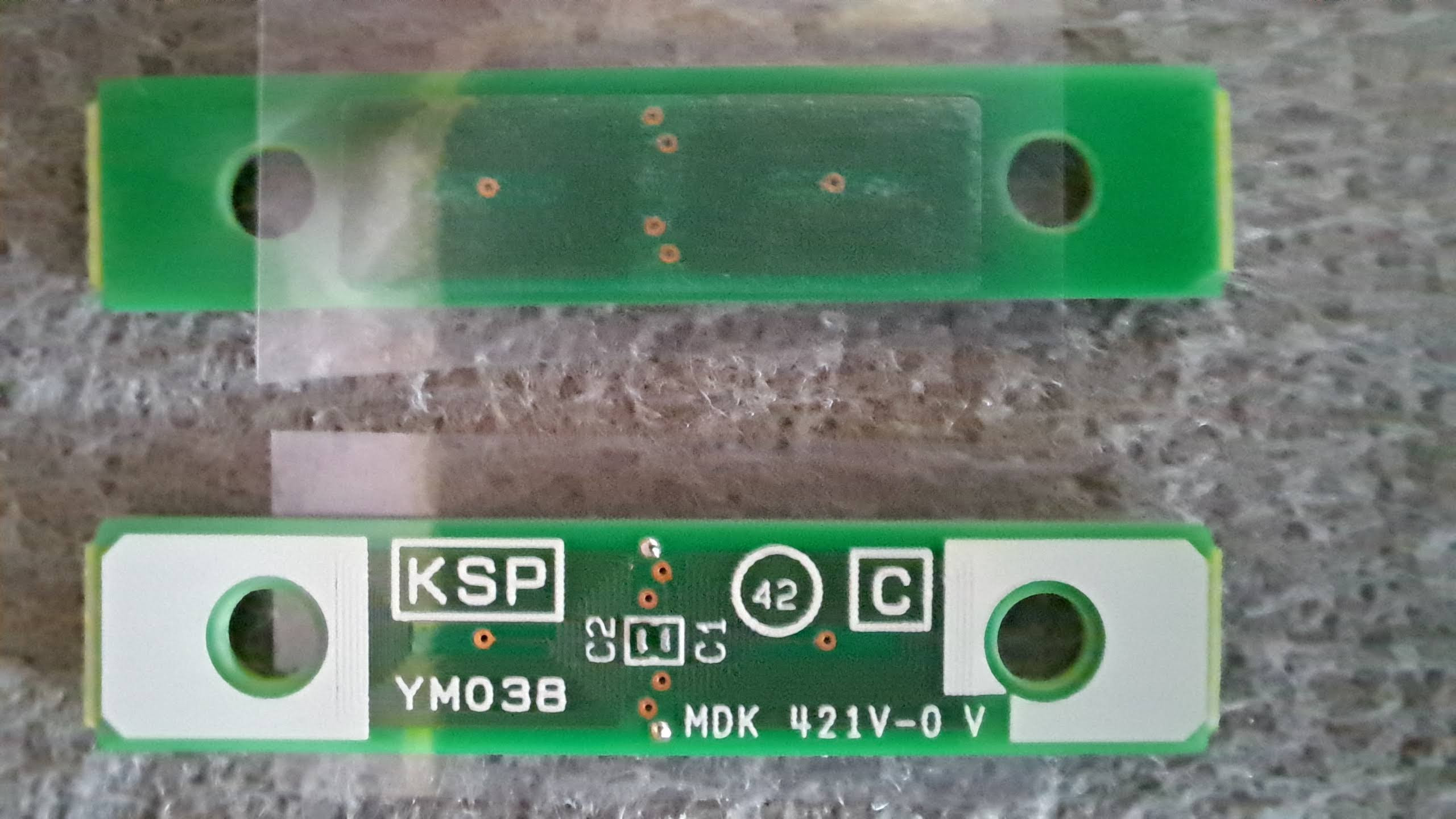
New Yamaha retrofit silent unit and grade up unit.

RIP

CyberGene I didn’t read the details. I thought it was about the new type of radio sensors under the keys which are supposedly better than the current optical gradient sensors.

I think you are correct here. That website (Google Translate) say

Through wireless communication between paired sensors, the movements of key presses and key releases on the keyboard are always accurately grasped. By installing sensors under all 88 keys so that they do not touch the keyboard, natural performance is possible without impairing the original touch of the piano.

But still I think that won't provide a huge difference (if any difference at all) on an N1? I've not seen anybody elaborating more on how/why these "wireless" (radio? perhaps something similar to RFID?) should be better compared to the LEDs. Sure, the latter eventually fade in intensity, but that could be calibrated automatically at each start-up, and they can be replaced easily when they totally die, but other than that? I doubt that RF can provide better spatial or temporal resolution, but I am just speculating without knowing anything here. Maybe @JayKominek or someone else knows better?
JayKominek

For key sensor, it says "非接触 連続検出 電磁誘導センサー" which Google translates to "Non-contact continuous detection electromagnetic induction sensor".

Probably something simpler than RFID. Based on the picture and the requirements, you put some sort of little inductive loop on the under side of the key stick, and then design the most inductive thing you can out of PCB traces, that hopefully directs the magnetic field straight up(?). Then constantly measure the inductance of whatever you built on the PCB. It'll change with distance.

You get a lot more design options when you're Yamaha and can design/fab ASICs. 😔


n-player

Google translate is hit-or-miss. So I checked with some engineering and general dictionaries and confirm the same results...in this case.

非接触
ひせっしょく
contactless

連続 検出
れんぞく けんしゅつ
continuous detection

電磁誘導
でんじゆうどう
electromagnetic induction, [inductive charge]

センサー
sensor


[deleted]

Does this upgrade have 3 sensors or only 2? The existing retrofit silent systems in uprights sometimes shoot loud notes when you repeat a key because the hammer is still in the air and there is no weight on the key when you repeat it which results in a high velocity.


RIP

[deleted] Does this upgrade have 3 sensors or only 2? The existing retrofit silent systems in uprights sometimes shoot loud notes when you repeat a key because the hammer is still in the air and there is no weight on the key when you repeat it which results in a high velocity.

This new sensor (and the previous one) should be continuous-detecting, so somewhat equivalent to infinite number of sensors. The problem you describe (which the NU1 has also) is inherent in how the upright actions work and can be eliminated completely only with hammer (or shank) sensors -- everything else is mitigation factor which will never completely eliminate it.

JayKominek Based on the picture and the requirements, you put some sort of little inductive loop on the under side of the key stick, and then design the most inductive thing you can out of PCB traces, that hopefully directs the magnetic field straight up

Okay, so just magnetic field like @aleath is doing or perhaps @xooorx ? I thought it was more sophisticated 😉


Queue99

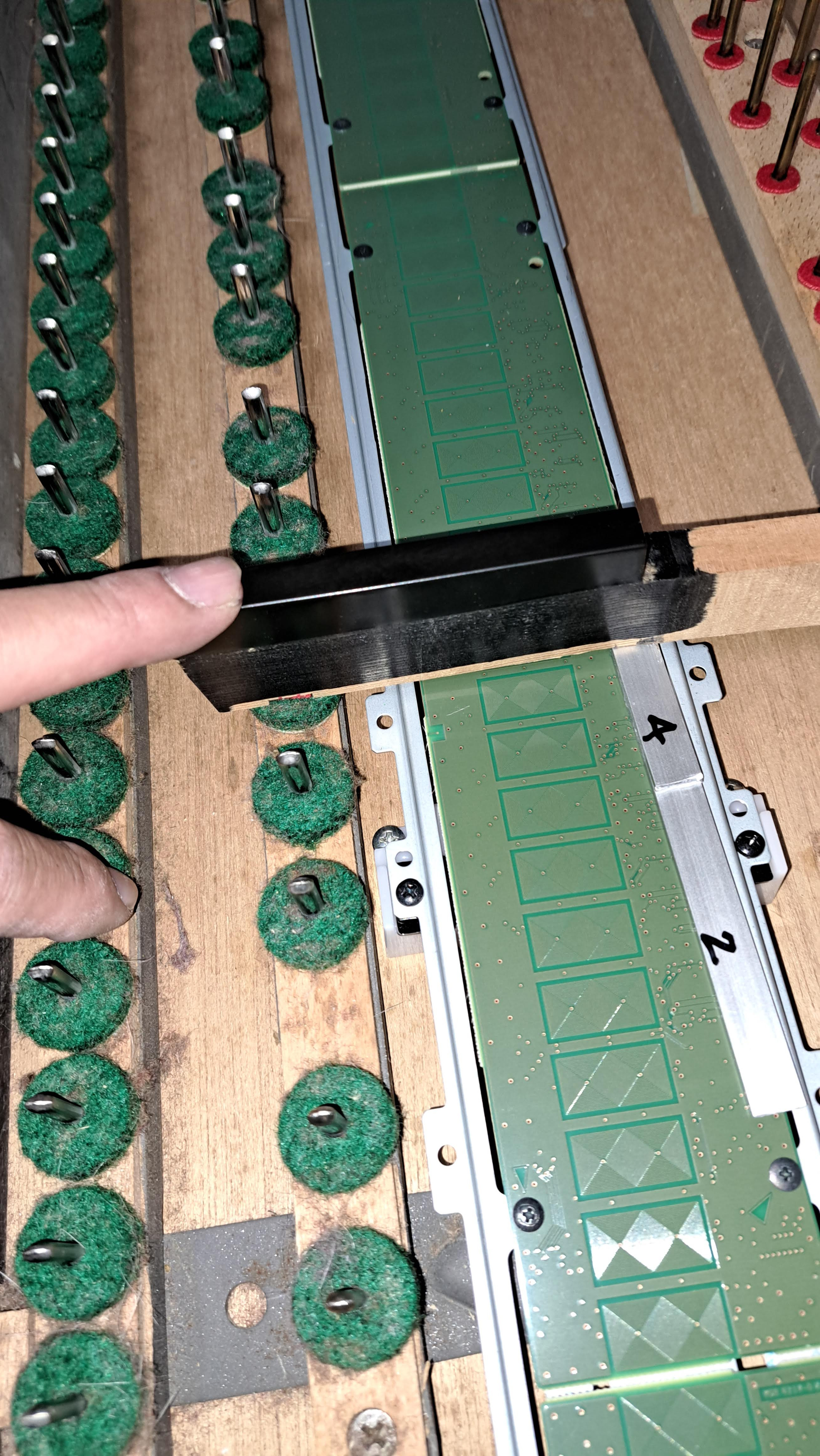
I installed the new retrofit silent unit yesterday.

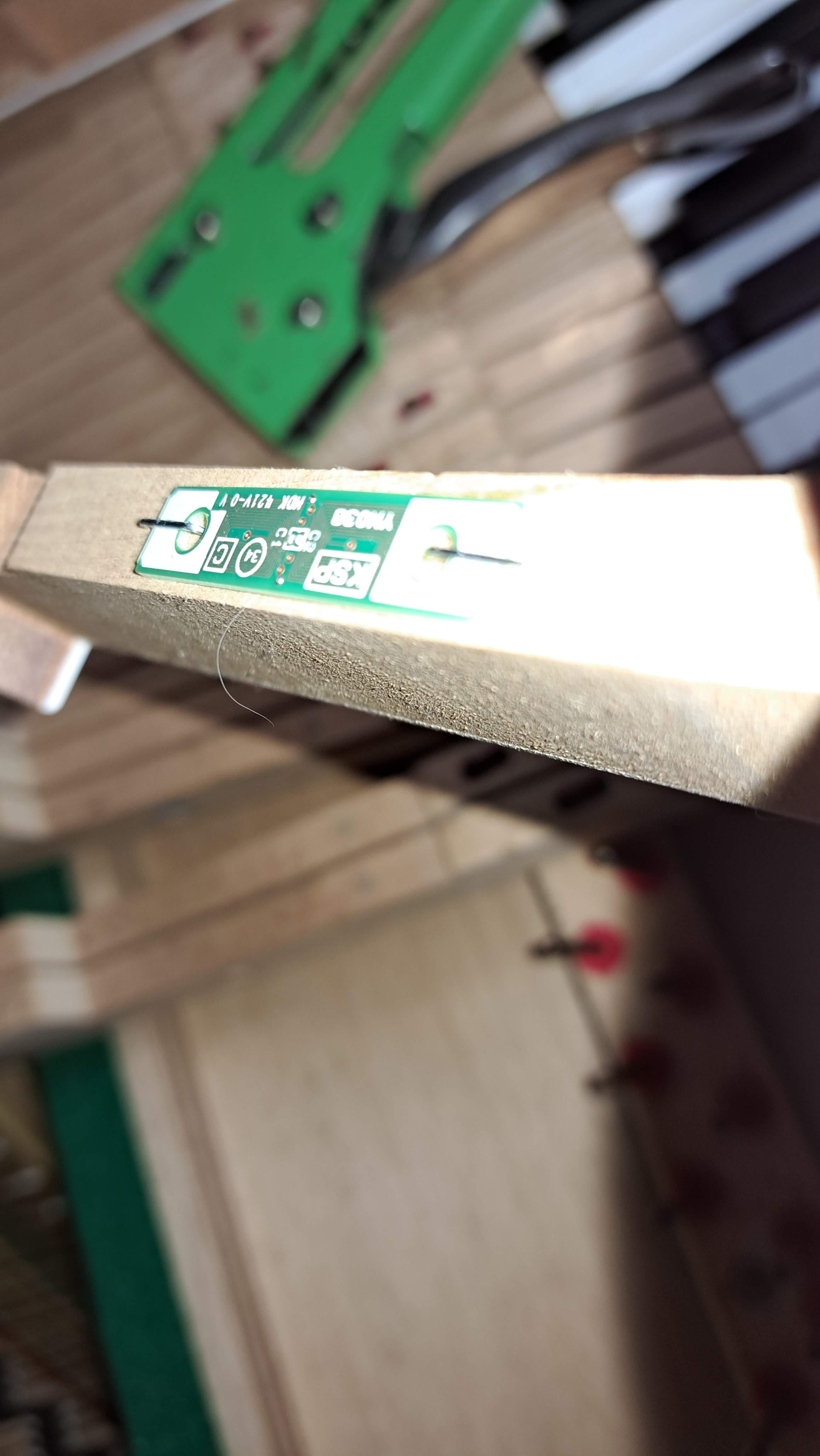
The keyboard electromagnetic induction sensor is shown in the phot


Pete14

Layman here, but are those “magnets” stapled onto the keys?

For some reason, this “new & improved” system looks more like Yamaha cutting costs, but please correct me if I’m wrong!

So far, the only “improvement” Yamaha has claimed: ‘less prone to needing maintenance as compared to the outgoing optical sensors,’ but I know of optical-sensor GranTouch from 1998 that are still out there working perfectly, so it seems to me like the optical sensors are quite solid and built to last (decades).


SouthPark

Pete14 Layman here, but are those “magnets” stapled onto the keys?

They are indeed stapled. It's like the operation staples, or like putting horse shoe nails!

Hopefully highest quality rust proof 'fasteners'.


Pete14

SouthPark They are indeed stapled.

In 2024, that doesn’t look very sophisticated to me.


SouthPark

Pete14 In 2024, that doesn’t look very sophisticated to me.

Fully agree. It's only one-short of duct taping heheheheh


Pete14

SouthPark Fully agree. It's only one-short of duct taping heheheheh

Yes, and it makes me wonder if this switch (from optical to magnetic) was done in the name of cutting costs (I could be wrong).

There’s a CLP from the late nineties (I forgot the model #), and it used what I considered Yamaha’s best “digital” action. The action used solid, wooden sticks for both white & black keys that pivoted at the center (no folding), but come the “next-generation” Clavinova, and Yamaha ditched the more-complex action for a folded action, and never looked back.

Don’t get me wrong, the folded action is good, but I wonder, what if they’d stuck to that more-robust action?

There’s no question in my mind that this action “switch” (long-stick to folded) was done for cost savings…..


SouthPark

Pete14 It appears to be cost cutting. Or combined with exercise in … if we go down this path, then what could evolve from it in the design and engineering and materials etc area. Making us the guinea pigs!! Or maybe not all of us, such as you and me haha … as patience, and looking at enough reviews, and listening/testing etc. gets us over the line every time.

For the next P series ….. and if there are no issues reported from guinea pigs … eg. NU1XA users, then we may well get to tinker with the P-535 T (tank) range of piano, with the mag field detector devices. But no stapler please. Otherwise, it's baseball bat time in the yammy office.


SouthPark

With the magnetic field system, if dust or light emitter aging etc is an issue for selected cases with the optical systems, then mag can offer some benefits over the optical one. Although, at this stage, just have to wait to see if the mag system holds up well to aging, calibration etc. Or even staples coming loose etc.

Love the requisite and all-important dog/cat hair in the pic as well.


Pete14

SouthPark

That’s the thing, the optical sensors have been proven highly reliable and low-maintenance; especially when compared to the “rubber-based,” contact-sensors used in the likes of Clavinova, slabs, etc…

Contact sensors are infamous for gathering dust; which lead to erratic behaviors, like “loud notes,” etc….sometimes as soon as a year or two into use (especially if you have a slab and don’t cover it up when not in use).

I rarely hear this to be the case with optical sensors, and perhaps that has to do with dust settling on the “key-bed,” not on the optical sensors (I assume), but certainly, optical sensors have proven reliable, durable, and low-maintenance, and the best proof is the GranTouch; still kicking ass after several decades……

The jury is out on the new magnetic sensors, but so far no one has shown us the “true” advantages over the optical, and the cynic in me + staples can’t help but think that these might not prove to be better in the long run (or perhaps even in the short run), but yes, I hope to be proven wrong.


MacMacMac

Years ago Dave Horne (on PW) reported problems with dirt/dust/debris on the optical sensors of his N-model.

Exposed optics are always prone to such problems.


Pete14

MacMacMac

This is the first time I’ve heard of any issues with “dirt/dust/debris” affecting the “optical” sensors, and I wonder if Mr. Horne ever vacuumed his house!

Of course, dust can eventually get into anything; however, as far as Yamaha’s optical sensors go, it seems like the dust settles on the “key-bed,” but not on the optical sensors per se; that is, unless, you live in Mr. Horne’s un-vacuumed, filthy, moldy, dirty, filled-with-spiders-and-webs home!


David B

Pete14 Contact sensors are infamous for gathering dust; which lead to erratic behaviors, like “loud notes,” etc….sometimes as soon as a year or two into use (especially if you have a slab and don’t cover it up when not in use).

I always keep her cozy when not fired up.


Queue99

The KSP board is attached to the keyboard with double-sided tape

After that, it is fixed with a staple gun.

Calibration of the keyboard is the same method as SC3, but

Setting items differ depending on the size of the piano

Silent mechanism is the same as before.


Pete14

Queue99 The KSP board is attached to the keyboard with double-sided tape

Double-sided tape & staples?

What is this, a Somalian DIY?

I’m sorry, but it all smells of heavy cost savings, so I’m sticking with the old optical!


Paulo164

Queue99

Hi @Queue99,

Excuse me but the real and only question for me is : how did you manage to acquire and install this new Yamaha silent system ? 🤷🏻‍♂️

I thought it was exclusive to brand new Yamaha SH3 Silent pianos ?!


Next Page »