Skip to content

piano midi controller diy

scherbakov.​al

CyberGene

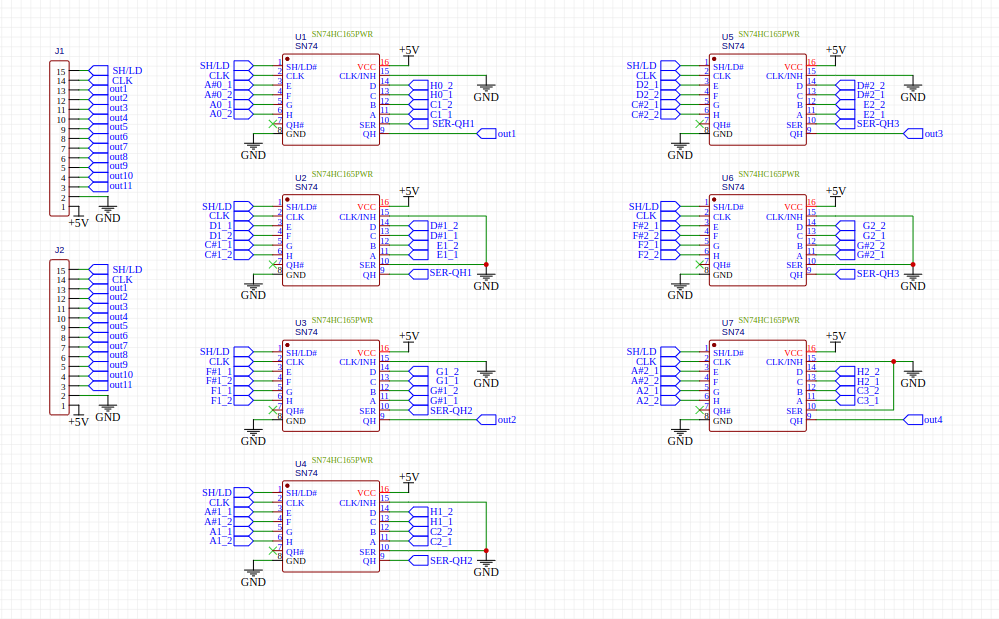
CyberGene That’s quite interesting although I’m not sure I understand it but I had to just read what shift register is, so maybe I need more time to think of it.

yes, DavisB discloses information.

CyberGene Do you use trimpots to set the comparator voltages?

I used trimming resistors to find out the required resistance value to switch the comparator at a given distance from the qre1113 sensor. This way I found out the required resistance values and subsequently used them on the boards.


scherbakov.​al

DavisB The main question I had is where does the two reference voltages come from? Are they fixed voltages same for all sensors (coming from resistors/voltage dividers?), are there trimpots (or digital trimpots), or something else entirely?

Voltages are generated by resistors with predefined values. But the question is, are the voltages the same? Ha! now I don’t know) .. this needs to be checked. I didn't think about it and didn't know. Thank you. Need to check.

DavisB What's the element with five feet in the schematic?

"five feet" I don't understand because of the translation. Please clarify.


scherbakov.​al

CyberGene

CyberGene Опять же, отличная работа! И отличная игра👏🏻

Heh.. the work is exciting, but the game.. something chattered from my student days.. I need to study more! Having practiced on this keyboard and learned pieces on it that we had to play at work, we, together with our oboist students, successfully performed at the competition. I am glad.


scherbakov.​al

SouthPark That's a good question, as an object hypothethically at the same physical distance from two different sensors of the same type/model/fabrication process etc might not output the same ballpark voltage.

I have to check this out. Voltage is supplied in the middle. Maybe the tension gradually sags a little towards the edges. Perhaps because of this, the distances at which the comparators operate are shifted. This should be checked.


SouthPark

scherbakov.​al Thanks for checking! For the photo-diodes and/or photo-transistors, if their performances etc are different in the different devices (of the same model and type etc), the output voltages could possibly be different, as in percentage differences could be significantly different. I got to order some of those devices to check out for myself later.

And in some other thread, I mentioned that I'm still on the long-haul wait (could be ages or forever) for absolute rotary optical encoders that a flat and compact enough - and haven't quite thought about physical coupling to key mechanisms yet hehe .... but the idea is to use absolute optical encoders for all or part of the tracking of key-mechanism position. Could possibly be used in conjunction with the optical velocity sensing device (based on that proximity sensing and timing measurement between two sensed pulses).


scherbakov.​al

I have not yet measured the power supply on the comparators, but I remember that there is definitely some voltage drop on the LEDs. And on the other edge of the board from the voltage input there is some voltage drop. If you look at the LEDs through a camera (to see this radiation inaccessible to the eye), it seems like they all shine the same way. But I also looked at the boards with a thermal imager and yes, the sensors on the edges of the tool get a few degrees cooler than those closer to the power input. But when I installed the boards by adjusting the distance to the hammers, I did not visually detect any noticeable difference in the distance at which the sensors were triggered. Also, when playing, we have not yet discovered any differences in the operation of the central keys compared to the outer ones.


scherbakov.​al

DavisB Функционально эквивалентные датчики QRE1113 можно приобрести оптом (200+) по цене 6-7 центов за штуку,

When I was selecting sensors, I found completely inexpensive Cny70 on aliexpress. I also had several original Cny70s. When testing “on the knees”, inexpensive sensors showed some noticeable scatter in their readings in contrast to the original ones. Also, by that time, I had found super cheap qre1113 on Ali and ordered them. A set of 300+ pieces cost about $40. But on the boards I decided to use the original qre1113, a set of which cost $200. And I even had to wait a couple of weeks until the next batch of sensors was manufactured.


scherbakov.​al

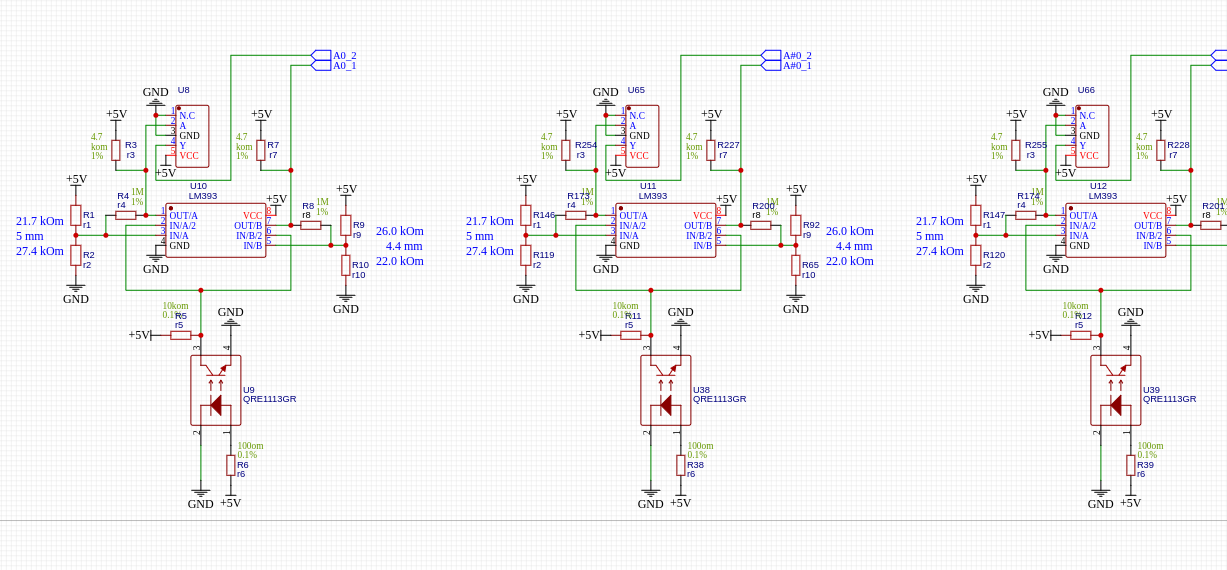
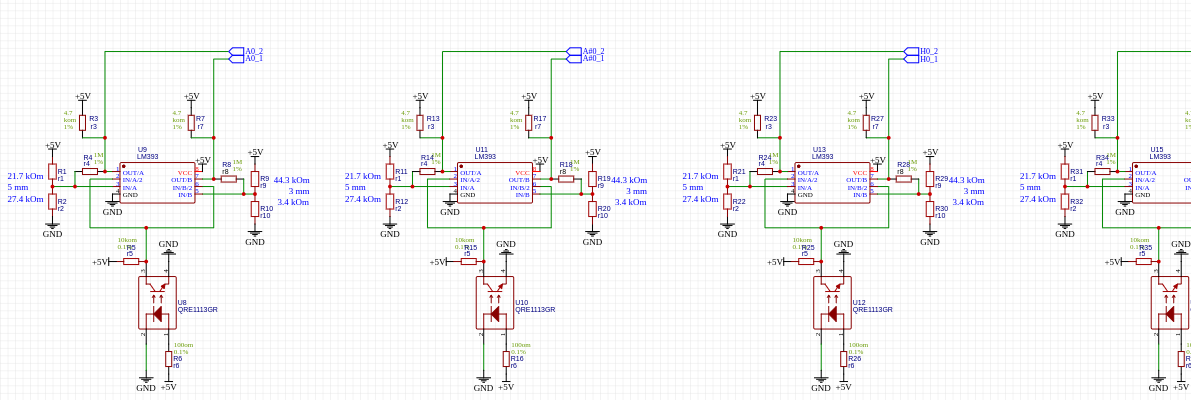
The board diagrams look like this:

For the reference voltage for the comparators and power supply for the sensors, I used resistors with an accuracy of 0.1%


scherbakov.​al

So far the current shortcomings:

The boards are heating up. Not much, but they become noticeably warm. If this is not particularly critical for the boards above the hammers, then it is not clear how the heat from the boards responsible for note-off and located between the keys and the mechanism will affect the mechanism. It takes time to test.

The stop rail for the hammers is made of an aluminum profile on which I cast polyurethane strips. And this rail turned out to be very loud when the hammers hit it. And I have already received dissatisfied feedback from my neighbors.

https://youtu.be/Du5AhiOGDJg

For now, the idea is to make the stop rail out of wood and perhaps choose another rubber-like material + body.

If the sensors above the hammers perform well and, in principle, their work suits me, then the sensors located above the keys (for note-off) require improvement. It is necessary to come up with some adjustment of the distances from the keys to the sensors. So far, the response points of the “dampers” are very uneven.

And while there is some bug, most likely in the code, sometimes the dampers do not work and some keys remain sounding (pressing it again clears this). Analysis required.

DavisB

scherbakov.​al

Thank you very much for taking the time to answer the questions regarding your design!

The five-feet, five-leg, five-pin element I was talking about was the red one. (hopefully the translation engine will pick up atleast one of the terms)

It's good to know in general that if you use tight-tolerance parts, that design with fixed resistor values can work quite well.


SouthPark

For the optical sensors --- if a particular diode shines a bit different to another one (from eg. neighbouring sensor device), and if the photo transistor of one device has different performance than another, then the voltages of the various different devices can/will be different. This probably where a testing jig or something might come in handy - with a computer controller striker that strikes at the same velocity, in order to tweak the second comparator reference voltage for purposes of getting roughly the same duration between the 'timing pulses'.

And the second comparator reference voltage for each sensor system would probably need to be recorded, in order to know the characteristics of each sensor device used. And then after that, the assumption would be that the characteristics for that particular device remain the same - which it might not remain the same - depending on age and/or other operating conditions.


scherbakov.​al

DavisB The five-feet, five-leg, five-pin element

five-leg..yes) This is an inverter added to boards that monitor note-off events.


CyberGene

scherbakov.​al This is an inverter added to boards that monitor note-off events.

That's clever, however this means that you basically have the equivalent of two-sensor action: you measure the velocity between the two points, and you generate a key-off event when the hammer is below the first point which means that you have to position that point to be halfway through the hammer travel, but then it won't allow for you to replay the keys without releasing beyond that point? A solution would be to set the first trigger point to be high enough (close to the second one) but then it will generate key-off on release way too easy?


scherbakov.​al

Unfortunately, there is no measurement of the shutdown speed yet. Damn it! Now I think what prevented me from coming up with the idea of installing boards to turn off notes on the other side of the key lever and use the same circuit as when turning on notes? And without an inverter. And with speed scanning. I don't understand.

..I think I’m starting to guess why the dampers sometimes don’t work..


scherbakov.​al

CyberGene when the hammer is below the first point

Release events are released from the key, not the hammer. Passing one point when pressed says something like “hey, follow me”, and the second when released “we trigger”.


CyberGene

scherbakov.​al there's always place for improvement. And it can be fun 🙂 Let me not start about how my project is really amateurish in most parts of it 🤦🏻‍♂️I'm glad I was able to finish it while I had a newborn. I can't find time for anything nowadays...


scherbakov.​al

CyberGene Heh, mine doesn’t shine with professionalism either) What I learned, I applied..

And all this most likely became possible due to the current absence of a woman. Which would either eat my brain out with the phrases “why are you sitting there, tinkering with your little details, go earn money” or I wouldn’t get out of bed for days because of which I’d have problems at work (well, at least I’ve come across such ones before, but somewhere there are some good ones too). And while your child is growing up, your ideas are maturing, maturing, waiting in the wings and will be realized!


CyberGene

scherbakov.​al And all this most likely became possible due to the current absence of a woman. Which would either eat my brain out with the phrases “why are you sitting there, tinkering with your little details, go earn money”

My wife kept mocking the keyboard and calling it "клавесин" (harpsichord in Bulgarian/Russian) just because she hated it since the entire project was in our bedroom for two years. Well, I am not blaming her 🤣


CrisOliveira

scherbakov.​al Hey, I've been watching your videos on youtube. I saw you implemented damper position sensing. How do you map that on MIDI? If you addressed that on the videos, sorry I missed that.


scherbakov.​al

CrisOliveira

Damper events are read from the keys using the same boards as above the hammers. Only the resistor values ​​were changed and an inverter was added. While the note-off event is sent at the preset midi speed.


« Previous Page Next Page »