scherbakov.al
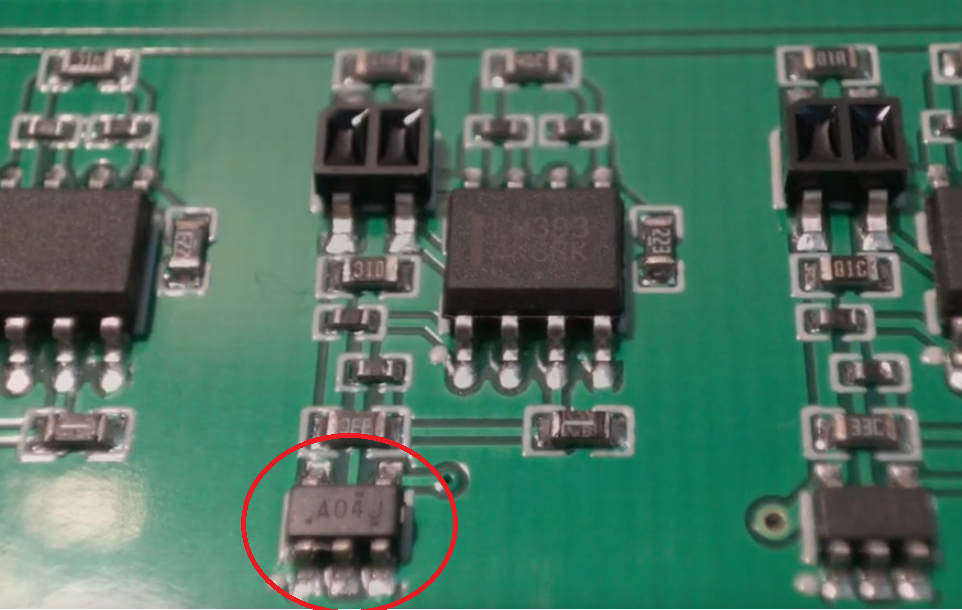
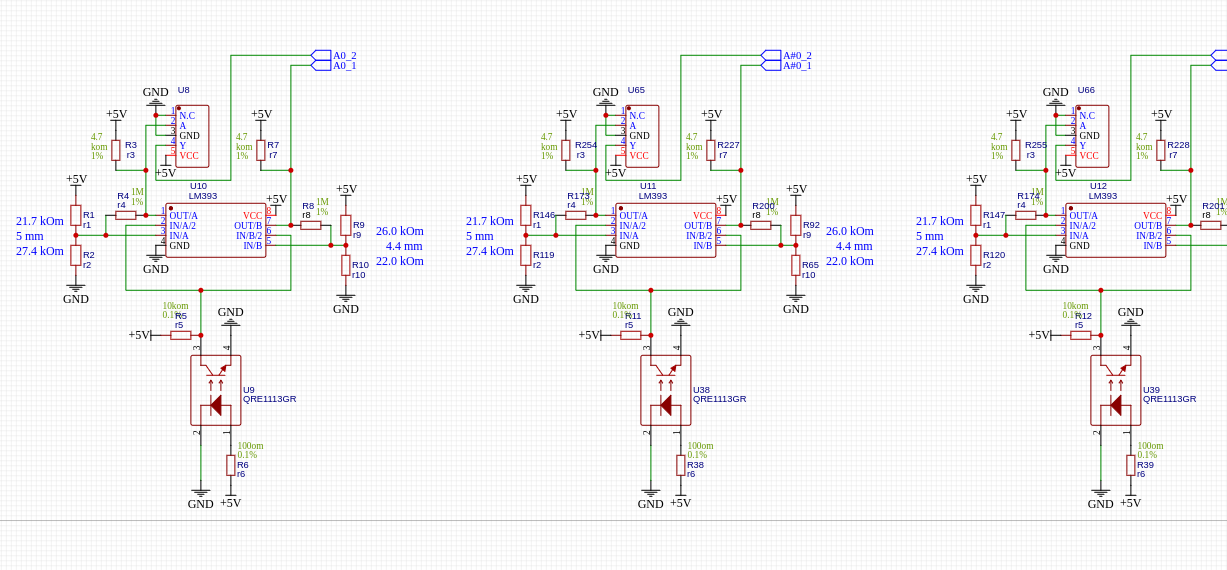
The board diagrams look like this:
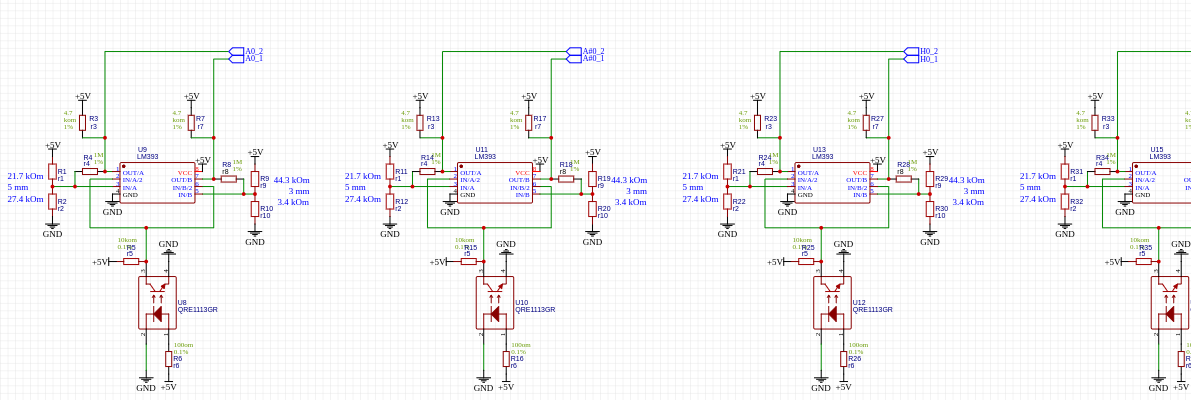
For the reference voltage for the comparators and power supply for the sensors, I used resistors with an accuracy of 0.1%

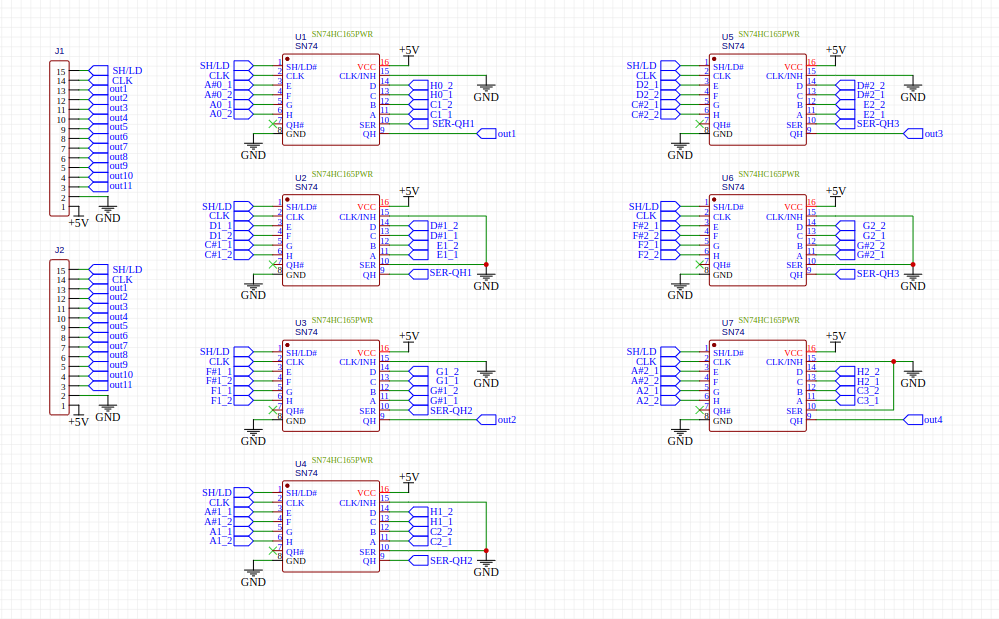
The board diagrams look like this:
For the reference voltage for the comparators and power supply for the sensors, I used resistors with an accuracy of 0.1%
So far the current shortcomings:
The boards are heating up. Not much, but they become noticeably warm. If this is not particularly critical for the boards above the hammers, then it is not clear how the heat from the boards responsible for note-off and located between the keys and the mechanism will affect the mechanism. It takes time to test.
The stop rail for the hammers is made of an aluminum profile on which I cast polyurethane strips. And this rail turned out to be very loud when the hammers hit it. And I have already received dissatisfied feedback from my neighbors.
For now, the idea is to make the stop rail out of wood and perhaps choose another rubber-like material + body.
If the sensors above the hammers perform well and, in principle, their work suits me, then the sensors located above the keys (for note-off) require improvement. It is necessary to come up with some adjustment of the distances from the keys to the sensors. So far, the response points of the “dampers” are very uneven.
And while there is some bug, most likely in the code, sometimes the dampers do not work and some keys remain sounding (pressing it again clears this). Analysis required.
Thank you very much for taking the time to answer the questions regarding your design!
The five-feet, five-leg, five-pin element I was talking about was the red one. (hopefully the translation engine will pick up atleast one of the terms)
It's good to know in general that if you use tight-tolerance parts, that design with fixed resistor values can work quite well.
For the optical sensors --- if a particular diode shines a bit different to another one (from eg. neighbouring sensor device), and if the photo transistor of one device has different performance than another, then the voltages of the various different devices can/will be different. This probably where a testing jig or something might come in handy - with a computer controller striker that strikes at the same velocity, in order to tweak the second comparator reference voltage for purposes of getting roughly the same duration between the 'timing pulses'.
And the second comparator reference voltage for each sensor system would probably need to be recorded, in order to know the characteristics of each sensor device used. And then after that, the assumption would be that the characteristics for that particular device remain the same - which it might not remain the same - depending on age and/or other operating conditions.
DavisB The five-feet, five-leg, five-pin element
five-leg..yes) This is an inverter added to boards that monitor note-off events.
scherbakov.al This is an inverter added to boards that monitor note-off events.
That's clever, however this means that you basically have the equivalent of two-sensor action: you measure the velocity between the two points, and you generate a key-off event when the hammer is below the first point which means that you have to position that point to be halfway through the hammer travel, but then it won't allow for you to replay the keys without releasing beyond that point? A solution would be to set the first trigger point to be high enough (close to the second one) but then it will generate key-off on release way too easy?
Unfortunately, there is no measurement of the shutdown speed yet. Damn it! Now I think what prevented me from coming up with the idea of installing boards to turn off notes on the other side of the key lever and use the same circuit as when turning on notes? And without an inverter. And with speed scanning. I don't understand.
..I think I’m starting to guess why the dampers sometimes don’t work..
CyberGene when the hammer is below the first point
Release events are released from the key, not the hammer. Passing one point when pressed says something like “hey, follow me”, and the second when released “we trigger”.
scherbakov.al there's always place for improvement. And it can be fun 🙂 Let me not start about how my project is really amateurish in most parts of it 🤦🏻♂️I'm glad I was able to finish it while I had a newborn. I can't find time for anything nowadays...
CyberGene Heh, mine doesn’t shine with professionalism either) What I learned, I applied..
And all this most likely became possible due to the current absence of a woman. Which would either eat my brain out with the phrases “why are you sitting there, tinkering with your little details, go earn money” or I wouldn’t get out of bed for days because of which I’d have problems at work (well, at least I’ve come across such ones before, but somewhere there are some good ones too). And while your child is growing up, your ideas are maturing, maturing, waiting in the wings and will be realized!
scherbakov.al And all this most likely became possible due to the current absence of a woman. Which would either eat my brain out with the phrases “why are you sitting there, tinkering with your little details, go earn money”
My wife kept mocking the keyboard and calling it "клавесин" (harpsichord in Bulgarian/Russian) just because she hated it since the entire project was in our bedroom for two years. Well, I am not blaming her 🤣
scherbakov.al Hey, I've been watching your videos on youtube. I saw you implemented damper position sensing. How do you map that on MIDI? If you addressed that on the videos, sorry I missed that.
Damper events are read from the keys using the same boards as above the hammers. Only the resistor values were changed and an inverter was added. While the note-off event is sent at the preset midi speed.
CrisOliveira How do you map that on MIDI?
You might want to watch the ones from @gzpiano too. He addresses that question
scherbakov.al A certain stage has been passed and the keyboard starts playing. There are still problems and bugs, but overall I am happy with this device!
Whoa! Fantastic progress, thanks for sharing. Do you know what piano that action came from? There are some intriguing things that I would like to learn about it.
RIP There are some intriguing things that I would like to learn about it
Like, why it has waterfall keys? 😀
RIP Oh, I thought he was Greg! :-P Gonna check his project too.
RIP Do you know what piano that action came from?
This is a keyboard mechanism from a Red October grand piano. He was missing a lot of pieces and hammers. A year ago I managed to find and purchase another keyboard (slightly broken) from a similar instrument and I thought that they could be interchangeable. I made a mistake. It turned out that the places where the figures were installed had grooves of different sizes. The screws from one tool had metric threads, while the other had inch threads. The fastening of the mechanical parts had different holes in different, non-interchangeable places. The hammers are slightly different sizes. The drums on the hammers are located at different distances from the axes of rotation. This blew my mind, but nevertheless I managed to assemble Frankenshain). Reassembling and adjusting the mechanism took almost the entire fall. This keyboard does not shine with its capabilities. Due to the lack of hammers and mechanisms in the instrument, three upper notes and two lower ones do not work. Still, I'm glad I have it. And now there is an opportunity to look at the sheet music at home that needs to be played at work.
scherbakov.al This is a keyboard mechanism from a Red October grand piano.
That’s interesting. For the last few days Valentina Lisitsa has been teasing about a mysterious grand piano she obtained recently and it appears to be a Red October grand. From the comments she made, there’s a speculation that it’s the grand piano Horowitz played when he recorded a recital at the Moscow Conservatory in 1986. I even read about Red October and its history because I heard the name for the first time. Seems it’s the legacy of a German piano builder who settled in Russia and made some fine pianos.
scherbakov.al This blew my mind,
Yeah, that's pretty common. Before embarking into this project myself, I too thought the pianos actions were all interchangeable. They are not! Even from the same manufacturer, even from the exact same model, there are some adjustments that are not drop-in interchangeable but needs adjustment. Yamaha is an exception, they have very tight tolerance in their process that you can almost replace the whole action from one piano to another (of the same model!!) with very minimal adjustment.
but nevertheless I managed to assemble Frankenshain)
Alright, that explains some of the things that I saw. Congratulations of making it work, that's not an easy feat!
scherbakov.al This is a keyboard mechanism from a Red October grand piano.
CyberGene Like, why it has waterfall keys?
Still I have never seen a piano with waterfall keytops and even a google search for images of R.O. pianos did not turn anything like that. Quite interesting....
CyberGene For the last few days Valentina Lisitsa has been teasing about a mysterious grand piano she obtained recently
I saw that but I have not watched the videos just yet...