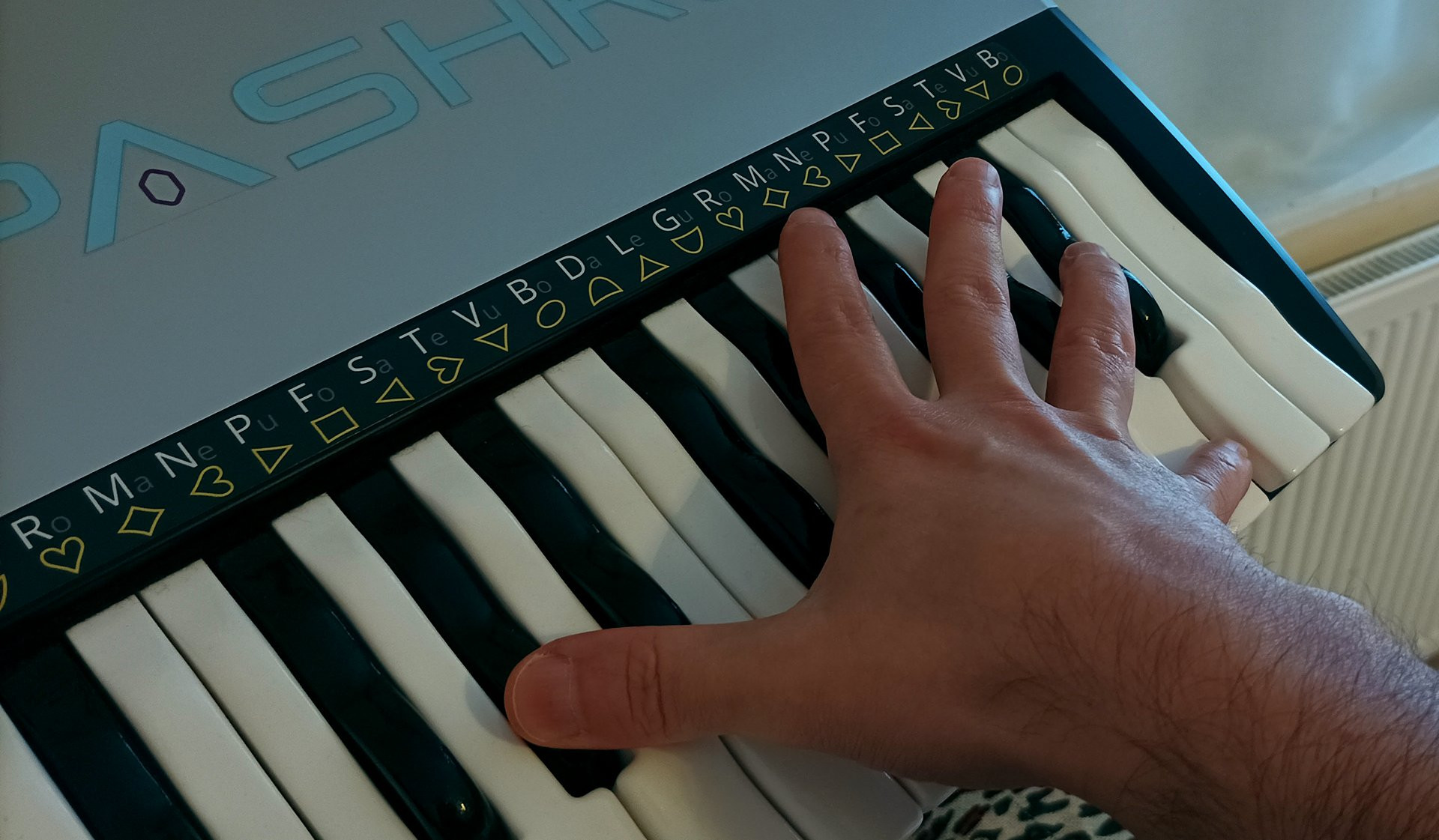
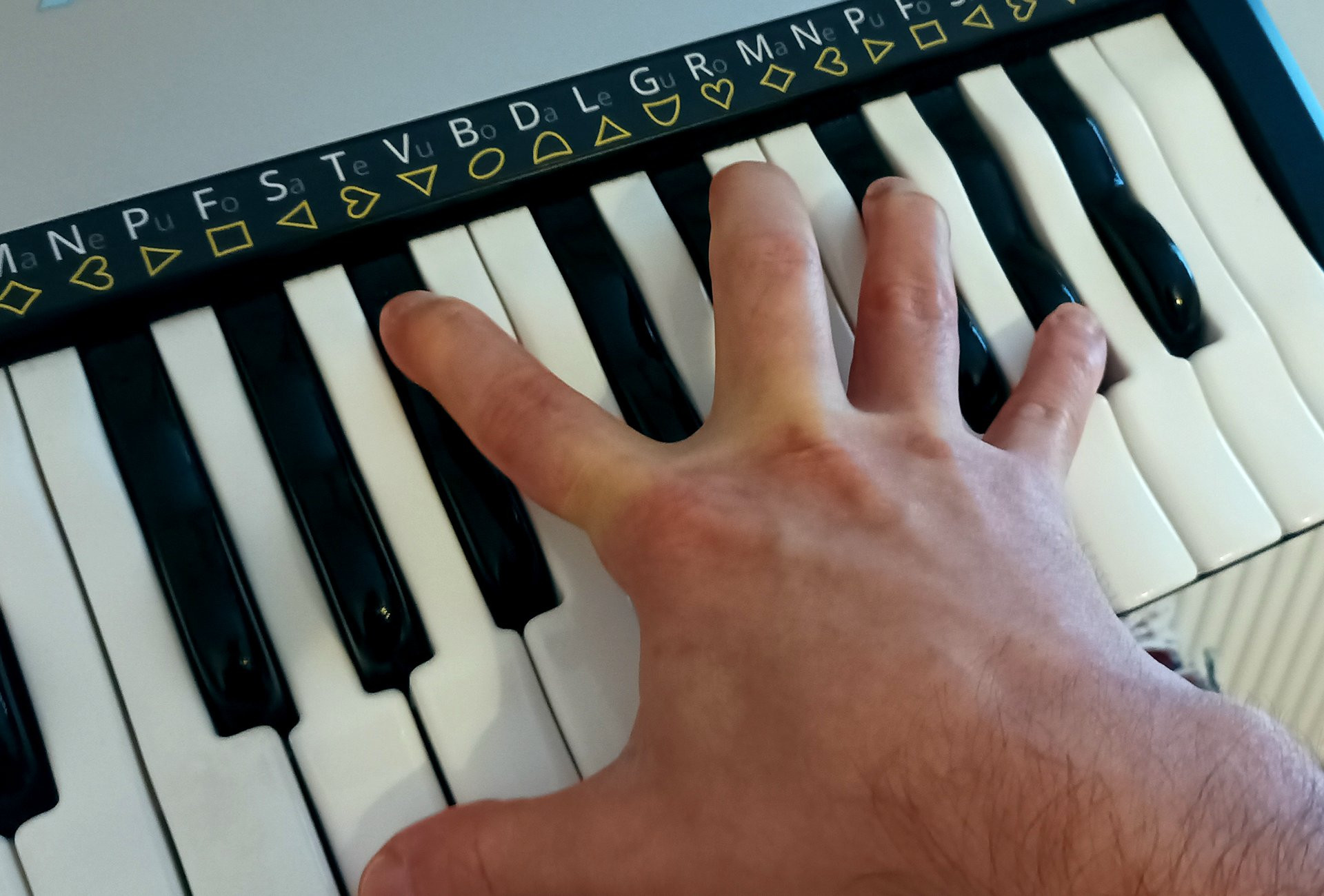
Pete14 What about people with bigger hands, can’t they get a “bigger key size”?
Yes. The DS7.
Pete14 And while we’re at it, what about people with six fingers (per hand), what about them, do we just leave them hanging in the dark?
I always searched for one of them and see if they could play better chords. Unfortunately more recently they chop off the supernumerary fingers at birth (rather than celebrating it as the ancient native Americans did)
Pete14 I also think it unfair that none of you has ever shown any consideration for people with no hands/arms at all (how dare you), and why can’t we build a keyboard that’s better suited for their toes?
An intern of mine could play trumpet and solve the Rubik cube at the same time. But he did have hands. Many people can solve the cube with their toes. Yes, they deserve an ergonomic keyboard too (not just a pedalboard where they can play at most two notes at the time).
Pete14 I almost forgot, the people with neither hands/arms, nor legs/toes, don’t they matter? surely, we could accommodate a keyboard that allows them to play with their butts, but no, we simply push them aside, too!
They're working on brain implants for that (and with greater success than I thought I could see in my lifetime already!), but meanwhile everybody should do mental practice and see how the regular keyboard is great for that.
Yes we are indeed 🙁
Not strictly trolling, but talking past each other for sure.
PASHKULI You are mentioning 'symmetry'. This is a really interesting topic and I have not finished my third video
Sorry for the offence, but I point at the moon and you look at my finger.
Think of playing something in F# minor (a beautiful key signature, both in the score, on the keyboard and in the sound, especially in non-equal temperament). Playing it on your keyboard is pretty much impossible unless one either plays at the edge and avoid going "back" in the keys (which is bad), or play something extremely simple, or just rely on muscle memory alone (which is the worse of all).
Your obsession with the spaces being equal is misplaced. Human beings are mammals and they thrive in irregular patterns. Heck, even pitch and rhythm itself can be irregular and the irregular ones are more interesting and easier to remember. Recent research on dementia place people in irregular environments with non-flat floors and lots of obstacle. But I digress….
Back to the F# minor example, playing that on a (even irregularly spaced) keyboard, with traditional "sticking out" black keys in groups of 3 or 2 is wonderful. Playing it on your keyboard would be a nightmare for the lack of reference in the back of the key. I can't comment on the curvature because I haven't tried it, but I suspect that would be a "neutral" thing (neither better nor worse). But I can comment on the keys being all identical in the back because you are removing the very soul of playing the piano at intermediate and advanced level. If you don't understand that, you are simply too much of a beginner. As others have said, you might get a use for such a keyboard in very limited settings, e.g. for doing chromatic glissandos, but those are just minor things which musically have almost irrelevant importance. I can't think of any major thing that intermediate or advanced players want to do on a piano keyboard that would be easier/better/possible on yours compared to the normal one. And you have not mentioned one either.
PASHKULI they are costructed to fit the dexterity of left-handed players!!!
🤣 -- As others have already pointed out to you, that is not true all. And by the way there are "mirror" pianos that are made switching the bass and treble. However you did get an intuition for a problem of piano which is greatly studied: namely that the more dexterous fingers (thumb, index and middle) are towards the middle of the instrument rather than the outside. Many pages have been written on the topic, and I think it's irrelevant to the conversation here, so I'll just mention one thing: semi-jokingly some teachers recommend to play with the left and right hands crossed, so the more dexterous fingers point outside (in this situation a "mirror" piano would be useful for right-handed people, so they can play the melody with their right). Obviously that's close to trivial to do with digital instruments.
I'm out of here, the thread is not anymore interesting to me