Skip to content

Pianos (keys) are badly designed!

Johnstaf

PASHKULI Your hands are symmetric! Most people are right-handed! On a piano fingers of each hand do not oppose, rther they play on one side of the layout of notes.
Therefore, piano disregards the natural symmetry of fingers from each hand! And it forces you to use your left-hand where the heavier\bass notes are on the weak fingers (pinky and ring). And after all that analysis it is evident piano is more suitable to left-handed players!

The bass parts of music usually require less dexterity. That's the nature of western music. The treble part is the one that requires more dexterity when playing most piano music. Whether the music is being played by a single person or an orchestra, the treble usually moves more. This gives right-handed pianists a huge advantage -at least early on.

If the piano keys in the bass are too hard to play for the weaker fingers, there's something wrong with the piano.


PASHKULI

Johnstaf

Piano keys are heavier on the bass side (weight wise) as the treble ones have more percussive sound and if heavier it will be not a treble sound rather a… clack, forte clack.

What makes you think then that legato and virtuoso right-handed guitar players shold use their right hand as your logic suggests? They do not. Right handed guitar players use ther left hand to do the fretboard passes, phrases, legato flows. The right hand is picking, responsible for dynamic volume\picking\strum.

If you match that to the piano – just place your left hand and sort of try to pretend the keyboard becomes a guitar fretboard – that hand is the one that should play higher notes (from thumb to pinky).

Who ever (in History) said that piano notes should ascend from left to right? Why? What is the logic behind it?
It does make sense mostly if you are a left-handed player.


HeartKeys

The topic itself is interesting.

Meanwhile, while I am impartial about the following (about whether they should be kept/banned), I could see why OP might’ve been banned in some forums, and it’s probably due to the posts seeming to be of business interests versus purely for sake of discussion.

Notice how the first post seemed innocent in nature and then bam— long post about what the OP has been working on. Look at the YouTube channel description where there’s info about partaking in a business venture on this effort.

I for one will be ignoring this particular thread from here on out, but wish the OP the best in their business endeavors on the product that they intend to eventually monetize.


Pete14

PASHKULI Who ever (in History) said that piano notes should ascend from left to right? Why? What is the logic behind it?
It does make sense mostly if you are a left-handed player.

Your theory posses a minor dilemma:

What if I’m ambidextrous?


ambrozy

Doesn't seem like playing virtuosic classical repertoire would be very ergonomic or even possible on this, but that is most likely because the music is wrong, right?


PASHKULI

Pete14

Indeed, that is why the symmetry matters! The two tier piano concept got you covered!
That is the Natural way to design such keyboard instruments. Then, if you are really ambidexterous you can swap both tiers if you feel more left-handed today.

Current one direction flow of notes makes at least one hand "not so comfy" even if you are ambidext.
Imagine an ambidext guitarist. They will have two guitar necks symmetrically (tiers) from the guitarist's body and the notes will go also that way on the neck.

Piano is badly designed in so many levels.


PASHKULI

ambrozy:

Doesn't seem like playing virtuosic classical repertoire would be very ergonomic or even possible on this, but that is most likely because the music is wrong, right?

ambrozy

No. You have learnt it that way. Those who compose it did it the same way.
How many days\months\years it took till you been able to pull off such\any masterpiece on the "usual\standard" piano?
You have to count from the first day you got at a piano!
Be honest!


MacMacMac

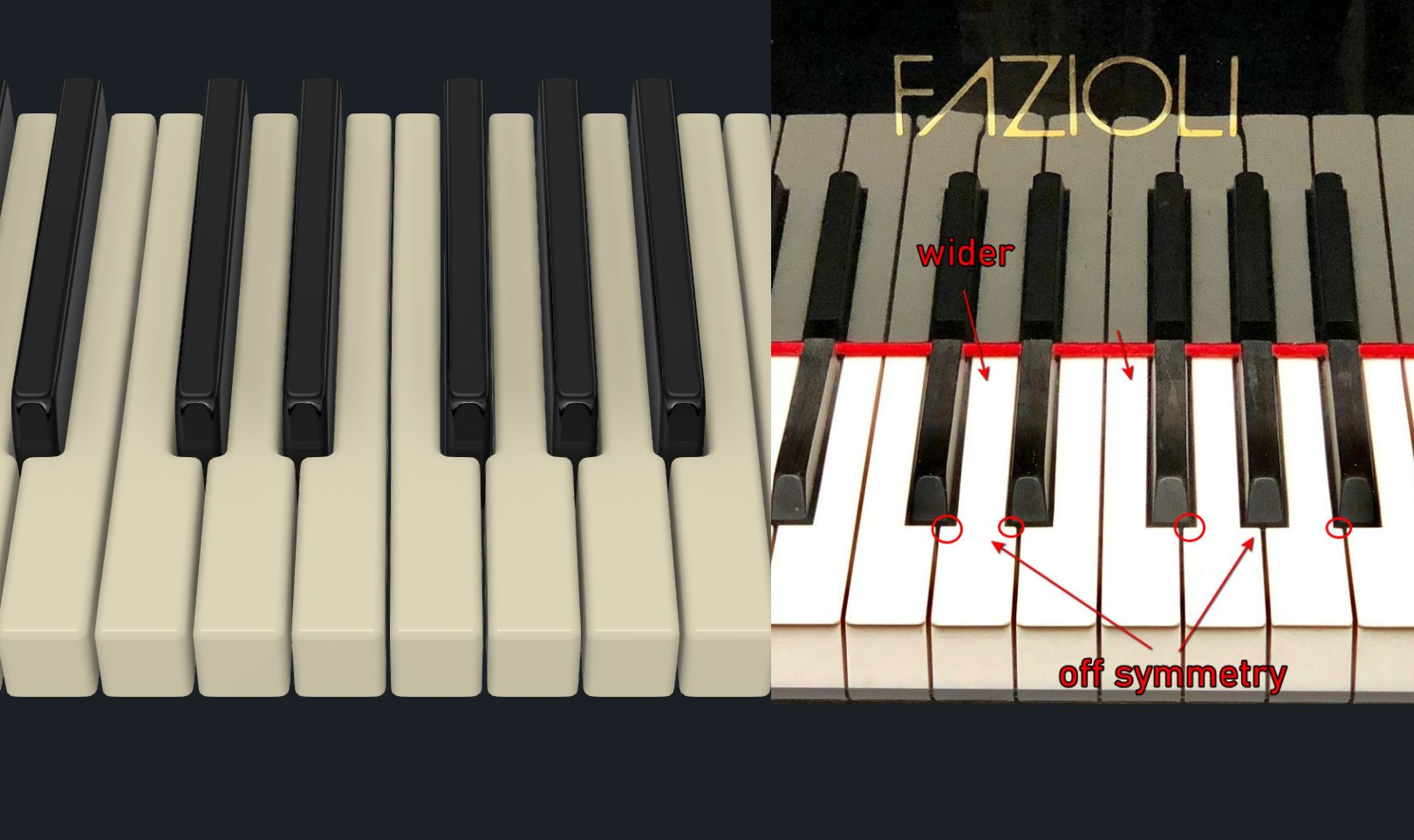
I was playing piano for over a decade before I noticed the difference in the "tail" widths.
I don't see why anyone would care. It doesn't affect me at all. So ... much ado about nothin?


PASHKULI

MacMacMac

Good. It did affect me when I was 14. It told to me, whomever designed it – they had no idea how to do it correctly.
That's all. But it was not just one key, some digital keyboards by Yamaha and Roland had excessively wide D key.
It was obvious they were trying… to do something but couldn't. They (not brand specific) could not for 400+ years.


vagfilm

Guys… It is New Years Eve and this trolling has been going on for a few hours. Pop some champagne instead!


Pianissimo

I have only watched the first video, and tomorrow I will watch the second part. So far I can't see any trolling, you seem genuinely confident about the new simmetry on every tail and head. Which you achieved, yes, but at the expense of what? Something has to give. I would be surprised if nobody thought about it before you. Now you achieved a perfect simmetry on heads and tails, but there is a new problem now: the F# is almost sitting on the middle of the entire F head, and the Bb is sitting almost entirely on the middle of B head. This is not good when you play chromatic passages, because the shift of your thumb underneath your middle finger, will encounter different distances in those two areas. So all in all, I think there is not covenience in making heads and tails perfectly simmetrical. But it was a good idea. Probably you haven't thought about the chromatic passages because as you said, you can barely play the piano. So great effort and intention anyway.


Pianissimo

I have watched the second part. That was interesting, but again, you might get an advantage at the expence of something else. What is our priority playing piano? Glissando and fast repetition of the black key? Ehm, I would say no. If you were an advanced player you would spot quickly the flaws here. The first flaw is that with these curved black keys, you are increasing the chance of playing two or three keys at once, accidentally. The second problem is that when you need to stretch the hand span a lot (beyond one octave), you often need to push your hand forward until you litterally push the keys forward (and that's why also a cheap action will fail and get destoyed quickly by a good player), so with your curved black keys there is the risk that your stretched fingers won't meet any resistance from the the black keys, and you will end up again playing the wrong notes accidentally. But who knows, your idea might be good for those few pianists who are fixated with glissando and fast repetition with a flick. Or maybe for those with severe tendonitis. This second part is more interesting than the first, so thanks for sharing the idea.


CyberGene

The black keys seem to have a very short contact surface, they are reduced to mere buttons. That would make it very difficult to play various chords, especially in the rear where black and white keys are on the same level and so narrow. There’s a real reason why black and white keys on the standard keyboard are on different height levels and why they are long. That gives you a leeway for pressing the key at an angle without pushing the adjacent keys. All that advantage is removed here. Also having a curved surface would work only for plastic and non-weighted synth keys where inertia and dynamics are not very important. On a hammer-action with inertia being the main tactile feedback for your fingers to put precise dynamics, any non-level surface (curvature) would make it almost unpredictable where the key is and how much of the vertical component of the force you apply will be taken at the corresponding spot. Good luck making those wooden curvatures and plastic keytops 😃 As a matter of fact, I love the standard piano keyboard and not only find it very ergonomic, I think it’s been chosen very diligently by the keyboard builders when they came up with it. I only agree that the key size can be smaller for people with smaller hands and there are such pianos AFAIK (Hailun?). Anything more than that is too exotic and unorthodox, bringing more issues than “improvement”. I don’t want to sound harsh, but the obsession with changing what is a proven and established thing, namely the piano keyboard layout, is a bit childish, no offense. Just look at it from aside for a while. You ever heard pianists complaining about the piano keyboard design? And especially if you can barely play the piano, and getting annoyed that manufacturers didn’t care for you, sorry that’s immature.


Pete14

CyberGene I only agree that the key size can be smaller for people with smaller hands….

What about people with bigger hands, can’t they get a “bigger key size”?

And while we’re at it, what about people with six fingers (per hand), what about them, do we just leave them hanging in the dark?

I also think it unfair that none of you has ever shown any consideration for people with no hands/arms at all (how dare you), and why can’t we build a keyboard that’s better suited for their toes?

I almost forgot, the people with neither hands/arms, nor legs/toes, don’t they matter? surely, we could accommodate a keyboard that allows them to play with their butts, but no, we simply push them aside, too!

You people are rude!


PASHKULI

Pianissimo:
the F# is almost sitting on the middle of the entire F head, and the Bb is sitting almost entirely on the middle of B head. This is not good when you play chromatic passages, because the shift of your thumb underneath your middle finger, will encounter different distances in those two areas. So all in all, I think there is not convenience in making heads and tails perfectly symmetrical. But it was a good idea.

Are you sure you know what you point out as an argument of concern regarding chromatic passes?
I might not be proficient at piano playing but I know what good design is and what isn't. If you have problems (when such keyboards are there for you to try out) I will personally by you another piano of your choice.
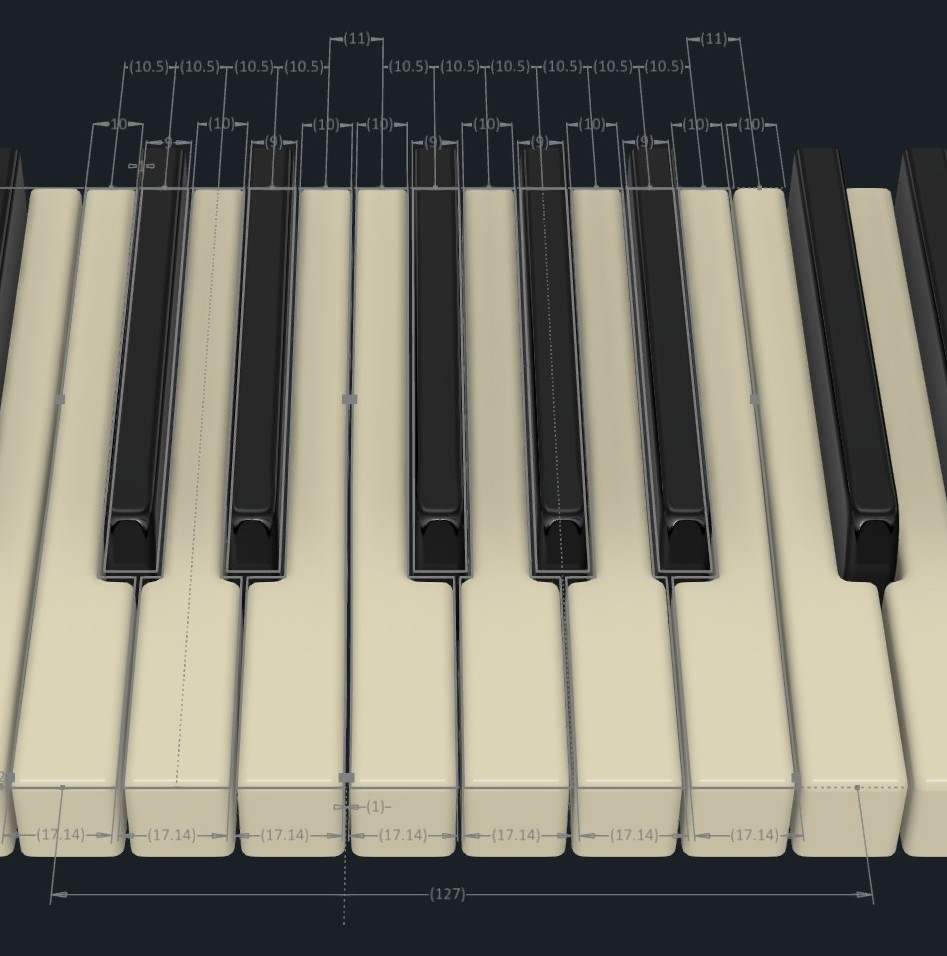
Keep in mind that in my "flat" design above, with perfect widths, from the comparison screenshot above the renova ("octave") span (C₄ to C₅) is 127mm, where Fazioli is 164mm (a difference slightly bigger than one White Head + Black). That is why the relative corners look smaller – the "octave" is ridiculosly smaller in size ("octave" is actually what C to A is on a "standard" width). See next:

Pianissimo:
The first flaw is that with these curved black keys, you are increasing the chance of playing two or three keys at once, accidentally.
The second problem is that when you need to stretch the hand span a lot (beyond one octave), you often need to push your hand forward until you litterally push the keys forward so with your curved black keys there is the risk that your stretched fingers won't meet any resistance from the black keys, and you will end up again playing the wrong notes accidentally.

You can do that on B‑C and E‑F on your keys as well. And you have to jump over the akjacent black keys… especially on wider stretches, so… you learn to play with confidence.
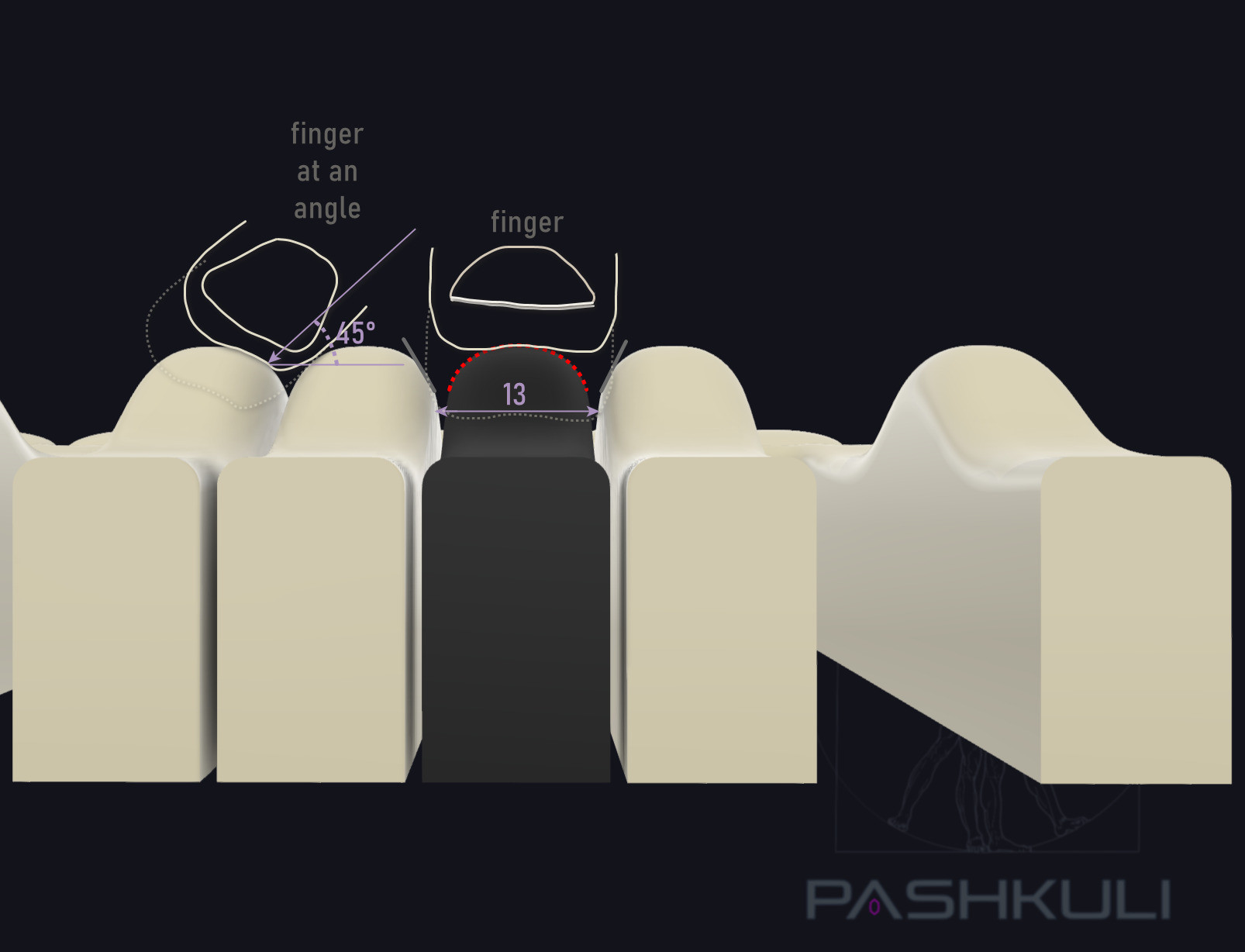
With my design you can benefit from the fact that naturally fingers get positioned at an angle (most of the times) and especially… again… whin you have to do very wider stretches, so the curved profile (if you slice the key) gives you more surface and support at the same time to play the stretched note. See next:

CyberGene:
The black keys seem to have a very short contact surface, they are reduced to mere buttons. That would make it very difficult to play various chords, especially in the rear where black and white keys are on the same level and so narrow. There’s a real reason why black and white keys on the standard keyboard are on different height levels and why they are long. That gives you a leeway for pressing the key at an angle without pushing the adjacent keys. All that advantage is removed here.

Please, see above screenshots as responses to Pianissimo. You will find that angle is better and your finger has more grip (control) on the key thanks to the curved section profile.

CyberGene:
Anything more than that is too exotic and unorthodox, bringing more issues than “improvement”. I don’t want to sound harsh, but the obsession with changing what is a proven and established thing, namely the piano keyboard layout, is a bit childish, no offence. And especially if you can barely play the piano, and getting annoyed that manufacturers didn’t care for you, sorry that’s immature.

No offence but you don't know anything regarding the origin of piano keys, how black keys got introduced (one by one), etc. historically and from construction\deisign point of view. I do not blame you, there is hardly any info on this on the internet and even libraries.

For example, you might find it interesting that at some point B♭ and B were accidentals, yet both they were "big white" keys. In my almost 20+ years of research I have found pianists (pro and hobby) absolutely ignorant on what instrument they play and how it came to be as such. This "flat" design has been here for over 600 years and composers have played it and written 'piano' music for it and on it. It is normal to think "that it is better the way it is" as a pianist yourself.

PASHKULI


CyberGene

@PASHKULI any chance you're the same person who used to post under the nickname of AdXok (and many other nicknames after repeated bans) some years ago on the Bulgarian Musician's Forum? He struck me as a smart person who was nevertheless obsessed with rebelling/challenging the establishment with (in my opinion) insignificant topics that were overblown and represented as very important such as renaming the notes (to be easier to sung?), the Janko keyboard layout, various tunings, tonality, harmony and whatnot, my memory is fading already. The guy had perfect grammar, well structured thought and would obviously spend a lot of (negative, IMO) energy and effort in trying to (re)educate and disrupt the establishment about all these topics instead of actually enjoying music the way most musicians do. I hope I'm not mixing it up with anyone else, but the guy even wrote a manifesto (no, luckily not on the Industrial society and its future 😉 ) or a treatise on new music or something like that. So, @PASHKULI , seeing your detailed and high quality renders of your keyboard layout, that is nevertheless ridiculous (IMO and apologies if that's offensive to you but I really think that keyboard layout is ridiculous), I got a deja vu about AdXok 🙂 BTW, I have nothing to do with his bans, I was a mod on the keyboard sub-forum and he posted a lot on the other forums too, can't remember why he was banned, since he was annoying but not offensive...


CyberGene

PASHKULI Please, see above screenshots as responses to Pianissimo

I don't have time to respond to that with a picture but you've missed that your finger is angled not only in the vertical plane, but also in the horizontal one (when looked from above the keyboard where your fingers will be spread like \|///), then your layout will make it difficult to not touch the adjacent keys, especially towards the rear where black and white keys are on the same plane.

But really, I don't need to argue, I just think your layout is wrong 🙂 If you like, take that as a retreat on my side, I don't care.


PASHKULI

CyberGene

That is typical. You have not tried it but you know. I have the small MIDI prototype.
If you'd like me to perform a scenario, I can… ah, you don't care. Really argumentative.

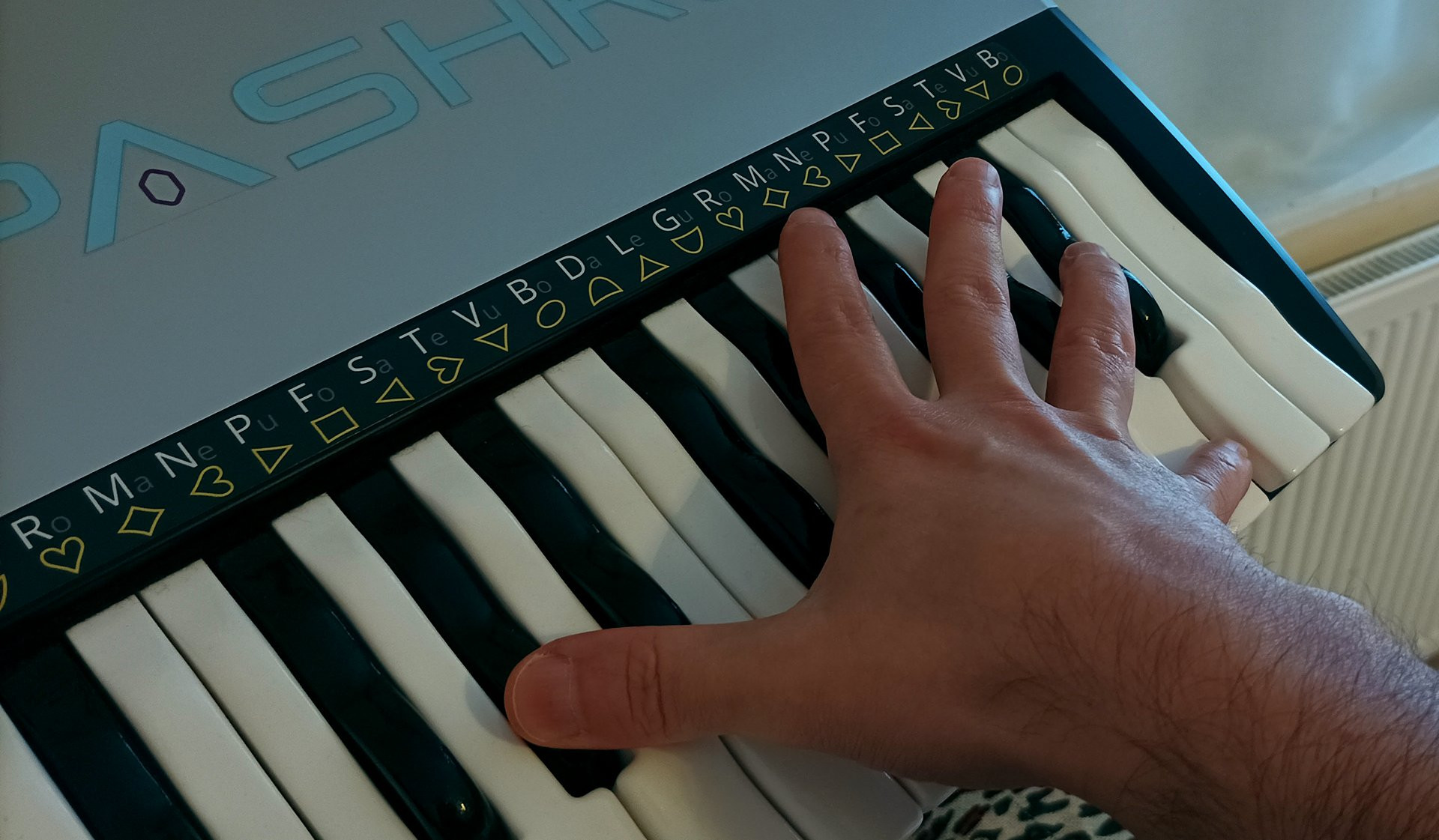
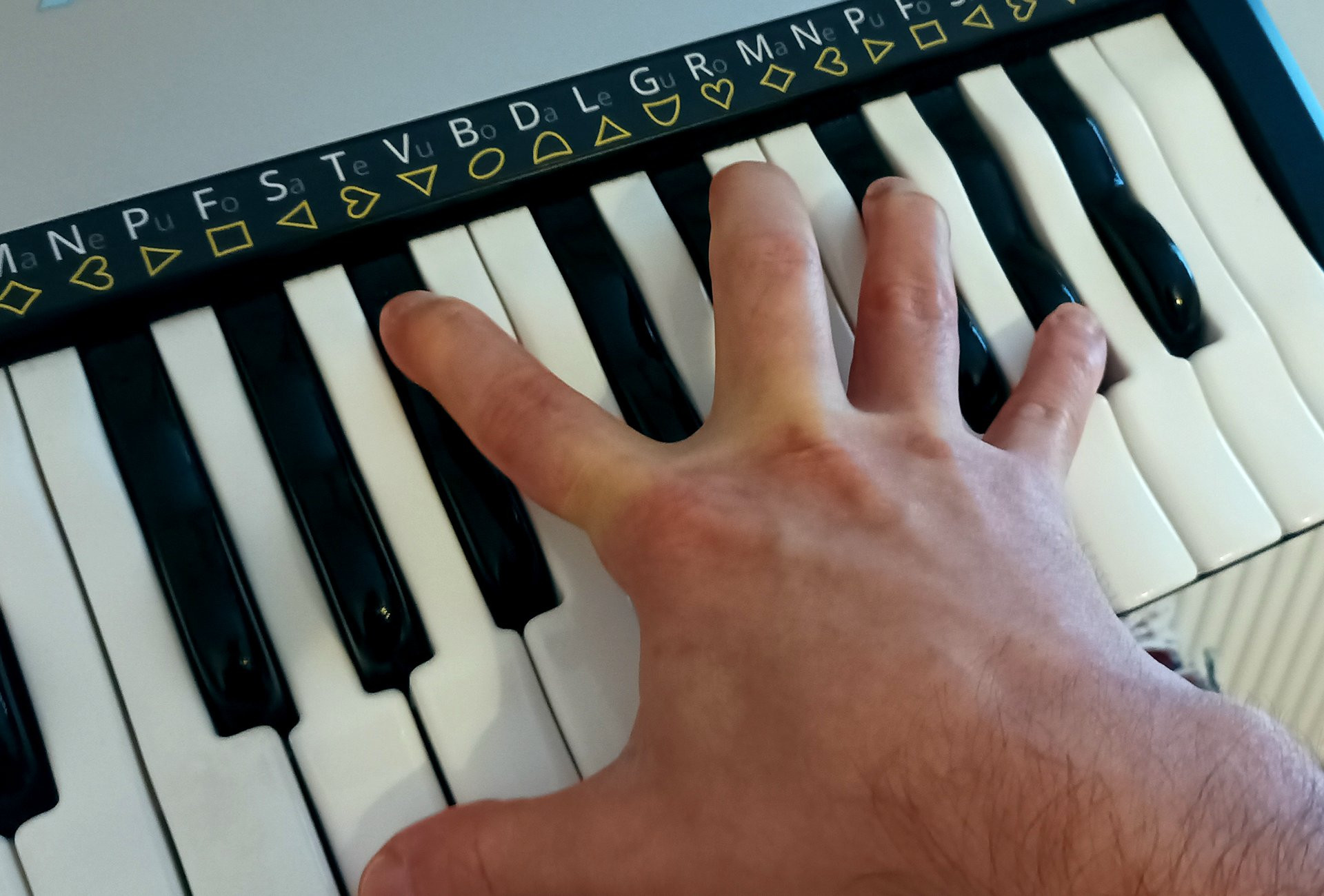
Hint: on my design you can even play black and white keys even if your fingers are almost perpendicullarly oriented across the keys. Just imagine your thumb on a black key and you'd like to stretch the pinky to hit a white key (its head\front)… do you notice what direction the rest of the fingers take with regards to the kyes? Some of them are at 45°~55°~65° (ring finger even 70°+)

Show it on your piano… ah, you don't care.

and just for the sake of comprehensiveness… another scenario:


EssBrace

PASHKULI In my almost 20+ years of research I have found pianists (pro and hobby) absolutely ignorant on what instrument they play and how it came to be as such.

I think this is a view that just fails to see the issue from the only perspective that matters, and that is a musical perspective.

Anyone who has witnessed a superlative musician on a piano (whether in person, or via some kind of media) cannot possibly conclude that there is anything intrinsically wrong with the piano keyboard in its current state. Musical expressiveness, power and emotion is possible that surpasses all other instruments. This is across a wide range of musical genres. A player, whether good or bad, doesn't need to know the story of piano keyboard development.

As no doubt others have stated, you are trying to solve a problem that does not exist in anyone's mind but your own.


« Previous Page Next Page »