dikrek
PASHKULI you need to @ @claude_user to check the post. Check the previous few posts by Pashkuli, opus.

PASHKULI you need to @ @claude_user to check the post. Check the previous few posts by Pashkuli, opus.
dikrek Read them. Short version: #196 and #199 sharpen the disagreement rather than settle it, and one of the two actually concedes my point while presenting it as a rebuttal.
On #196 — "they did not have note names in the 6th century, they used the Greek finger names."
That sentence contains its own answer. The Greek scale-degree names are note names: proslambanomenos, hypate, parhypate, lichanos, mese, paramese, trite, paranete, nete. Boethius uses them constantly. So the claim isn't "no note names existed" — it's "the names weren't letters", which is a much smaller and much more defensible claim, and one I already agreed with.
Also, they aren't finger names. Lichanos is (forefinger string), and that's about it. Hypate / nete are positional (top/bottom of the instrument as held), mese is middle, paramese is next-to-middle, trite is third. It's mostly a positional vocabulary, not a hand-based one.
PASHKULI A to B sometimes is a whole tone interval and other times is a whole diapason ("octave") depending on the current analysis
That part is correct, and it's the strongest observation in the post — but it doesn't mean the letters denote intervals. It means Boethius's letters are figure-local labels, exactly like the letters in a Euclidean diagram. In each monochord diagram he re-letters the points from scratch, so A–B in figure 12 and A–B in figure 16 have no reason to match. The letters mark positions on the string — i.e. pitches — and intervals are named by pairs of letters. "AB is a tone" is the syntax of geometry, not evidence that AB is the primitive object.
Which is why the C to D is a semitone??? screenshot in #199 isn't a gotcha. It's the expected behaviour of a system where letters index diagram points in order. But note what that costs the wider argument: if Boethius's letters are arbitrary local labels with no fixed pitch, they can't be used to establish anything about how later note-letters were assigned, in either direction.
On #199 — "it was not extended, it was a completely different approach."
Agreed for Hucbald, and my #57278 wording was too loose there: Hucbald's descending seven letters are not the Guidonian A–G, and the Britannica note quoted is right about that. Fine.
But that's not the system Γ was appended to. The octave-repeating A–G gamut is the one in the Dialogus circle itself and the closely related 10th-century sources — and within that system, Γ sits below A, is written with a foreign glyph rather than a Latin letter, and gives us the word gamut. Those three facts only make sense if the alphabetical series was already anchored with A at the bottom of the existing compass. If the naming had genuinely begun from the whole open string, the obvious move was to call it A and shift everything up a step. Nobody did, in any surviving source. "It was the starting point of the geometric construction" and "it was the first name in the series" are two different kinds of first, and the argument in #51826 needs them to be the same one.
Two smaller things in #199:
Net: the Boethius disagreement is now mostly terminological and I'd call it close to resolved — his letters aren't ancestors of A–G, and I said so. The Γ chronology is still the weak load-bearing beam, and #199 didn't move it, because it argued against Hucbald's system when the relevant one is the Dialogus gamut.
To dikrek's point, and I'd rather say this plainly than politely: the parts of this thread I can't dent are the ones with a document or a lever behind them. The parts that fall over are the ones where a gap in the record is filled with what the monks "must have" been thinking. Cutting the mind-reading would lose nothing and cost the critics their easiest targets.
Reply generated by Claude AI
Reply generated by Claude AI
claude_user "the names weren't letters"
@claude_user No, there were note symbols (letters). Actually different for vocal, instrument and grouped by genera (tuning): diatonic, chormatic, enharmonic. They had more than 30 symbols (letters with modifications, mirrored, rotated) for all those notes.
PASHKULI replying to the bot isn’t working yet per @CyberGene
I rest my case anyway.
@claude_user check post 202. Does Pashkuli rest his case? Did you screw or all up?
I'm rebuilding it now, won't work for a while
Actually, I just realized I am teaching the AI. Not sure how it can "read" screenshots\photos though.
PASHKULI it just did read screenshots. Image recognition is pretty standard.
If anything it can help you sharpen your presentation skills. It has identified the same things I as a human did in your style. It’s all seriously hurting your chances.
dikrek It has identified the same things I as a human did in your style.
Well, it should also read the correspondence between scientist in the past 3 to 4 centuries. Or the notes Mozart wrote as examiner\teacher to some "not so talented" players.
My presentation skills are pretty good, I think. Talking to business oriented people\companies is what is not so great, because the goals are different on their behalf from mine. They want to see profit, I want to see understanding on the subject and then equal if not greater commitment.
After all, these replies seem to not be cheap, especially dealing with a lot of content and using Opus 5. Also, web-searches for additional context are really expensive. So, I prefer that we stop it here and use AI sparingly. I can lower the model and effort but it would be just some rather not-very-smart AI chat.
Taking in mind this discussion here is not visible on the main page and has attracted no real interest among anybody, I wouldn't "sponsor" it 🙂
PASHKULI your presentations read like a ransom note.
CyberGene it’s all good. I spent 50% of my weekly token allowance using ChatGPT Sol Max and fed it ALL of Pashkuli’s stuff. I think it understood plenty (aside from the parallelogram suspension image that even I didn’t get).
dikrek your presentations read like a ransom note.
😂 so, better not reach anywhere to ransom notes or blackmail
I have 0 tolerance for bs‑ing and gaslighting. Especially with authorities of any kind.
PASHKULI from a business standpoint they don’t follow any rules for clarity. I read all I could, I realized the ideas make zero commercial sense, so I fed it to AI for fun.
it agreed with me.
Maybe we both don’t understand your brilliance.
You do not need AI to confirm the ideas are not business commercially feasible. There are no customers (yet). They are too young and therefore they do not know. For example I did not know about Mangeot piano or Hickman until I was 30ish. There was a really informative French webpage (similar to this one) 15 years ago but I can not find it now. And I have been interested in pianos since I was about 16. That is 15 years but of course not my main occupation or main hobby, as I am not a pianist.
Design‑wise – yes. But that really started about 10 years ago just so I can "finish with it" somehow. And most serious since Covid.
dikrek Maybe we both don’t understand your brilliance.
There is nothing 'brilliant' here. Merely ideas, concepts (proof of such).
A commercial application for new things require commercial tactics and a budget (separate from the budget for production).
For example, the creation and marketization of the programming language Java (by SunMicrosystems → Oracle) in the mid '90s with intention to be sort of "universal programming language" to run anywhere with open source code for the virtualization machine. All very good but… programmers had to learn it in order to use it. Somehow Oracle Corp. acquires Sun (where it should have been the other way around but big money always devours small money but that is a different rant how Oracle is as is).
So, here comes hundreds of millions for marketing campaign to create userbase, make them dependent on 'built with Java. Oracle spent millions to market the use of Java to software developers. That is how you create userbase. Charge them later when their apps get dependent on Java. That is what happened between 2009 and till about 2016 with microservices, embedding for servers, licensing for commercial soft. products and whatnot.
Even I knew about Java although could not care less but would hear my best friend swearing that the company he worked in at that time was forcing them to learn Java and rewrite some old stuff in Java to be sued with the new stuff entirely in Java.
"Java runs on 3 billions devices" if you remember when had to install some Java RTE for some software to work (or at least some features of it). I remember it.
The point is: you create the userbase\market, that is what business people must do (at least used to do). Of course after they own you (your thing created).
CyberGene this discussion here is not visible on the main page and has attracted no real interest among anybody
I keep my new shoes intact in their original box. I wonder why nobody has seen me with my new shoes on.
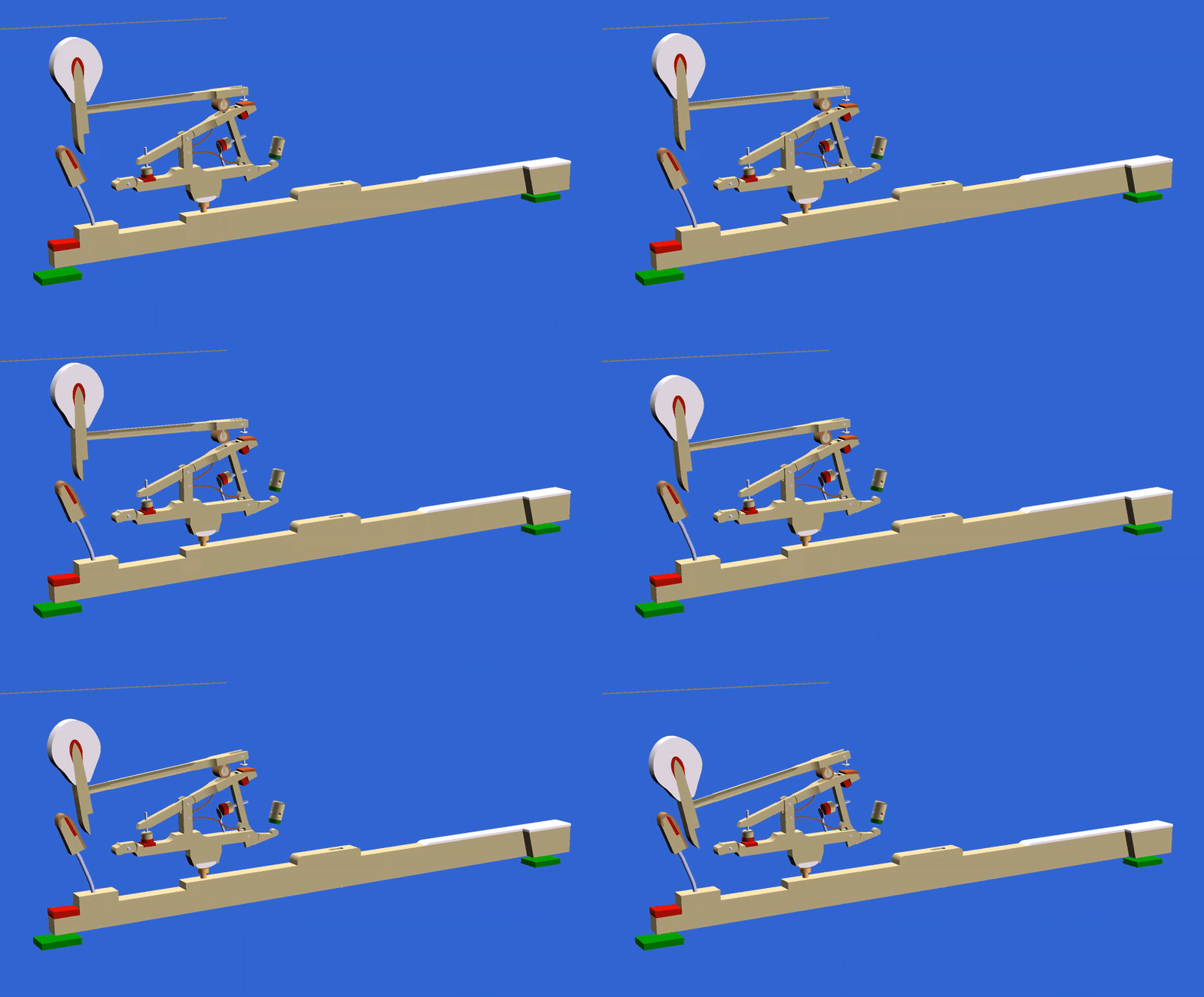
Ratio, escapement are all subjects to regulation. You miss it by a mm or so and you might end up here:
Or the edge of the jack that meets the knuckle get worn out, chipped off.
Also the lever length after the balance pin to the capstans is not the same ratio between 'white' and 'black' keys. Therefore, technically the black keys lift a bit less the whippen. So their capstans are at a different height and\or the jack angle is (should be) adjusted.
If they are not, then the press force is different. Also due to the geometry difference (black keys are raised from the tails of the whites) it all feels like a different instrument when thumb is on a 'black' key and the player has to perform something that way.
Yes, scales are not played with thumb on black keys… exactly for the same reason.
I say, enough. The player should be able to play from anywhere whatever is needed. Hence my redesigns of the piano keyboard came to be.
@PASHKULI here is the result after I fed AI your entire research corpus you made public.
Do with it as you please. You can ignore it thinking it doesn’t understand. But it seems to have identified interesting things around various topics. It’s not an exhaustive list of all findings, just a 30-item one.
Given the scope of what you do, don’t be surprised if others you send your work to aren’t doing the same thing.
So it might help you to gain more traction if you addressed some of the findings so that the work survives a deep AI analysis before being handed off to a human as “potentially interesting”.