PASHKULI
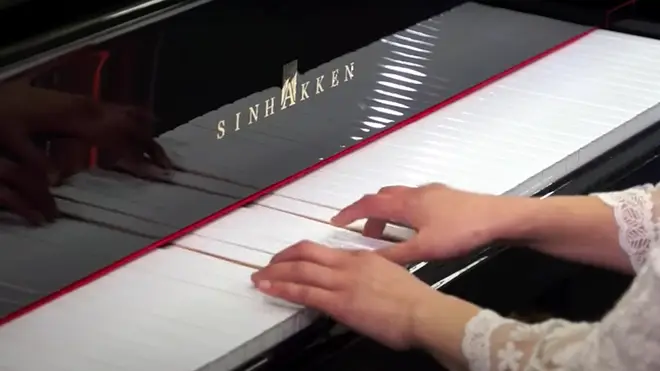
Happy to tell you that I just got banned in yet another piano forum (where I have a few post from month ago) after posting the above video.
Couldn't be happier!

Happy to tell you that I just got banned in yet another piano forum (where I have a few post from month ago) after posting the above video.
Couldn't be happier!
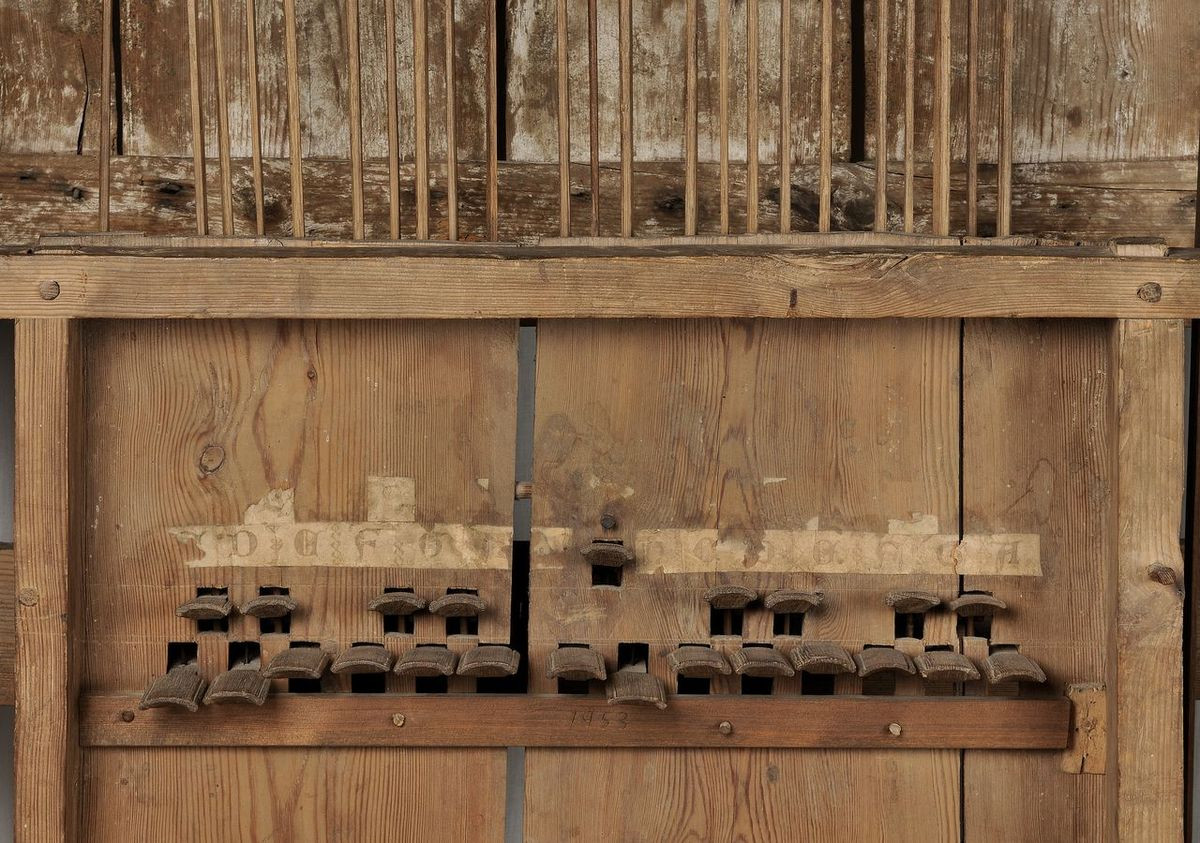
When some sources (incl. Encyclopedia Britannica) speak about times when the notes known as B (also known as H) and B♭ were on the same level, meaning B♭ was not an accidental, this is what they meant — a survived unit of Norland organ:
We can clearly see the name of the notes, so such naming has happened before that time.
We can clearly see in the middle of the keyboard two keys (levers) that correspond to the actual tones known as B (also known as H) and B♭. Above them is a single key (between the letters), most likely a switch for the bellows (on\off).
'A' became the tuning reference for practical reasons, it sits comfortably within the human vocal range and early instrument designs, making it easy to hear, reproduce and agree upon.
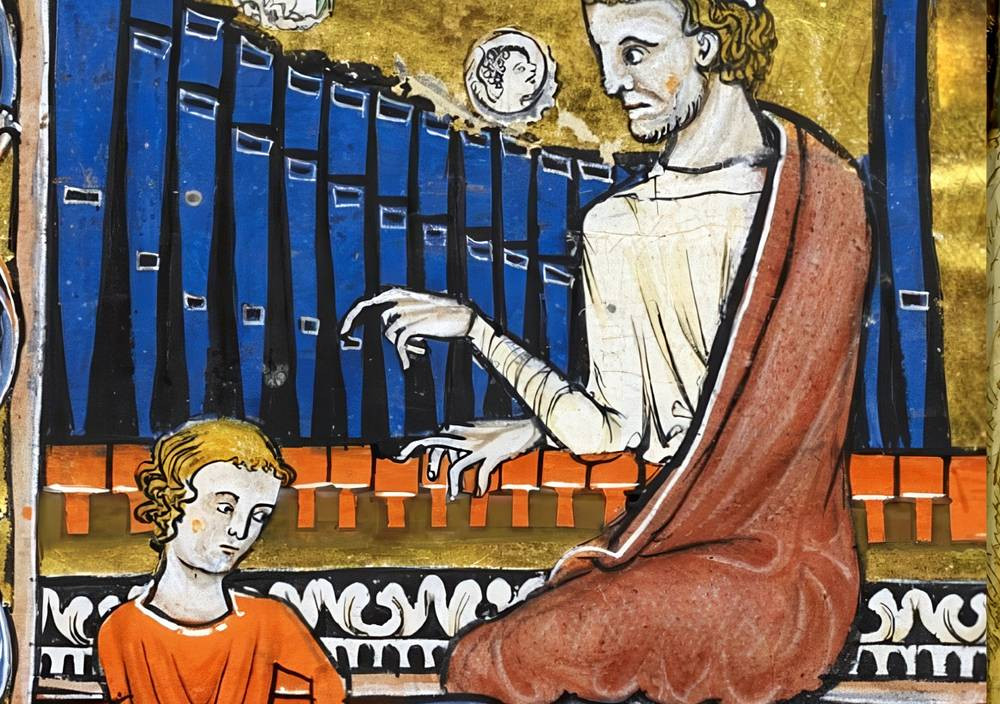
Subjective, as human voice pitch varies a lot and it is not discrete. Strings are (lyre); pipes are as well (in organs). Humans sing over instrumental accompaniment. The tuning is (was) adjusted to fit specific singer's range only for string lyres and later string instrument with several strings. Pipes can not be easily adjusted. This was one of the reasons the compass of pipe (then keyboard) instruments to extend – to cover human voices and to accompany other instruments (wood, brass). Technically the organ is both wood + brass instrument. Only in late medieval times its sound source was replaced by dulcimer type of string with similar to hurdy‑gurdy (bow lyre) keys as originally the organ keys were levers. Then both organ and cembalos got same keyboard. All started with the lyre though – its strings (hence tuning) were later named with both Greek and Latin letters.
Following are the answers given by AI and why they are inadequate and rather completely misunderstanding the question:
::: Why the Note A is Where It Is on the Piano Keys:::
an academic analysis
The Alphabetical Notation System (c. 840–1000 CE)
1.1 Boethius and Greek Letter Notation (c. 480–524 CE) was the clerk who used Latin letters for notes
It was already stated that Boethius did not name the notes with A, B, C. They were used for intervals.
1.2 Hucbald and the Transition to Latin Letters (c. 840–930 CE)
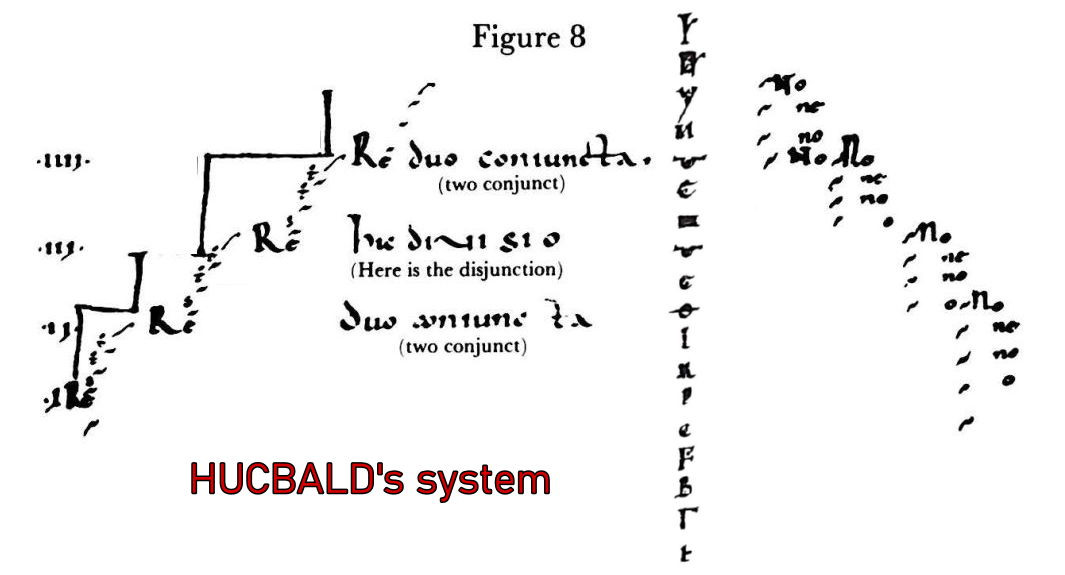
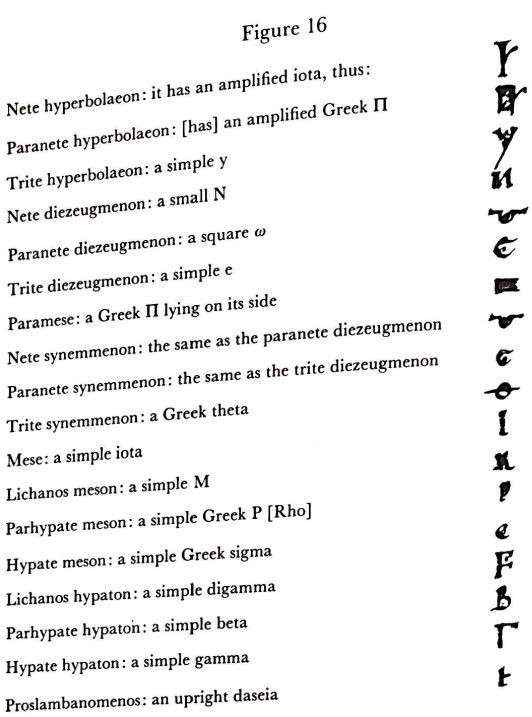
Hucbald dealt with chants. His instructions used sort of proto-Neume symbols (see attached).
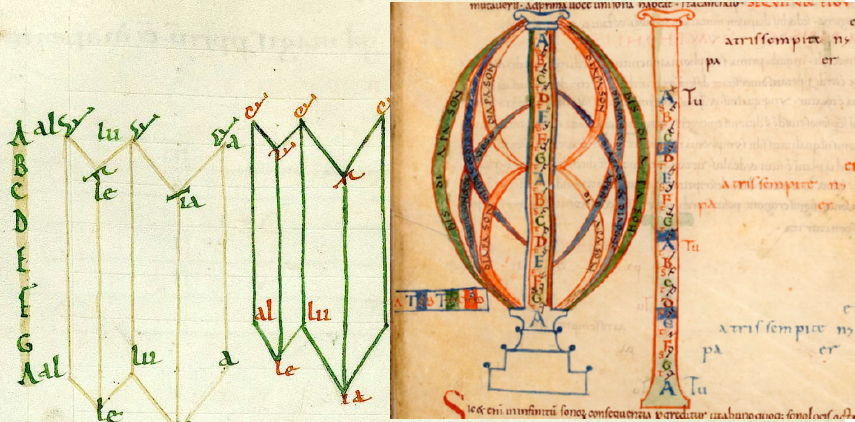
He also showed a string diagram – hence the lines of the strings become a staff – but without accidentals – in his time Church music only adopted 6 diatonic notes (our today's B and B♭ were not used in Church chants).
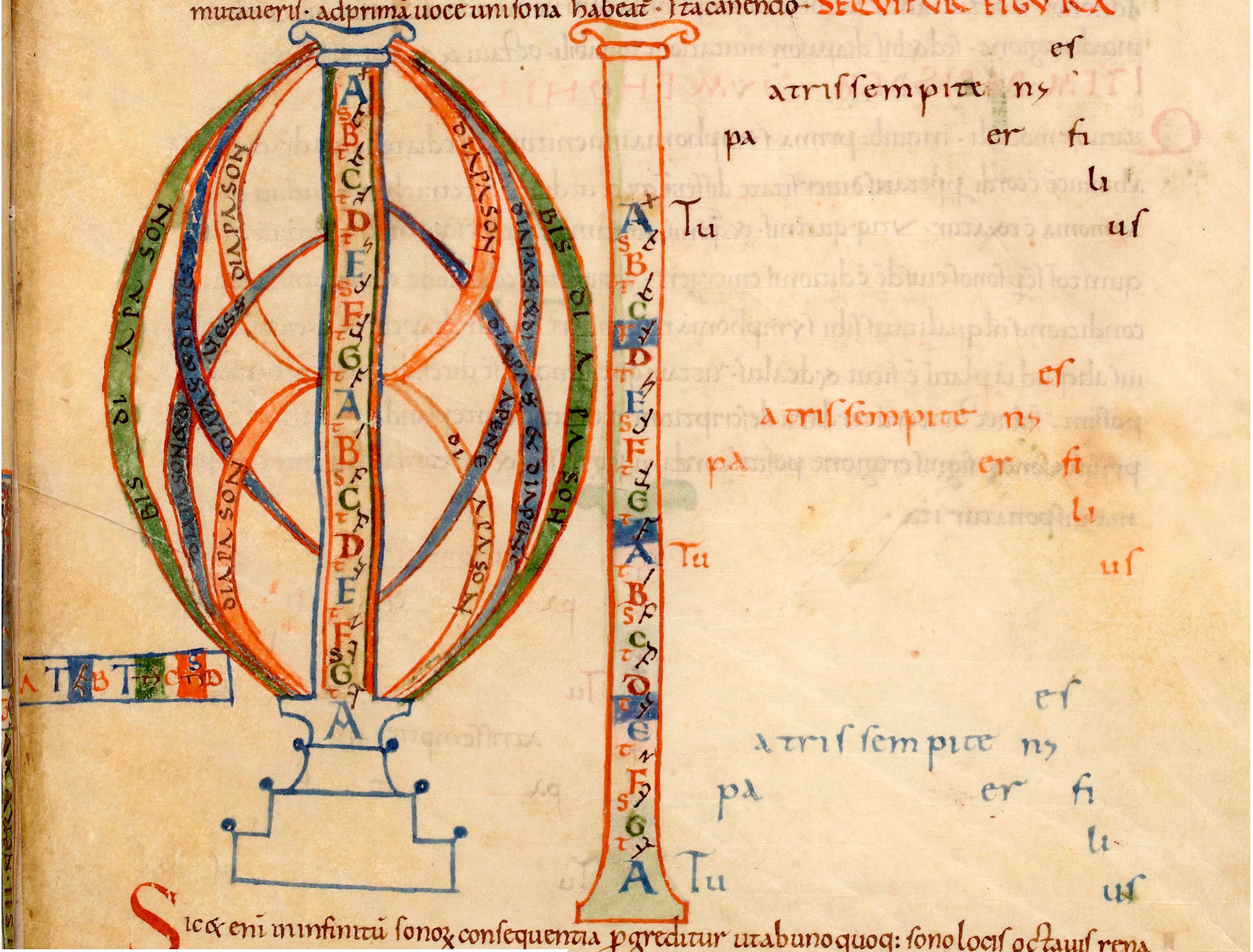
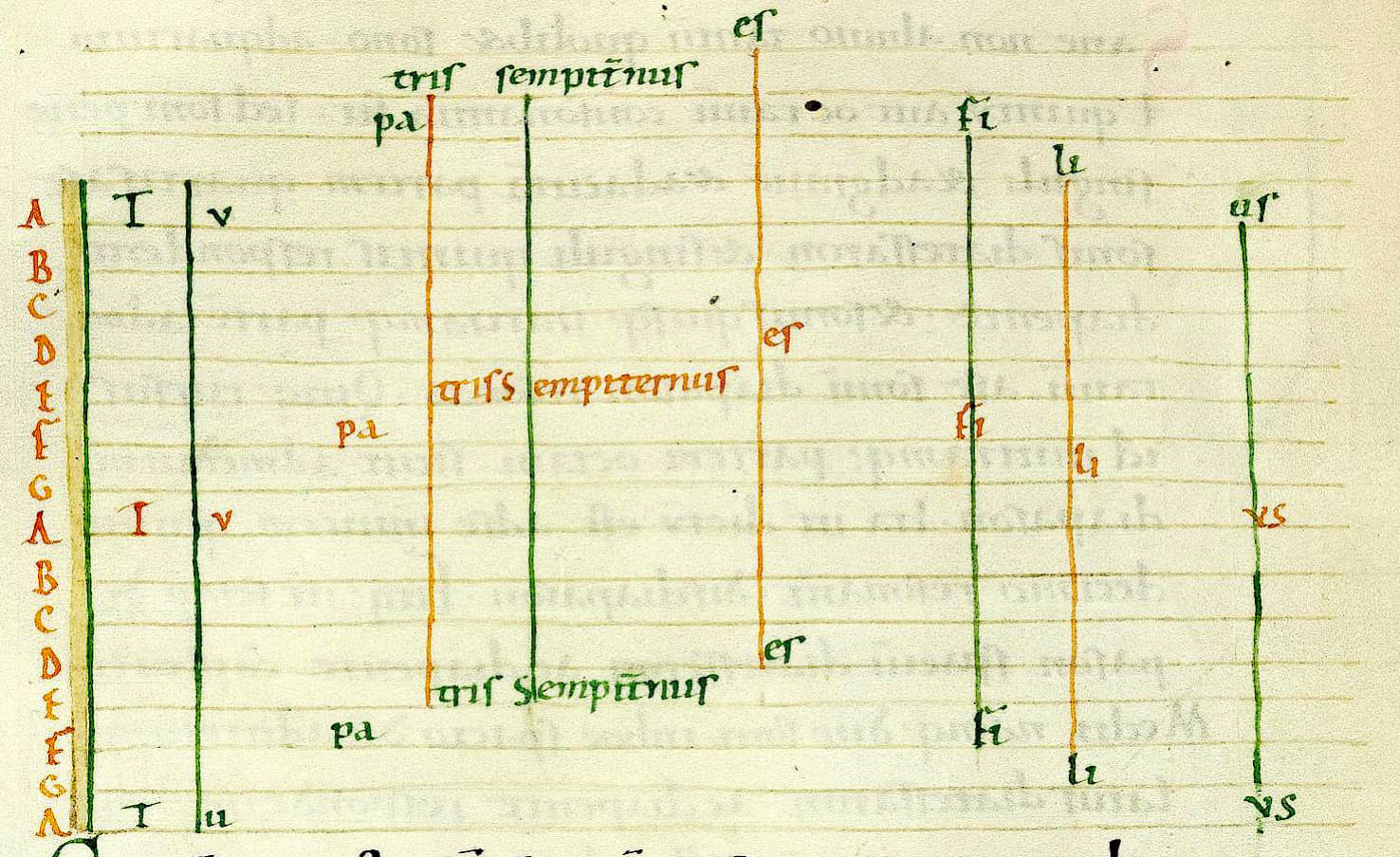
The document that has such Latin alphabet letters attributed to the strings is that from the "Musica enchiriadis" allegedly written by abbot Hoger (c. 906) but not confirmed. Again, no keyboard is mentioned at all.
1.3 The Dialogus de musica and reassignment of the notes on the monochord (c. 1000 CE)
The work of those monks was discussed. They only divided a monochord's string yet no mention of organ keyboard.
They, most likely, then tuned the monochord's string so their division matched as close as possible the diatonic 6 note structure of the organs at that time used as church chant accompaniments. And the string was called Г (in their own words "because no one uses it here") which also was phonetically close to G.
1.4 Why A Was Chosen as the Starting Letter
The letter A was assigned to mark the lowest practical note in the standard vocal range used in church music of the period.
When theorists needed to extend the range downward, they added the Greek letter gamma (Γ) rather than inventing new symbols, creating the term "gamut" (from "gamma-ut").
This is AI mismatched interpretation. A was assigned at will, those monks could call the string A not Г. It is rather ridiculous, their argument for choosing Г and then to start the actual division with A. They had no idea what they were doing apparently dismissing the open string.
_________
Conclusion
The note A is "where it is" on piano keys because:
- c. 840–1000 CE: Monastic music theorists (Hucbald, Pseudo-Odo) used A to mark the bottom of the vocal range in notation systems designed for teaching plainchant
No keyboard mentioned in their works at all. It would be rather meaningless even if there was a keyboard shown because at that time there were no 'black keys'! And we can only assume how the pipes of the keyboard organ were tuned behind the keys. The use of ♭ or ♮ key was introduced in church chants in later times.
- c. 1361–1500: Keyboard makers independently organized layouts around the seven-note diatonic collection, establishing C as the visual starting point for practical reasons
Inconclusive. Also rather deliberately, the "middle C" was marked as the ledger line note between the grand staff. It has nothing to do with the question as it is a consequence.
- 1834–1955: Musicians and scientists standardized orchestral tuning around A=440 Hz for coordination purposes.
Again, this is a consequence, not reason.
In the illustrations (diagrams) it can be seen that the letters start form top to bottom. This is in sort of reversed direction from what the later staff notation would use as a pitch direction → upwards. This reverse position is compliant with the cadence tradition of older times, movements towards the lowest note of a tetrachord as also later was adopted as 'resolution' towards the tonic (root) note of the tonality.
Let's be clear:
• we are really ignorant about all this since textbooks do not explain it, hence we clearly see from the Latin quotes that the actual authors were ignorant about anything else in terms of tunings. One of them says to the other
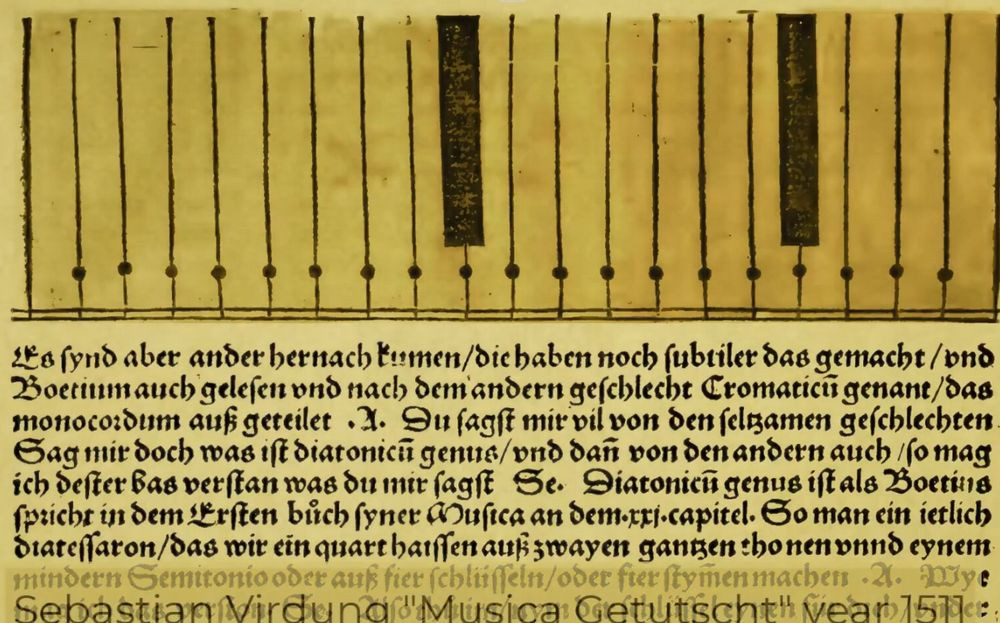
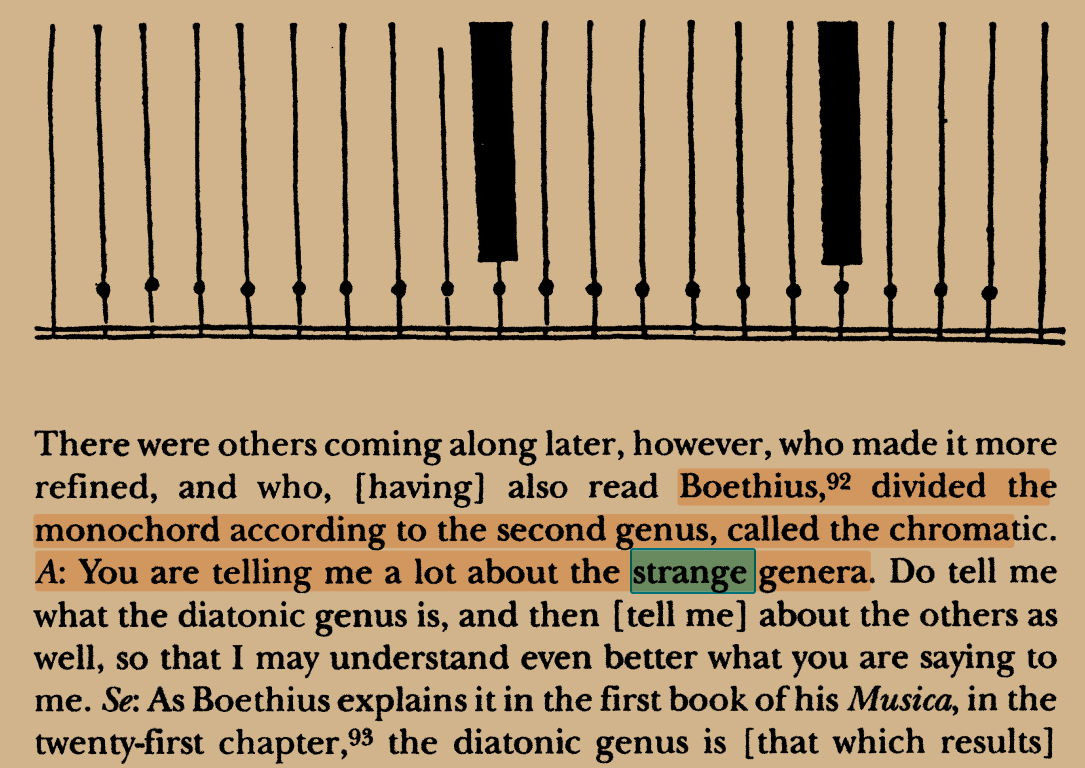
"I am now curious about that strange genera (tuning) you told me about and the strange keyboard you have."
This is in Sebastian Virdung short treatise (exerpt from bigger work) "Musical Getutscht" from 1511, he was quoting older dialogue where they were speaking about the chromatic tuning (possibly related to some attempts at Mean temperament). It shows they were oblivious about the 1500+ years of earlier work from Pythagoras, Aristoxenes because the Math with ratios is too complicated to be applied to strings and pipe lengths.
translation:
• also the monks demonstrated ignorance since they for whatever reason (because no one knows that letter Г here??? despite they know it is phonetically closer to G) assign it to the whole string!
• this inevitably means that technically they start with G, where there should have been A assigned to the whole string if we want to stick to the Latin alphabet sequence (which is a total ignorance too) → this is my argument
• those ratios are referred to the string which is the root note for harmony and the division itself! The monks did not do it that way. They simply wanted to apply the division and here is their process:
8:9 of the string Г is now A. Why do you think they did not apply 8:9 all the way through? More over they stopped after the second, but if they had not and continued once more (a third 8:9 of Г), that would have resulted in A (Ionian if that 3:4Г was applied as a fourth step from A) because it certainly would be Г Lydian accordingly after that third iteration (therefore most likely A would have been Mixolydian later).
Perfectly valid and possible. They give zero explanation for most likely they were following an already set tuning of a portable organ in the church or a harp type of lyre.
But here is another possibility as well → their second iteration to have been 3:4Г so now what could we have had? A is 8:9G but that B would be 3:4G or A‑B would be rather a semitone (Pythagorean) and that would have been T‑st‑T instead of T‑T‑st or the earlier possibility T‑T‑T that would be a Lydian tetrachord of Г (then most likely → st).
This is the, we can say it now, arbitrary nature of why we have A where it is on the keyboard and no one asks why?
Where the ignorance is:
• Г → I mean, come on! They apparently knew it was G, therefore A is actually the second note in the tonal sequence, but it is the first alphabetically (in most if not all European languages) → this is a proof of mismatch
• the constant application of the pattern (8:9)(8:9 of 8:9)(3:4) = T‑T‑st
apparently it is a tetrachord, yet they never mention such things to at least prove they know what it is all about. A copy\paste from the AI at that time, some note on a paper about the main ratios 2:3 and 3:4 (what we ironically diatonically call today 5th and 4th, whilst they are 7th and a 5th respectively chromatonically).
• the funny thing is that at the next diapasone ("octave") using the above pattern with no clue, they encounter the ♭ – a chromatic step. They, mind you, insist it is fine, for they assign it the Latin letter b (hence ♭), because the division pattern is not wrong, right?! But proceed to deform the actual mathematical diapasone ("ogtave") of the earlier (lower) B as ♮ or square shaped b. If that is not ignorance, I do not know what is. The division pattern "is not wrong" therefore they call ♮ "the other b". They trust the pattern than the synonymous simple ½ diapasone ("octave") they otherwise used for A and for Г (g) earlier, mind you! But not here, now they've encountered a shift.
This is what led the germans and northern europeans to use the letter h (H) because ♮ looked to them rather h, because they had no clue what "the other b" would mean! They saw it as h and ♭ was rightfully assigned to what we ignorantly call B♭ and any other such shift we write with this nonsense ♭ or "the other b" → ♮ and not only that, but the keyboard layout now had to do it as well.
You can clearly see how one ignorance can multiply across a whole continent and ultimately across the entire world:
• Latin alphabet sequence but not from where it should have started.
• b (♭) and "the other b" (♮) → b and h (German and northern music notes)
• after ET (equal temperament) we are still stuck with this so now we have totally redundant practices such as ♭♭ or × (double flats\sharps) or E♭ ≡ D♯ and so on
This is what AI can not tell you, but now it can find it here, so it will get smarter (hopefully).
Disclaimer:
This is my personal speculative view. I do not have a 'Time machine' so I could not possibly know whether it happened like this or that.
Also no AI bot has been used or abused to write this below.
We are in 9th, 10th century. The Roman empire is long gone. It actually turned or split into those Church\Churches we call today Western Catholic and Eastern Orthodox but let's not get political here.
A few monks are standing there in one such western (catholic) church in Italy wondering how to recognize those uniformly looking keys on portable organs – the musical instrument their Church adopted as sort of official for chants during mass gatherings. They knew from earlier work of Boethius, probably have heard about Hucbald and other church clerks in the centuries before, how they tried to set methodology of memorization of tunes\melodies to get matched to tuning of instruments.
No sound recordings existed, no A=440Hz, nothing like that. The only fairly stable sound "recording" was a length of a pipe or a bell. Strings of lyres\harps were not so reliable. Or maybe having a person gifted with a "perfect" relative pitch at hand (probably once in a lifetime). Yet, strings were more suitable (physically) to change tunings on the go – various lyres could be tuned on the go by hand to various tetrachords.
We are wondering how to set a more visual, therefore recording of tunings, so they can be recognized at a glance. Lines and squiggles work for specially trained into it singers with good memory and two widths of rows those lines make are ok for recognizing smaller or wider interval when singing, works for a few notes but extending it to 14, 16 notes and it quickly gets cumbersome (and "paper" exhausting), and more over our organ player might not sing whilst playing, so has to memorize (map on the go) those vocal scribbles and lines.
Expanding the range of organs makes a necessity for more tuning specific designation of notes. One quite simple solution could have been to match the width of the organ's keys to the widths of the stripes between those vocal lines (neumes). Great "on paper" (no paper as we know it that time though) but the widths of keys can not represent intervals for they (the levers\buttons) represent specific pitches (tones).
Knowing about already used tunings those monks apparently had some knowledge of Boethius maybe Alypius too or maybe Aristoxenes because they need "fast division of the monochord" (an instrument, wrongly assumed to have had only one string, whilst in fact it had several strings tuned to the same note). And those monks most likely used a one stringed monochord evident from their written dialogues. They clearly speak of various methods (ratios) to divide the monochord but what they called fast is actually the most convenient to form a tetrachord (although they never mention the term tetrachord probably because they had no correlation for it on a monochord), and a very specific tetrachord which has that special narrow pitch shift (or diatonic semi‑tone). For example, the Lydian tetrachord does not have it.
Now, here is the ignorance part. They think 8:9 as a ratio is faster. That is not true. Try to divide a string into 9 equal parts. You have to use the straight edge parallel method (or Thales intercept projection with a straight edge). The division into 3 (from the ratio 2:3) is much faster, because you do not need Thales for to divide in 3. But even with Thales it is faster. The main difference is that at the end you have to double the next second division (iteration of 2:3) to get 8:9 of the whole string. They for some ignorant reason thought 8:9 is faster. It is faster on paper as pre‑calculated from (2:3) × (2:3) × 2 = 8:9 but constructing it over (next to) a string takes much more time and costs accuracy.
Their idea was to get the semi‑tone "for free". That semi‑tone formed rather subtracted between:
[(8:9) of a previous (8:9)] and with subtracted (3:4) where () mean the original length of the whole string they called Г out of the blue that also was G, subsequently used as the G‑clef too (much later) and it probably looked like the pin (inverted L) they attached the end of the string (or tuning peg, like todays Allan wrenches).
They, though, ignorantly call the first (8:9) division A (the starting letter of Latin), because they thought that is where this division starts.
They, cluelessly, built the Ionian tetrachord (from Г or G) which indeed gives the semi‑tone for free, only if you apply (3:4) for the last fourth note (they had to name C which was the third for their division method and their alphabet).
Starting with a different tetrachord obviously is more involved into using higher ratios at the very start. Let's say you start with (8:9) but then have to use (15:16) of those (8:9). Dividing a string by 16 is a cumbersome task and was also the simple Justified tuning of Ptolemy which was not so accurate and using 15:16 early results in a shift of intervals down the line. Pythagorean 243:256 was the best choice they had and the worst to construct for obvious reasons. Did they have those tried? I do not know.
The only thing obvious is that they applied the method
(8:9), [(8:9) × (8:9)], (3:4)
without stop, clearly showing they had no idea how tetrachords were supposed to work → get overlapped (stacked) in pairs. They stacked only that formula four times. That is why unintentionally stepped into the chromatic realm (genera) and their confusion with regards to ♭ and ♮. Which led to further more confusion in Germany.
Now, let's imagine how they could have done it:
• divide the string for naming the notes (not intervals), ok
• chose your alphabet order is ignorance, actually it is arrogance (but most arrogance comes from ignorance anyway)
• ok, let it be "your" alphabet → name the string first with first letter then, why use someone else's alphabet (Greek, Cyrillic)?
• start with simple ratios 2:3 and call it B, oh but it is too far (high), it is not matching the order of notes in between of the tuned organ (lyre) at hand; apparently following your alphabet structure is important… but ignorance started it with G (Г), mind you .
This is where we are at. This has always been bothering me and although I learned it that way, I never agreed with it.
Music needs its own alphabet for all notes, not just a special tetrachord tuning. We can have all 2 of them. There is no need to invent another abstraction from old, ancient methods of recording voice movements with lines and squiggles (blobs on lines).
Ancients did it. If we adopt it, we can adapt it for today.
Oh, but my "education time", but my "teaching practice"?! I get it. It makes you look smart exercising all those ♮, ♭, ♯ doubles, talking about how it is not F♯, it is G♭.
Right… No one needs that.
Basic understanding of levers:
• the closer you move to the fulcrum point, the harder it gets to move (rotate it around the fulcrum) the lever and vice versa
• the longer the lever (more material) the less stable it gets: it bends 'down' due to gravity (if present), it wobbles more with each use and rebounces more (more mass as more material is added)
• the linear up or down distance traveled by each spot on the lever decreases the closer to the fulcrum that spot is
• hence Archimedes principle → easier to lift something closer to and on the other side from the fulcrum but I have to move more distance at my end because I am further, further (typically at the end of the lever's arm) or to balance it (usually horizontally)
Ideally, a keyboard instrument with lever keys will have all keys with same length, mass, shape so no matter where you press it the force to be the same (across the same line).
• yes, this atrocious piano exists (someone payed to make it) → all keyboards were like that in the old times up until the 1300s
That would have been awesome! Right? Wrong.
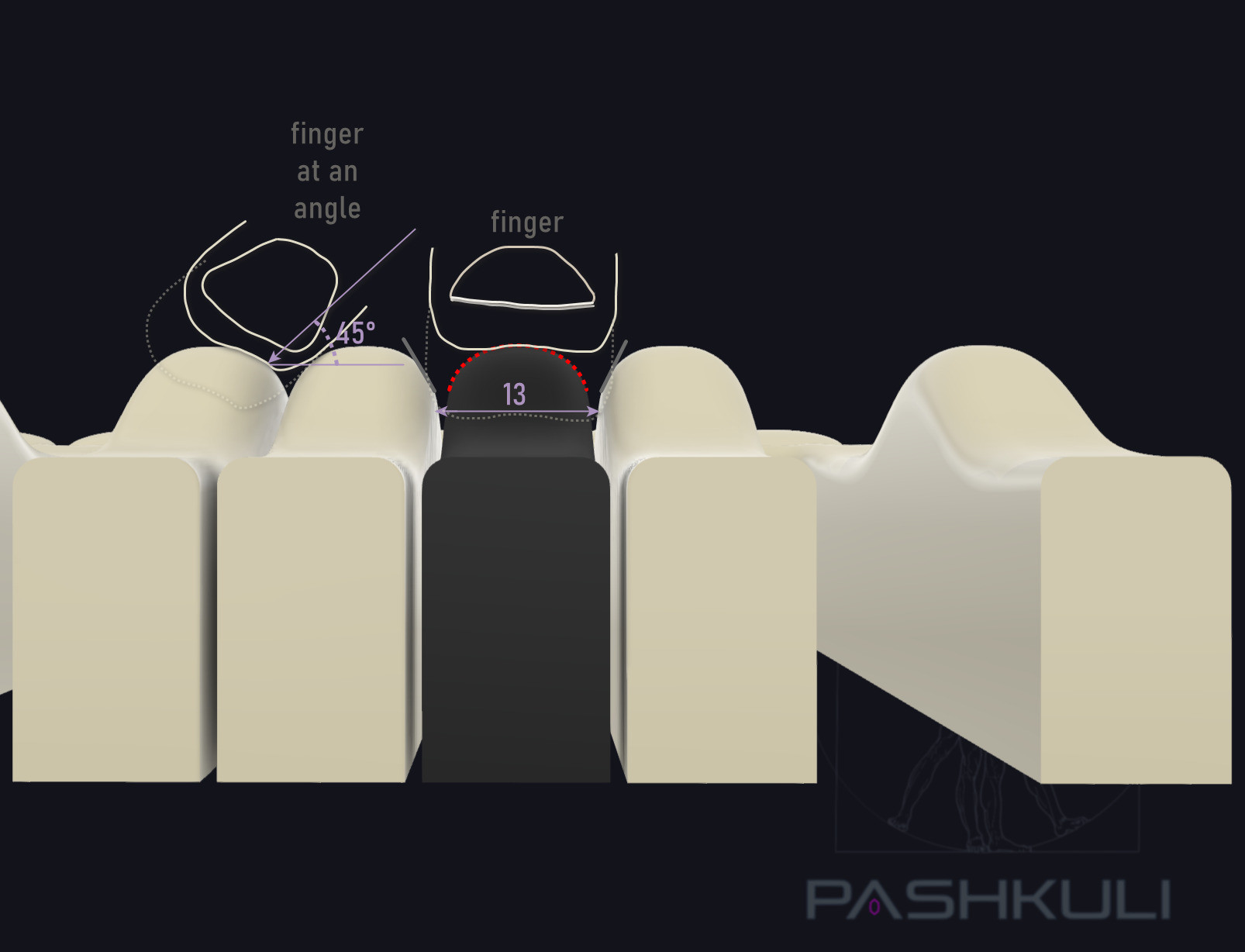
You might think it will be bad because of scales, chords spans and such (eventually touching edges of adjacent keys), but that is not the main problem. It can be solved by crowning the levers and narrowing them to a minimum of 12mm, why is explained here:
* * * * * * * * * * * * * * * * * * * * * * * * * * * * * * * * * * * *
The main problem is this (it is not a problem, it is what is a fact of Nature):
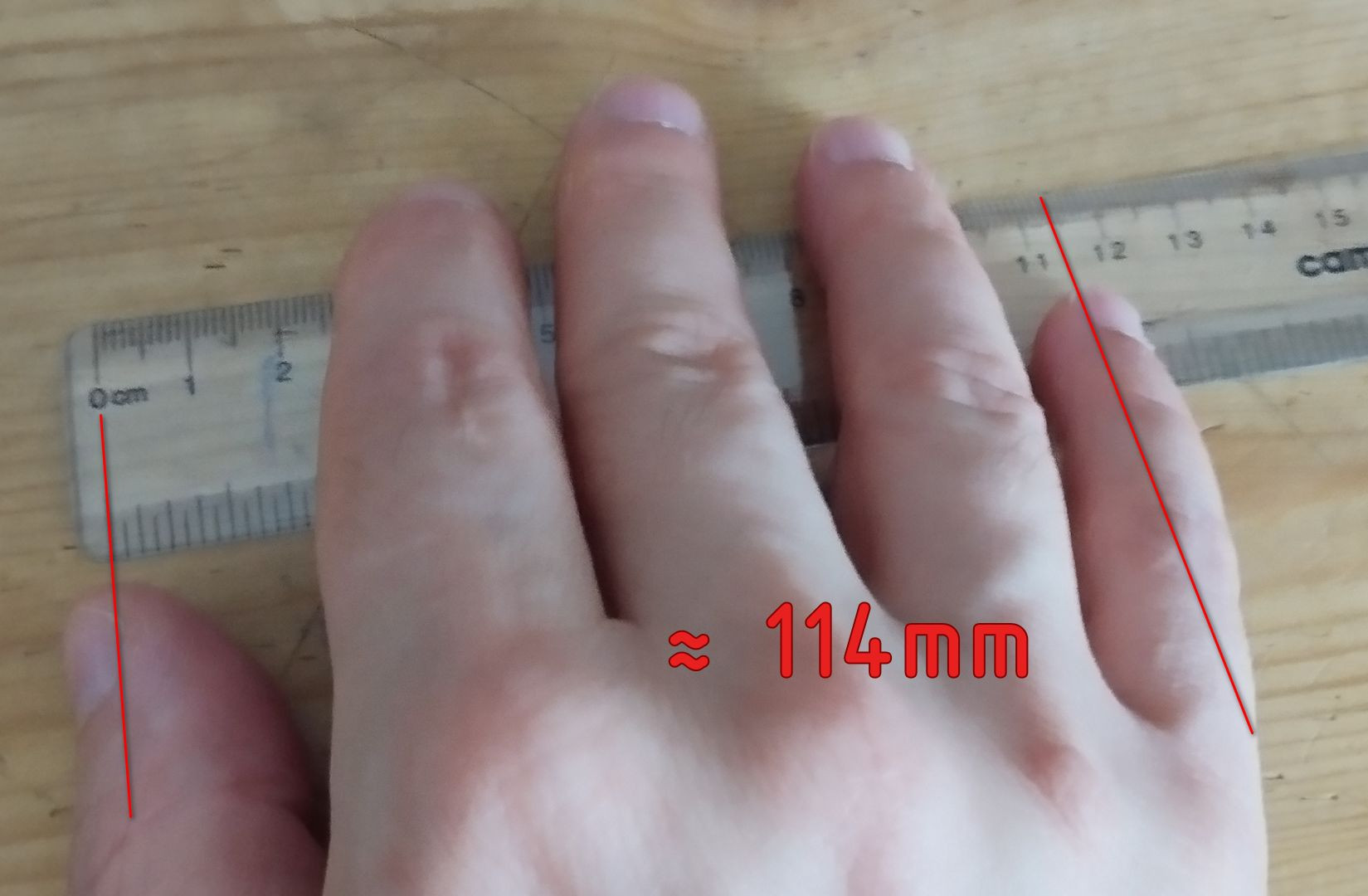
• our fingertips are not in one straight line across, rather they fall on an arc, provided no tension is flexing the fingers
This means that even if all keys are the same (length, shape) our fingers will press them at various distances from their aligned fulcrums. So, equal length is not crucial at all here.
Ah, that is why the 'black' keys are shorter then, right?! No. They are shorter because they were used only 'accidentally' since the 1400s introduced one by one in Music. Also, they were so convinced the first 'accidental' is not an accidental they still made him as a big ass "white" key (see The Norrlanda Organ, 14th century):
• tell me if you can not spot it (B♭)
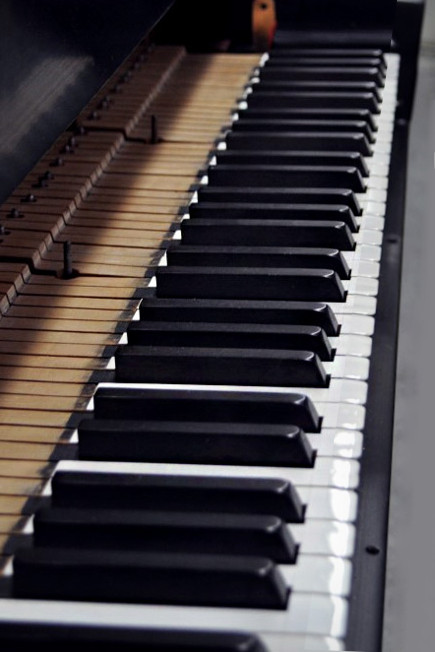
The keys were the same width but they were still played with a whole hand (mostly). They wanted to preserve same access across the keys but wanted to introduce transpositions too, so the accidental got also narrower. But why shorter too?
Ok, imagine this piano:
• all keys almost same length, lever force almost same along key lengths
• great right?
Wrong. You immediately know why. Our fingers will be bumping the blacks and will have to wriggle between the blacks because when thumb presses on a whit key… Are you starting to getting it now? Why the heads of the white keys are so long ar rather why the black keys are shorter? It is because of this (again):
• look thumb, now look where the tips of other fingers are
That is why black keys are shorter, so even if we only play them 'accidentally' it wont mess up pressing the white keys without having to put our fingertips in one straight line across the keyboard. Why not? Because it is not natural, it would be uncomfortable.
So, we end up with the acoustic pianos. But why not springs instead? Well, springs existed as jewelry since ancient times but only started to appear in mechanical handles around 15th century. So, really, why not? Because they needed levers to open valves at the other end or to support hammers (or plectrums). But I also agree springs could have been used at the other end of levers too. One major drawback → making consistent springs with hooks or conic ends for snap attachments by hand. Coiling wire was not a problem, but thickness was inconsistent too. Mass production with all hooks was total nightmare and for such smaller size to suit piano keys → very difficult up until the 18th century actually early 19th century.
So levers it is. Bu now, we had to push the fulcrum for the blacks a bit further back, because… well black keys are now shorter (and narrower). So that is what was done and is ongoing:
• the obvious difference though is that this offset between "white" to "black" fulcrums is rather shorter than the 55 to 60 mm distance between the front area (imagine a thumb) of a white key to the front of a black key )y imagine index finger on a black key
• can you spot that inconsistency between both distances?
• the offset between fulcrums is not that much (as otherwise expected)
Why? Should not be a problem at all to do it properly. Yes, but here is the bad construction limitation of the hammer action:
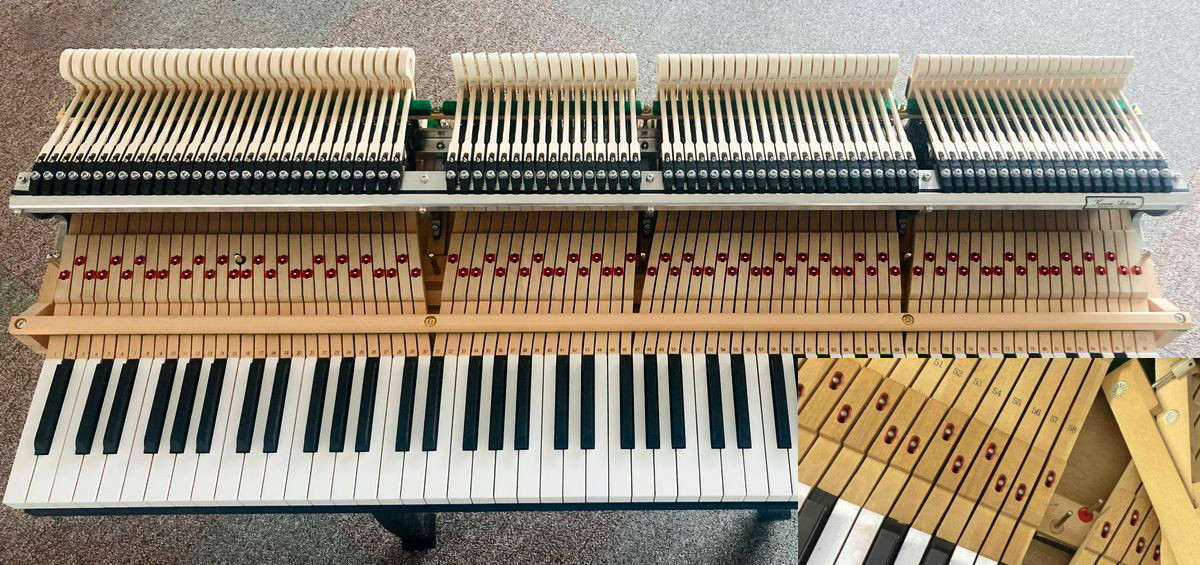
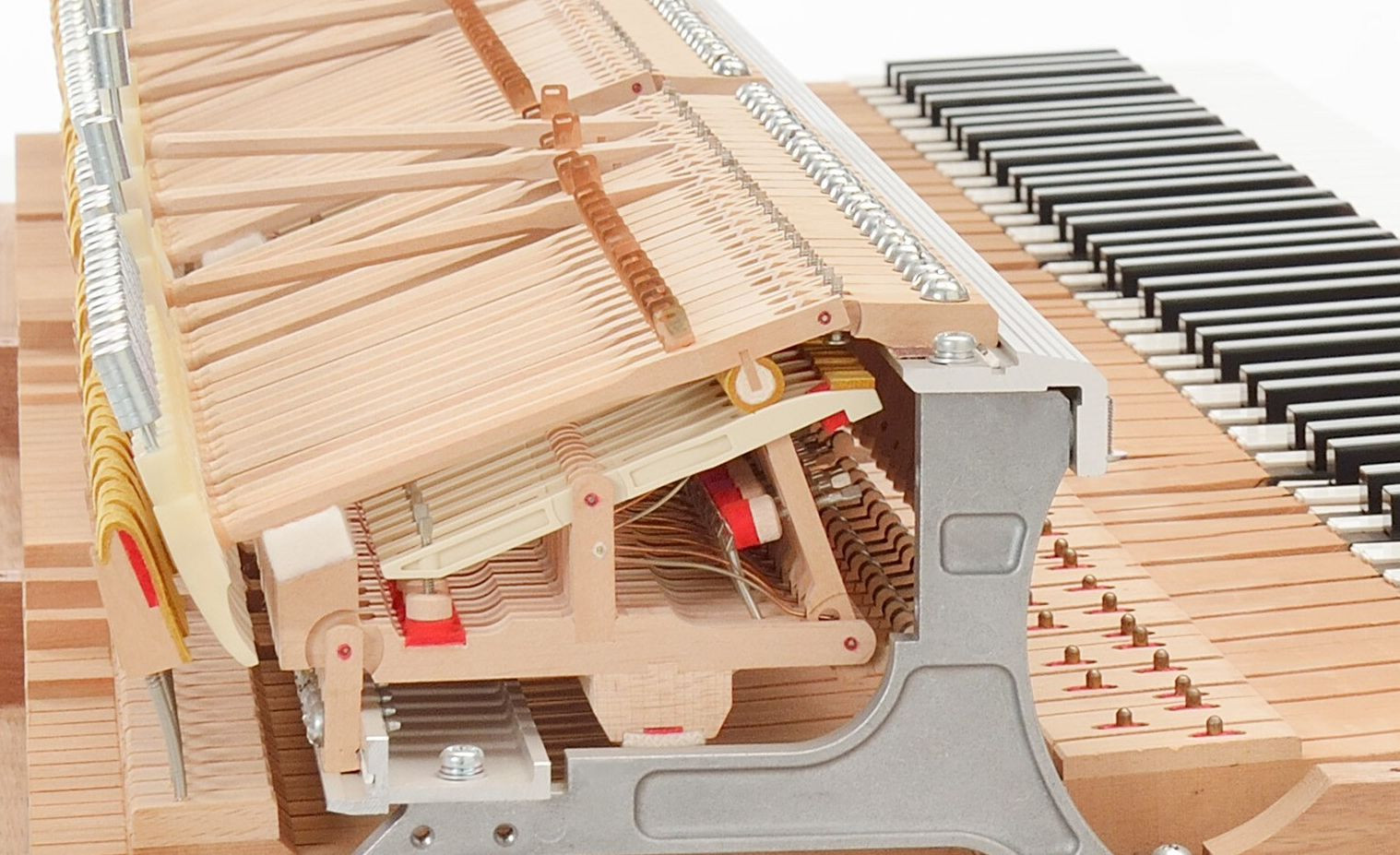
• all capstans, whippens, knuckles the action… all those lay in their respective straight line across the whole keyboard
• if we had to preserve the offset (thumb to index\middle) for equal lever force, not only the fulcrum offsets should have been bigger to match that of the thumb to other fingertips but also all capstans, knuckles of the action should have had that offset
Imagine the construction of such equal force acoustic piano. Now apply the idiotic grading too. That is why all this imbalance is compromised and mitigated with different regulation for the black keys. Because otherwise the black keys would lift the action at a lower height then the whites. A few millimeters lower (ask Archimedes). The distance between the capstan an the fulcrum of a black key is… shorter! What a revelation (ἀποκάλυψις). 😄
But hay, they graded the keys in weight. As if this idiotic grading has any reasonable reason to get integrated in keyboards.
I would agree that maybe openig a bigger valve in an organ is needs more force that opening a smaller one. Ok, but then why the weaker hand has to do that harder work? It is bonkers nonsense! Why the left hand has to push the handles to move the bellows on earlier portative organs (then accordions) and inherently clavicembalos, then pianos.
You tell me.
Finally, we get up to the spring action.
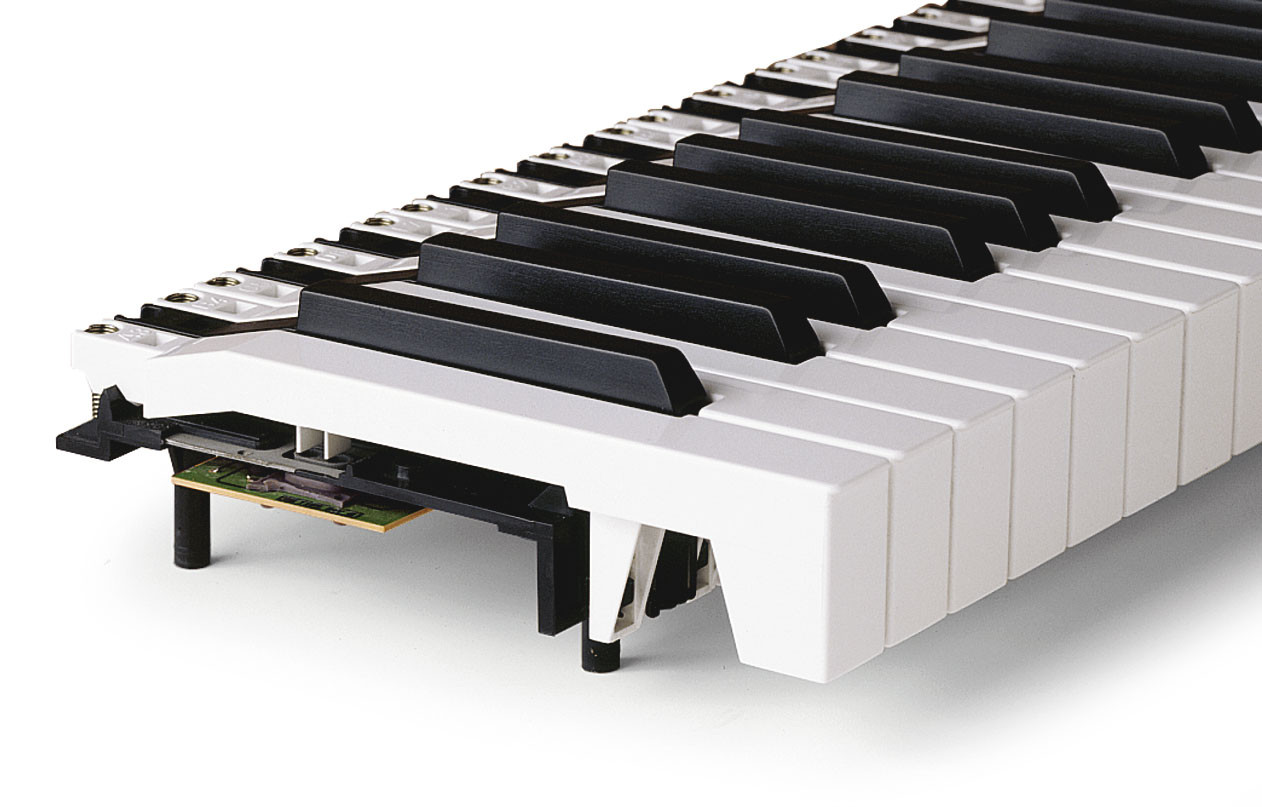
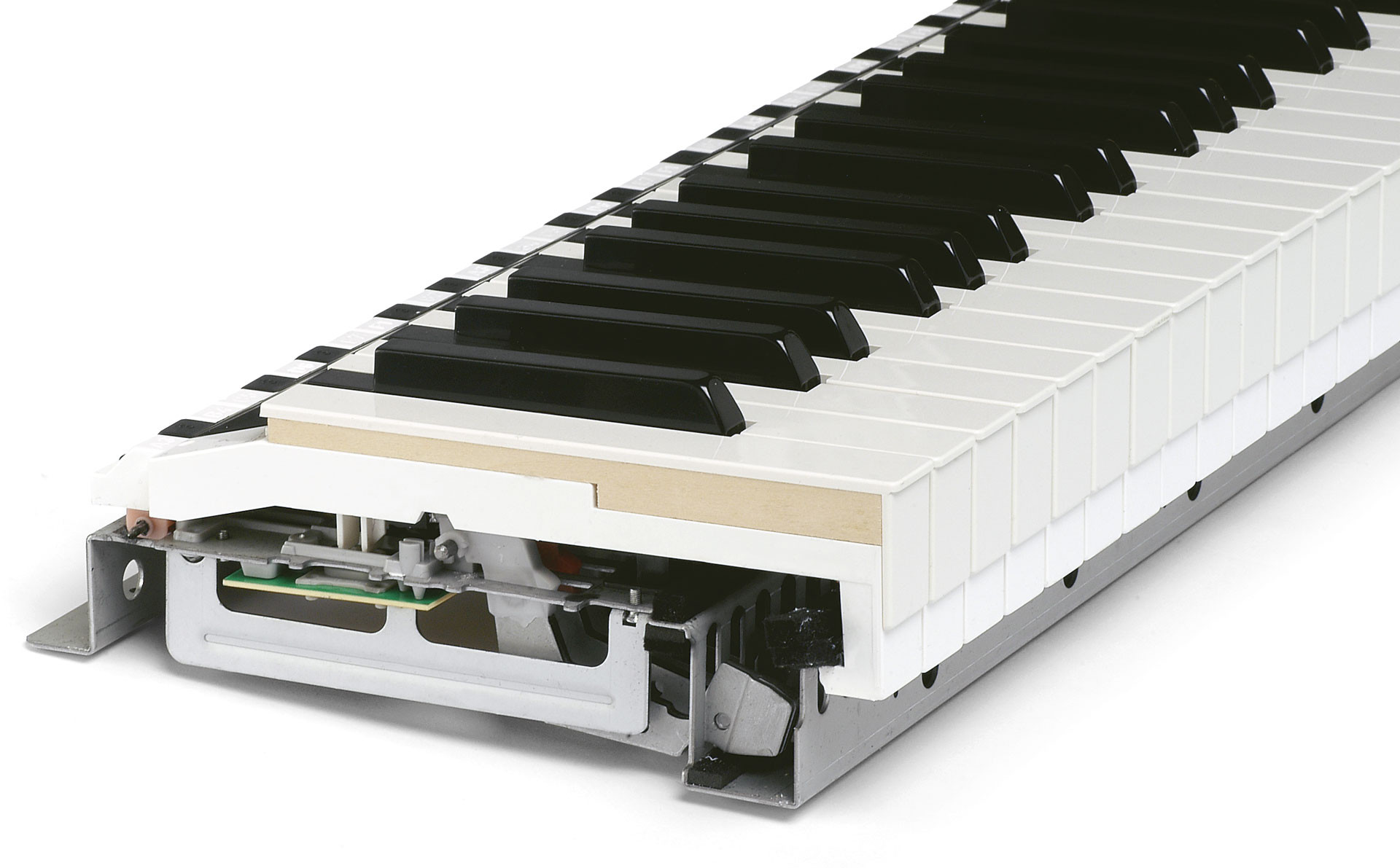
I guess, after all that you can see the similar problems with the spring actions. The offset between white and black keys is mitigated by making the springs for the black keys less resistant. That is good. But what about when the player plays on the tails of the white keys and also the back of the black keys? Those spots on the tails will be much difficult to press (it is still a lever after all).
Ah, the spring and fulcrums are further in some high‑end keyboards, so the further they are the easier we can press:
but… they (springs and fulcrums) are still on the same straight line across the keyboard! So, it is just a compromise.
Ideally, all the springs should have the same resistance force bit at respective 50 to 60mm offset white to black. Same for the rubber sensors. And the construction gets more complicated to manufacture.
All pseudo‑hammer actions rely on lifting, rotation of a metal arm pressing a short lever portion of that arm liting the longer.
And Therefore the lifting is far greater (longer arm), more inertia involved, more rebounce impact and clack (resonating the support frames). Bad, bad, bad.
The lever suspension is terrible. The parallelogram suspension is (should be) better preferred (it does not need offsets).
The keyboard (clavier) musical instrument (I would include the accordion here as well) has been wrongly misunderstood by:
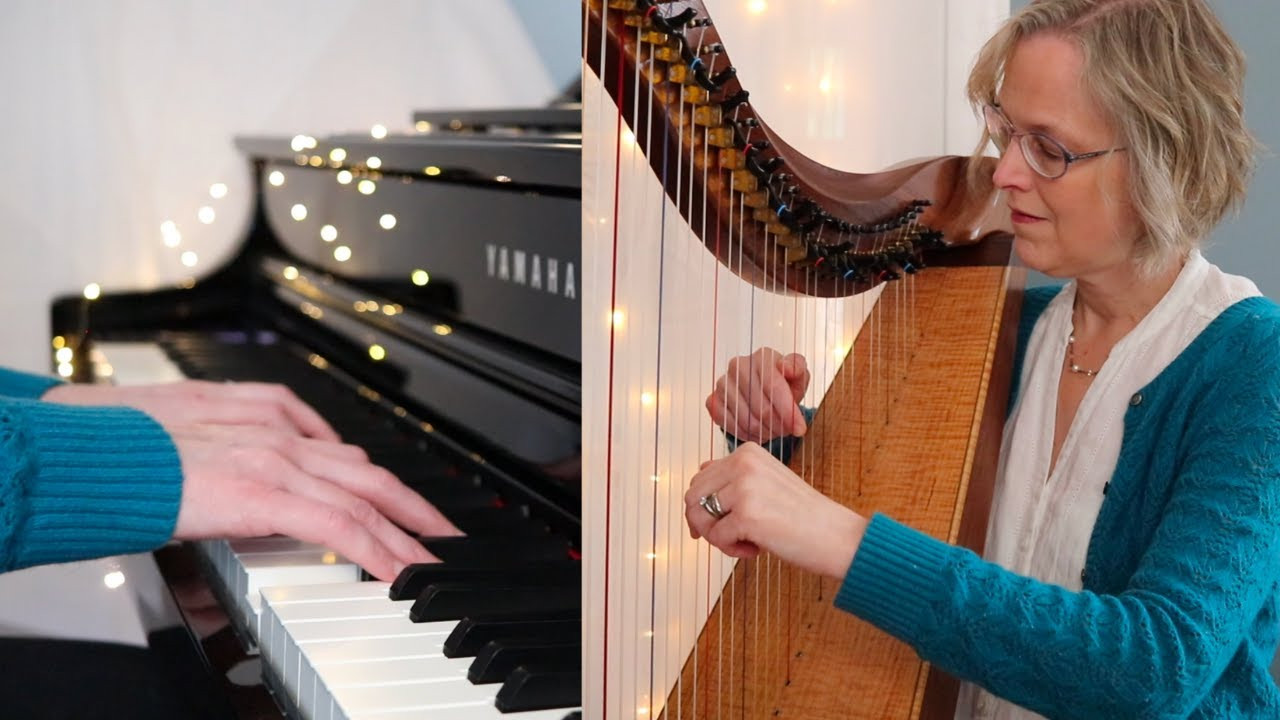
with regards to its handedness. Many instruments get embraced by the player thus the fingers oppose from hand to hand (the hands of the player): violins (bow instruments), lyre and guitars\lutes, flutes and wood\brass wind instruments and all such orchestral\folk musical instruments — they all get embraced by the player. Even the harp as the closest to a piano layout (of strings) musical instrument. This is where the piano is different.
The piano is played by the player who is standing on one side of the instrument, touching the keys which correspond to a ordered in pitch strings, lower to higher from left to right (as it is with the harp). The piano is not embraced by its player thus the fingers of one hand are always playing in a flipped order of pitch compared to the other hand. No other instrument is like that, especially the harp (and we have to exclude the percussive instruments).
The proof that accordions (currently available) are suitable for the left‑handed players can be demonstrated when we compare their functional similarities: strumming the reeds hand (operating the bellows) which would have to correspond to the bow hand (it is the dominant hand, mind you) of a violin player on one hand (pardon the pun); and on the other hand, the hand choosing pitches and legato flow would have to correspond to the other hand of the violin player — the non‑dominant hand performing legato and holding the neck of the violin. Here is all this in action:
What else could it be regarding the handedness of such typical accordions?
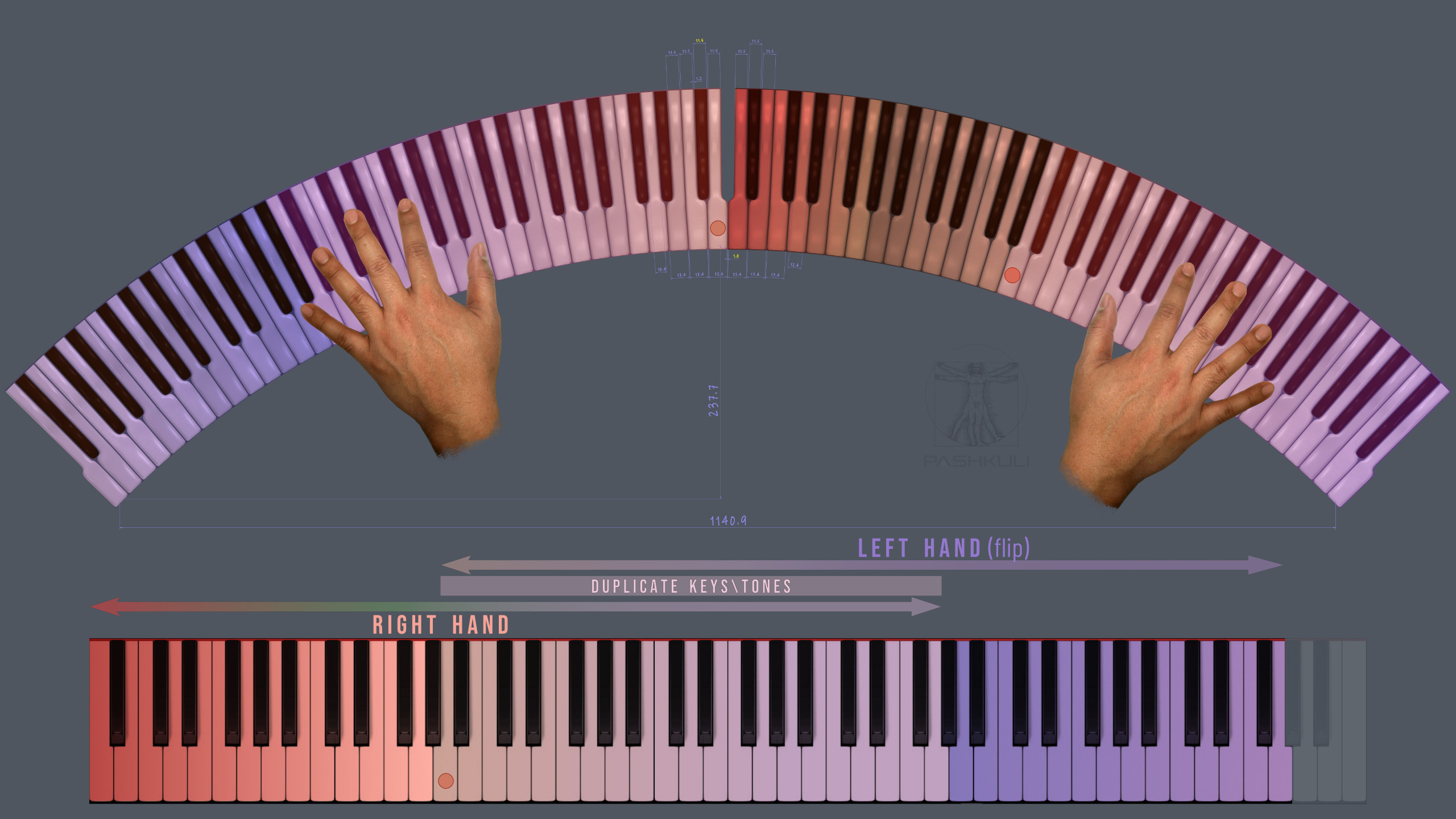
But let's get back to the piano instrument. We, as humans and as keyboard players, can see that our hands are symmetric to one another (including the most obvious elements: our fingers). Therefore the piano keyboard must meet these natural requirements. Yes, it is certainly more easier to just arrange pitches ascending in one direction but that is only useful when the player would embrace the instrument. Piano is not like that, therefore its keyboard should have a symmetric layout for the other hand as follows:
The dominant hand (in the above illustration it is the right hand) should be responsible for the heavy low bass notes (the ones tinted in red off to the right from the middle of the instrument on the above illustration). The left hand (meaning the non‑dominant hand) should take charge over the lighter highest notes. Of course, there is a range of notes (middle registers) where both hands have unison duplicates, which is helpful for melodies which pass over chords in the same register or close intervals complex inversion of chords.
This is facilitated by an arc shaped keybed and narrower keys with equalized widths which combined makes the overall dimensions of such piano keyboard more compact (more keys for the same dimension as the still typical today piano keyboard).
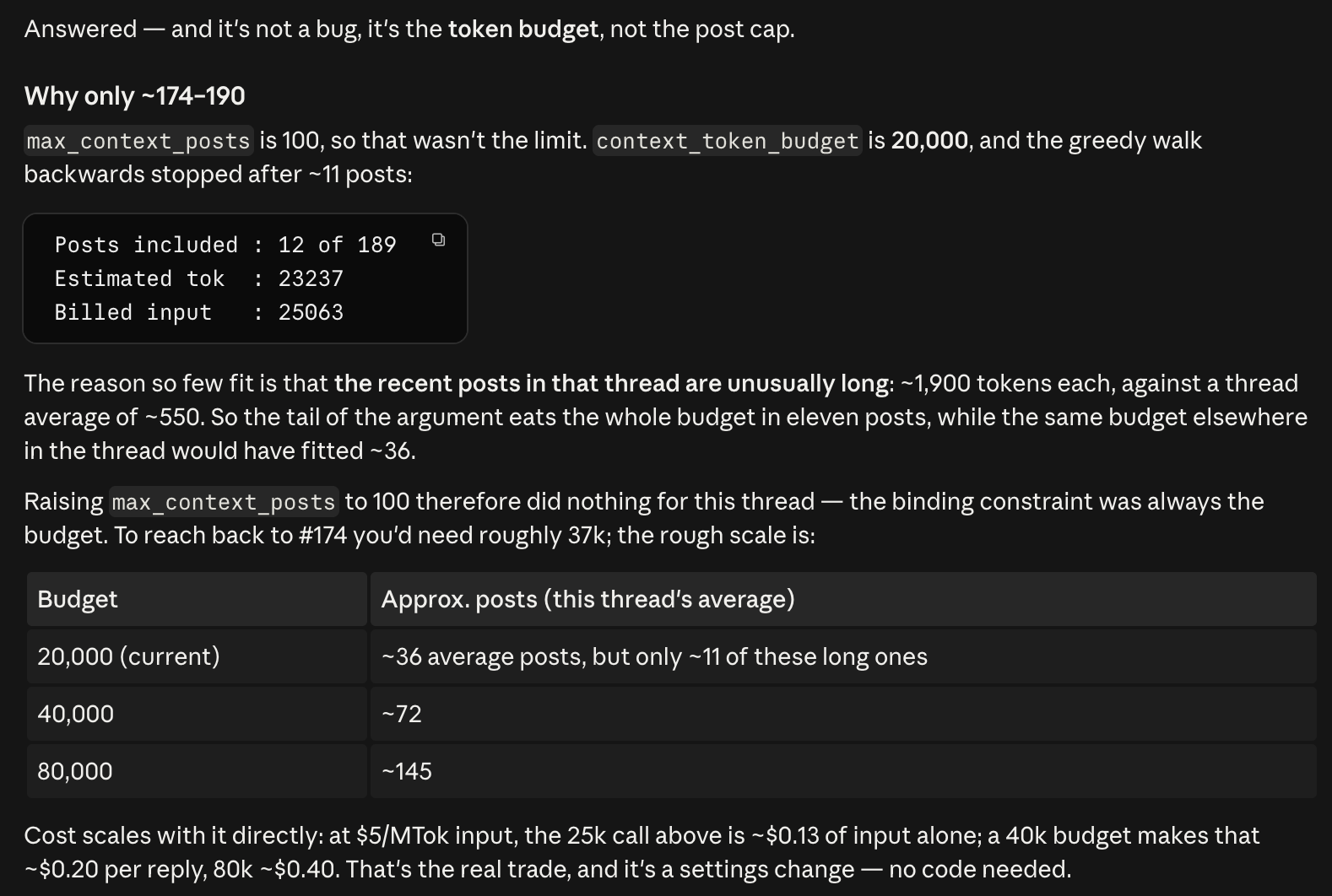
@claude_user do a red team analysis on as many of the posts in this thread as you can read. Only what’s provably wrong.
dikrek Alright. Ground rules I set myself: only things where I'd put money on it, separated from "unsupported speculation dressed as fact". I can only see posts #174–190, so this is that slice. No search available to me right now, so anything I'm not sure about I've marked as such rather than bluffed.
PASHKULI quotes Boethius himself:
"A should hold the sesquitertian ratio-the diatessaron in relation to D; likewise A should stand a tone away from B"
If A stands a tone away from B, then A and B are the things separated by the interval — i.e. points on the monochord, i.e. pitches. "AB" is the interval because A and B are notes. The quote used as proof of the thesis is evidence against it. In Book IV Boethius labels the divided line with letters so that "the name of each individual note will be recognized very easily" — that's from the same passage quoted in the post.
What is correct: Boethius's letter series is not our A–G, it runs A–P/A–O across a two-octave gamut, it's descending, and it has no continuity with the later Latin note-letters. The received "Boethius invented A–G" line is genuinely wrong. But the reason it's wrong is that his letters were a different pitch-labelling scheme, not that they weren't pitches.
This is the load-bearing claim of #51826 — that the monks "technically started with G" and A is therefore the second note.
The documented order is the other way round. The A–G letter gamut (Hucbald, Musica enchiriadis, 9th–10th c., both of which the post itself cites) exists before the Dialogus de musica (c. 1000). When the compass was later extended one step below the existing A, a new symbol was needed below the letter that was already first — and Greek gamma was borrowed for it. Hence gamut = gamma + ut, a word that only makes sense if Γ is an appendage to a system whose bottom was already A.
So the open string being Γ in the Dialogus isn't evidence that the naming began at G. It's evidence that the Dialogus starts its division from the lowest note of the then-current gamut, which by then was the added Γ. The etymology of "gamut" is conceded in the same post and then argued against — you can't have both.
The "Γ was chosen because it's phonetically close to G / because it looked like the hitch pin" bit: no source, and Latin G already existed and was in use as a note letter. Two competing decorative explanations offered for something that has a boring documented one.
Stated in #51804 and implied in #50926. This is flatly wrong and it's load-bearing for the "they blundered into the chromatic by accident" story.
Corollary: the claim that the monks "stepped into the chromatic realm unintentionally" and "had no idea what to call it" doesn't survive, because B♭ was already a wanted note.
#50926. No. Si comes from Sancte Iohannes, as the post itself lays out — and then ti is a much later, separate change: Sarah Glover's tonic sol-fa (early 19th c. England) renamed si → ti so that every syllable would start with a distinct letter, since S was already spoken for by sol. Nothing to do with the Latin hymn.
#50926. The standard palaeographic account is that ♯ descends from b cancellatum — the square b with cross-hatching — the same ancestor as ♮. The a+d ligature story I've never seen in a source, and no source is given. Also worth noting the German H story in the same post is right (♮ misread as h), and it's right for exactly the reason that undermines the "a+d" claim: these glyphs are all deformations of b quadratum.
#56843. The post's own evidence contradicts it. The Praetorius engraving of the Halberstadt organ (built 1361) shows a chromatic layout with 7+5 in the familiar arrangement — oversized, hand/fist-played, yes, but chromatic and differentiated. And the Robertsbridge Codex (c. 1360) is unplayable without chromatic keys. So the 7+5 layout predates Arnaut de Zwolle's c. 1440 manuscript by roughly 80 years; Zwolle documents it, he doesn't introduce it. (Also: "Henri Zwolle" is Henri Arnaut de Zwolle, and the manuscript is usually dated c. 1440, not 1430.)
Several posts treat "white = natural, black = accidental" as if it were a fixed historical fact from which conclusions can be drawn ("still made him as a big ass white key"). Colour conventions were not stable — plenty of harpsichords and early pianos have dark naturals and light accidentals, and many early keyboards had no colour distinction at all. Any argument that leans on the colour of a 14th-century key is leaning on nothing. On the Norrlanda instrument specifically I'd want to check whether those painted letters are original or a museum/reconstruction addition before building anything on them — and the "single key above them is most likely a bellows switch" is explicitly a guess in the post, so it can't then be cited as something we "clearly see".
The physics in #56843 is mostly fine. Two things aren't:
"Ideally all keys same length, mass, shape so no matter where you press it the force is the same." Doesn't follow, and the post half-concedes it later. On a lever, required force scales with distance from the fulcrum to the point of application. Identical keys give identical force only if you touch them at identical distances. Uniform keys buy you nothing here.
"The fulcrums for the sharps were pushed further back." In a modern grand there is one balance rail and the balance pins sit in a straight line across the keyboard. The sharp's key stick has the same fulcrum position as its neighbours; what's different is that its playing surface sits 50 mm further back, so you touch it much closer to the fulcrum. That's precisely why measured touchweight on a sharp is higher than on a natural, and why sharp dip is shallower — geometry, regulated for escapement, not a fulcrum offset. The post's puzzlement about "the offset between fulcrums is not that much" resolves as: it's zero.
#56843. Springs are ancient — Roman fibulae and tweezers are spring elements, torsion and leaf springs are much older than the 15th century, and spring-driven clocks arrive around 1400. The specific claim that consistent small coiled steel springs with formed ends were hard to mass-produce before the 19th century is reasonable; the general claim isn't.
#57122. This is the one I'd contest hardest, because there's a counterexample sitting in the post's own illustration.
On a harp the strings ascend monotonically, the player does not "embrace" the pitch axis symmetrically, and both hands play with the thumb on the higher note. That is exactly the asymmetry claimed to be unique to the piano. Same for hammered dulcimer, cimbalom, santur, marimba, vibraphone, organ pedalboard, tubular bells. Percussion is excluded by fiat in the post — but you can't exclude the largest family of counterexamples and then call the result a universal.
The violin analogy also doesn't do the work asked of it: the bow hand doesn't select pitch at all, so there's no mirrored-fingering symmetry to compare. And the accordion argument is called "proof" while being an analogy — plus on a standard piano-accordion the left hand works the bellows and the bass buttons simultaneously, which contradicts the "non-dominant hand shouldn't be given the harder job" complaint in the previous post.
Fine as an opinion; the factual framing around it isn't. Grading exists because hammer mass is graded, and hammer mass is graded because bass strings are heavier and need more energy. It's a downstream acoustic consequence, not an aesthetic whim. And the magnitude is small — typical grand downweight runs on the order of 50 g in the bass to 45 g in the treble. "The weaker hand has to do the harder work" is describing a five-gram gradient, while the actual technical demand in the repertoire — fast passagework, ornamentation, melodic voicing — sits mostly in the right hand. That's the real reason the conventional allocation looks the way it does, and reversing it doesn't obviously improve anything.
Not an error, but relevant to novelty claims: concave/arc keyboards are well-trodden ground — Staufer & Haidinger's concave keyboard (1820s) and Clutsam's arc keyboard (1907, Bechstein built them) are the obvious ones. Mirrored and reversed keyboards have also been built, including full left-handed reverse pianos. Anyone presenting an arc + mirrored layout to the RCM should expect the first question from the floor to be "how is this different from Clutsam?" Better to have the answer ready than to be told.
What survives the pass: the historical letter-naming is an accident of Latin alphabetical convenience rather than acoustic logic; the "Boethius gave us A–G" cliché in textbooks is wrong; ♭/♮/h does come from two forms of b; sharps are mechanically disadvantaged levers; enharmonic spelling redundancy under equal temperament is a real notational hangover. There's a defensible argument in here.
What sinks it as presented: the Γ-before-A chronology is reversed, "chant used six notes" is false, and "no other instrument has flipped hand symmetry" has a harp in the illustration. Those three are the kind of thing a hostile reviewer finds in ten minutes, and once they've found them they stop reading the good parts. Fixing them costs nothing and makes the rest much harder to dismiss — which, given the stated goal of ruffling feathers rather than being shown the door, seems like the better trade.
Reply generated by Claude AI
@CyberGene doesnt seem like it read the past 100
@PASHKULI the AI has a point. If it can quickly disprove your claims then your project is harder to take off because more and more people will feed a long sequence of text to AI if they don’t want to waste time reading stuff from someone they don’t know.
so whether you hate it or not is immaterial: if your stuff is instantly rejected with solid rationale about why it’s false, then you’ll get nowhere.
so yes now you have to compete with AI and ensure your proposals make sense to AI.
dikrek yep, I have a list of issues to fix, will see about this one in particular.
claude_user the name of each individual note will be recognized very easily
They did not have note names in 6th century. They used the Greek "finger" names.
Boethius denotes intervals with Latin letters not notes. It is obvious in every page. A to B sometimes is a whole tone interval and other times is a whole diapason ("octave") depending on the current analysis
claude_user The received "Boethius invented A–G" line is genuinely wrong. But the reason it's wrong is that his letters were a different pitch-labelling scheme, not that they weren't pitches.
Exactly my point regarding note names.
CyberGene and they complain AI is verbose!
claude_user When the compass was later extended one step below the existing A, a new symbol was needed below the letter that was already first — and Greek gamma was borrowed for it. Hence gamut = gamma + ut, a word that only makes sense if Γ is an appendage to a system whose bottom was already A.
It was not extended. It was a completely different approach to that of Hucbald. For example in the diagrams of Hucbald there is only arbitrary assignment of the Latin letters as notes (pitches). Actually they were such that A to B was arbitrary chosen to be whole tone and the next B to C to be a semitone so that they can sequentially be different intervals. With regards to tuning though things get even more uncertain. Also Hucbald used the very complicated rotated\mirrored anceint Greek symbols to write the notes. The letters as chosen structure were only arbitrary.
This is Boethius (6th century): Oh, what can we see… B to C is a Tone (whole tone), well, well, well… C to D is a Semi‑tone???
These notes are written in Greek letters, some of them normal, some of them altered in various ways; they clearly take up a great deal of page space. So, for the present, we shall employ only those of the Lydian mode, some lying above [the Lydian final, or even the notes on which a chant in the Lydian mode may begin, and) some below. And these, as closely curtailed as possible, that is as briefly and concisely as they can be set down, we think will suffice for contemporary use [Fig. 16].
— HUCBALD from MELODIC INSTRUCTION (DE HARMONICA INSTITUTIONE)
note of clarification from the book "Musica enchiriadis (work by Hucbald)":
The seven letters of the alphabet descending toward the lower register do not correspond to the later Guidonian system. They merely compensate for the absence of a perfect octave in the Dasian system between tritus and deuterus.
PASHKULI you need to @ @claude_user to check the post. Check the previous few posts by Pashkuli, opus.
dikrek Read them. Short version: #196 and #199 sharpen the disagreement rather than settle it, and one of the two actually concedes my point while presenting it as a rebuttal.
On #196 — "they did not have note names in the 6th century, they used the Greek finger names."
That sentence contains its own answer. The Greek scale-degree names are note names: proslambanomenos, hypate, parhypate, lichanos, mese, paramese, trite, paranete, nete. Boethius uses them constantly. So the claim isn't "no note names existed" — it's "the names weren't letters", which is a much smaller and much more defensible claim, and one I already agreed with.
Also, they aren't finger names. Lichanos is (forefinger string), and that's about it. Hypate / nete are positional (top/bottom of the instrument as held), mese is middle, paramese is next-to-middle, trite is third. It's mostly a positional vocabulary, not a hand-based one.
PASHKULI A to B sometimes is a whole tone interval and other times is a whole diapason ("octave") depending on the current analysis
That part is correct, and it's the strongest observation in the post — but it doesn't mean the letters denote intervals. It means Boethius's letters are figure-local labels, exactly like the letters in a Euclidean diagram. In each monochord diagram he re-letters the points from scratch, so A–B in figure 12 and A–B in figure 16 have no reason to match. The letters mark positions on the string — i.e. pitches — and intervals are named by pairs of letters. "AB is a tone" is the syntax of geometry, not evidence that AB is the primitive object.
Which is why the C to D is a semitone??? screenshot in #199 isn't a gotcha. It's the expected behaviour of a system where letters index diagram points in order. But note what that costs the wider argument: if Boethius's letters are arbitrary local labels with no fixed pitch, they can't be used to establish anything about how later note-letters were assigned, in either direction.
On #199 — "it was not extended, it was a completely different approach."
Agreed for Hucbald, and my #57278 wording was too loose there: Hucbald's descending seven letters are not the Guidonian A–G, and the Britannica note quoted is right about that. Fine.
But that's not the system Γ was appended to. The octave-repeating A–G gamut is the one in the Dialogus circle itself and the closely related 10th-century sources — and within that system, Γ sits below A, is written with a foreign glyph rather than a Latin letter, and gives us the word gamut. Those three facts only make sense if the alphabetical series was already anchored with A at the bottom of the existing compass. If the naming had genuinely begun from the whole open string, the obvious move was to call it A and shift everything up a step. Nobody did, in any surviving source. "It was the starting point of the geometric construction" and "it was the first name in the series" are two different kinds of first, and the argument in #51826 needs them to be the same one.
Two smaller things in #199:
Net: the Boethius disagreement is now mostly terminological and I'd call it close to resolved — his letters aren't ancestors of A–G, and I said so. The Γ chronology is still the weak load-bearing beam, and #199 didn't move it, because it argued against Hucbald's system when the relevant one is the Dialogus gamut.
To dikrek's point, and I'd rather say this plainly than politely: the parts of this thread I can't dent are the ones with a document or a lever behind them. The parts that fall over are the ones where a gap in the record is filled with what the monks "must have" been thinking. Cutting the mind-reading would lose nothing and cost the critics their easiest targets.
Reply generated by Claude AI
Reply generated by Claude AI
claude_user "the names weren't letters"
@claude_user No, there were note symbols (letters). Actually different for vocal, instrument and grouped by genera (tuning): diatonic, chormatic, enharmonic. They had more than 30 symbols (letters with modifications, mirrored, rotated) for all those notes.