Skip to content

Pianos (keys) are badly designed!

PASHKULI

Now, let's get back to left-handed or right-handed fortepianos.
In the next fosts I will try and prove that current layout of notes on pianos are more suitable for left-handed players. Also will have to strictly point out that despite this suitability the notes for the left hand go in the wrong direction. This means that the notes for the left hand should also ascend in pitch from thumb to pinky! Then the piano will be 100% suited for a left-handed players. For right-handed players the configuration should be mirorred: left hand playes higher notes, right hand playes lower notes. Th enotes ascend in pitch from thumb to pinkie for either hand again.


PASHKULI

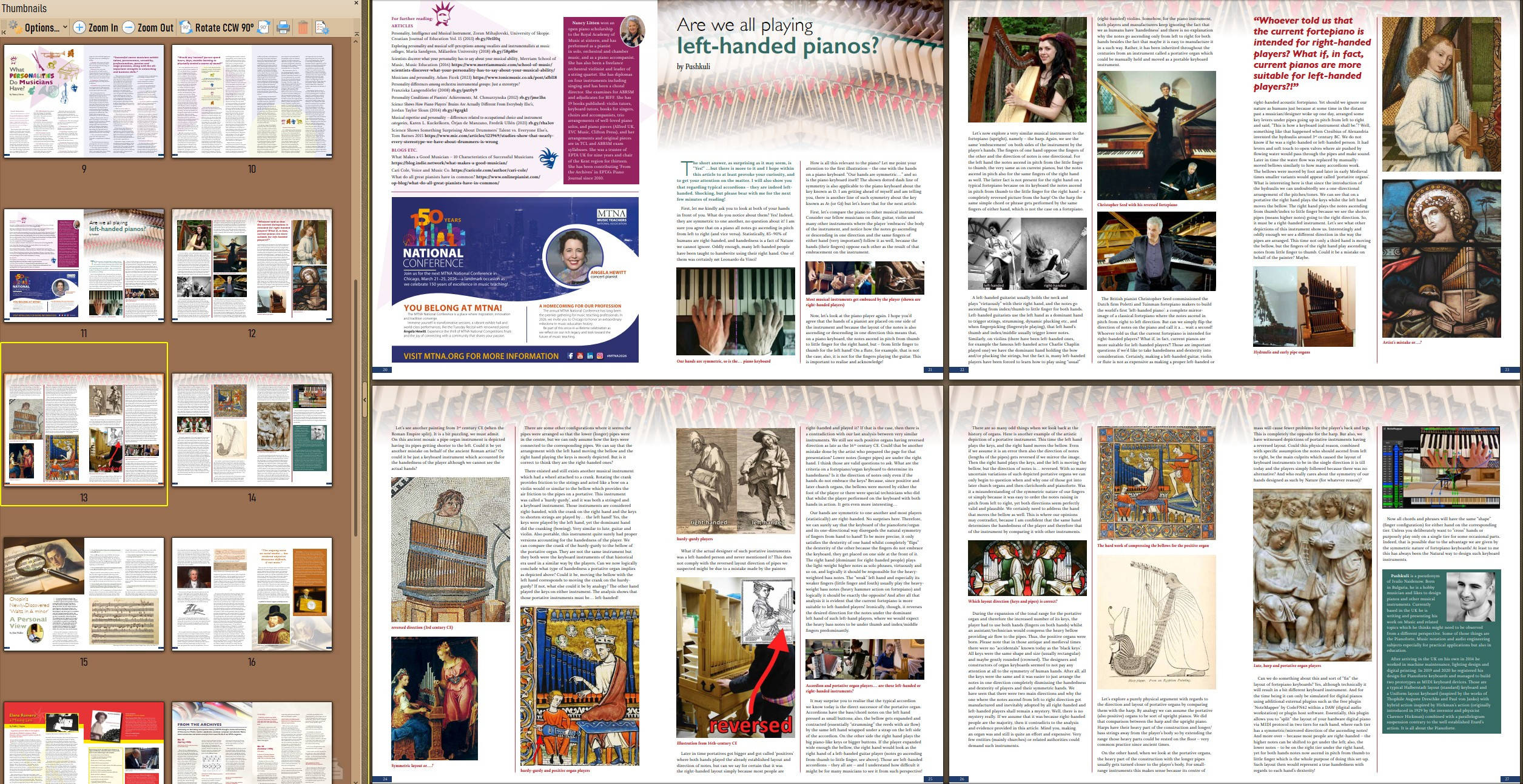
My article titled "Are we all playing left-handed pianos" has been published in the British piano magazine 'Piano Journal' (#135 April 2025). It is the UK's oldest piano magazine and the international flagship publication for European Piano Teachers.

Here is a preview:

3 more articles to follow (summer, autumn and winter 2025)

It will be available to read online (for members) at some point or order in print on their website. https://epta-uk.org/?s=Piano+Journal

I am waiting for it in the mail maybe end of this week (19-20th April 2025).

Happy reading!


xooorx

Fancy melodica with mirrored keyboards:


PASHKULI

xooorx

Do you have access to my email correspondence???
I was in the forum of Melodica a few days ago and sending this video to the editor of the magazine and Christophfer Seed. WTF?
But regardless… if you are interested you might find this really eye-opening:

It was not only I who had seen this as a possibility. This is from 1878. I simply translated it and edit out the non-essential parts.


PASHKULI

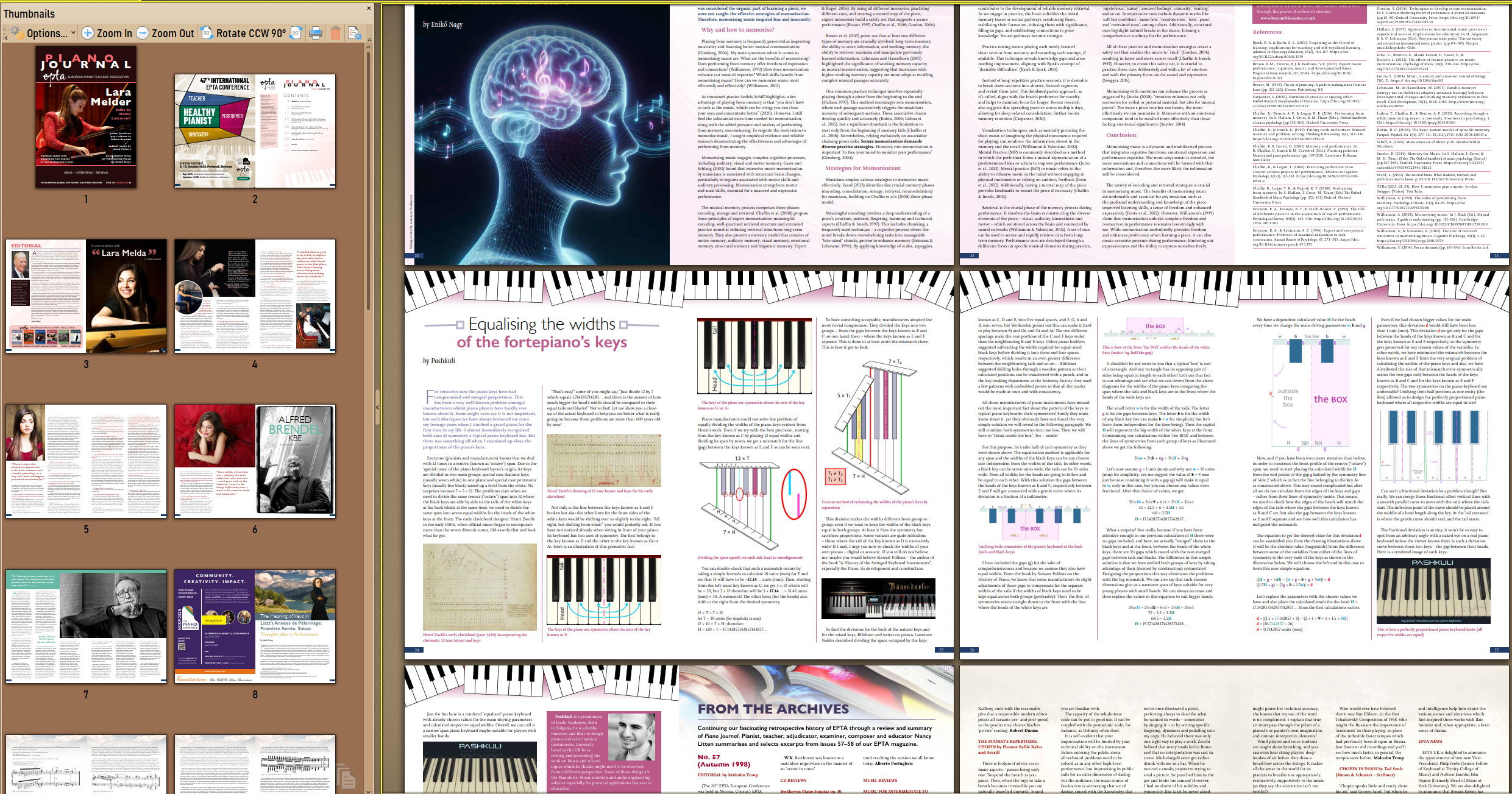
My second article regarding the discrepancies in piano's keys (widths and proportions) is in edit and pre-print for the next edition of 'Piano Journal' UK. The article is titled "Equalizing the widths of the pianoforte's keys".
After fore than 15 years of waiting (well, blatantly knocking on door to door) it happened. In 2025.

I also submitted a request to participate in the conference of 'Modern piano in the 21st century' organized by The Royal College of Music (UK, London) around mid December this same year but no response yet (the deadline is 18 of July, so they might not have a time slot for me). Three days to go. 30 min per presentation is not much though but even that is enormous for my endeavor.


PASHKULI

I am thrilled to inform you that my second article has been published by 'Piano Journal UK' in the #136 edition of the magazine coming out in 14th August 2025.
This all has been made possible by Anthony Williams who was kind enough to publish my ideas for the pianoforte so we can "ruffle some feathers" in the community.


PASHKULI

My new article has been published by 'Piano Journal' UK (August 2025) so here is the pdf format for reading:


PASHKULI

The previous article can be found here:


PASHKULI

For people who do not use Google accounts or simply browse from iPhones and other devices here is a QR code to the dropbox folder I share with many of the work I have done with regards to the piano, clavir, clavecin instrument. There is more to come…

Just scan it with your phone\tablet camera and choose to open it with your default Internet Browser.

or click the direct link below:
Piano Articles, Images and Books (works in progress)


PASHKULI

Warning: this will be a long post! Buckle up because it is about knowing and knowledge.

In my almost 30 years of interest surrounding the Piano instrument only in that (other) forum I found an individual asking the right questions I tried to ask when I was a teenager. And was ignored or dismissed as seeking problems where there are none. I beg to differ and am glad I am not the only one. I am quoting this question as found in the other forum about piano and Music "theory".
This thread is for archiving purpose or for posterity in case other people look up for it online.


The Paradigm Shift (how did we end up like this?)

Question by silph: Why are we using a naming system that names the most basic scale starting with the letter 'C'?! It seems arbitrary that the name of the first note of the most basic scale we use is C, instead of A. "Why is the note that we call 'C' on the piano, actually not called 'A' instead?".

So, why A is where it is on a piano? Why is it not assigned to a different key?

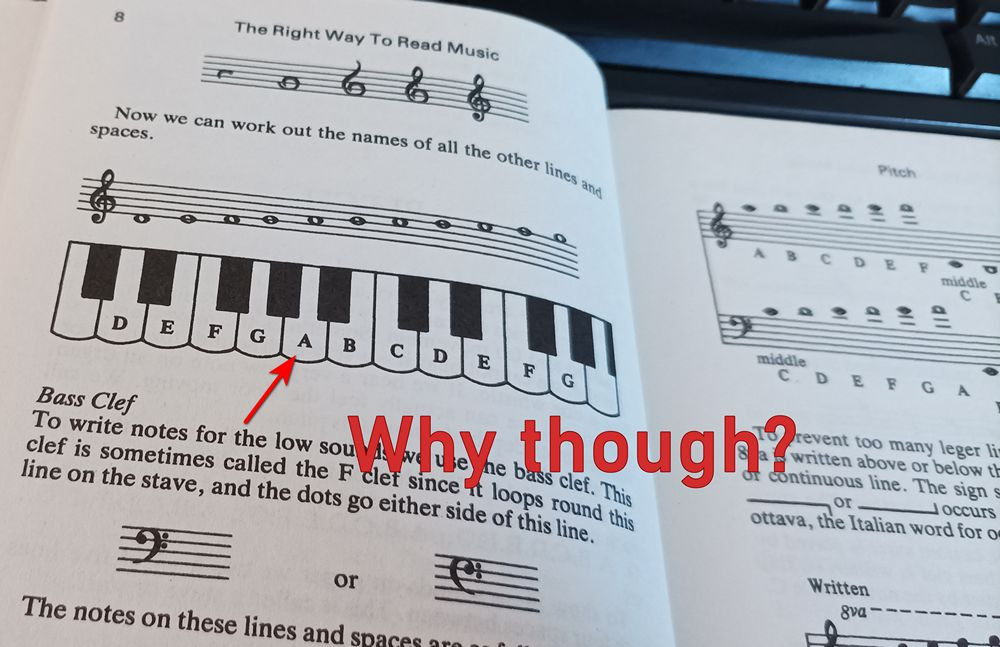
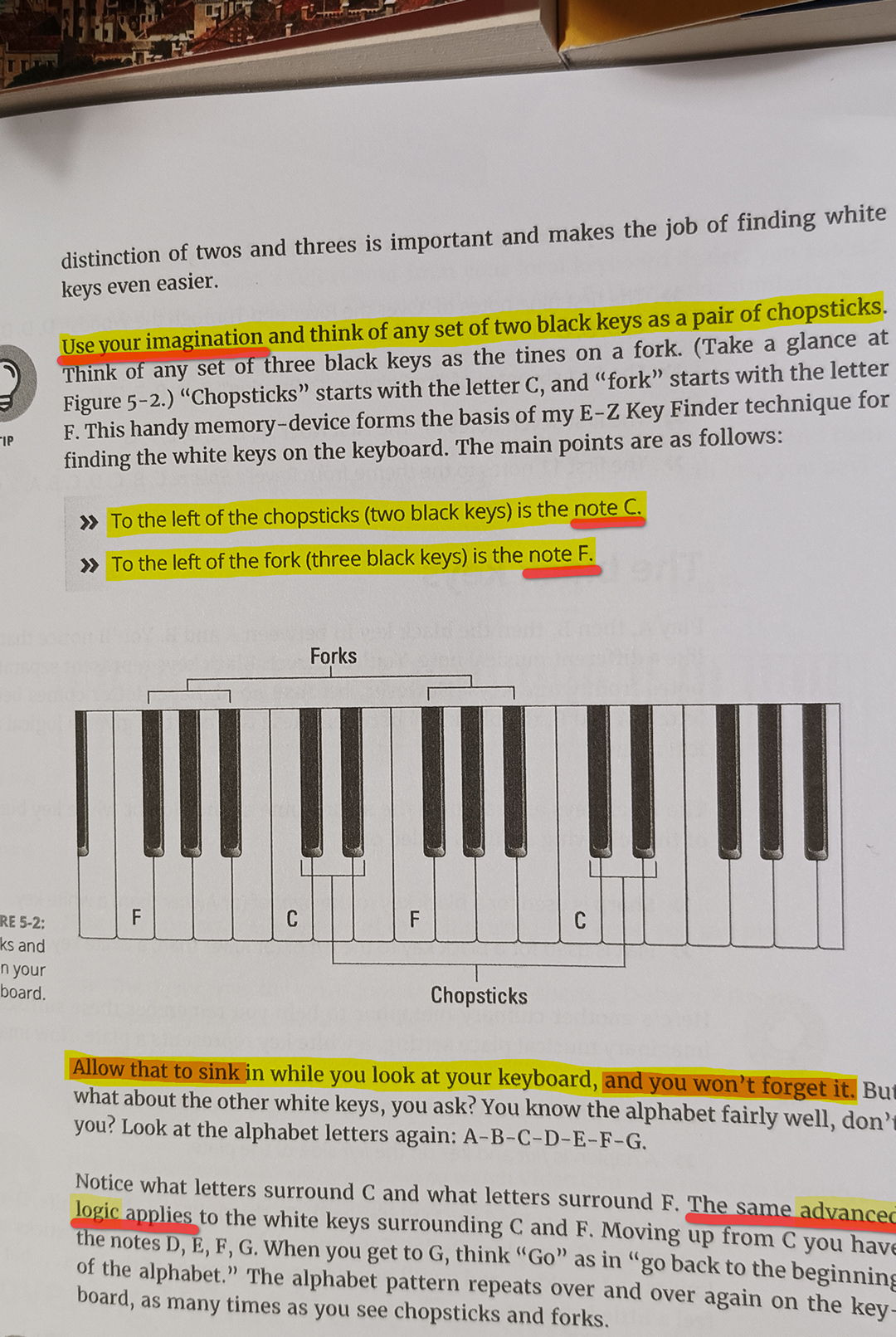
Interestingly enough (not to me though) is that all the participant besides one (much later in the discussion) could not even comprehend the question as asked by silph. I do not blame them as this type of indoctrination we have discussed in another thread and I had to visualize it with a screenshot from a book on 'Music theory'.

Another participant, kosulin, makes a quick search with 'Google AI' and cites this as the answer:

Around the year 500 AD, the Roman philosopher Boethius is widely credited with assigning the first 14 letters of the Latin alphabet to the notes of the two-octave range used during his era. The simple, systematic nature of the alphabet provided a convenient way to label notes in ascending order. The system was later condensed to letters A through G.


Hi, all
I will answer your question because believe or not it caused me to realize and express certain criticism over the so called "standard" music notation which got me banned from many forums related to Piano and Music.

We have to go way back in time… in times when the Church dominated all aspects of human activity (at least in Europe… most of Europe and consequently in America after 1500s). Also, times when Latin language was the de facto international language as today is its (indirect) successor the English language (they share the same alphabet more than less).

Contrary to popular belief, many will say that it was Boethius (end of 5th and beginning of 6th century CE) who gave us the first letters of the notes as arranged by the Latin language alphabet (he was Italian so it makes sense). That is incorrect and incomplete because all he was marking with the first 14 letters were… intervals (in his time the letter J did not exist by the way).
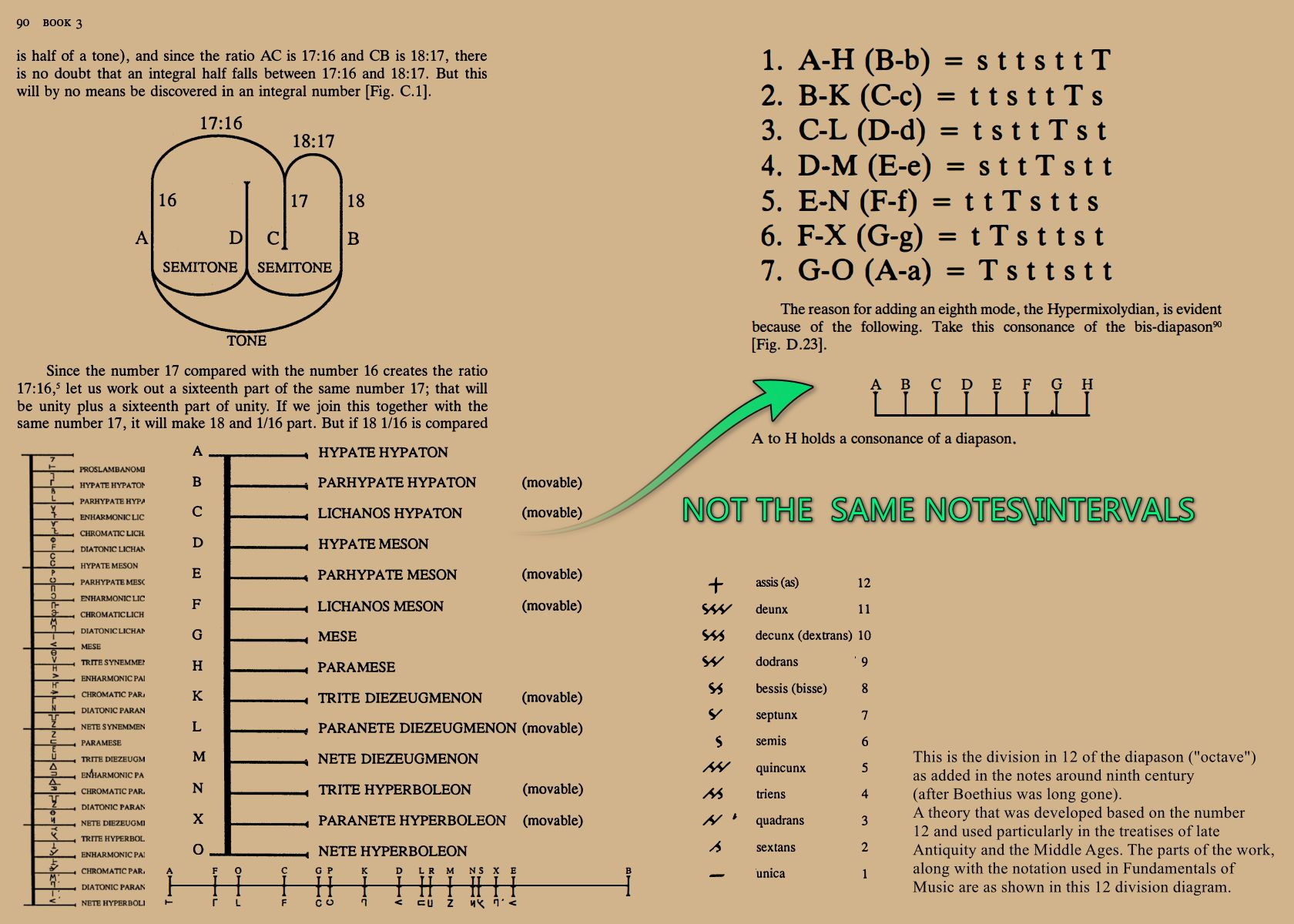
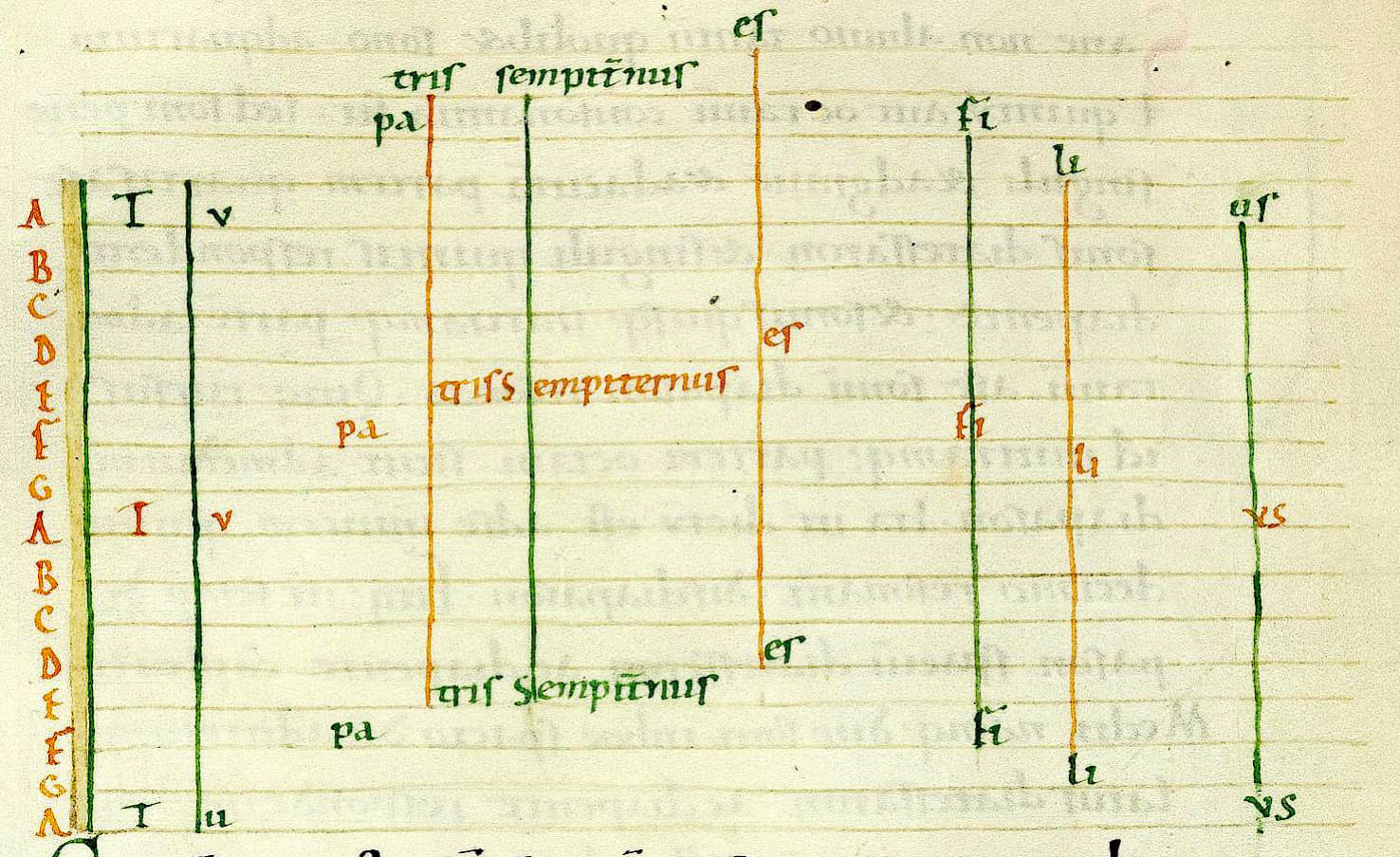
Boethius did not name the notes. A common misconception apparently is that he did. He named the intervals using the Latin letters. All notes still had their own symbols (runic like, mirrored, rotated, etc., a long story) as derived from the cumulative work of Aristoxenes and then Ptolemy and Alypius (the latter in 3rd century CE, two centuries before Boethius). In his work "Fundamentals of Music" can be seen he used AB as a full tone interval, then AD as a semi-tone interval, and DB as another semi-tone. In another diagram he would use AB (full tone), BC (again a full tone!, not a semi-tone), CE (semi-tone). AB could be a semi-tone or a tone, as it is appointed as 'movable' interval (read his work!), not a specified pitch (or string). In his work "Fundamentals of Music" we can read the following:

"Take four middle notes:
A, B, C, and D. A should hold the sesquitertian ratio-the diatessaron in relation to D; likewise A should stand a tone away from B, and B a tone away from C. The remainder, C to D, should maintain the interval of a semitone [Fig. D.22] → A I B I C I D"
— Boethius

Note: The letters only designated intervals! Above, Boethius clearly says C to D to represent a semi-tone! He used the letters as we today use them for geometry problems (or alike). No indication of pitch is given in conjunction with this alphabetical series Boethius used. The enumeration of species here may be seen as an abstract demonstration that, given a two "octave" system, one octave segment remains after the seven species have been computed, and that this segment may become the basis of an eighth mode. If this series is taken concretely, on the other hand, letter A must represent the highest pitch (the nete hyperboleon). In Boethius's numbering of species and derivation of the modes, the first species of diapason, that between the nete hyperboleon and the mese, becomes the basis for the first mode.
Only occasionally in his work certain tetrachords A, B, C, D will match the intervals "tone, semi-tone, tone". But mostly, any two of those letters would make or get other intervals, sometimes A-B is a renova (an "octave").

Boethius' influence on Music theory and nomenclature (naming notes, rather intervals)


Boethius is credited for constructing the modes from lower strings to higher as today we would call and present the scales in Music (in his time the typical representation would be downwards, where 'cadence' comes from as it was very popular modal move).
Anyway, using an alphabetic letter sequence (of a language) as a Music alphabet is a predilection and should be avoided as otherwise it dismisses other writing systems. Music must have its own alphabet and I created it long time ago. Certainly, Latin was the sort of the international (at least in Europe, so hardly ever international!) language at that time and English today as its successor but that should not be "the norm".

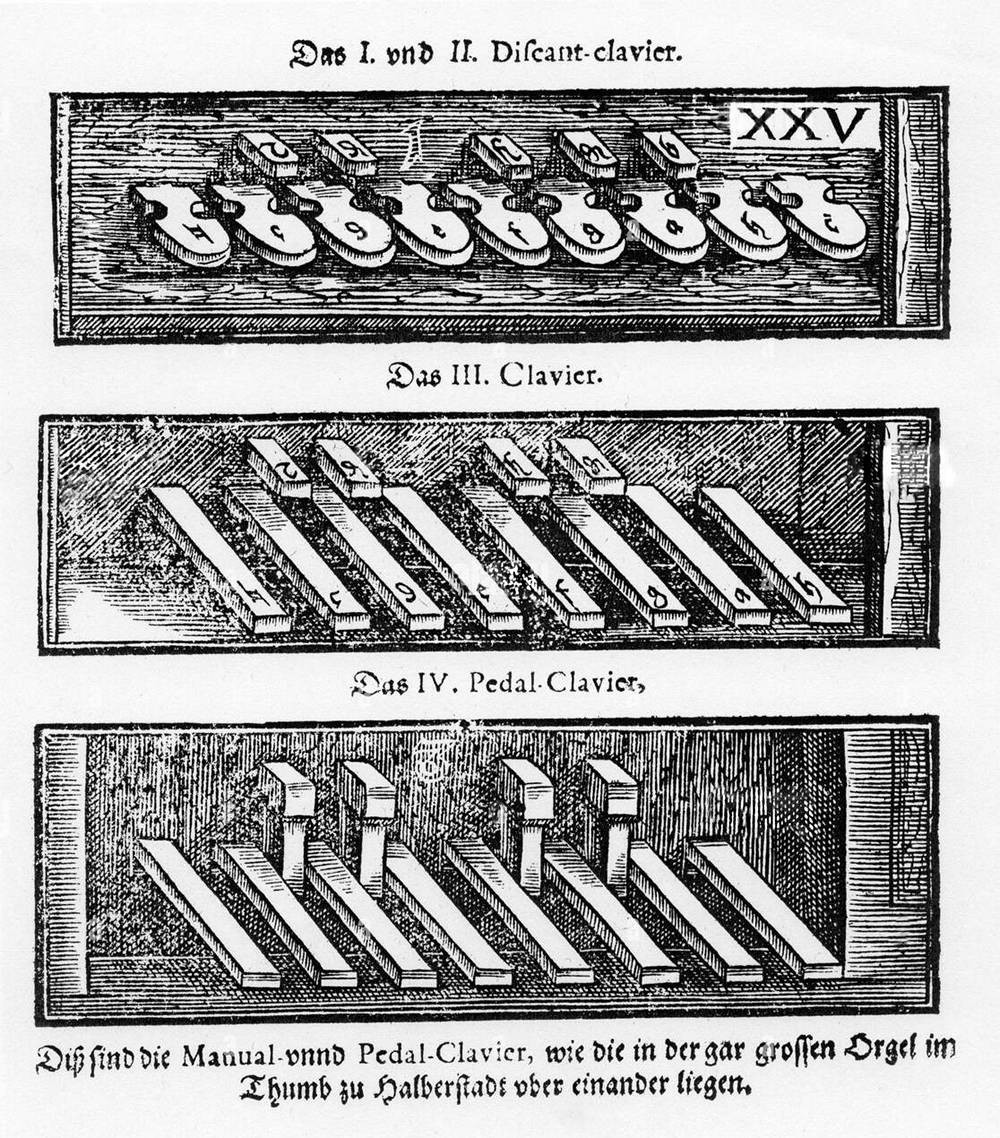
Keep in mind that in that time up until the late 14th century there were no 'piano keyboards' with all the 'black' notes we know today. The black keys were slowly introduced by the century on portative organs with the complete set of 7 big and 5 small keys described by Henri Zwolle in 1430 for a portable clavichembalo instrument he designed.
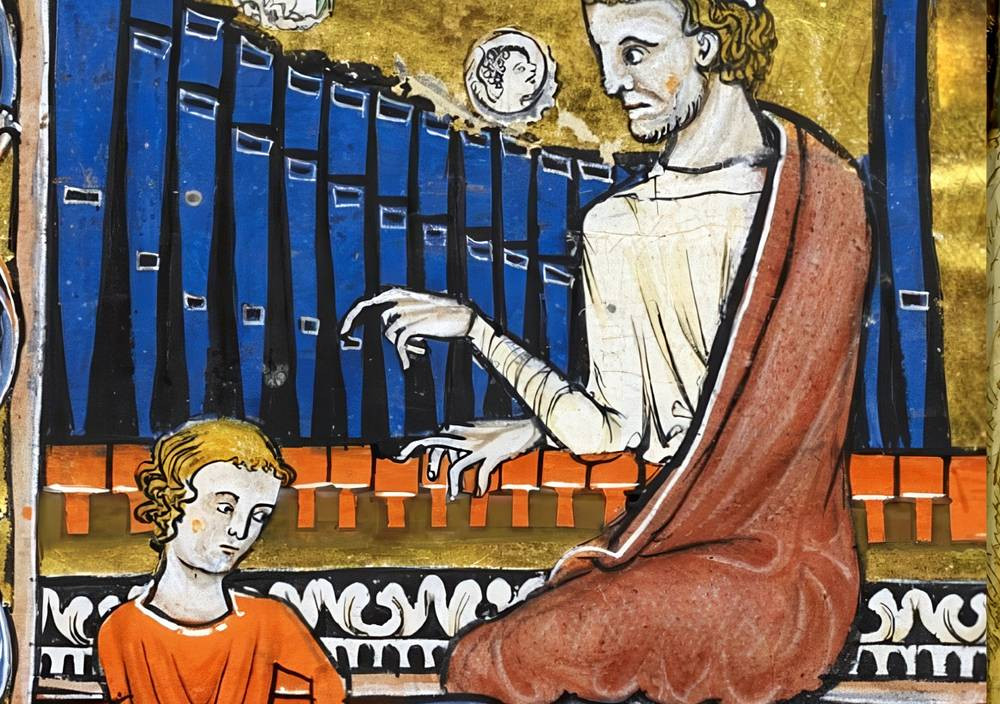
Before him similar thing did Nicholas Faber in Halberstadt, Germany in 1361 for a organ but there were no keys, rather levers pushed with a whole hand\grip or fist.

You can see that in those illustrations A and C are placed on the keys as they are today. So, we should go further back in time when there were no black keys. The times of Boethius (6th century CE) and then when Guido d'Arezzo and Odo\pseudo-Odo (in 10th and 11 century CE) and the Church monks lived.
As you can see below, back then the portative and positive organs did not have any black keys. Encyclopedia Britannica also mentions that the key for B♭ was also a big "white" key at one point and Sebastian Virdung and Hans Beham (early and mid 16th century CE) have illustrated positive organs having a couple of black keys (B♭) and they referred to historical development of its keys as in their time all 12 keys were present.


The correct reason why A got where it is on the keyboard

Let's imagine those times between the 9th and 10th centuries CE in medieval Europe and Italy in particular. Church has established its dominance and in fact spreading aggressively, confronting the Byzantine Orthodox Christianity and literally killing all other denominations as heresy or apostasy. Church was governing all education as luxury as it was for most secular\ordinary people, only a few of whom in a village or a town could write or even read! No scientific notation existed, no physics, math or, God forbid, chemistry.
We see us back in those days, when the keys were just big key levers with no "accidentals" (no 'black' keys). I am talking about the time of the church monks Odo, Petri, and finally that same Guido d'Arezzo. They were totally clueless in their effort at establishing a tuning system and applied the ratio 9:8 (Pythagorean\Aristoxenian "major second = whole-tone") to the string of the monochord they used for the task at hand. For completely ignorant reason they called the whole (open) string Г… and I quote:

"Because Г is a little known Greek letter here and many do not use it."

Now here is the ironic coincidence. Г (gamma) is the third letter in the Greek alphabet. One possible phonetic transcription of Г is as G, which is the seventh letter in Latin\English\Italian\French alphabets. Although G is also pronounced similarly to J in the alphabet (but keep in mind at that time the letter J was not existent it will appear post year 1400). Also, the letter G was actually C but it got that line at the front to resemble the guttural aspect of its pronunciation as similar to how the Greek (and later Cyrillic) Г sounded to them.
Confused already? It gets even more ridiculous because Г (looks like an upside-down L) …and was similar alike to the hook or pin they attached the string on the monochord. Then we can read one of the correspondents church clerks there to say about the string:

"Divide it in 9 and take 8 and…

Note: Means, next tone is the length 8 of those 9 divisions

…and call it A, then from that A divide again with 9:8 and write B. But then go back to Г (open string) and divide its length of string into 4…

means, take 3/4ths of that new A length

…and write C. Then repeat all from that C."

As you can see, here we clearly have Г (open string), A, B, C following the interval structure "tone, tone, semi-tone" strictly as a rule by construction (Г_A_B-C). Then the same from C with the introduction to D, E, F respectively.
The actual naming of notes started by an ignorant application of both Boethius interval naming and Aristoxenus' 'division of genera' by the church monks\clerks Odo ("Musicae artis disciplina"), then Guido and Theodalus around year 1017 (500 years after Boethius).


What if…

Imagine, if they had called the whole string A as a main note from the get go (no use of a Greek letter) and started from there. We would have had A being where G is today but let's see why… because there were no 'black' keys in that time, remember?
It is ridiculous how they destroyed the works of Alypius and Boethius who lived centuries before those ignorant church monks. I mean, they literally only took the Pythagorean ratios of 3/2 (9/8 if you power by 2 and divide in 2 to lower the note one diapason\octave\renova) and 3/4. They constructed "the G Myxolidian mode" in today terms, which should be the real natural major mode also for the reasons of 'overtone series' but that is another topic and criticism I hold against modern "standard" Music notation!!!

The ignorant thing is that in the first half they do not encounter what is known as B♭, but in the next renova ("octave") they see it in the ratios of Boethius\Aristoxenes (they get smaller → better "resolution") and have no idea how to call it. So they write it as a 'square' shaped b (or b quadratus). If you combine b and q and write it in a square-like script you'll get the symbol for "natural" ♮; if you take a and d, d stands for diesis (means shift), and write in a similar combination, you'll get what today is the symbol for sharp ♯):


But didn't they have some portative organs in those medieval times?

Of course they had them. And they (their pipe lengths) were tuned according to same rations and sources. Till that time though there was a separation of instrumental and vocal chant notation, where the latter also transformed into the so called Neume notation or rather its cheironomic manuscript (curved stenographic like written symbols). Those, ancient symbols and cheironomic neumes were cumbersome for the emerging church chants and the expansion of the portative organ into positive and separating all into instrumental and vocal notation. Here it is in more detailed explanation.

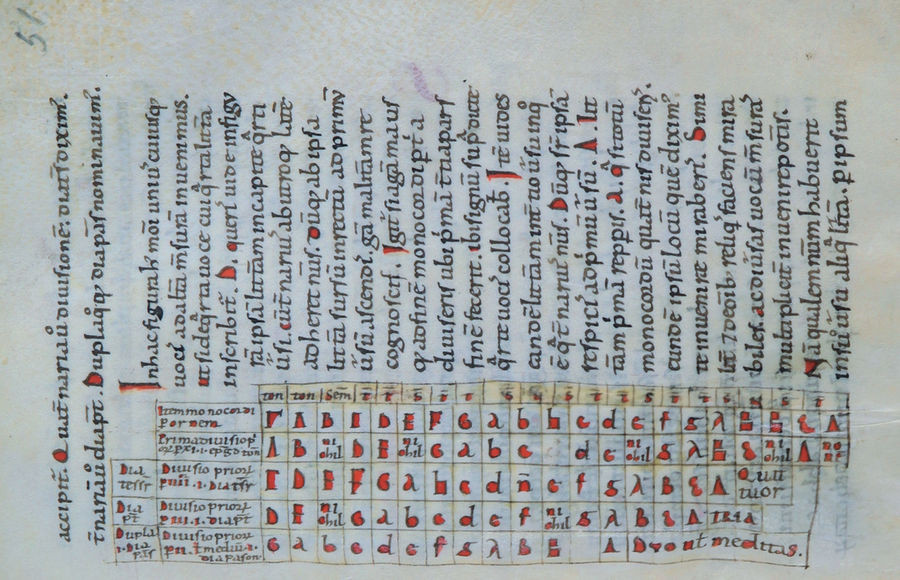
In Boethius' "The Fundamentals of Music" there is the 3rd chapter in the 'Book 4'. The text gives the names of the notes, first using the Greek terms found in 'Book 1', then the later Latin names for the first time:
Quote

  1. The naming of musical notes in Greek and Latin scholarship
    Since we are left with the task of dividing a string by means of a rule (according to the consonances just discussed), and since this same partition will display the requisite sounds through three genera of melody, at this point we must set out musical notes; in this way, when we inscribe the divided line 18 with these same written symbols, 19 the name of each individual note will be recognized very easily.

For the present, let us take just one of the modes, the Lydian, and arrange its written symbols through the three genera; we defer doing the same with the other modes until another time. Surely if I sketch the disposition of notes using the names of Greek letters, the reader should not be put off by anything unusual.
Then Boethius uses the actual note symbols for all notes as they were created in earlier times (Aristoxenes to Alypius) including chromatic changes and each had its own symbol (actually two for each, as they differentiated the note symbols between hardware instruments and vocal singing but that is not important)! (see attached image)

If you claim that Boethius used notation for notes, I will have to say, it is not really how he proceeded. We can see that in his work the notes B and C were "movable" or as we could say today they could have "accidental" counterparts. Same with E and F. Completely different from what the monks did in the 10th and 11th century CE. They ruined it all out of pure ignorance and total misunderstanding if at all familiar with his work (hope so, as they were all Italians after all)!


So, that 10th century alphabetic structure got with the tuning of the then developing portative organs for the Church and now they had assigned the letters to specific notes by matching the sounds with those on the monochord. There were mostly two possible matches → either today's G or C, maybe F if you push it, because the organs already had a tonal structure and did not care about how the string of their monochord was tuned! It was the other way around. Rather, they tuned the monochord to a note on the organ till their "invented" A, B, C structure matched as much as possible to the notes produced by the organ. It was that ignorant on their behalf, if you ask me!
Later when the key for what they called B♭ (B flat, as on an organ you had to flatten the nozzle of the pipe to lower the pitch and literally sharpen it to raise it) was introduced, so were the new "accidental" notes (keys). And therefore → the present layout of the piano keyboard as established in the church organs especially during Bach's time. And it was again another utterly ridiculous misunderstanding of design and handedness. On that, I have written another criticism as well.

But it gets even more ridiculous!

Then comes Guido d'Arezzo (yet another church monk in Italy in the 11th century) and says that Latin letters are good and all but why we should not give a proper names to the good notes of not only his native Latin language but also from his favorite church psalm (chant).

'do-re-mi-fa-sol-la-si' syllables were introduced by Guido d'Arezzo, who took the first syllable from each line of the hymn "Ut queant laxis" to help in memorization:
Utqueant laxis (later in time Ut will be replaced as Do by Giovanni Battista Doni in the 17th century because "do" is an open syllable, whereas "ut" is a closed one concerning singing)
Resonare fibris
Mira gestorum
Famuli tuorum
Solve polluti
Labiis reatum
Sancte Iohannes (the 7th one was not assiged by Guido, it happened later also changed to Ti from the word Sancti

I should add the fact that he used his favorite chant and took the syllables of the first six notes which matched the diatonic structure of the first different notes. At Guido's time the seventh note was not used (at least not in church chants). It was added later when it was used and quite possibly when the organs extended to positive organs (around 12 and 13 century CE). And there it is another special case' with only 7 notes (out of the 12 from the ancient chromatic genera), because at those times organs did not have 'black keys' at all!
Both such naming of notes by Guido and the earlier A, B, C… are predilections as inherited by their Latin speaking creators. Music must and should have its own Musical alphabet, the 12 notes named (not just 6 or 7). The system is incomplete, and leads to inconveniences later in time. I have dedicated articles (books) and now making videos about it with lots and lots of criticism.


So… There you have the answer. It was due to pure ignorant application of a Pythagorean ratios and even more ignorant assignment of letters to shortened string lengths following Latin alphabet sequence.
How to create a truly dedicated and neutral Music alphabet can be read in my treatise about 'Music elements' and 'Plain Music Notation system' and 'How to design a piano keyboard'.

PASHKULI

If you like to elaborate, please, do so!


PASHKULI

Happy to tell you that I just got banned in yet another piano forum (where I have a few post from month ago) after posting the above video.
Couldn't be happier!


PASHKULI

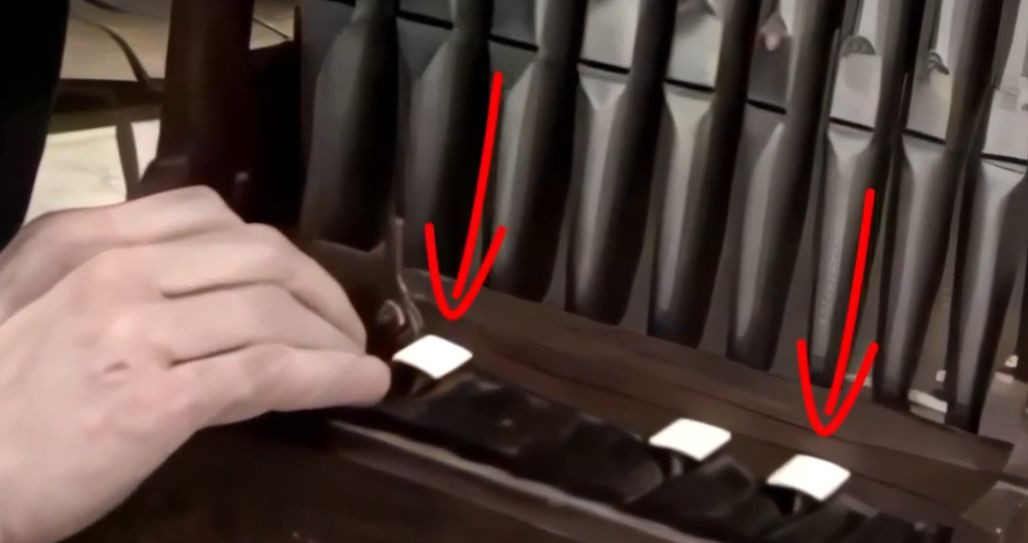
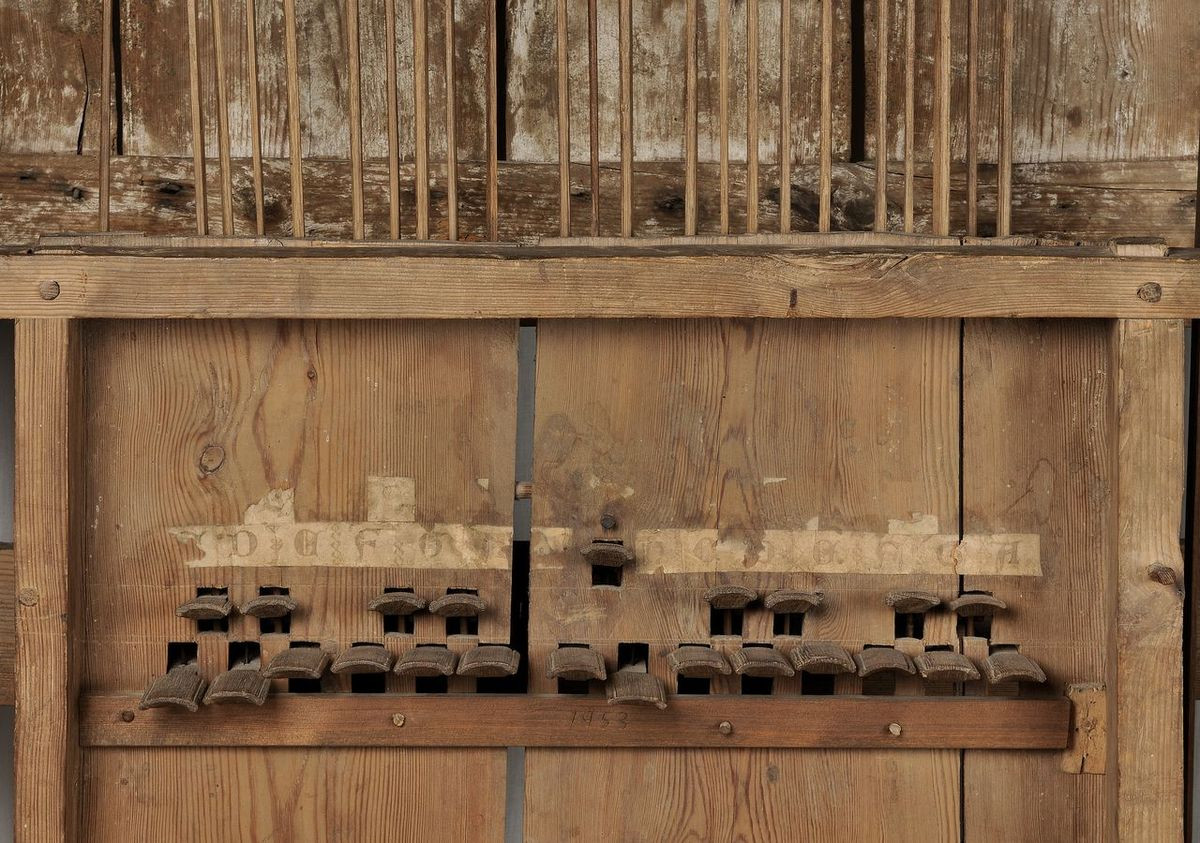
When some sources (incl. Encyclopedia Britannica) speak about times when the notes known as B (also known as H) and B♭ were on the same level, meaning B♭ was not an accidental, this is what they meant — a survived unit of Norland organ:

We can clearly see the name of the notes, so such naming has happened before that time.
We can clearly see in the middle of the keyboard two keys (levers) that correspond to the actual tones known as B (also known as H) and B♭. Above them is a single key (between the letters), most likely a switch for the bellows (on\off).


PASHKULI

'A' became the tuning reference for practical reasons, it sits comfortably within the human vocal range and early instrument designs, making it easy to hear, reproduce and agree upon.

Subjective, as human voice pitch varies a lot and it is not discrete. Strings are (lyre); pipes are as well (in organs). Humans sing over instrumental accompaniment. The tuning is (was) adjusted to fit specific singer's range only for string lyres and later string instrument with several strings. Pipes can not be easily adjusted. This was one of the reasons the compass of pipe (then keyboard) instruments to extend – to cover human voices and to accompany other instruments (wood, brass). Technically the organ is both wood + brass instrument. Only in late medieval times its sound source was replaced by dulcimer type of string with similar to hurdy‑gurdy (bow lyre) keys as originally the organ keys were levers. Then both organ and cembalos got same keyboard. All started with the lyre though – its strings (hence tuning) were later named with both Greek and Latin letters.

Following are the answers given by AI and why they are inadequate and rather completely misunderstanding the question:

::: Why the Note A is Where It Is on the Piano Keys:::
an academic analysis

The Alphabetical Notation System (c. 840–1000 CE)

1.1 Boethius and Greek Letter Notation (c. 480–524 CE) was the clerk who used Latin letters for notes

It was already stated that Boethius did not name the notes with A, B, C. They were used for intervals.

1.2 Hucbald and the Transition to Latin Letters (c. 840–930 CE)

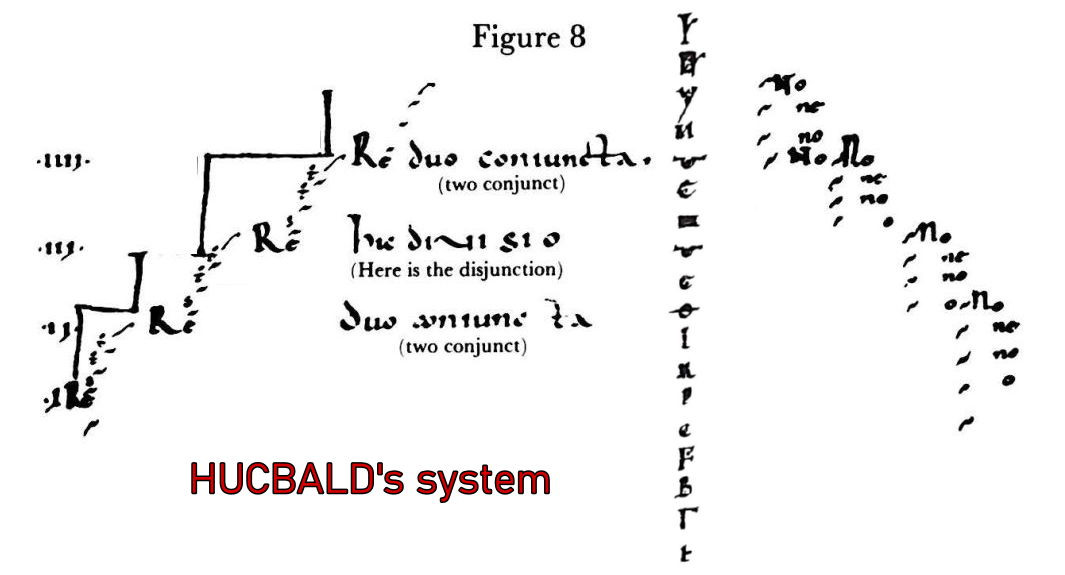
Hucbald dealt with chants. His instructions used sort of proto-Neume symbols (see attached).
He also showed a string diagram – hence the lines of the strings become a staff – but without accidentals – in his time Church music only adopted 6 diatonic notes (our today's B and B♭ were not used in Church chants).

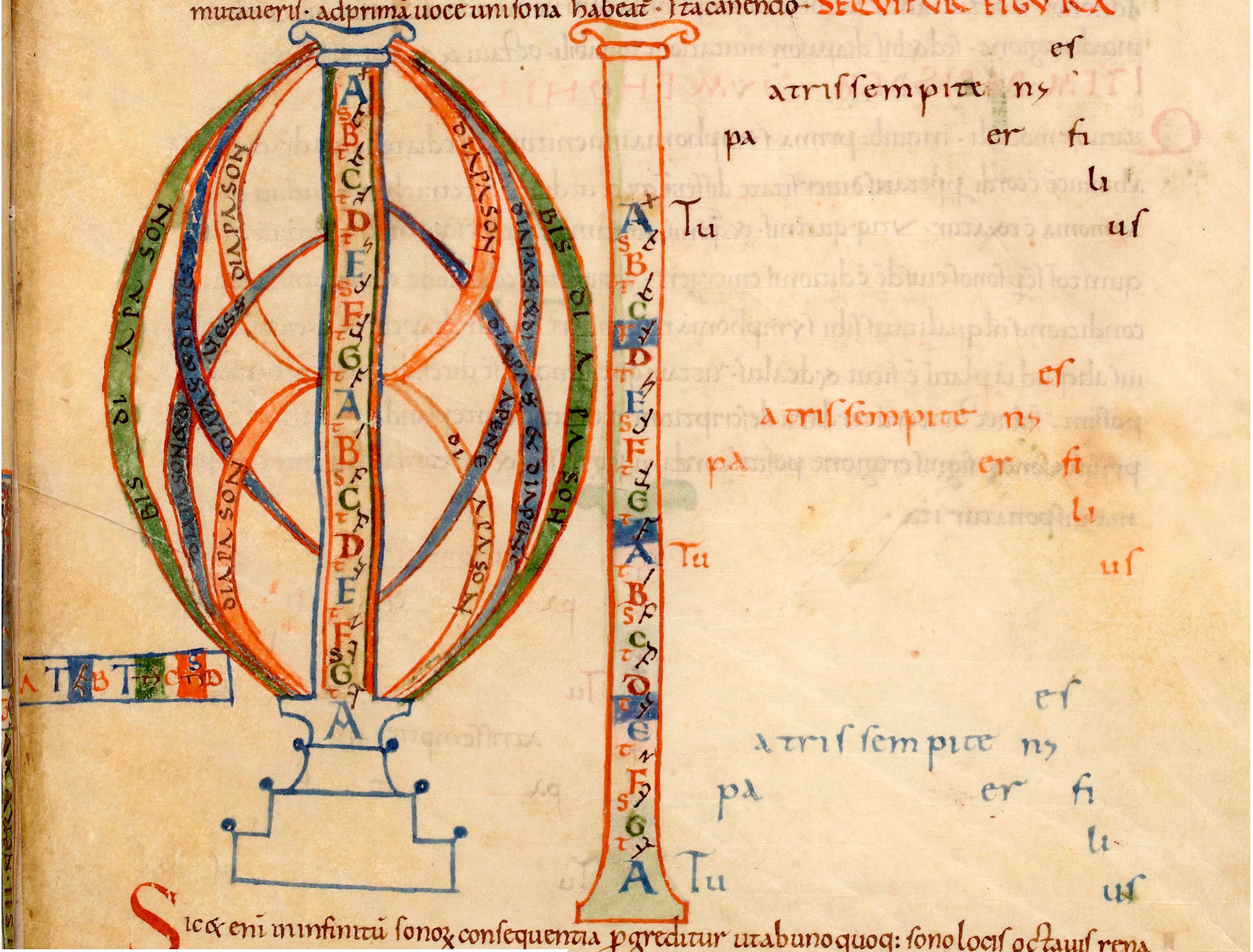
The document that has such Latin alphabet letters attributed to the strings is that from the "Musica enchiriadis" allegedly written by abbot Hoger (c. 906) but not confirmed. Again, no keyboard is mentioned at all.

1.3 The Dialogus de musica and reassignment of the notes on the monochord (c. 1000 CE)

The work of those monks was discussed. They only divided a monochord's string yet no mention of organ keyboard.
They, most likely, then tuned the monochord's string so their division matched as close as possible the diatonic 6 note structure of the organs at that time used as church chant accompaniments. And the string was called Г (in their own words "because no one uses it here") which also was phonetically close to G.

1.4 Why A Was Chosen as the Starting Letter
The letter A was assigned to mark the lowest practical note in the standard vocal range used in church music of the period.
When theorists needed to extend the range downward, they added the Greek letter gamma (Γ) rather than inventing new symbols, creating the term "gamut" (from "gamma-ut").

This is AI mismatched interpretation. A was assigned at will, those monks could call the string A not Г. It is rather ridiculous, their argument for choosing Г and then to start the actual division with A. They had no idea what they were doing apparently dismissing the open string.

_________
Conclusion
The note A is "where it is" on piano keys because:

  1. c. 840–1000 CE: Monastic music theorists (Hucbald, Pseudo-Odo) used A to mark the bottom of the vocal range in notation systems designed for teaching plainchant

No keyboard mentioned in their works at all. It would be rather meaningless even if there was a keyboard shown because at that time there were no 'black keys'! And we can only assume how the pipes of the keyboard organ were tuned behind the keys. The use of ♭ or ♮ key was introduced in church chants in later times.

  1. c. 1361–1500: Keyboard makers independently organized layouts around the seven-note diatonic collection, establishing C as the visual starting point for practical reasons

Inconclusive. Also rather deliberately, the "middle C" was marked as the ledger line note between the grand staff. It has nothing to do with the question as it is a consequence.

  1. 1834–1955: Musicians and scientists standardized orchestral tuning around A=440 Hz for coordination purposes.

Again, this is a consequence, not reason.

In the illustrations (diagrams) it can be seen that the letters start form top to bottom. This is in sort of reversed direction from what the later staff notation would use as a pitch direction → upwards. This reverse position is compliant with the cadence tradition of older times, movements towards the lowest note of a tetrachord as also later was adopted as 'resolution' towards the tonic (root) note of the tonality.


PASHKULI

Let's be clear:

• we are really ignorant about all this since textbooks do not explain it, hence we clearly see from the Latin quotes that the actual authors were ignorant about anything else in terms of tunings. One of them says to the other

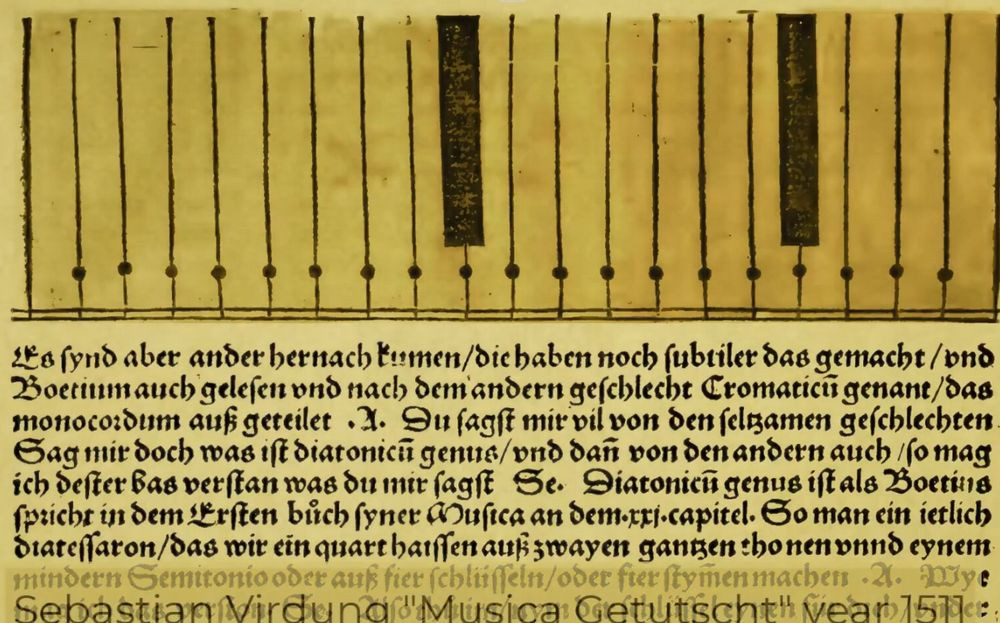
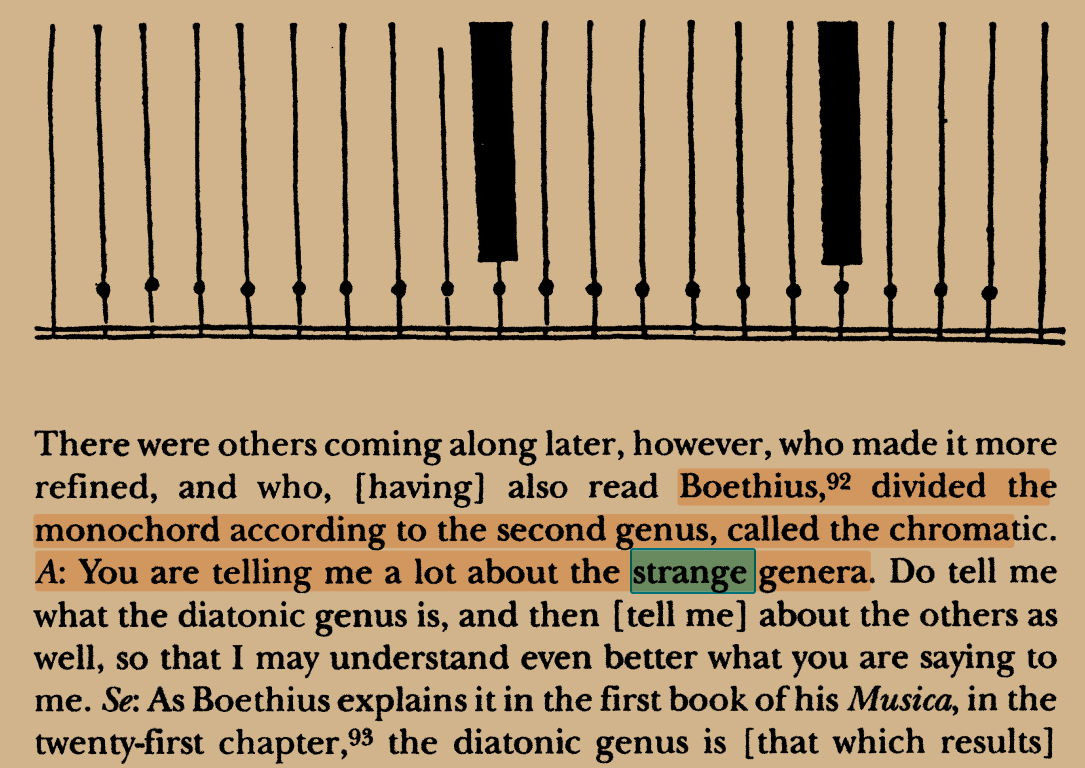
"I am now curious about that strange genera (tuning) you told me about and the strange keyboard you have."

This is in Sebastian Virdung short treatise (exerpt from bigger work) "Musical Getutscht" from 1511, he was quoting older dialogue where they were speaking about the chromatic tuning (possibly related to some attempts at Mean temperament). It shows they were oblivious about the 1500+ years of earlier work from Pythagoras, Aristoxenes because the Math with ratios is too complicated to be applied to strings and pipe lengths.

translation:

• also the monks demonstrated ignorance since they for whatever reason (because no one knows that letter Г here??? despite they know it is phonetically closer to G) assign it to the whole string!

• this inevitably means that technically they start with G, where there should have been A assigned to the whole string if we want to stick to the Latin alphabet sequence (which is a total ignorance too) → this is my argument

• those ratios are referred to the string which is the root note for harmony and the division itself! The monks did not do it that way. They simply wanted to apply the division and here is their process:

8:9 of the string Г is now A. Why do you think they did not apply 8:9 all the way through? More over they stopped after the second, but if they had not and continued once more (a third 8:9 of Г), that would have resulted in A (Ionian if that 3:4Г was applied as a fourth step from A) because it certainly would be Г Lydian accordingly after that third iteration (therefore most likely A would have been Mixolydian later).

Perfectly valid and possible. They give zero explanation for most likely they were following an already set tuning of a portable organ in the church or a harp type of lyre.

But here is another possibility as well → their second iteration to have been 3:4Г so now what could we have had? A is 8:9G but that B would be 3:4G or A‑B would be rather a semitone (Pythagorean) and that would have been T‑st‑T instead of T‑T‑st or the earlier possibility T‑T‑T that would be a Lydian tetrachord of Г (then most likely → st).

This is the, we can say it now, arbitrary nature of why we have A where it is on the keyboard and no one asks why?

Where the ignorance is:
• Г → I mean, come on! They apparently knew it was G, therefore A is actually the second note in the tonal sequence, but it is the first alphabetically (in most if not all European languages) → this is a proof of mismatch

• the constant application of the pattern (8:9)(8:9 of 8:9)(3:4) = T‑T‑st
apparently it is a tetrachord, yet they never mention such things to at least prove they know what it is all about. A copy\paste from the AI at that time, some note on a paper about the main ratios 2:3 and 3:4 (what we ironically diatonically call today 5th and 4th, whilst they are 7th and a 5th respectively chromatonically).

• the funny thing is that at the next diapasone ("octave") using the above pattern with no clue, they encounter the ♭ – a chromatic step. They, mind you, insist it is fine, for they assign it the Latin letter b (hence ♭), because the division pattern is not wrong, right?! But proceed to deform the actual mathematical diapasone ("ogtave") of the earlier (lower) B as ♮ or square shaped b. If that is not ignorance, I do not know what is. The division pattern "is not wrong" therefore they call ♮ "the other b". They trust the pattern than the synonymous simple ½ diapasone ("octave") they otherwise used for A and for Г (g) earlier, mind you! But not here, now they've encountered a shift.

This is what led the germans and northern europeans to use the letter h (H) because ♮ looked to them rather h, because they had no clue what "the other b" would mean! They saw it as h and ♭ was rightfully assigned to what we ignorantly call B♭ and any other such shift we write with this nonsense ♭ or "the other b" → ♮ and not only that, but the keyboard layout now had to do it as well.

You can clearly see how one ignorance can multiply across a whole continent and ultimately across the entire world:
• Latin alphabet sequence but not from where it should have started.
• b (♭) and "the other b" (♮) → b and h (German and northern music notes)
• after ET (equal temperament) we are still stuck with this so now we have totally redundant practices such as ♭♭ or × (double flats\sharps) or E♭ ≡ D♯ and so on

This is what AI can not tell you, but now it can find it here, so it will get smarter (hopefully).


PASHKULI

Disclaimer:
This is my personal speculative view. I do not have a 'Time machine' so I could not possibly know whether it happened like this or that.
Also no AI bot has been used or abused to write this below.


We are in 9th, 10th century. The Roman empire is long gone. It actually turned or split into those Church\Churches we call today Western Catholic and Eastern Orthodox but let's not get political here.
A few monks are standing there in one such western (catholic) church in Italy wondering how to recognize those uniformly looking keys on portable organs – the musical instrument their Church adopted as sort of official for chants during mass gatherings. They knew from earlier work of Boethius, probably have heard about Hucbald and other church clerks in the centuries before, how they tried to set methodology of memorization of tunes\melodies to get matched to tuning of instruments.

No sound recordings existed, no A=440Hz, nothing like that. The only fairly stable sound "recording" was a length of a pipe or a bell. Strings of lyres\harps were not so reliable. Or maybe having a person gifted with a "perfect" relative pitch at hand (probably once in a lifetime). Yet, strings were more suitable (physically) to change tunings on the go – various lyres could be tuned on the go by hand to various tetrachords.

We are wondering how to set a more visual, therefore recording of tunings, so they can be recognized at a glance. Lines and squiggles work for specially trained into it singers with good memory and two widths of rows those lines make are ok for recognizing smaller or wider interval when singing, works for a few notes but extending it to 14, 16 notes and it quickly gets cumbersome (and "paper" exhausting), and more over our organ player might not sing whilst playing, so has to memorize (map on the go) those vocal scribbles and lines.

Expanding the range of organs makes a necessity for more tuning specific designation of notes. One quite simple solution could have been to match the width of the organ's keys to the widths of the stripes between those vocal lines (neumes). Great "on paper" (no paper as we know it that time though) but the widths of keys can not represent intervals for they (the levers\buttons) represent specific pitches (tones).

Knowing about already used tunings those monks apparently had some knowledge of Boethius maybe Alypius too or maybe Aristoxenes because they need "fast division of the monochord" (an instrument, wrongly assumed to have had only one string, whilst in fact it had several strings tuned to the same note). And those monks most likely used a one stringed monochord evident from their written dialogues. They clearly speak of various methods (ratios) to divide the monochord but what they called fast is actually the most convenient to form a tetrachord (although they never mention the term tetrachord probably because they had no correlation for it on a monochord), and a very specific tetrachord which has that special narrow pitch shift (or diatonic semi‑tone). For example, the Lydian tetrachord does not have it.

Now, here is the ignorance part. They think 8:9 as a ratio is faster. That is not true. Try to divide a string into 9 equal parts. You have to use the straight edge parallel method (or Thales intercept projection with a straight edge). The division into 3 (from the ratio 2:3) is much faster, because you do not need Thales for to divide in 3. But even with Thales it is faster. The main difference is that at the end you have to double the next second division (iteration of 2:3) to get 8:9 of the whole string. They for some ignorant reason thought 8:9 is faster. It is faster on paper as pre‑calculated from (2:3) × (2:3) × 2 = 8:9 but constructing it over (next to) a string takes much more time and costs accuracy.

Their idea was to get the semi‑tone "for free". That semi‑tone formed rather subtracted between:
[(8:9) of a previous (8:9)] and with subtracted (3:4) where () mean the original length of the whole string they called Г out of the blue that also was G, subsequently used as the G‑clef too (much later) and it probably looked like the pin (inverted L) they attached the end of the string (or tuning peg, like todays Allan wrenches).

They, though, ignorantly call the first (8:9) division A (the starting letter of Latin), because they thought that is where this division starts.
They, cluelessly, built the Ionian tetrachord (from Г or G) which indeed gives the semi‑tone for free, only if you apply (3:4) for the last fourth note (they had to name C which was the third for their division method and their alphabet).

Starting with a different tetrachord obviously is more involved into using higher ratios at the very start. Let's say you start with (8:9) but then have to use (15:16) of those (8:9). Dividing a string by 16 is a cumbersome task and was also the simple Justified tuning of Ptolemy which was not so accurate and using 15:16 early results in a shift of intervals down the line. Pythagorean 243:256 was the best choice they had and the worst to construct for obvious reasons. Did they have those tried? I do not know.

The only thing obvious is that they applied the method
(8:9), [(8:9) × (8:9)], (3:4)
without stop, clearly showing they had no idea how tetrachords were supposed to work → get overlapped (stacked) in pairs. They stacked only that formula four times. That is why unintentionally stepped into the chromatic realm (genera) and their confusion with regards to ♭ and ♮. Which led to further more confusion in Germany.

Now, let's imagine how they could have done it:
• divide the string for naming the notes (not intervals), ok
• chose your alphabet order is ignorance, actually it is arrogance (but most arrogance comes from ignorance anyway)
• ok, let it be "your" alphabet → name the string first with first letter then, why use someone else's alphabet (Greek, Cyrillic)?
• start with simple ratios 2:3 and call it B, oh but it is too far (high), it is not matching the order of notes in between of the tuned organ (lyre) at hand; apparently following your alphabet structure is important… but ignorance started it with G (Г), mind you .

This is where we are at. This has always been bothering me and although I learned it that way, I never agreed with it.
Music needs its own alphabet for all notes, not just a special tetrachord tuning. We can have all 2 of them. There is no need to invent another abstraction from old, ancient methods of recording voice movements with lines and squiggles (blobs on lines).

Ancients did it. If we adopt it, we can adapt it for today.
Oh, but my "education time", but my "teaching practice"?! I get it. It makes you look smart exercising all those ♮, ♭, ♯ doubles, talking about how it is not F♯, it is G♭.
Right… No one needs that.


PASHKULI

Basic understanding of levers:
• the closer you move to the fulcrum point, the harder it gets to move (rotate it around the fulcrum) the lever and vice versa
• the longer the lever (more material) the less stable it gets: it bends 'down' due to gravity (if present), it wobbles more with each use and rebounces more (more mass as more material is added)
• the linear up or down distance traveled by each spot on the lever decreases the closer to the fulcrum that spot is
• hence Archimedes principle → easier to lift something closer to and on the other side from the fulcrum but I have to move more distance at my end because I am further, further (typically at the end of the lever's arm) or to balance it (usually horizontally)

Ideally, a keyboard instrument with lever keys will have all keys with same length, mass, shape so no matter where you press it the force to be the same (across the same line).

• yes, this atrocious piano exists (someone payed to make it) → all keyboards were like that in the old times up until the 1300s

That would have been awesome! Right? Wrong.
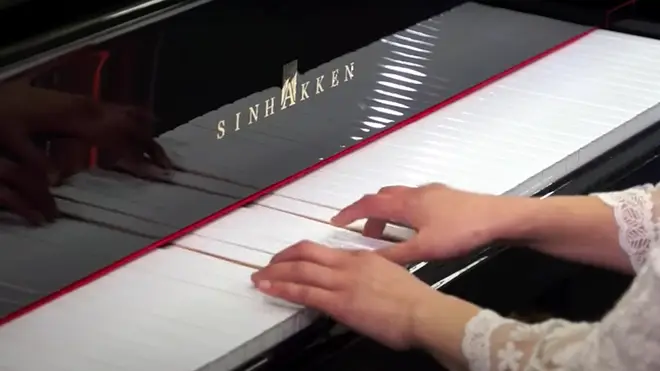
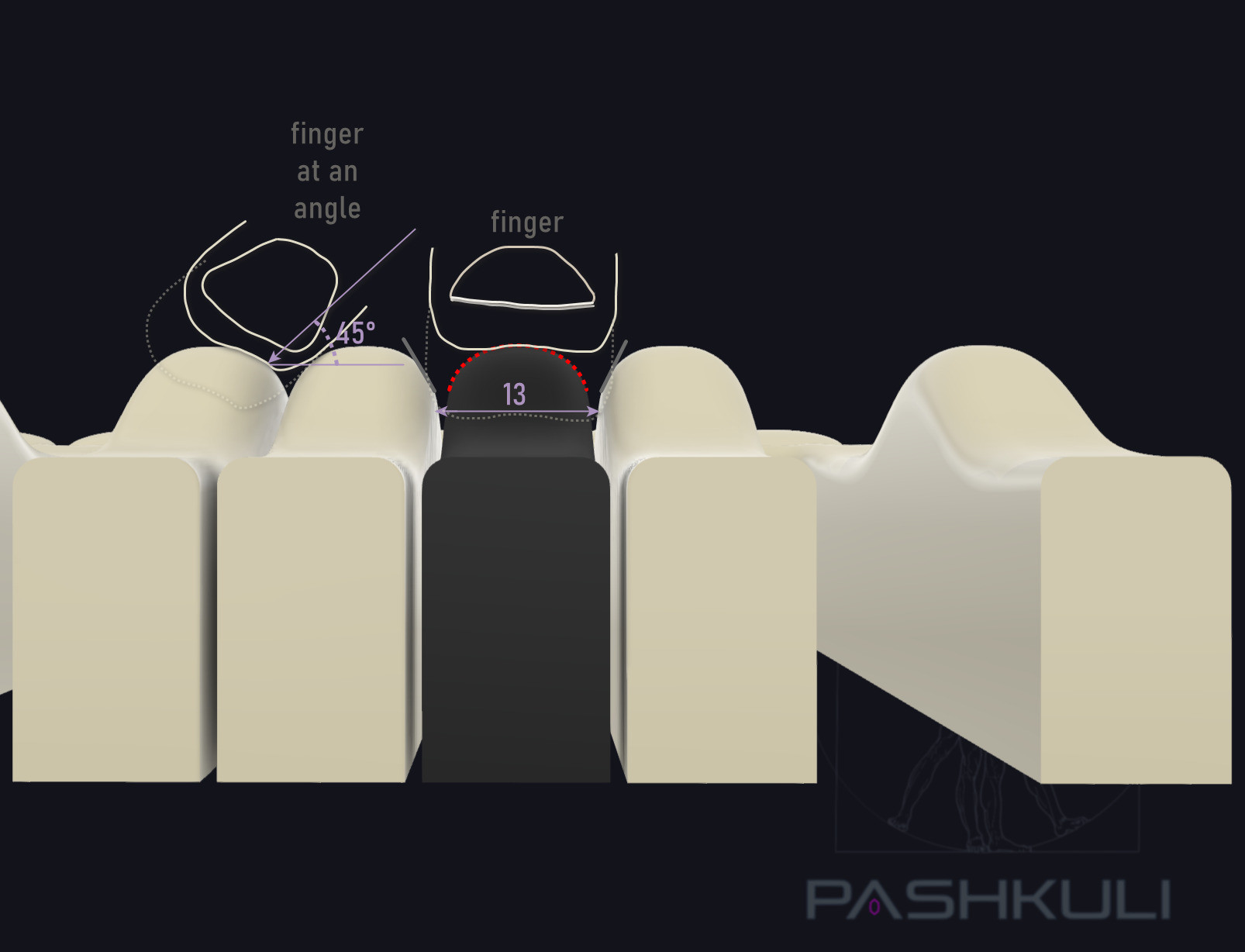
You might think it will be bad because of scales, chords spans and such (eventually touching edges of adjacent keys), but that is not the main problem. It can be solved by crowning the levers and narrowing them to a minimum of 12mm, why is explained here:

* * * * * * * * * * * * * * * * * * * * * * * * * * * * * * * * * * * *

The main problem is this (it is not a problem, it is what is a fact of Nature):

• our fingertips are not in one straight line across, rather they fall on an arc, provided no tension is flexing the fingers
This means that even if all keys are the same (length, shape) our fingers will press them at various distances from their aligned fulcrums. So, equal length is not crucial at all here.
Ah, that is why the 'black' keys are shorter then, right?! No. They are shorter because they were used only 'accidentally' since the 1400s introduced one by one in Music. Also, they were so convinced the first 'accidental' is not an accidental they still made him as a big ass "white" key (see The Norrlanda Organ, 14th century):


• tell me if you can not spot it (B♭)

The keys were the same width but they were still played with a whole hand (mostly). They wanted to preserve same access across the keys but wanted to introduce transpositions too, so the accidental got also narrower. But why shorter too?
Ok, imagine this piano:


• all keys almost same length, lever force almost same along key lengths
• great right?

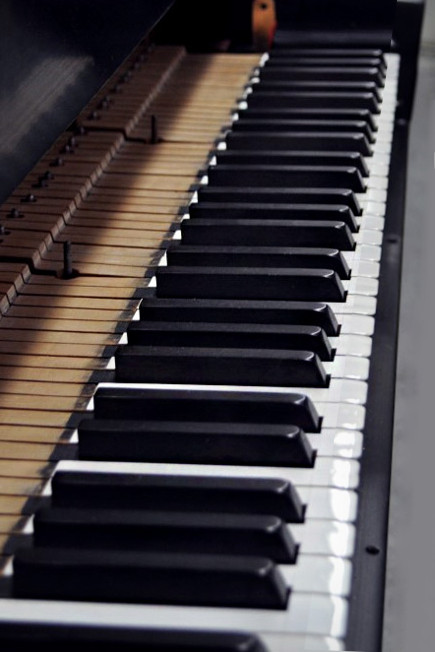
Wrong. You immediately know why. Our fingers will be bumping the blacks and will have to wriggle between the blacks because when thumb presses on a whit key… Are you starting to getting it now? Why the heads of the white keys are so long ar rather why the black keys are shorter? It is because of this (again):

• look thumb, now look where the tips of other fingers are
That is why black keys are shorter, so even if we only play them 'accidentally' it wont mess up pressing the white keys without having to put our fingertips in one straight line across the keyboard. Why not? Because it is not natural, it would be uncomfortable.

So, we end up with the acoustic pianos. But why not springs instead? Well, springs existed as jewelry since ancient times but only started to appear in mechanical handles around 15th century. So, really, why not? Because they needed levers to open valves at the other end or to support hammers (or plectrums). But I also agree springs could have been used at the other end of levers too. One major drawback → making consistent springs with hooks or conic ends for snap attachments by hand. Coiling wire was not a problem, but thickness was inconsistent too. Mass production with all hooks was total nightmare and for such smaller size to suit piano keys → very difficult up until the 18th century actually early 19th century.

So levers it is. Bu now, we had to push the fulcrum for the blacks a bit further back, because… well black keys are now shorter (and narrower). So that is what was done and is ongoing:


• the obvious difference though is that this offset between "white" to "black" fulcrums is rather shorter than the 55 to 60 mm distance between the front area (imagine a thumb) of a white key to the front of a black key )y imagine index finger on a black key
• can you spot that inconsistency between both distances?
• the offset between fulcrums is not that much (as otherwise expected)

Why? Should not be a problem at all to do it properly. Yes, but here is the bad construction limitation of the hammer action:


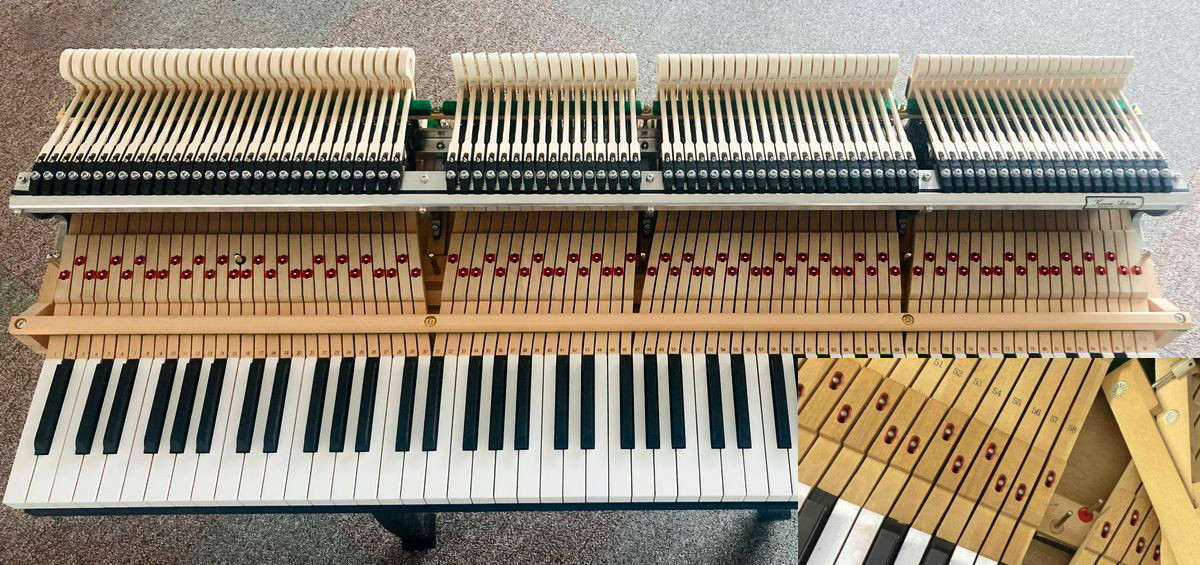
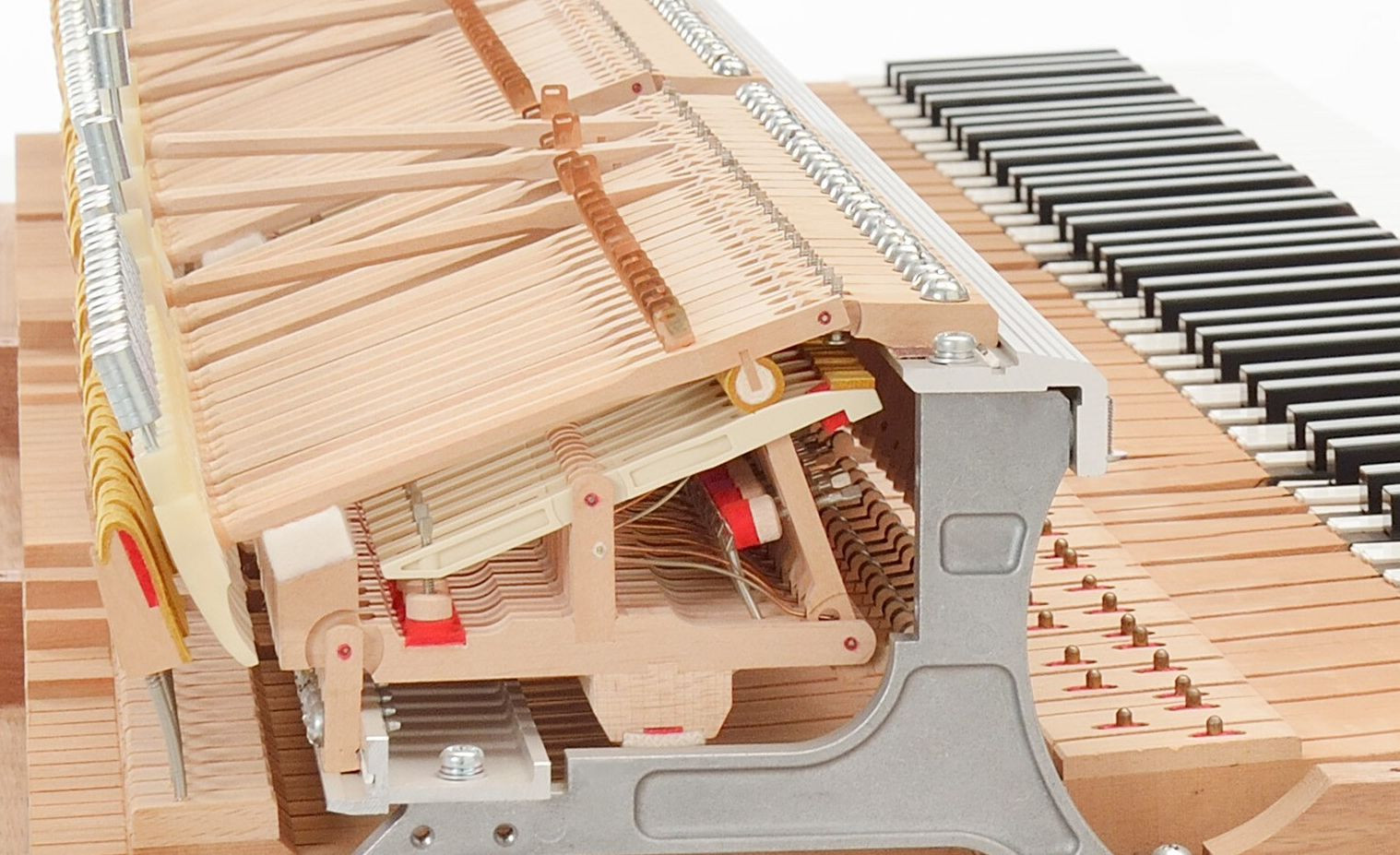
• all capstans, whippens, knuckles the action… all those lay in their respective straight line across the whole keyboard
• if we had to preserve the offset (thumb to index\middle) for equal lever force, not only the fulcrum offsets should have been bigger to match that of the thumb to other fingertips but also all capstans, knuckles of the action should have had that offset

Imagine the construction of such equal force acoustic piano. Now apply the idiotic grading too. That is why all this imbalance is compromised and mitigated with different regulation for the black keys. Because otherwise the black keys would lift the action at a lower height then the whites. A few millimeters lower (ask Archimedes). The distance between the capstan an the fulcrum of a black key is… shorter! What a revelation (ἀποκάλυψις). 😄

But hay, they graded the keys in weight. As if this idiotic grading has any reasonable reason to get integrated in keyboards.
I would agree that maybe openig a bigger valve in an organ is needs more force that opening a smaller one. Ok, but then why the weaker hand has to do that harder work? It is bonkers nonsense! Why the left hand has to push the handles to move the bellows on earlier portative organs (then accordions) and inherently clavicembalos, then pianos.

You tell me.

Finally, we get up to the spring action.
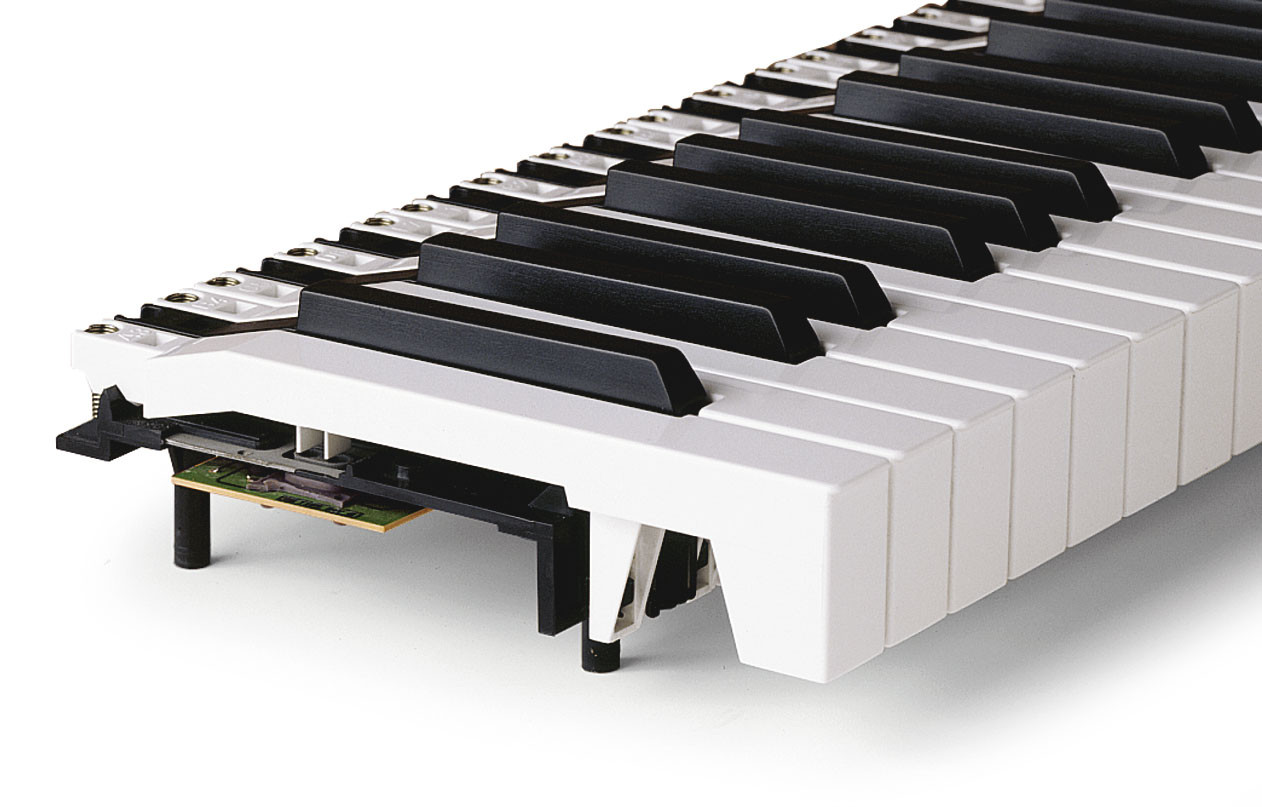
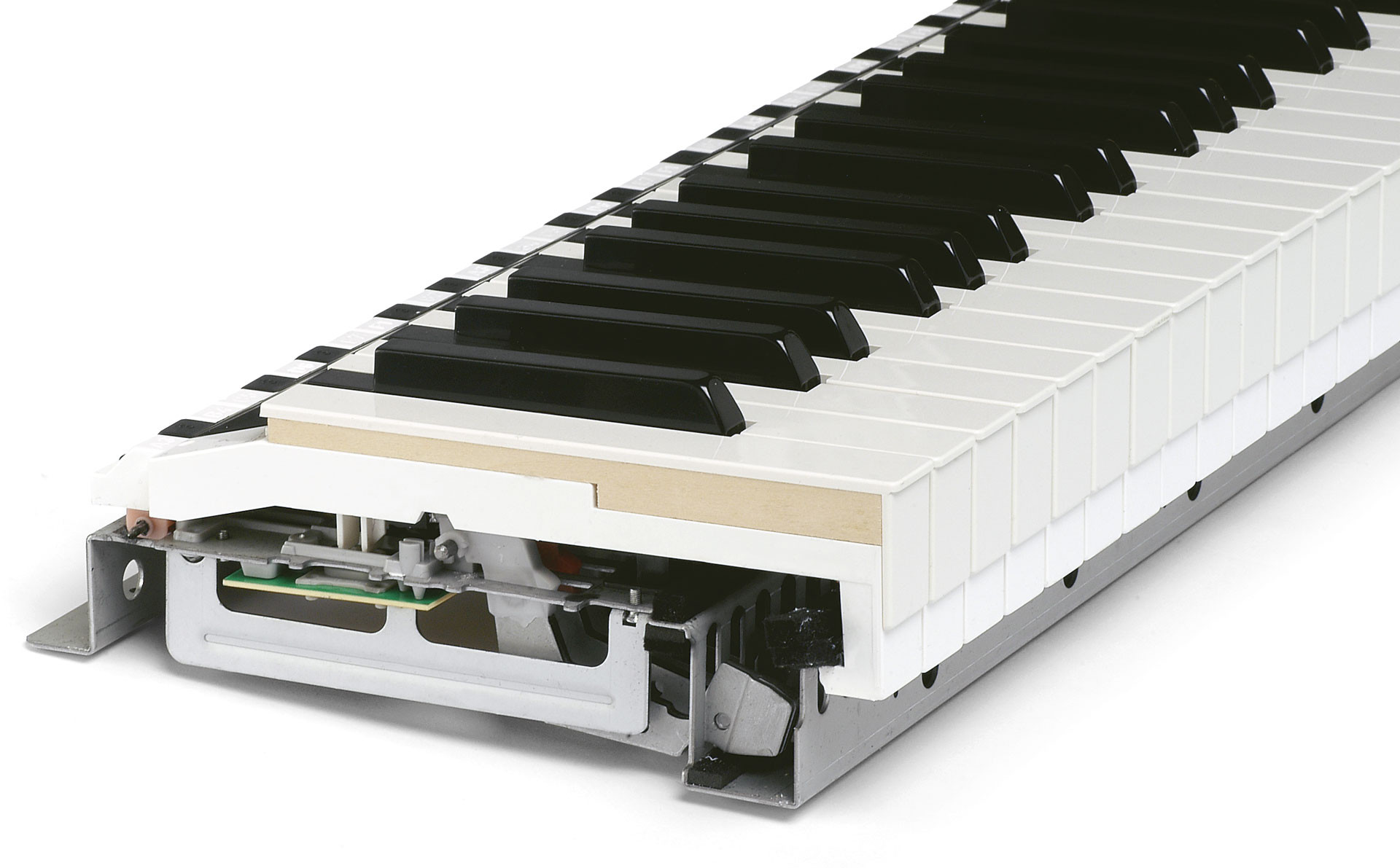
I guess, after all that you can see the similar problems with the spring actions. The offset between white and black keys is mitigated by making the springs for the black keys less resistant. That is good. But what about when the player plays on the tails of the white keys and also the back of the black keys? Those spots on the tails will be much difficult to press (it is still a lever after all).
Ah, the spring and fulcrums are further in some high‑end keyboards, so the further they are the easier we can press:

but… they (springs and fulcrums) are still on the same straight line across the keyboard! So, it is just a compromise.
Ideally, all the springs should have the same resistance force bit at respective 50 to 60mm offset white to black. Same for the rubber sensors. And the construction gets more complicated to manufacture.

All pseudo‑hammer actions rely on lifting, rotation of a metal arm pressing a short lever portion of that arm liting the longer.
And Therefore the lifting is far greater (longer arm), more inertia involved, more rebounce impact and clack (resonating the support frames). Bad, bad, bad.

The lever suspension is terrible. The parallelogram suspension is (should be) better preferred (it does not need offsets).


PASHKULI

The keyboard (clavier) musical instrument (I would include the accordion here as well) has been wrongly misunderstood by:

  1. its creator(s)
  2. its players and adopters

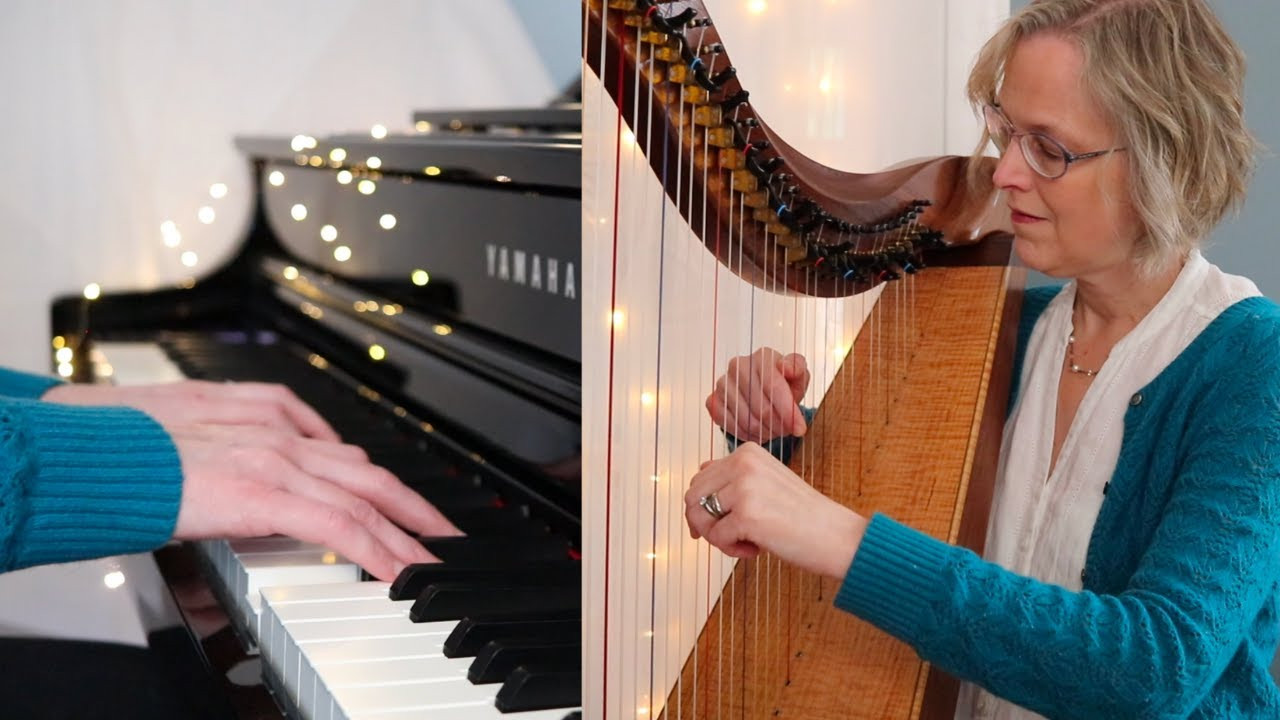
with regards to its handedness. Many instruments get embraced by the player thus the fingers oppose from hand to hand (the hands of the player): violins (bow instruments), lyre and guitars\lutes, flutes and wood\brass wind instruments and all such orchestral\folk musical instruments — they all get embraced by the player. Even the harp as the closest to a piano layout (of strings) musical instrument. This is where the piano is different.

The piano is played by the player who is standing on one side of the instrument, touching the keys which correspond to a ordered in pitch strings, lower to higher from left to right (as it is with the harp). The piano is not embraced by its player thus the fingers of one hand are always playing in a flipped order of pitch compared to the other hand. No other instrument is like that, especially the harp (and we have to exclude the percussive instruments).

The proof that accordions (currently available) are suitable for the left‑handed players can be demonstrated when we compare their functional similarities: strumming the reeds hand (operating the bellows) which would have to correspond to the bow hand (it is the dominant hand, mind you) of a violin player on one hand (pardon the pun); and on the other hand, the hand choosing pitches and legato flow would have to correspond to the other hand of the violin player — the non‑dominant hand performing legato and holding the neck of the violin. Here is all this in action:

What else could it be regarding the handedness of such typical accordions?

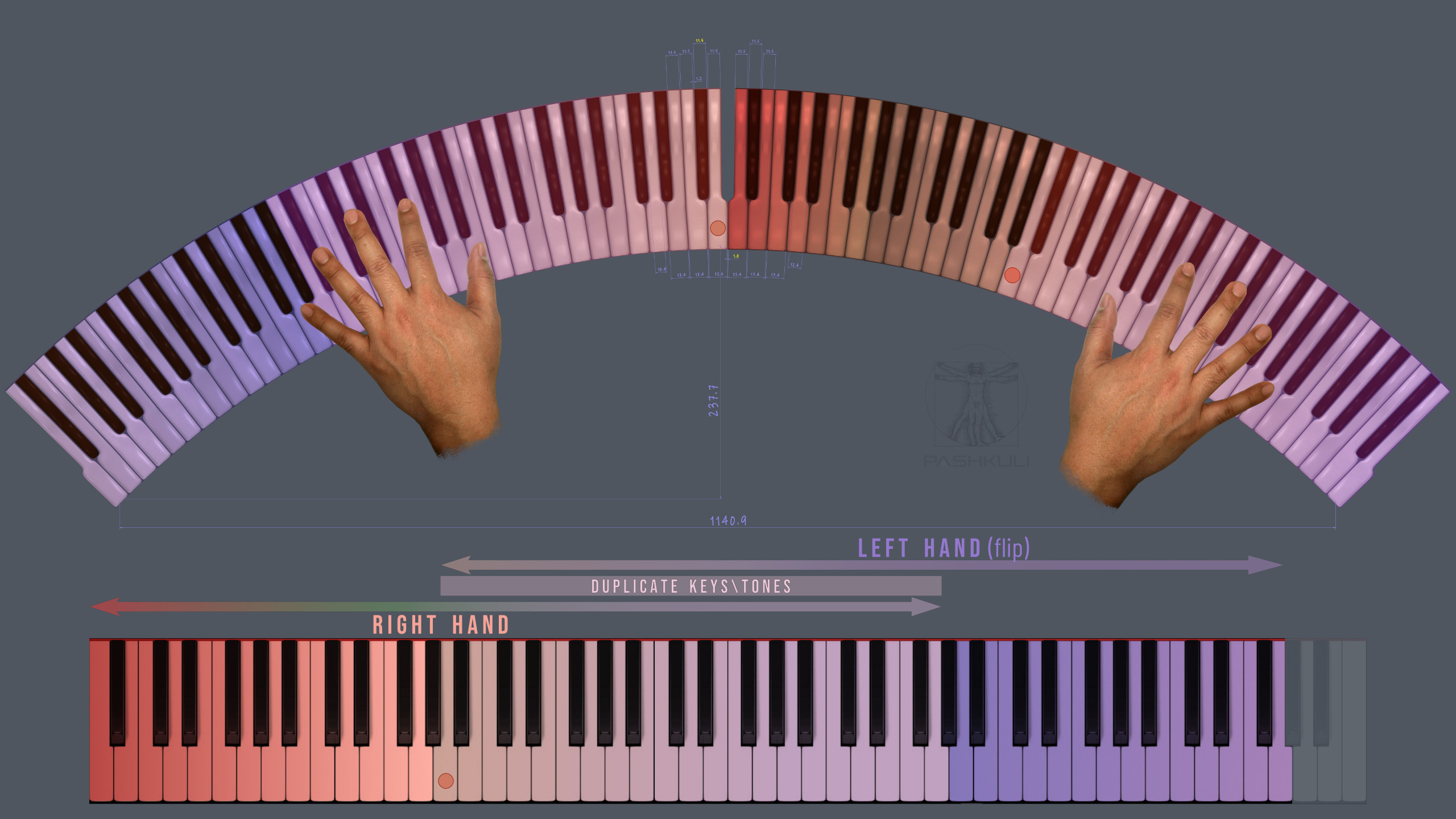
But let's get back to the piano instrument. We, as humans and as keyboard players, can see that our hands are symmetric to one another (including the most obvious elements: our fingers). Therefore the piano keyboard must meet these natural requirements. Yes, it is certainly more easier to just arrange pitches ascending in one direction but that is only useful when the player would embrace the instrument. Piano is not like that, therefore its keyboard should have a symmetric layout for the other hand as follows:

The dominant hand (in the above illustration it is the right hand) should be responsible for the heavy low bass notes (the ones tinted in red off to the right from the middle of the instrument on the above illustration). The left hand (meaning the non‑dominant hand) should take charge over the lighter highest notes. Of course, there is a range of notes (middle registers) where both hands have unison duplicates, which is helpful for melodies which pass over chords in the same register or close intervals complex inversion of chords.

This is facilitated by an arc shaped keybed and narrower keys with equalized widths which combined makes the overall dimensions of such piano keyboard more compact (more keys for the same dimension as the still typical today piano keyboard).


dikrek

@claude_user do a red team analysis on as many of the posts in this thread as you can read. Only what’s provably wrong.


« Previous Page Next Page »