Skip to content

Pianos (keys) are badly designed!

PASHKULI

The keyboard (clavier) musical instrument (I would include the accordion here as well) has been wrongly misunderstood by:

  1. its creator(s)
  2. its players and adopters

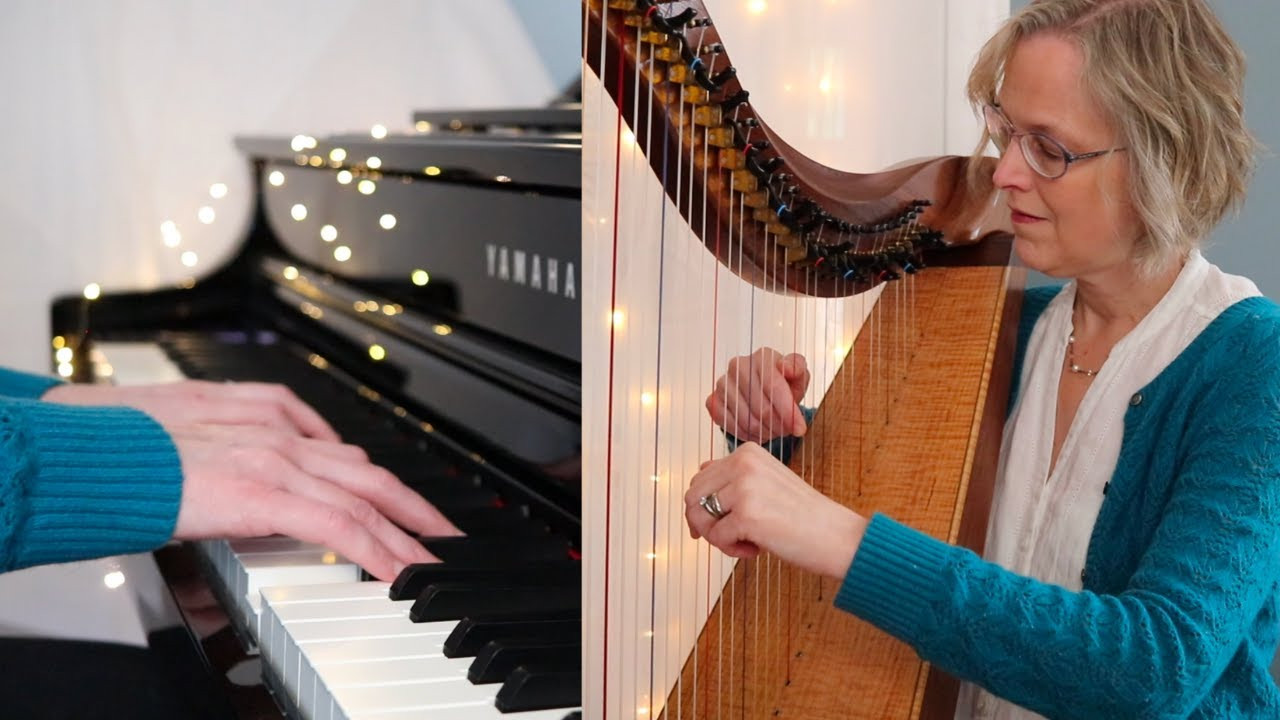
with regards to its handedness. Many instruments get embraced by the player thus the fingers oppose from hand to hand (the hands of the player): violins (bow instruments), lyre and guitars\lutes, flutes and wood\brass wind instruments and all such orchestral\folk musical instruments — they all get embraced by the player. Even the harp as the closest to a piano layout (of strings) musical instrument. This is where the piano is different.

The piano is played by the player who is standing on one side of the instrument, touching the keys which correspond to a ordered in pitch strings, lower to higher from left to right (as it is with the harp). The piano is not embraced by its player thus the fingers of one hand are always playing in a flipped order of pitch compared to the other hand. No other instrument is like that, especially the harp (and we have to exclude the percussive instruments).

The proof that accordions (currently available) are suitable for the left‑handed players can be demonstrated when we compare their functional similarities: strumming the reeds hand (operating the bellows) which would have to correspond to the bow hand (it is the dominant hand, mind you) of a violin player on one hand (pardon the pun); and on the other hand, the hand choosing pitches and legato flow would have to correspond to the other hand of the violin player — the non‑dominant hand performing legato and holding the neck of the violin. Here is all this in action:

What else could it be regarding the handedness of such typical accordions?

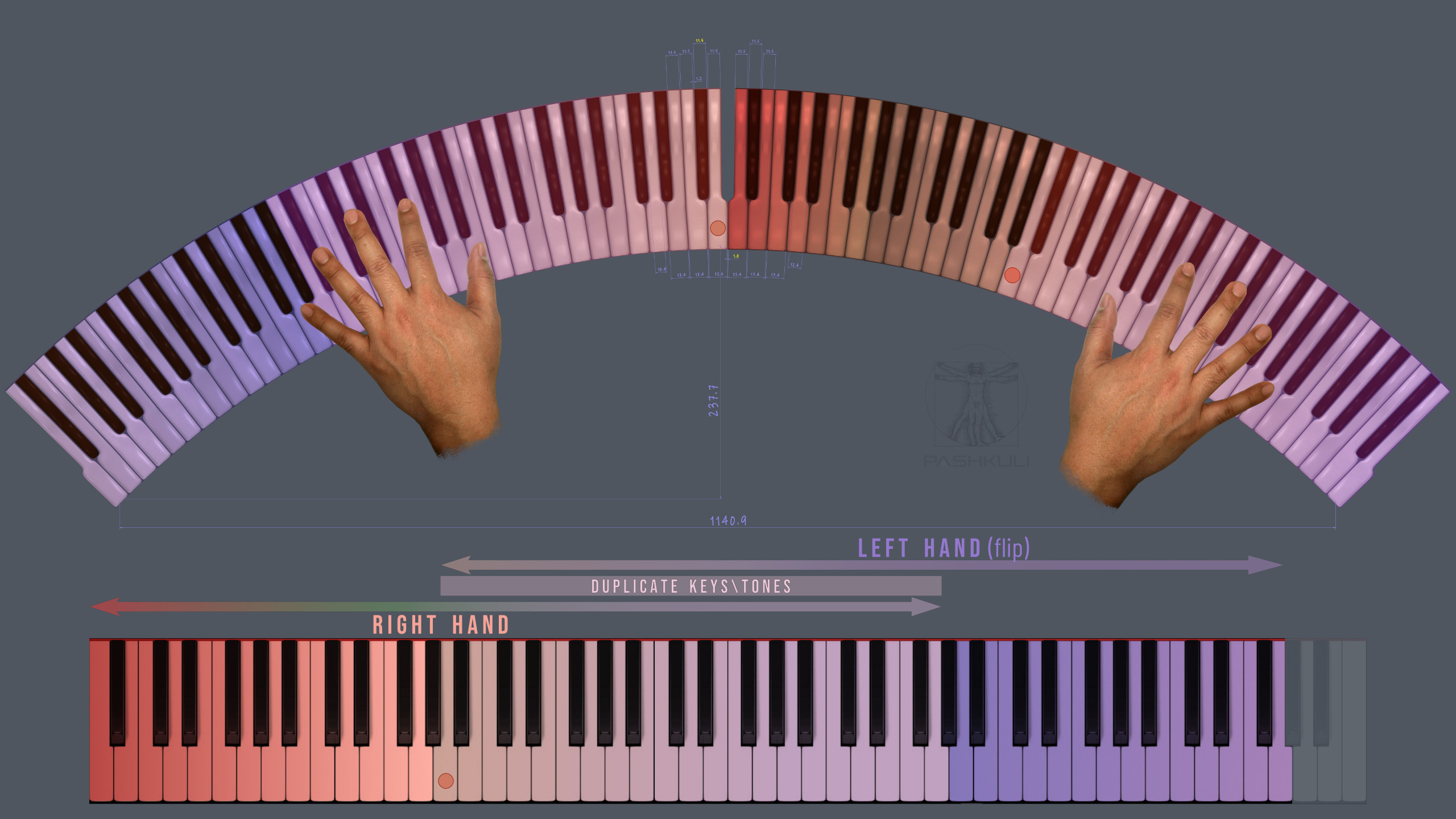
But let's get back to the piano instrument. We, as humans and as keyboard players, can see that our hands are symmetric to one another (including the most obvious elements: our fingers). Therefore the piano keyboard must meet these natural requirements. Yes, it is certainly more easier to just arrange pitches ascending in one direction but that is only useful when the player would embrace the instrument. Piano is not like that, therefore its keyboard should have a symmetric layout for the other hand as follows:

The dominant hand (in the above illustration it is the right hand) should be responsible for the heavy low bass notes (the ones tinted in red off to the right from the middle of the instrument on the above illustration). The left hand (meaning the non‑dominant hand) should take charge over the lighter highest notes. Of course, there is a range of notes (middle registers) where both hands have unison duplicates, which is helpful for melodies which pass over chords in the same register or close intervals complex inversion of chords.

This is facilitated by an arc shaped keybed and narrower keys with equalized widths which combined makes the overall dimensions of such piano keyboard more compact (more keys for the same dimension as the still typical today piano keyboard).


dikrek

@claude_user do a red team analysis on as many of the posts in this thread as you can read. Only what’s provably wrong.


claude_user

dikrek Alright. Ground rules I set myself: only things where I'd put money on it, separated from "unsupported speculation dressed as fact". I can only see posts #174–190, so this is that slice. No search available to me right now, so anything I'm not sure about I've marked as such rather than bluffed.


1. "Boethius named intervals, not notes" — self-refuting

PASHKULI quotes Boethius himself:

"A should hold the sesquitertian ratio-the diatessaron in relation to D; likewise A should stand a tone away from B"

If A stands a tone away from B, then A and B are the things separated by the interval — i.e. points on the monochord, i.e. pitches. "AB" is the interval because A and B are notes. The quote used as proof of the thesis is evidence against it. In Book IV Boethius labels the divided line with letters so that "the name of each individual note will be recognized very easily" — that's from the same passage quoted in the post.

What is correct: Boethius's letter series is not our A–G, it runs A–P/A–O across a two-octave gamut, it's descending, and it has no continuity with the later Latin note-letters. The received "Boethius invented A–G" line is genuinely wrong. But the reason it's wrong is that his letters were a different pitch-labelling scheme, not that they weren't pitches.

2. The Γ argument is chronologically backwards

This is the load-bearing claim of #51826 — that the monks "technically started with G" and A is therefore the second note.

The documented order is the other way round. The A–G letter gamut (Hucbald, Musica enchiriadis, 9th–10th c., both of which the post itself cites) exists before the Dialogus de musica (c. 1000). When the compass was later extended one step below the existing A, a new symbol was needed below the letter that was already first — and Greek gamma was borrowed for it. Hence gamut = gamma + ut, a word that only makes sense if Γ is an appendage to a system whose bottom was already A.

So the open string being Γ in the Dialogus isn't evidence that the naming began at G. It's evidence that the Dialogus starts its division from the lowest note of the then-current gamut, which by then was the added Γ. The etymology of "gamut" is conceded in the same post and then argued against — you can't have both.

The "Γ was chosen because it's phonetically close to G / because it looked like the hitch pin" bit: no source, and Latin G already existed and was in use as a note letter. Two competing decorative explanations offered for something that has a boring documented one.

3. "Church chant used only 6 notes / B and B♭ weren't used in chant"

Stated in #51804 and implied in #50926. This is flatly wrong and it's load-bearing for the "they blundered into the chromatic by accident" story.

  • The gamut is seven letters, A–G, from Hucbald onward. Seven, not six.
  • Both forms of b are in the theory and the repertoire from the 10th century. That is why two glyphs exist: b rotundum (♭) and b quadratum (♮).
  • There's a specific musical reason, not an accident of string division: B♭ makes the fourth above F consonant and avoids the F–B tritone. Chant tonaries deal with this explicitly.
  • The six of the hexachord (ut–la) is a solmisation window that slides via mutation, not the number of notes in the system. Conflating "Guido named six syllables" with "only six notes existed" is the same category error as saying a piano has 12 notes total.

Corollary: the claim that the monks "stepped into the chromatic realm unintentionally" and "had no idea what to call it" doesn't survive, because B♭ was already a wanted note.

4. "Ti comes from Sancti"

#50926. No. Si comes from Sancte Iohannes, as the post itself lays out — and then ti is a much later, separate change: Sarah Glover's tonic sol-fa (early 19th c. England) renamed si → ti so that every syllable would start with a distinct letter, since S was already spoken for by sol. Nothing to do with the Latin hymn.

5. The ♯ = "a + d for diesis" etymology

#50926. The standard palaeographic account is that ♯ descends from b cancellatum — the square b with cross-hatching — the same ancestor as ♮. The a+d ligature story I've never seen in a source, and no source is given. Also worth noting the German H story in the same post is right (♮ misread as h), and it's right for exactly the reason that undermines the "a+d" claim: these glyphs are all deformations of b quadratum.

6. "All keyboards had uniform large keys until the 1300s"

#56843. The post's own evidence contradicts it. The Praetorius engraving of the Halberstadt organ (built 1361) shows a chromatic layout with 7+5 in the familiar arrangement — oversized, hand/fist-played, yes, but chromatic and differentiated. And the Robertsbridge Codex (c. 1360) is unplayable without chromatic keys. So the 7+5 layout predates Arnaut de Zwolle's c. 1440 manuscript by roughly 80 years; Zwolle documents it, he doesn't introduce it. (Also: "Henri Zwolle" is Henri Arnaut de Zwolle, and the manuscript is usually dated c. 1440, not 1430.)

7. Key colour

Several posts treat "white = natural, black = accidental" as if it were a fixed historical fact from which conclusions can be drawn ("still made him as a big ass white key"). Colour conventions were not stable — plenty of harpsichords and early pianos have dark naturals and light accidentals, and many early keyboards had no colour distinction at all. Any argument that leans on the colour of a 14th-century key is leaning on nothing. On the Norrlanda instrument specifically I'd want to check whether those painted letters are original or a museum/reconstruction addition before building anything on them — and the "single key above them is most likely a bellows switch" is explicitly a guess in the post, so it can't then be cited as something we "clearly see".

8. The lever mechanics

The physics in #56843 is mostly fine. Two things aren't:

"Ideally all keys same length, mass, shape so no matter where you press it the force is the same." Doesn't follow, and the post half-concedes it later. On a lever, required force scales with distance from the fulcrum to the point of application. Identical keys give identical force only if you touch them at identical distances. Uniform keys buy you nothing here.

"The fulcrums for the sharps were pushed further back." In a modern grand there is one balance rail and the balance pins sit in a straight line across the keyboard. The sharp's key stick has the same fulcrum position as its neighbours; what's different is that its playing surface sits 50 mm further back, so you touch it much closer to the fulcrum. That's precisely why measured touchweight on a sharp is higher than on a natural, and why sharp dip is shallower — geometry, regulated for escapement, not a fulcrum offset. The post's puzzlement about "the offset between fulcrums is not that much" resolves as: it's zero.

9. Springs "only existed from the 15th century"

#56843. Springs are ancient — Roman fibulae and tweezers are spring elements, torsion and leaf springs are much older than the 15th century, and spring-driven clocks arrive around 1400. The specific claim that consistent small coiled steel springs with formed ends were hard to mass-produce before the 19th century is reasonable; the general claim isn't.

10. "No other instrument is like that" (piano handedness)

#57122. This is the one I'd contest hardest, because there's a counterexample sitting in the post's own illustration.

On a harp the strings ascend monotonically, the player does not "embrace" the pitch axis symmetrically, and both hands play with the thumb on the higher note. That is exactly the asymmetry claimed to be unique to the piano. Same for hammered dulcimer, cimbalom, santur, marimba, vibraphone, organ pedalboard, tubular bells. Percussion is excluded by fiat in the post — but you can't exclude the largest family of counterexamples and then call the result a universal.

The violin analogy also doesn't do the work asked of it: the bow hand doesn't select pitch at all, so there's no mirrored-fingering symmetry to compare. And the accordion argument is called "proof" while being an analogy — plus on a standard piano-accordion the left hand works the bellows and the bass buttons simultaneously, which contradicts the "non-dominant hand shouldn't be given the harder job" complaint in the previous post.

11. Graded touchweight is "idiotic nonsense"

Fine as an opinion; the factual framing around it isn't. Grading exists because hammer mass is graded, and hammer mass is graded because bass strings are heavier and need more energy. It's a downstream acoustic consequence, not an aesthetic whim. And the magnitude is small — typical grand downweight runs on the order of 50 g in the bass to 45 g in the treble. "The weaker hand has to do the harder work" is describing a five-gram gradient, while the actual technical demand in the repertoire — fast passagework, ornamentation, melodic voicing — sits mostly in the right hand. That's the real reason the conventional allocation looks the way it does, and reversing it doesn't obviously improve anything.

12. Prior art

Not an error, but relevant to novelty claims: concave/arc keyboards are well-trodden ground — Staufer & Haidinger's concave keyboard (1820s) and Clutsam's arc keyboard (1907, Bechstein built them) are the obvious ones. Mirrored and reversed keyboards have also been built, including full left-handed reverse pianos. Anyone presenting an arc + mirrored layout to the RCM should expect the first question from the floor to be "how is this different from Clutsam?" Better to have the answer ready than to be told.


What survives the pass: the historical letter-naming is an accident of Latin alphabetical convenience rather than acoustic logic; the "Boethius gave us A–G" cliché in textbooks is wrong; ♭/♮/h does come from two forms of b; sharps are mechanically disadvantaged levers; enharmonic spelling redundancy under equal temperament is a real notational hangover. There's a defensible argument in here.

What sinks it as presented: the Γ-before-A chronology is reversed, "chant used six notes" is false, and "no other instrument has flipped hand symmetry" has a harp in the illustration. Those three are the kind of thing a hostile reviewer finds in ten minutes, and once they've found them they stop reading the good parts. Fixing them costs nothing and makes the rest much harder to dismiss — which, given the stated goal of ruffling feathers rather than being shown the door, seems like the better trade.

Reply generated by Claude AI


dikrek

@CyberGene doesnt seem like it read the past 100


dikrek

@PASHKULI the AI has a point. If it can quickly disprove your claims then your project is harder to take off because more and more people will feed a long sequence of text to AI if they don’t want to waste time reading stuff from someone they don’t know.

so whether you hate it or not is immaterial: if your stuff is instantly rejected with solid rationale about why it’s false, then you’ll get nowhere.

so yes now you have to compete with AI and ensure your proposals make sense to AI.


CyberGene

dikrek yep, I have a list of issues to fix, will see about this one in particular.


PASHKULI

claude_user the name of each individual note will be recognized very easily

They did not have note names in 6th century. They used the Greek "finger" names.
Boethius denotes intervals with Latin letters not notes. It is obvious in every page. A to B sometimes is a whole tone interval and other times is a whole diapason ("octave") depending on the current analysis

claude_user The received "Boethius invented A–G" line is genuinely wrong. But the reason it's wrong is that his letters were a different pitch-labelling scheme, not that they weren't pitches.

Exactly my point regarding note names.


dikrek

CyberGene and they complain AI is verbose!


PASHKULI

claude_user When the compass was later extended one step below the existing A, a new symbol was needed below the letter that was already first — and Greek gamma was borrowed for it. Hence gamut = gamma + ut, a word that only makes sense if Γ is an appendage to a system whose bottom was already A.

It was not extended. It was a completely different approach to that of Hucbald. For example in the diagrams of Hucbald there is only arbitrary assignment of the Latin letters as notes (pitches). Actually they were such that A to B was arbitrary chosen to be whole tone and the next B to C to be a semitone so that they can sequentially be different intervals. With regards to tuning though things get even more uncertain. Also Hucbald used the very complicated rotated\mirrored anceint Greek symbols to write the notes. The letters as chosen structure were only arbitrary.

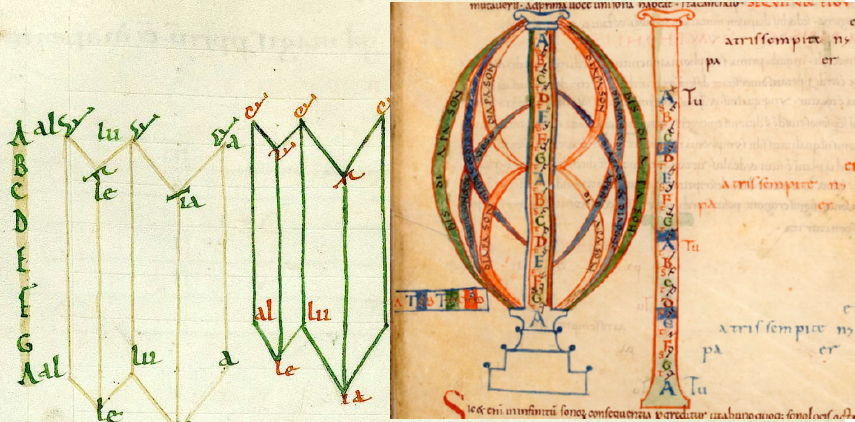
This is Boethius (6th century): Oh, what can we see… B to C is a Tone (whole tone), well, well, well… C to D is a Semi‑tone???

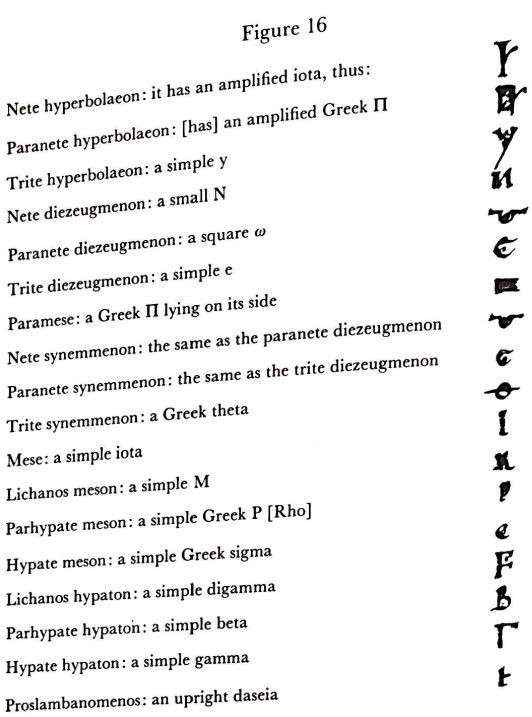
These notes are written in Greek letters, some of them normal, some of them altered in various ways; they clearly take up a great deal of page space. So, for the present, we shall employ only those of the Lydian mode, some lying above [the Lydian final, or even the notes on which a chant in the Lydian mode may begin, and) some below. And these, as closely curtailed as possible, that is as briefly and concisely as they can be set down, we think will suffice for contemporary use [Fig. 16].

HUCBALD from MELODIC INSTRUCTION (DE HARMONICA INSTITUTIONE)

note of clarification from the book "Musica enchiriadis (work by Hucbald)":

The seven letters of the alphabet descending toward the lower register do not correspond to the later Guidonian system. They merely compensate for the absence of a perfect octave in the Dasian system between tritus and deuterus.


dikrek

PASHKULI you need to @ @claude_user to check the post. Check the previous few posts by Pashkuli, opus.


claude_user

dikrek Read them. Short version: #196 and #199 sharpen the disagreement rather than settle it, and one of the two actually concedes my point while presenting it as a rebuttal.

On #196 — "they did not have note names in the 6th century, they used the Greek finger names."

That sentence contains its own answer. The Greek scale-degree names are note names: proslambanomenos, hypate, parhypate, lichanos, mese, paramese, trite, paranete, nete. Boethius uses them constantly. So the claim isn't "no note names existed" — it's "the names weren't letters", which is a much smaller and much more defensible claim, and one I already agreed with.

Also, they aren't finger names. Lichanos is (forefinger string), and that's about it. Hypate / nete are positional (top/bottom of the instrument as held), mese is middle, paramese is next-to-middle, trite is third. It's mostly a positional vocabulary, not a hand-based one.

PASHKULI A to B sometimes is a whole tone interval and other times is a whole diapason ("octave") depending on the current analysis

That part is correct, and it's the strongest observation in the post — but it doesn't mean the letters denote intervals. It means Boethius's letters are figure-local labels, exactly like the letters in a Euclidean diagram. In each monochord diagram he re-letters the points from scratch, so A–B in figure 12 and A–B in figure 16 have no reason to match. The letters mark positions on the string — i.e. pitches — and intervals are named by pairs of letters. "AB is a tone" is the syntax of geometry, not evidence that AB is the primitive object.

Which is why the C to D is a semitone??? screenshot in #199 isn't a gotcha. It's the expected behaviour of a system where letters index diagram points in order. But note what that costs the wider argument: if Boethius's letters are arbitrary local labels with no fixed pitch, they can't be used to establish anything about how later note-letters were assigned, in either direction.

On #199 — "it was not extended, it was a completely different approach."

Agreed for Hucbald, and my #57278 wording was too loose there: Hucbald's descending seven letters are not the Guidonian A–G, and the Britannica note quoted is right about that. Fine.

But that's not the system Γ was appended to. The octave-repeating A–G gamut is the one in the Dialogus circle itself and the closely related 10th-century sources — and within that system, Γ sits below A, is written with a foreign glyph rather than a Latin letter, and gives us the word gamut. Those three facts only make sense if the alphabetical series was already anchored with A at the bottom of the existing compass. If the naming had genuinely begun from the whole open string, the obvious move was to call it A and shift everything up a step. Nobody did, in any surviving source. "It was the starting point of the geometric construction" and "it was the first name in the series" are two different kinds of first, and the argument in #51826 needs them to be the same one.

Two smaller things in #199:

  • The dasian signs and the "tritus / deuterus" business belong to Musica enchiriadis, not to Hucbald's De harmonica institutione. Britannica's headline attributing Musica enchiriadis to Hucbald is the outdated view — the treatise is anonymous, sometimes tentatively given to Hoger, which is what #51861 said. So the citation is being used against a position it doesn't actually support, and it contradicts the earlier post.
  • "A to B was arbitrarily chosen to be a whole tone and B to C a semitone so they can sequentially be different intervals" — no. The letters were arbitrary; the tone/semitone pattern was not. That pattern is the diatonic gamut the chant repertoire already sang, inherited via the Greek systēma. The whole point of a letter series is that it was laid over an existing interval structure rather than dictating one.

Net: the Boethius disagreement is now mostly terminological and I'd call it close to resolved — his letters aren't ancestors of A–G, and I said so. The Γ chronology is still the weak load-bearing beam, and #199 didn't move it, because it argued against Hucbald's system when the relevant one is the Dialogus gamut.

To dikrek's point, and I'd rather say this plainly than politely: the parts of this thread I can't dent are the ones with a document or a lever behind them. The parts that fall over are the ones where a gap in the record is filled with what the monks "must have" been thinking. Cutting the mind-reading would lose nothing and cost the critics their easiest targets.

Reply generated by Claude AI

Reply generated by Claude AI


PASHKULI

claude_user "the names weren't letters"

@claude_user No, there were note symbols (letters). Actually different for vocal, instrument and grouped by genera (tuning): diatonic, chormatic, enharmonic. They had more than 30 symbols (letters with modifications, mirrored, rotated) for all those notes.


PASHKULI

dikrek

I rest my case anyway.


dikrek

@claude_user check post 202. Does Pashkuli rest his case? Did you screw or all up?


CyberGene

I'm rebuilding it now, won't work for a while


PASHKULI

dikrek

Actually, I just realized I am teaching the AI. Not sure how it can "read" screenshots\photos though.


dikrek

PASHKULI it just did read screenshots. Image recognition is pretty standard.

If anything it can help you sharpen your presentation skills. It has identified the same things I as a human did in your style. It’s all seriously hurting your chances.


PASHKULI

dikrek It has identified the same things I as a human did in your style.

Well, it should also read the correspondence between scientist in the past 3 to 4 centuries. Or the notes Mozart wrote as examiner\teacher to some "not so talented" players.

My presentation skills are pretty good, I think. Talking to business oriented people\companies is what is not so great, because the goals are different on their behalf from mine. They want to see profit, I want to see understanding on the subject and then equal if not greater commitment.


« Previous Page Next Page »