dikrek
PASHKULI sure. Check the PDF I linked before it’s too late

PASHKULI sure. Check the PDF I linked before it’s too late
CyberGene is what banned you from many forums around the world. It is toxic and causes people to either get angry or leave the forum.
This due to their own ignorance on matters I present as a discussion (and they feel obligated… for some reason to reply…) or they think that the current designs and features are the ultimate truth. As one such piano repair shop owner said to me a few years ago:
"Do not waste your and others people in the industry time. Everything about the piano has been done for 200+ years now."
I disagree, hence I propose new ideas. Imagine something coming to you and say: "Everything about piano has been played and composed. Do not bother trying to make some now piano original works."
Stagnation is not good. It is not making a solution in search of a problem. If I do not like the piano, let it be only me then.
PASHKULI seriously, check that PDF.
Yes, I got it, thank you for the effort. Will read it in a bit (a couple of hours).
To truly implement "escapement" on such digital\hybrid pianos, the samples behaviour (or sequence) should be related to the action of the hammer. Technically the sensor should be triggered by the hammer. But that is equivalent to place such sensor where actual strings would be and the rest of the construction of the action to be a lightweight version of typical grand\upright.
This all assuming the currant "escapement action" and suspension (kay lever) should be considered as the only truth (which it is not).
The only thing current action does is: only accelerate the hammer (no humanly possible chance of deceleration for gentle touch on the strings) and loss of energy due to that "escapement" (slipping off) of the jack.
Regarding the piano and where it fails ordered by difficulty to grasp, make:
I
• its keys widths and overall proportions are plainly wrong
• its shapes are limiting and restricting the player (see Chopin) from a fair access of touch\reach
↑ those two above being corrected would be enough
II
• lever vs parallelogram suspension
• Hickman's moded action (it is actually less difficult to make than Erard\Renner type of action)
III
• arc shaped keybed for ergonomic hand moves at both ends of range
• mirrored layout to comply with our natural symmetry of the hands (reduces learning by a factor of at least 4 especially for scales, chord inversions, arpeggios and counterpoint)
IV (mechanically very challenging)
• additional (but to me they are the most natural\trivial) expression features: vibrato, pitch bend per note\key
• dynamic volume control over the action (pedal)
• mute pedal (it is called sordino) with the purpose of representing the area of the palm on the pinky finger side touching the strings
V (electrical\electronic only, challenging for cost and application\harnessing all components mentioned below and so on)
• individual pickups for any set of string tuned to a pitch\note + PCB miltiplex boards, controllers
• piezo pickups under\on bridges
• sensor for any digital feature (parameter): velocity, vibrato\PB after‑touch, pedals, stick\wheels
The other concepts with regards to Music notation are not so important although to me they are as the misunderstanding there throughout the centuries is equally as crucial.
I mention that:
There was a really informative French webpage (similar to this one) 15 years ago but I can not find it now.
I found it although it has been changed a bit (most of it won't work, it is outdated):
also this one I frequently used to read:
@dikrek says:
you’ve been told your keyboard may make chromatic scales possible but then breaks other stuff.
That’s your challenge: you identify one thing and maniacally pursue it, and ignore what else your solution breaks.
Well, I think playing chromatic scales is possible even now and pianist do it.
All I am saying is that those scales will be possible (or any other scale for that matter) even if you start with a note on a 'black' key with your thumb on that key (using my wavy shaped piano keyboard keys). Chromatic glissandi and sliding of chords is just a positive side effect.
What "other stuff" it breaks? Let me see it, point it out, please?
Or do you meant to also include the mirrored direction for the left hand (the arc shaped keybed with narrow keys and wavy shapes)?
Yes, in that case it will "break" some specific configs between the index and thumb (widest distance for adjacent fingers) but it will be for the better outcome. See next:
• and probably if those are low bass notes (current left hand) it will have to be played with the right hand (right handed player) assuming my suggestion the right hand to typically play the lowest bass notes (range)
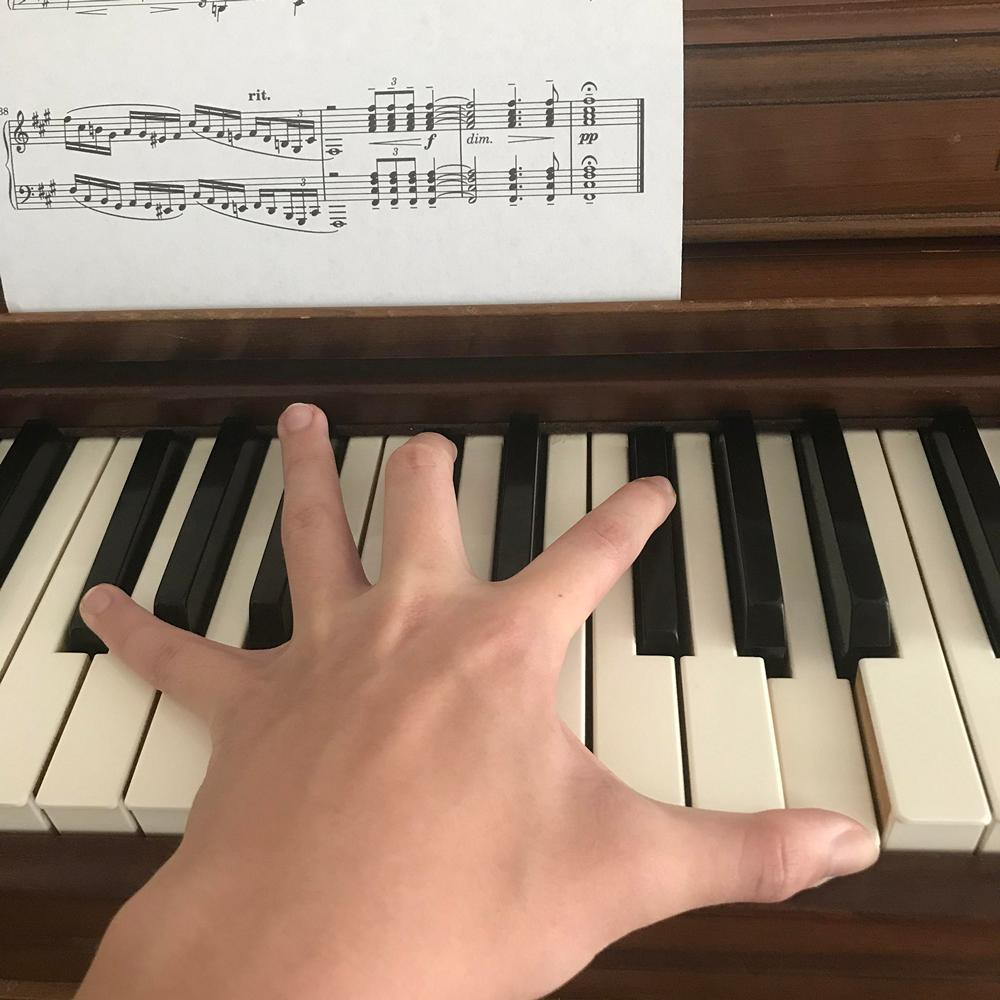
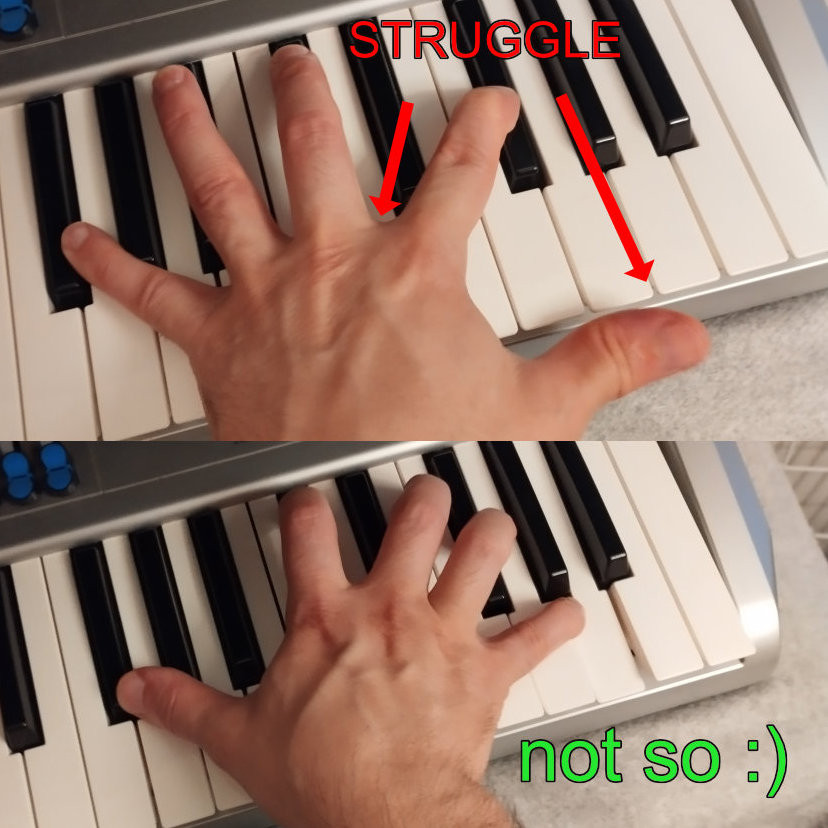
• then yes, that may seem "broken" but you know what… exactly that config (shown in the photo) is much easier to reach with the 'mirrored' hand fingering as follows: thumb on black, index on black (5th you call it), then middle on black ("octave" you call it) and then pinky on white (highest)
For example (for me at least), the shown chord is impossible for my left hand (yes my hands are not that big as that humongous one above) → absolute pain to get that stretch between middle and index (because even if I manage somehow my thumb goes way, way out of the keyboard)!
On the other hand (pun intended), it is more reachable with the right hand (pun unintended) config though. Weird heh?! So, another proof again. It is not weird, it is natural.
Here for you to assess because I have done it long, long time ago:
• this is good because usually in the lows bass notes rarely you'd find "thirds" in the bass → the frequencies are too similar.
Usually it is "fifths" but there is an "octave" (most of the times at least in modern music) of the bass note and the "third" ("tenth"? from the bass note) of that "octave". The stretch is a nightmare! Look at the pinky to middle fingers (a "fifth") and my index finger is who knows what its doing.
But you know what? Mirror it for the bass notes to be played as absolutely normal and both hands can play the same keys with the same fingers for matching scale, chord inversions and in the brain it is really natural.
Proof. Poof.
Currently, I am working on a concept of trying to emphasize the importance of getting the dexterity for both hands the correct (natural) way.
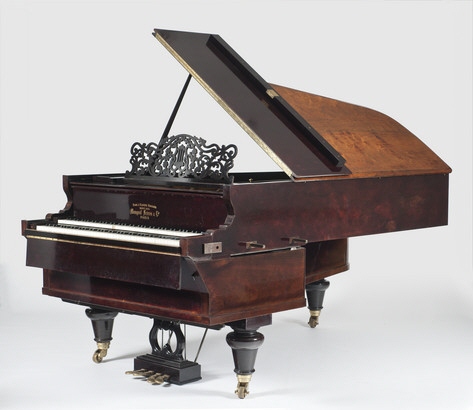
Known as Mirrored layout, first made by Mangeot in 1878 (suggested by the polish pianist J. Wieniawski) although they stacked two keyboards (and frames) on top of each other:
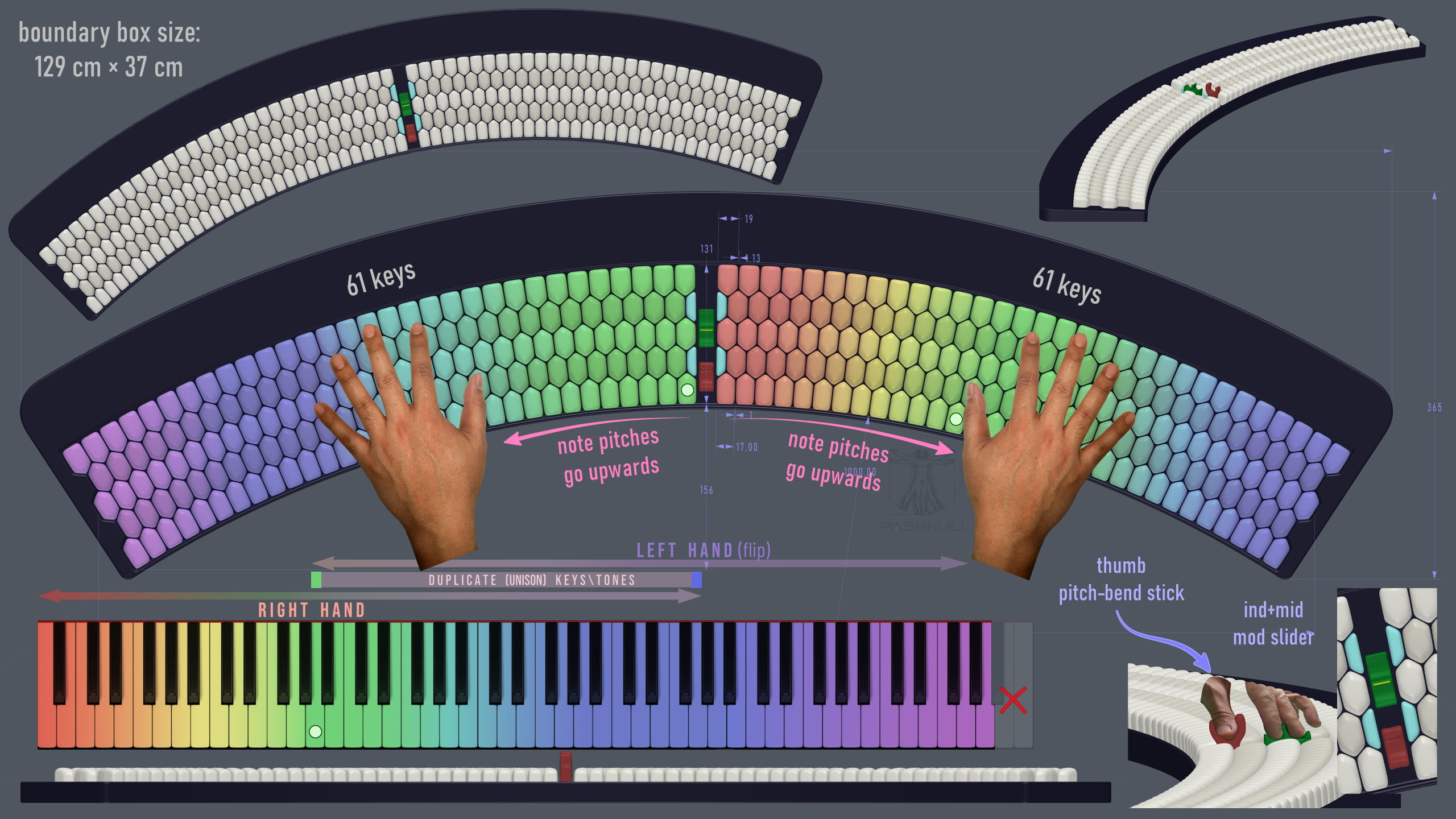
The one I design has Isomorph layout too (Jankò \ Dreschke, it is rather Dreschke modification). Its size is comparable to any current standard 88 MIDI controller keyboard (digital piano). No need to mention that any scale, chord, etc. is the same for the fingers of either hand (that is the point of mirrored layout):