@dikrek says:
you’ve been told your keyboard may make chromatic scales possible but then breaks other stuff.
That’s your challenge: you identify one thing and maniacally pursue it, and ignore what else your solution breaks.
Well, I think playing chromatic scales is possible even now and pianist do it.
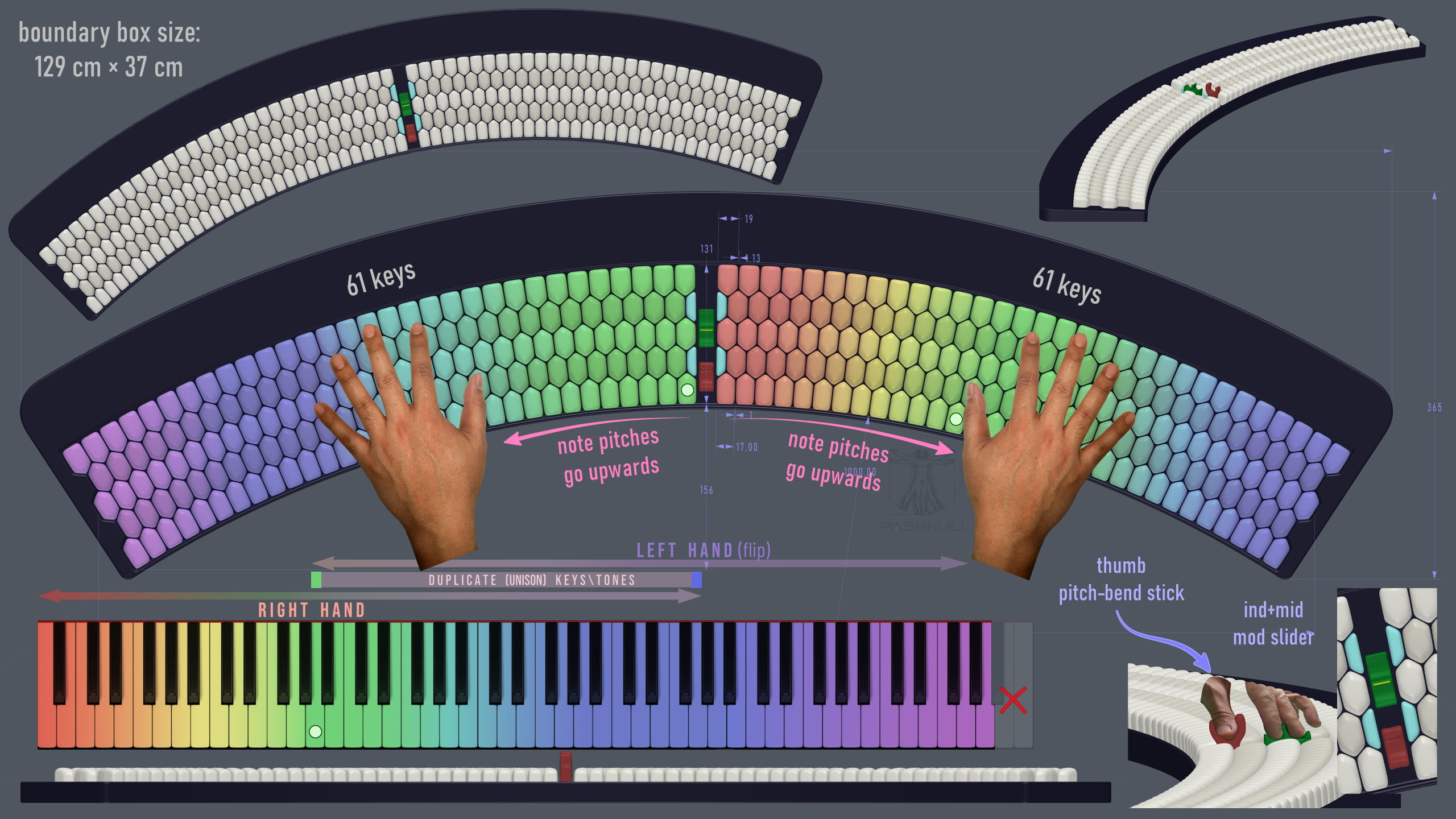
All I am saying is that those scales will be possible (or any other scale for that matter) even if you start with a note on a 'black' key with your thumb on that key (using my wavy shaped piano keyboard keys). Chromatic glissandi and sliding of chords is just a positive side effect.
What "other stuff" it breaks? Let me see it, point it out, please?
Or do you meant to also include the mirrored direction for the left hand (the arc shaped keybed with narrow keys and wavy shapes)?
Yes, in that case it will "break" some specific configs between the index and thumb (widest distance for adjacent fingers) but it will be for the better outcome. See next:
![]()
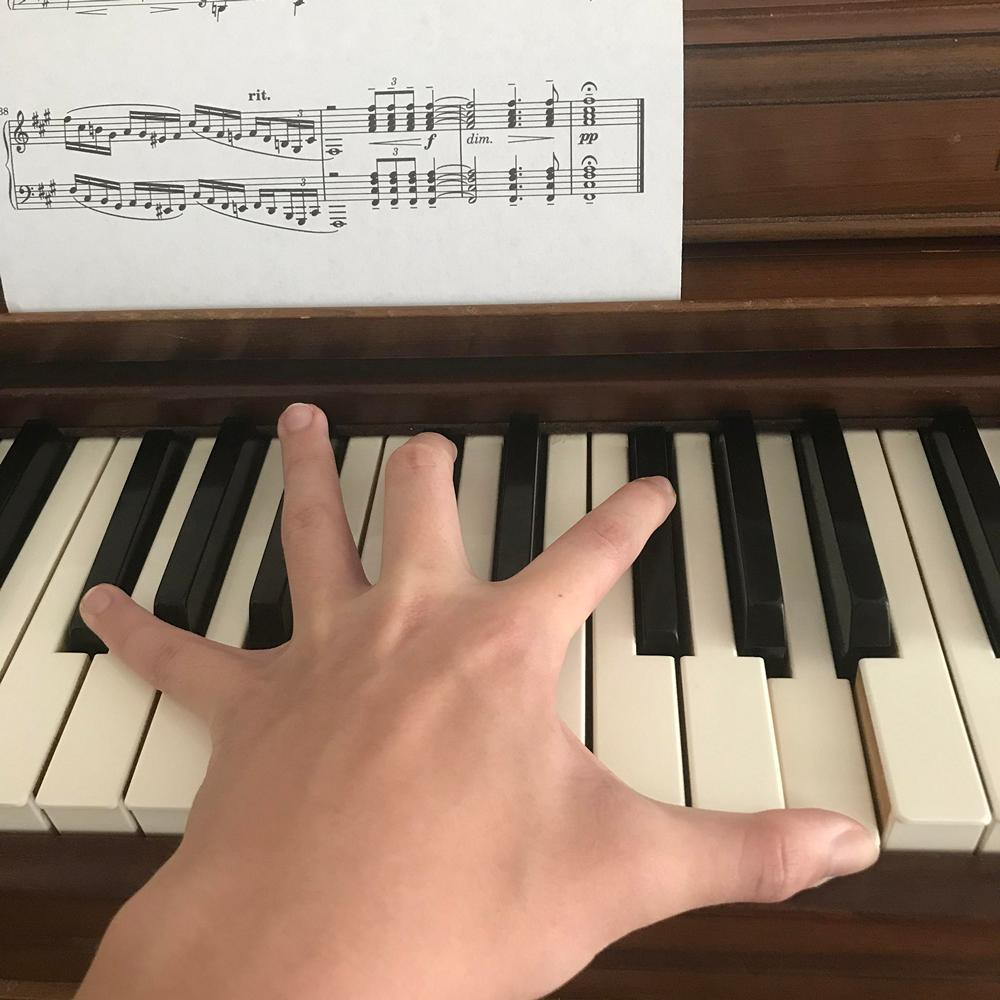
• and probably if those are low bass notes (current left hand) it will have to be played with the right hand (right handed player) assuming my suggestion the right hand to typically play the lowest bass notes (range)
• then yes, that may seem "broken" but you know what… exactly that config (shown in the photo) is much easier to reach with the 'mirrored' hand fingering as follows: thumb on black, index on black (5th you call it), then middle on black ("octave" you call it) and then pinky on white (highest)
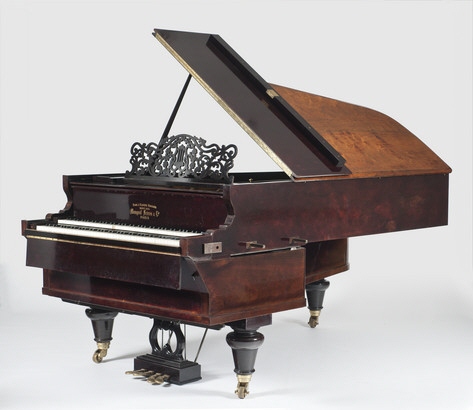
For example (for me at least), the shown chord is impossible for my left hand (yes my hands are not that big as that humongous one above) → absolute pain to get that stretch between middle and index (because even if I manage somehow my thumb goes way, way out of the keyboard)!
On the other hand (pun intended), it is more reachable with the right hand (pun unintended) config though. Weird heh?! So, another proof again. It is not weird, it is natural.
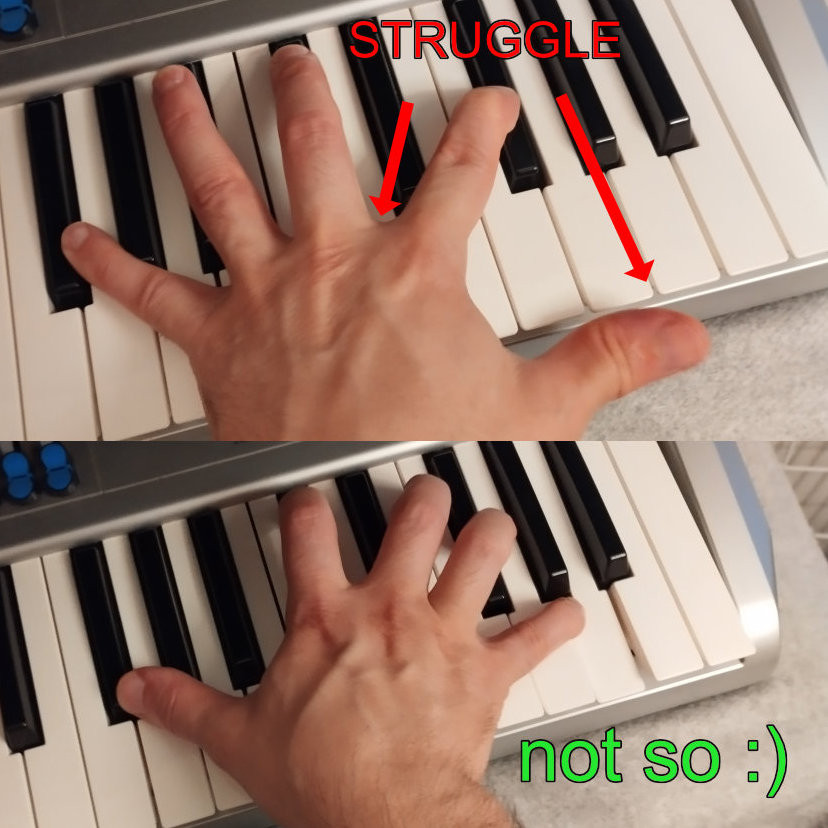
Here for you to assess because I have done it long, long time ago:
![]()
• this is good because usually in the lows bass notes rarely you'd find "thirds" in the bass → the frequencies are too similar.
Usually it is "fifths" but there is an "octave" (most of the times at least in modern music) of the bass note and the "third" ("tenth"? from the bass note) of that "octave". The stretch is a nightmare! Look at the pinky to middle fingers (a "fifth") and my index finger is who knows what its doing.
But you know what? Mirror it for the bass notes to be played as absolutely normal and both hands can play the same keys with the same fingers for matching scale, chord inversions and in the brain it is really natural.
Proof. Poof.