PASHKULI
dikrek your presentations read like a ransom note.
😂 so, better not reach anywhere to ransom notes or blackmail
I have 0 tolerance for bs‑ing and gaslighting. Especially with authorities of any kind.

dikrek your presentations read like a ransom note.
😂 so, better not reach anywhere to ransom notes or blackmail
I have 0 tolerance for bs‑ing and gaslighting. Especially with authorities of any kind.
PASHKULI from a business standpoint they don’t follow any rules for clarity. I read all I could, I realized the ideas make zero commercial sense, so I fed it to AI for fun.
it agreed with me.
Maybe we both don’t understand your brilliance.
You do not need AI to confirm the ideas are not business commercially feasible. There are no customers (yet). They are too young and therefore they do not know. For example I did not know about Mangeot piano or Hickman until I was 30ish. There was a really informative French webpage (similar to this one) 15 years ago but I can not find it now. And I have been interested in pianos since I was about 16. That is 15 years but of course not my main occupation or main hobby, as I am not a pianist.
Design‑wise – yes. But that really started about 10 years ago just so I can "finish with it" somehow. And most serious since Covid.
dikrek Maybe we both don’t understand your brilliance.
There is nothing 'brilliant' here. Merely ideas, concepts (proof of such).
A commercial application for new things require commercial tactics and a budget (separate from the budget for production).
For example, the creation and marketization of the programming language Java (by SunMicrosystems → Oracle) in the mid '90s with intention to be sort of "universal programming language" to run anywhere with open source code for the virtualization machine. All very good but… programmers had to learn it in order to use it. Somehow Oracle Corp. acquires Sun (where it should have been the other way around but big money always devours small money but that is a different rant how Oracle is as is).
So, here comes hundreds of millions for marketing campaign to create userbase, make them dependent on 'built with Java. Oracle spent millions to market the use of Java to software developers. That is how you create userbase. Charge them later when their apps get dependent on Java. That is what happened between 2009 and till about 2016 with microservices, embedding for servers, licensing for commercial soft. products and whatnot.
Even I knew about Java although could not care less but would hear my best friend swearing that the company he worked in at that time was forcing them to learn Java and rewrite some old stuff in Java to be sued with the new stuff entirely in Java.
"Java runs on 3 billions devices" if you remember when had to install some Java RTE for some software to work (or at least some features of it). I remember it.
The point is: you create the userbase\market, that is what business people must do (at least used to do). Of course after they own you (your thing created).
CyberGene this discussion here is not visible on the main page and has attracted no real interest among anybody
I keep my new shoes intact in their original box. I wonder why nobody has seen me with my new shoes on.
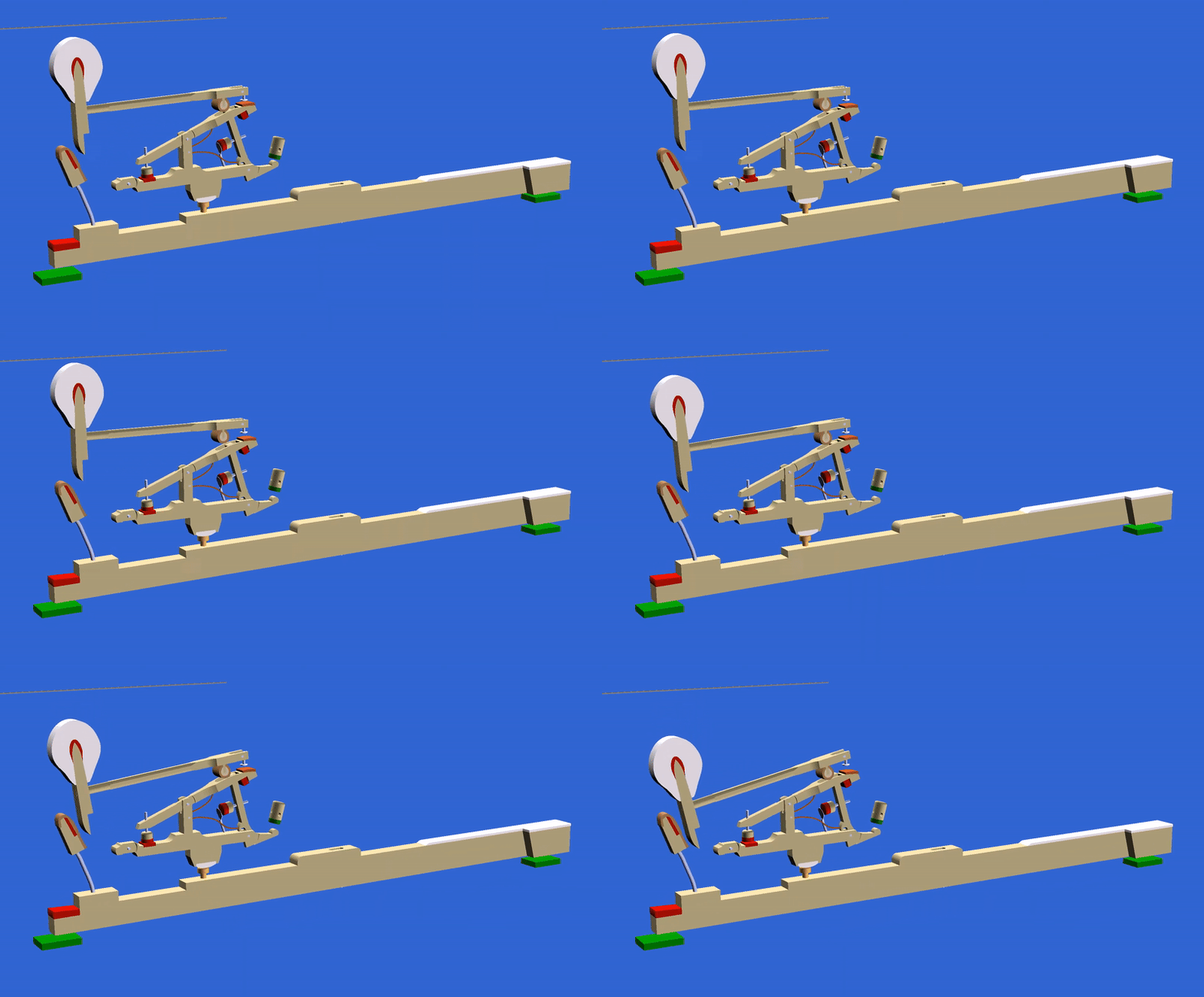
Ratio, escapement are all subjects to regulation. You miss it by a mm or so and you might end up here:
Or the edge of the jack that meets the knuckle get worn out, chipped off.
Also the lever length after the balance pin to the capstans is not the same ratio between 'white' and 'black' keys. Therefore, technically the black keys lift a bit less the whippen. So their capstans are at a different height and\or the jack angle is (should be) adjusted.
If they are not, then the press force is different. Also due to the geometry difference (black keys are raised from the tails of the whites) it all feels like a different instrument when thumb is on a 'black' key and the player has to perform something that way.
Yes, scales are not played with thumb on black keys… exactly for the same reason.
I say, enough. The player should be able to play from anywhere whatever is needed. Hence my redesigns of the piano keyboard came to be.
@PASHKULI here is the result after I fed AI your entire research corpus you made public.
Do with it as you please. You can ignore it thinking it doesn’t understand. But it seems to have identified interesting things around various topics. It’s not an exhaustive list of all findings, just a 30-item one.
Given the scope of what you do, don’t be surprised if others you send your work to aren’t doing the same thing.
So it might help you to gain more traction if you addressed some of the findings so that the work survives a deep AI analysis before being handed off to a human as “potentially interesting”.
PASHKULI because you seem to have forgotten, let me remind you that your permanent thrashing the piano, piano actions, etc is what banned you from many forums around the world. It is toxic and causes people to either get angry or leave the forum. I agreed to let that BS only in that dedicated thread of yours.
I know what you’re in constant need for, and I won’t provide it. Enough is enough. One more mentioning of anything (not just pianos, actions, recording techniques, sampling, modeling, anything!) you consider bad/wrong and you’re out of the forum, as will be that other thread. I understand this becomes personal attitude towards you but I’m the owner of this forum, I pay for it, I spend time maintaining it and ultimately it’s me deciding what totally unfair treatment I can take to save my forum.
@PASHKULI no need for a response, leaving this here in case you find it useful regarding a study of your methodology and findings (and for anyone else that stumbles upon this thread).
I put it in the AI thread as well. It seems helpful.
Just this past Saturday I went to a piano\music shop and tested a psedo‑hammer action by Yamaha (forgot the model, should have taken a photo…):
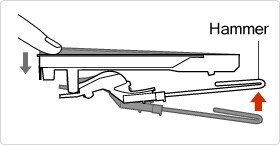
• if you have a good enough associative imagination, they used an element of parallelogram attaching the hammer to the "front" of the key. Very similar to this:
Technically, the hammer lips (front), hold the keys long protrusion (like a hook), and there is no escapement → let go of the hammer. The player "balances" the weight of that hammer at all times because there are no strings.
Some hybrid actions include this rubber bud that a protrusion on the lever would flick or tickle and it is quite frankly idiotic. The y are just trying to deceive the player as if some haptic "realistic" such "escapement" feature has been implemented. I have no idea who was the "engineer" behind such feature, but most likely it was some non‑engineer who insisted it should be there for marketing purposes.
PASHKULI sure. Check the PDF I linked before it’s too late
CyberGene is what banned you from many forums around the world. It is toxic and causes people to either get angry or leave the forum.
This due to their own ignorance on matters I present as a discussion (and they feel obligated… for some reason to reply…) or they think that the current designs and features are the ultimate truth. As one such piano repair shop owner said to me a few years ago:
"Do not waste your and others people in the industry time. Everything about the piano has been done for 200+ years now."
I disagree, hence I propose new ideas. Imagine something coming to you and say: "Everything about piano has been played and composed. Do not bother trying to make some now piano original works."
Stagnation is not good. It is not making a solution in search of a problem. If I do not like the piano, let it be only me then.
PASHKULI seriously, check that PDF.
Yes, I got it, thank you for the effort. Will read it in a bit (a couple of hours).
To truly implement "escapement" on such digital\hybrid pianos, the samples behaviour (or sequence) should be related to the action of the hammer. Technically the sensor should be triggered by the hammer. But that is equivalent to place such sensor where actual strings would be and the rest of the construction of the action to be a lightweight version of typical grand\upright.
This all assuming the currant "escapement action" and suspension (kay lever) should be considered as the only truth (which it is not).
The only thing current action does is: only accelerate the hammer (no humanly possible chance of deceleration for gentle touch on the strings) and loss of energy due to that "escapement" (slipping off) of the jack.
Regarding the piano and where it fails ordered by difficulty to grasp, make:
I
• its keys widths and overall proportions are plainly wrong
• its shapes are limiting and restricting the player (see Chopin) from a fair access of touch\reach
↑ those two above being corrected would be enough
II
• lever vs parallelogram suspension
• Hickman's moded action (it is actually less difficult to make than Erard\Renner type of action)
III
• arc shaped keybed for ergonomic hand moves at both ends of range
• mirrored layout to comply with our natural symmetry of the hands (reduces learning by a factor of at least 4 especially for scales, chord inversions, arpeggios and counterpoint)
IV (mechanically very challenging)
• additional (but to me they are the most natural\trivial) expression features: vibrato, pitch bend per note\key
• dynamic volume control over the action (pedal)
• mute pedal (it is called sordino) with the purpose of representing the area of the palm on the pinky finger side touching the strings
V (electrical\electronic only, challenging for cost and application\harnessing all components mentioned below and so on)
• individual pickups for any set of string tuned to a pitch\note + PCB miltiplex boards, controllers
• piezo pickups under\on bridges
• sensor for any digital feature (parameter): velocity, vibrato\PB after‑touch, pedals, stick\wheels
The other concepts with regards to Music notation are not so important although to me they are as the misunderstanding there throughout the centuries is equally as crucial.
I mention that:
There was a really informative French webpage (similar to this one) 15 years ago but I can not find it now.
I found it although it has been changed a bit (most of it won't work, it is outdated):
also this one I frequently used to read:
@dikrek says:
you’ve been told your keyboard may make chromatic scales possible but then breaks other stuff.
That’s your challenge: you identify one thing and maniacally pursue it, and ignore what else your solution breaks.
Well, I think playing chromatic scales is possible even now and pianist do it.
All I am saying is that those scales will be possible (or any other scale for that matter) even if you start with a note on a 'black' key with your thumb on that key (using my wavy shaped piano keyboard keys). Chromatic glissandi and sliding of chords is just a positive side effect.
What "other stuff" it breaks? Let me see it, point it out, please?
Or do you meant to also include the mirrored direction for the left hand (the arc shaped keybed with narrow keys and wavy shapes)?
Yes, in that case it will "break" some specific configs between the index and thumb (widest distance for adjacent fingers) but it will be for the better outcome. See next:
• and probably if those are low bass notes (current left hand) it will have to be played with the right hand (right handed player) assuming my suggestion the right hand to typically play the lowest bass notes (range)
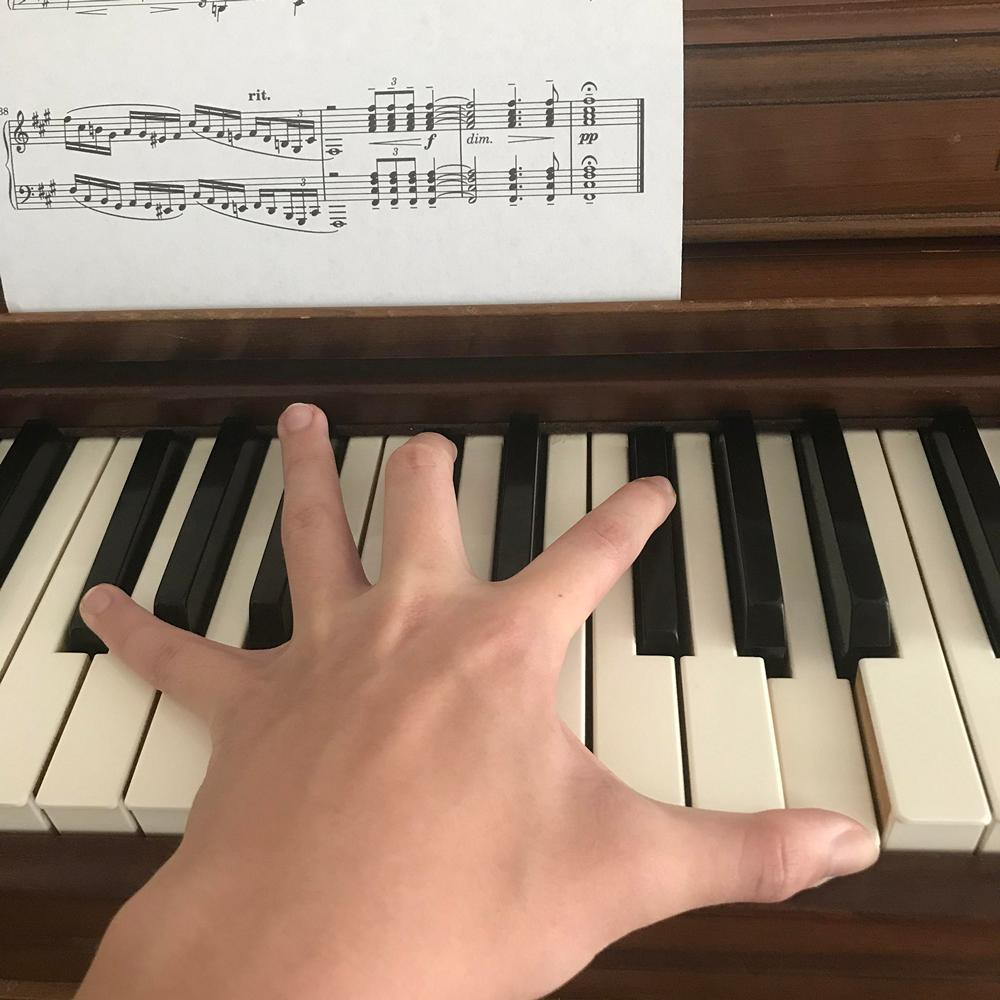
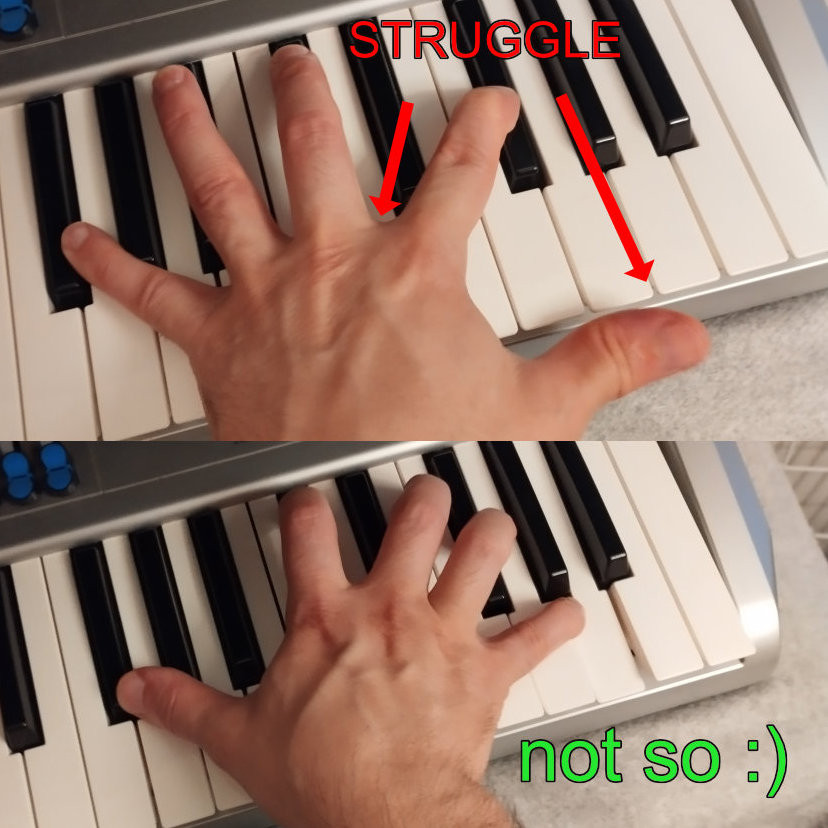
• then yes, that may seem "broken" but you know what… exactly that config (shown in the photo) is much easier to reach with the 'mirrored' hand fingering as follows: thumb on black, index on black (5th you call it), then middle on black ("octave" you call it) and then pinky on white (highest)
For example (for me at least), the shown chord is impossible for my left hand (yes my hands are not that big as that humongous one above) → absolute pain to get that stretch between middle and index (because even if I manage somehow my thumb goes way, way out of the keyboard)!
On the other hand (pun intended), it is more reachable with the right hand (pun unintended) config though. Weird heh?! So, another proof again. It is not weird, it is natural.
Here for you to assess because I have done it long, long time ago:
• this is good because usually in the lows bass notes rarely you'd find "thirds" in the bass → the frequencies are too similar.
Usually it is "fifths" but there is an "octave" (most of the times at least in modern music) of the bass note and the "third" ("tenth"? from the bass note) of that "octave". The stretch is a nightmare! Look at the pinky to middle fingers (a "fifth") and my index finger is who knows what its doing.
But you know what? Mirror it for the bass notes to be played as absolutely normal and both hands can play the same keys with the same fingers for matching scale, chord inversions and in the brain it is really natural.
Proof. Poof.
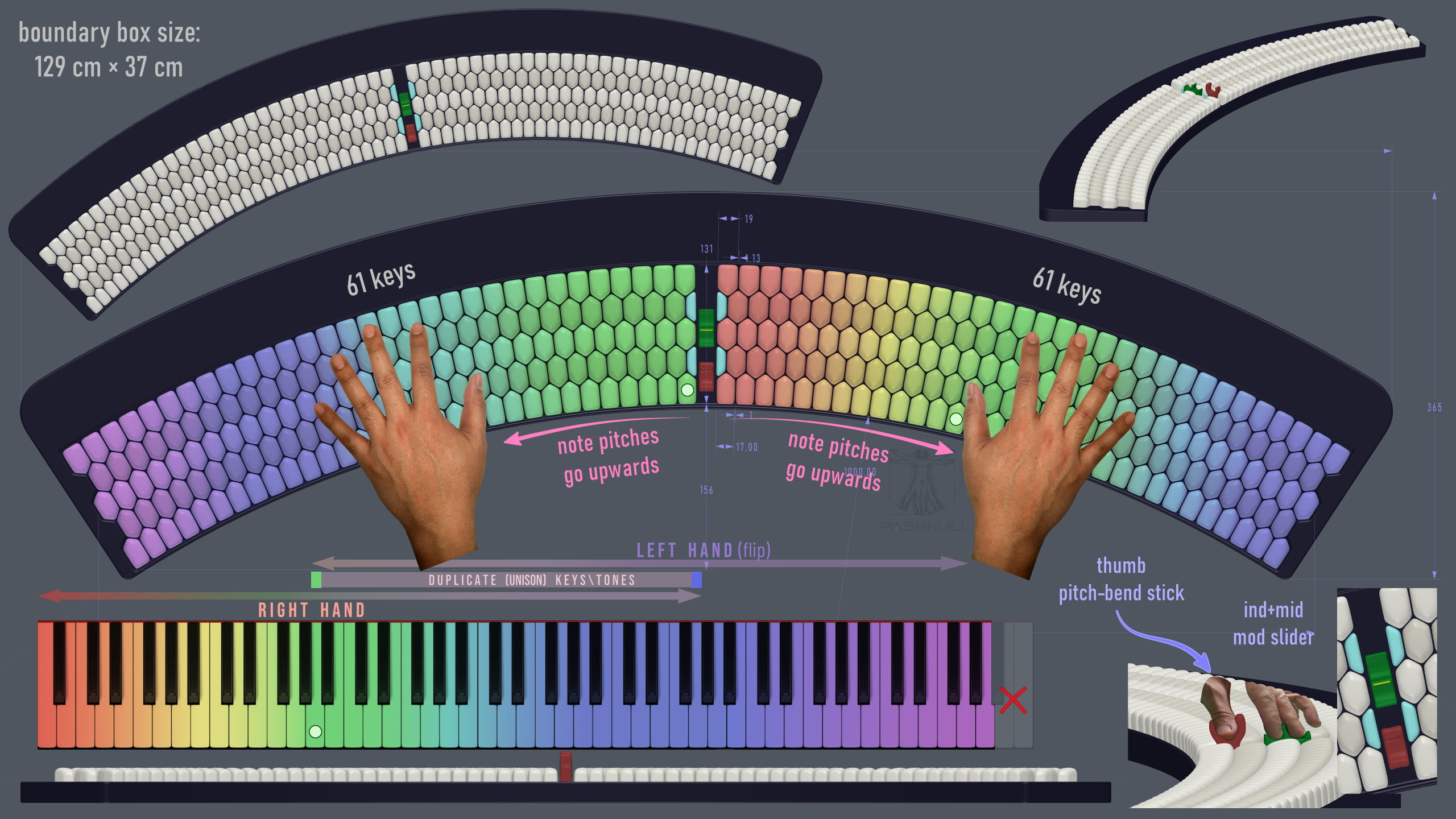
Currently, I am working on a concept of trying to emphasize the importance of getting the dexterity for both hands the correct (natural) way.
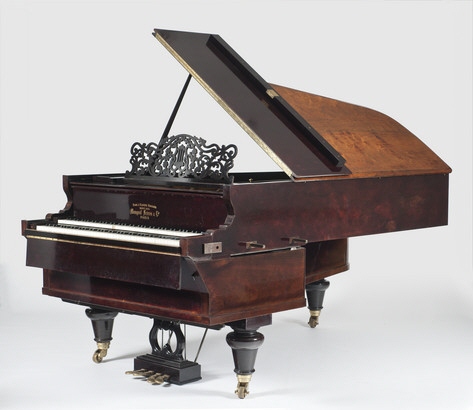
Known as Mirrored layout, first made by Mangeot in 1878 (suggested by the polish pianist J. Wieniawski) although they stacked two keyboards (and frames) on top of each other:
The one I design has Isomorph layout too (Jankò \ Dreschke, it is rather Dreschke modification). Its size is comparable to any current standard 88 MIDI controller keyboard (digital piano). No need to mention that any scale, chord, etc. is the same for the fingers of either hand (that is the point of mirrored layout):