Skip to content

Pianos (keys) are badly designed!

PASHKULI

ambrozy and how am I suppose to play that?

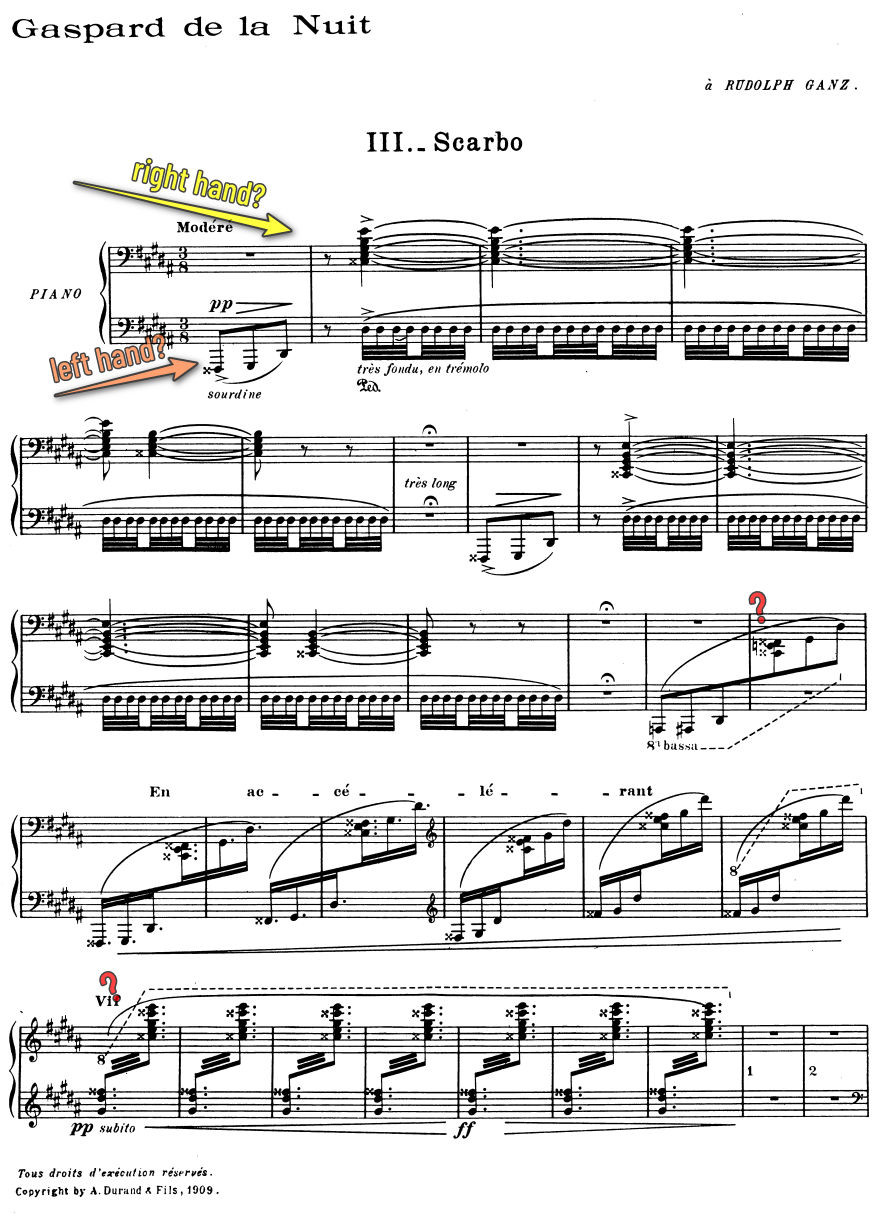
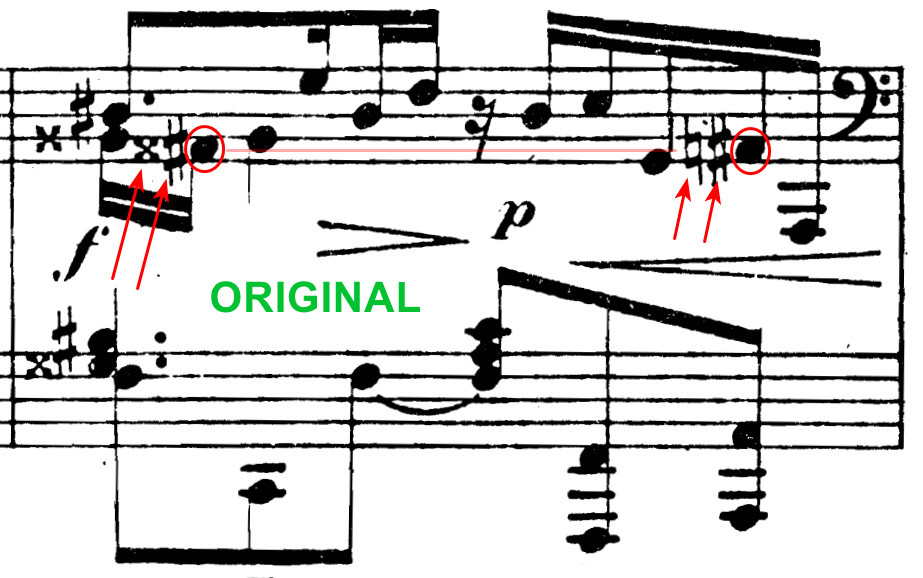
Right. Here is whet I have from Rousseau (it is a .pdf of the "Gaspard" but from year 1909). Maybe he used that score to play the piece – I have no idea:

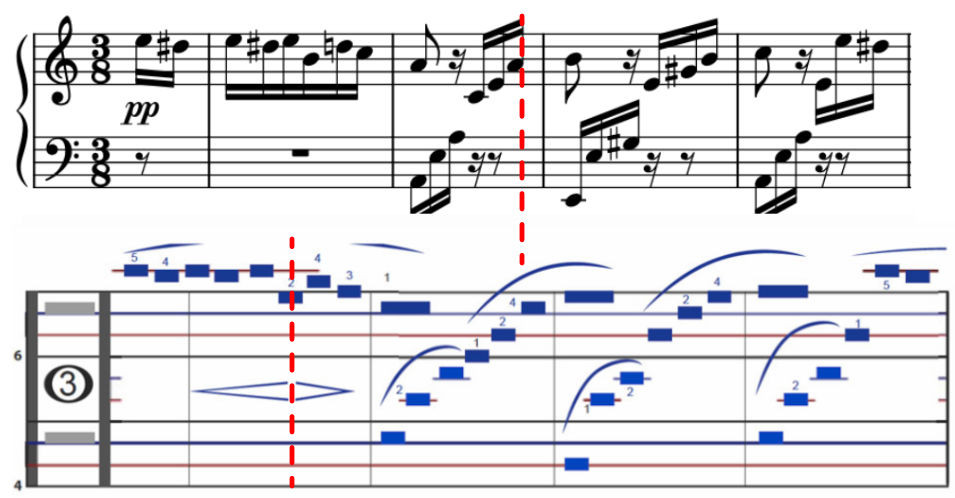
So, if I run it through a score OCR scanning software can I expect the midi exported file to have separate "hands" channels? It is quite interesting to see what will happen. But it won't tell me the individual fingers. I know, itis because I am not a pianist and you see the score and know what finger goes where, but is it really that easy to tell? I doubt it.
For example… those repeated notes (on the page 1 above) – I assume u play them with two fingers alternating? WHich ones? 'Thumb and index' or 'index and middle'? I doubt it is 'middle and ring'. Ah, this…
https://www.youtube.com/watch?v=8fcy2X06VH4

Ravel really did try his best to represent 'flamenco' style on the piano. Quite challenging indeed.


ambrozy

PASHKULI So, if I run it through a score OCR scanning software can I expect the midi exported file to have separate "hands" channels?

That is not always the case but you can assume that it is in this case

PASHKULI But it won't tell me the individual fingers. I know, itis because I am not a pianist and you see the score and know what finger goes where, but is it really that easy to tell? I doubt it.
For example… those repeated notes (on the page 1 above) – I assume u play them with two fingers alternating? WHich ones? 'Thumb and index' or 'index and middle'? I doubt it is 'middle and ring'. Ah, this…

No, sometimes the fingering is written in the score, but this is just a suggestion, each player must come up with his own fingerings that suits him while learning the piece, the same goes for which hand plays which notes in some cases.

https://www.youtube.com/watch?v=MbMvOjtcsRU
Here is an example, normally you play this with finger 1 (thumb) on A, finger 2 on A#, finger 3 on B and finger 4 on C but then you have to play in the order: 32413241… fingers are out of order and so it is relatively hard to play but he swaps fingers 2 and 3 and then sequence is 23412341… in which fingers are in order and it's very easy to play the notes in correct order, but you have to cross the fingers 2 and 3 which for me doesn't work, I barely can do that and I lose control of the keys (on piano you don't just press the keys at the correct time, you have to controll dynamics and articulation, how hard and how long each key is pressed) so I play this as originally intended, it just needs a little PRACTICE. This is very simple example, you can even try it yourselve!


PASHKULI

I have a licence for Overture 5 (by SonicScores) – really great piece of software for score music notation.
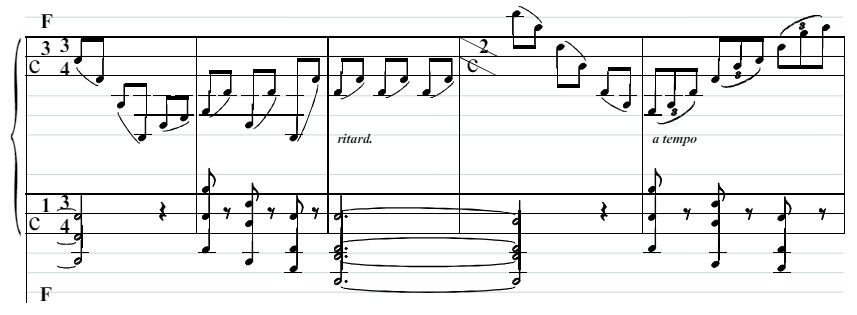
Also have one for Notion 6 by PreSonus. MuseScore is free and it is quite powerful where with the other two I have struggled to achieve this masterpiece:

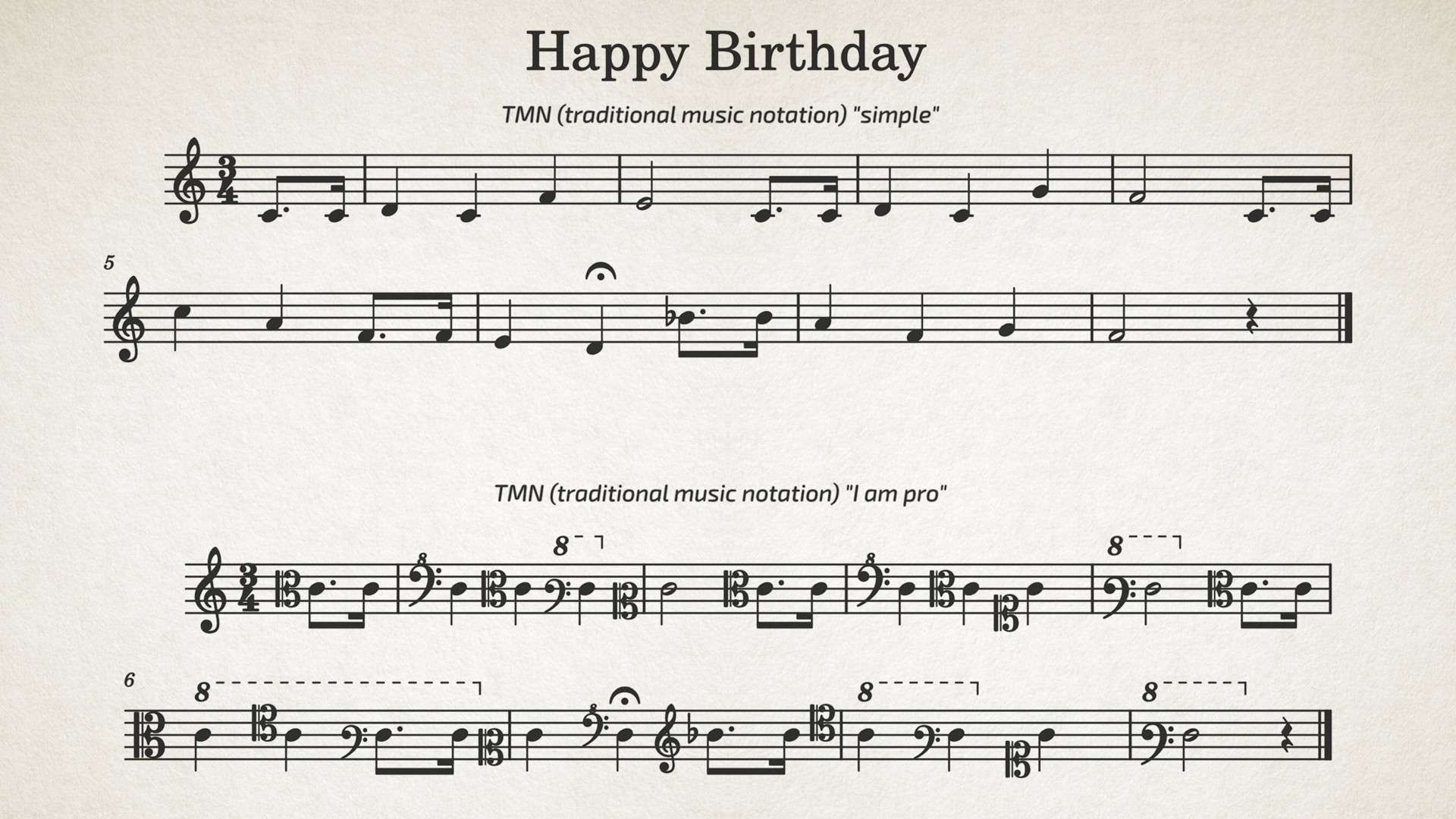
The problem is with all those programs I can ever hardly find any collection of works from great composers and simply open them in the software to get the score. There are some 'openformat' MusicXML files but they are terrible (mostly) when opened!

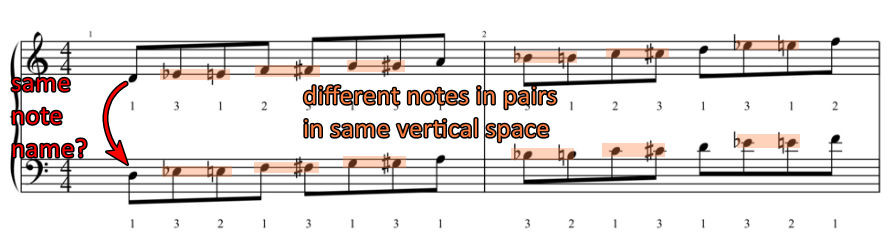
All these score programs (and their proprietary format) seem to "not speak" to each other. Probably inheritad by the terrible standart music notation and its tripple\quadruple ambiguity (see above).
But I guess, it is part of the business. If you'd like scores in "our format" by them from here and there. Or, why do not simply get a teacher to do it for you as they have already mestered it.

Really discouraging. Maybe one of the reasons I never liked the idea of learning to play the piano. Anyway…
"Decoding" such works form .pdf scores is guing to be painful. That is why I created my own Music notation which is based on such from 2000+ years ago with a modern finish. Technically – it is a TAB for any instrument (even drums).


PASHKULI

I was in London (UK) today to get my new passport and later went to one of these Music stores.
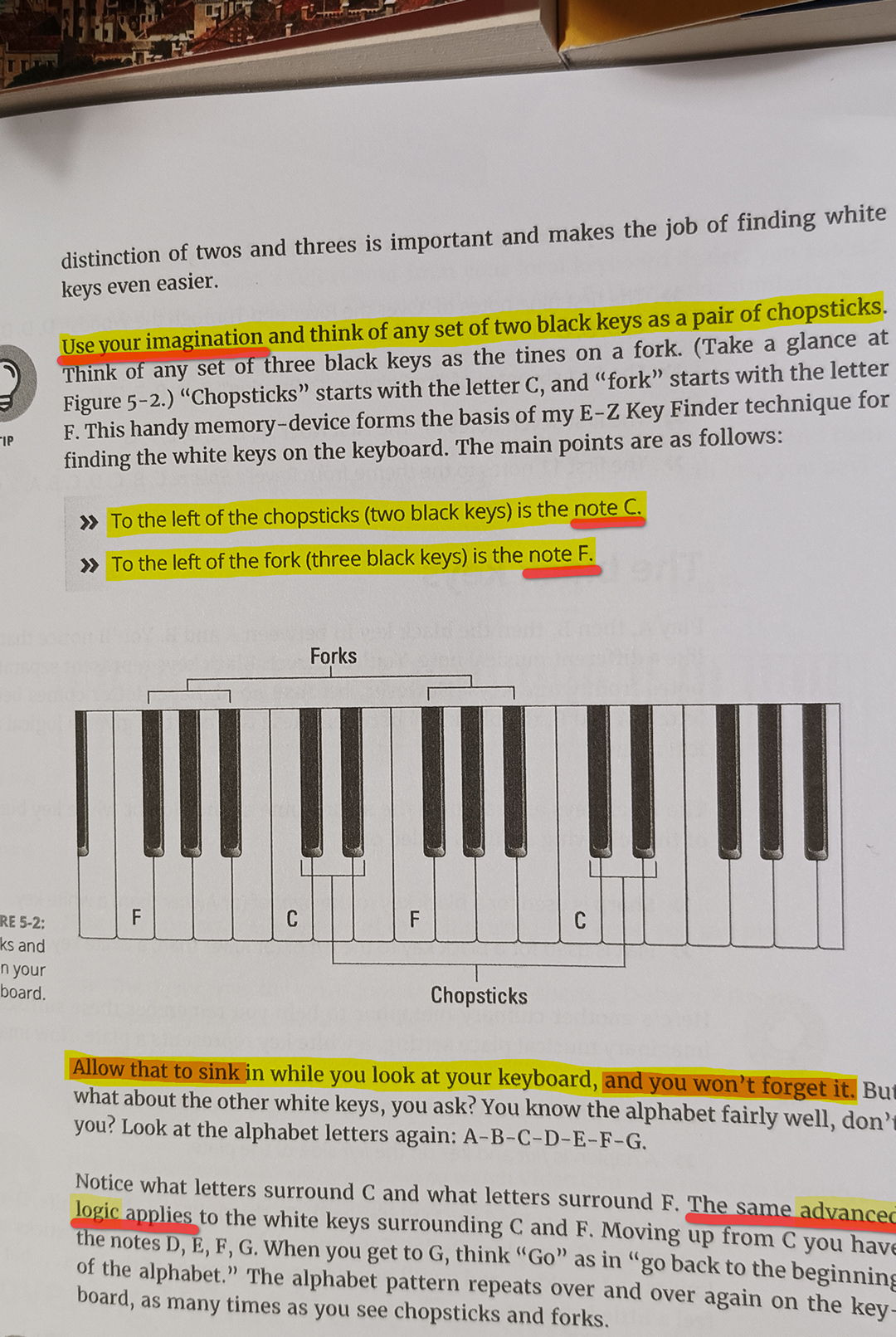
Found some books regarding Piano and how to learn, study Music notation with the piano. This one was about 600+ pages (not joking!). I had to take out my phone!
A picture is worth a thousand words…

What can I say (I laughed and still shake my head):
• undisputable use of the… imagination – could not be better than that!
• advanced… (I kid you not!) …logic


xooorx

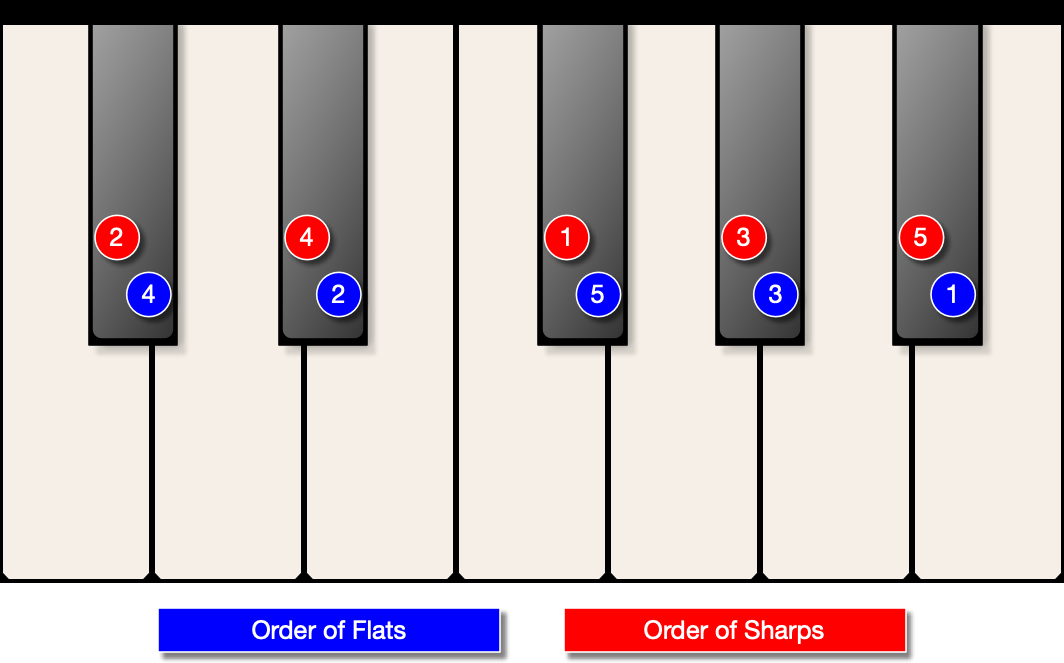
Pianissimo [...]but there is a new problem now: the F# is almost sitting on the middle of the entire F head, and the Bb is sitting almost entirely on the middle of B head. This is not good when you play chromatic passages, because the shift of your thumb underneath your middle finger, will encounter different distances in those two areas.

This is true also on the standard keyboard layout though? In our "mental map" of the keyboard the F# is in the middle between the F and the G, and it is often drawn this way in diagrams (e.g. see the book page photo above). But on the actual physical keyboard it's mostly over the F.

And this is (arguably) a good thing! Sure, it makes chromatic runs and clusters slightly trickier, but it makes the normal western scales easier. Because F# is the "first sharp". If you are in a key with any sharps at all then you are using the F# key instead of the F key. Having F# almost over the F makes the E-F#-G spacing similar to the E-F-G spacing. Meanwhile the same key's role as Gb is relatively rare: It's the last of the black-key flats and you have to be all the way out in Db major before it replaces the G in the scale.

With Bb its the symmetrically opposite situation: It's mostly used as Bb, rarely as A#, and you find it out over the B key.

The second sharp and second flat are also shifted over the keys they most often replace, but not by quite so much.

Only the G#/Ab key, simultaneously the third sharp and the third flat, sits exactly between the keys it replaces.

If nothing else, all of this means you don't have to mentally go through "F-C-G-D-A" or "B-E-A-D-G" when sat at the keyboard: You can see the orders of flats and sharps written in the displacement of the keys.


PASHKULI

I promised to not open any other threads so here we are (I am… it will be a monologue for sure) discussing the problems of Music notation:

. . . : : :  M U S I C  N O T A T I O N  : : : . . .

To understand the current Musical notation (please note, that understanding it is completely different from learning it!) one should first know how it came to be, its origin and what it represents. What makes (or had to be made) the need for distinguishing certain 7 notes from 5 at least in 12 TET (12 tone equal temperament).

Is it a special case? Yes, it is.

Can it (flat\sharps) seen clearly seen anywhere? Yes, it can – on a Halberstadt ("standard" piano keyboard).
• the 'black' keys are representing such "accidentals"
• so, there must be a correlation… and there is!
• so why call them "accidentals"… well, those keys were not present there and when they were introduced they were used quite "accidentally" as a 'chromatic' colorising mode (see, ancient hellenic genera from Pythagoras\Aristoxenus and Alypius times)
• but not every musician is a pianist, therefore it is yet another special case
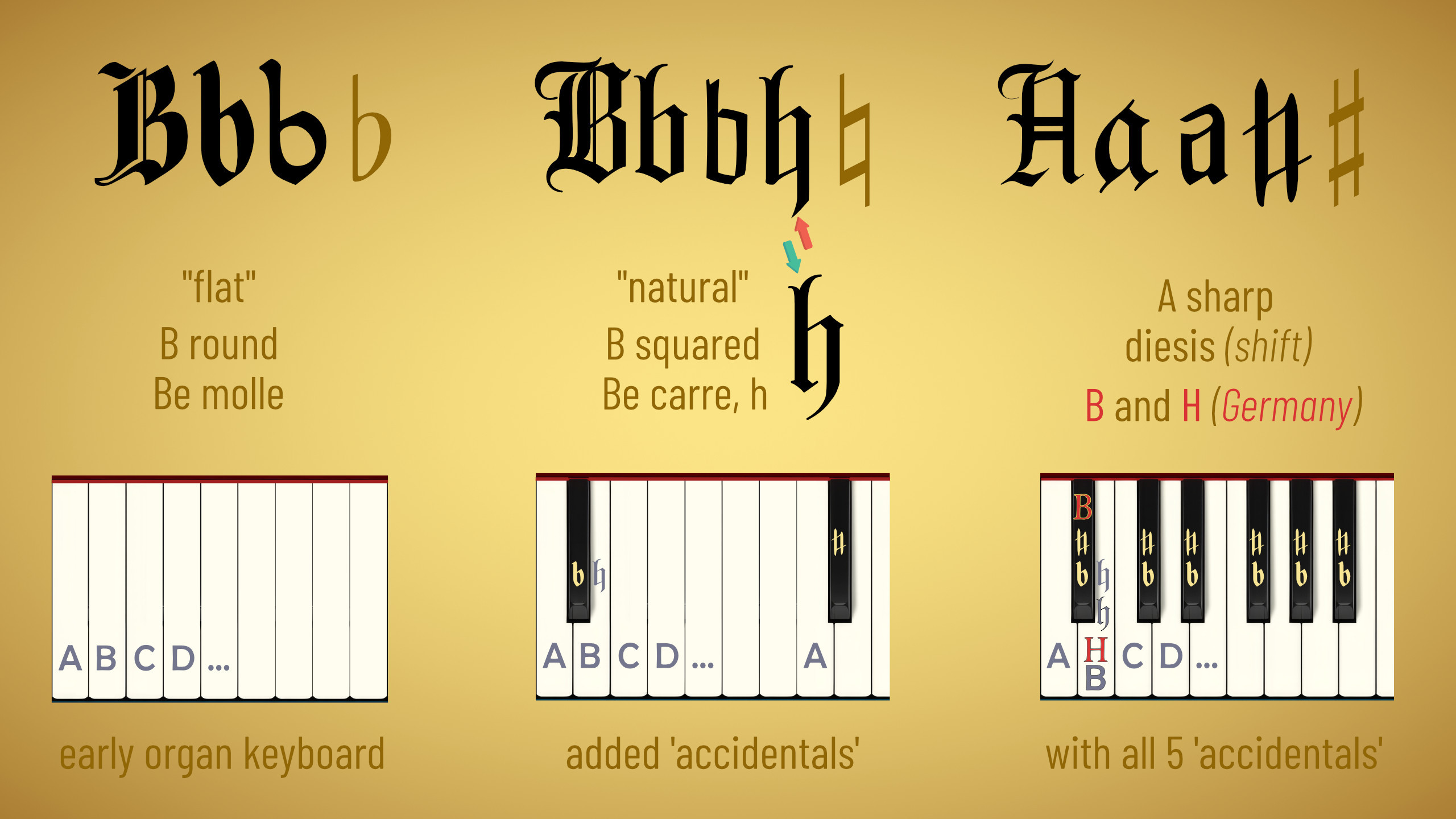
• at the very beginning of creating the "standard" music notation (year 1017) B (♮) and B♭ (♭) were both considered accidentals for the Roman church (catholic) chants. That was not the case in other parts of Europe and certainly not in folk music!

Does it lead to ambiguity? Yes, it does.
• a 'black' key can have two accidental sufixes or prefixes (♭ or ♯) depending on the chosen modal structure (already included notes as written symbols); same is valid for yet another special cases of double alterations to escape structiral ambiguity… and that is the irony of it!
• this all originates from the special case of naming only 7 of the notes (originaly only 6 as explained about ♮ and ♭) as the eraly church chants were strictly modal or diatonic (to use the hellenic terminology)

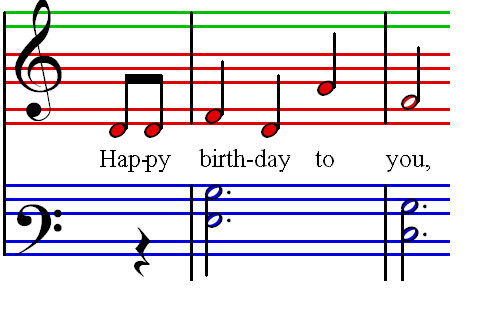
Similarly, at the very origins staff had 4 lines, later a 5th was added. Then the introduction of clefs made each staff lines and spaces between lines represent different notes (mismatch).

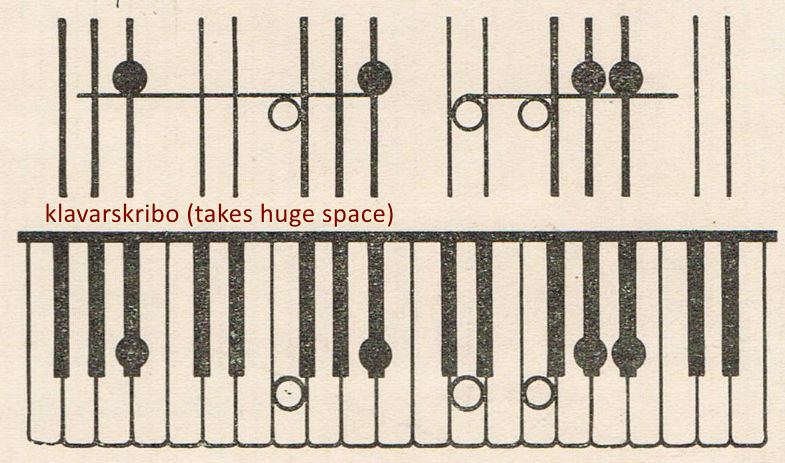
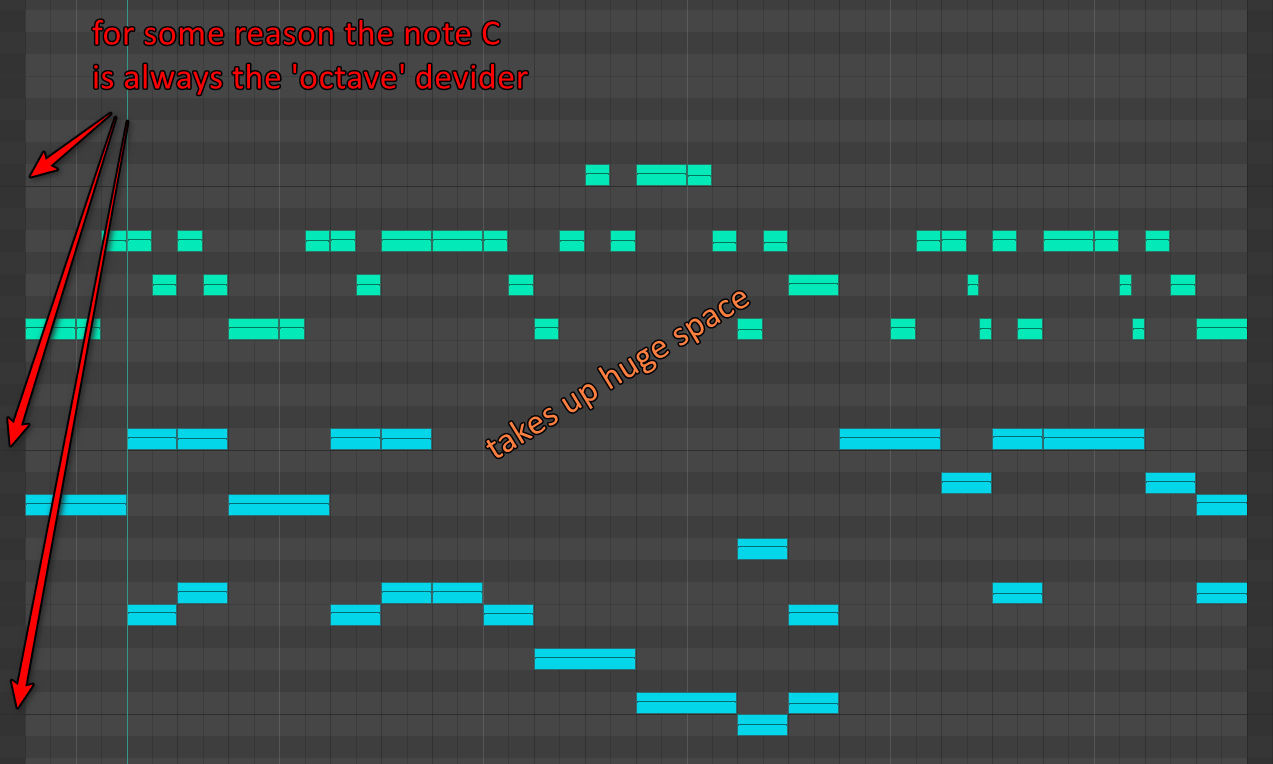
Some modern (pianolla roll and MIDI) type of 'chromatic' staves eliminated such problem (mismatch). The problem is they would take enormous space.

The typical stave with 5 lines sacrifices 42% of that space (as 5 out of 12 notes are not represented vertically!) but if we take into consideration the 'double accidentals' and 'octave' designations this % goes to 50% and a bit more.
So, no… The "standard" music notation does not give us a correct interval structure vertically but a special case one.

Introducing key signatures makes it even worse as they have to be imprinted and shown but usually learned. Then there are rules for an alterated note within a bar which would be valid for any note on same line but not 'octaves' of same note till the end of the bar. Then it has to be written again (otherwise it stops affecting the notes).

Such problems are inherited by the special cases mentioned above.

But all those chromatic notations, besides taking up much more vertical space (MIDI roll is not good for human reading from paper anyway!) and paper or screen estate (turning of pages), they also are either bound to the piano layout (Klavarskribo and Clairnote, Muto and others) or using quite a lot of ledger lines – which does not make them any more good than the typical music staff.

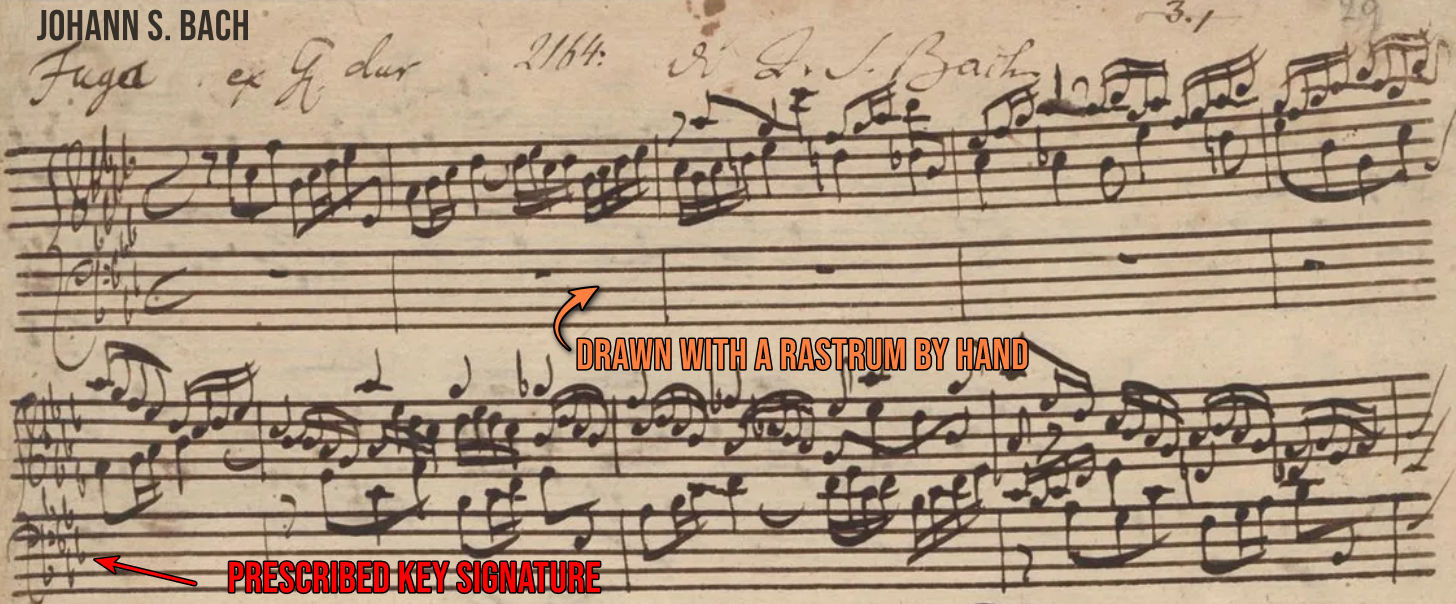
All those require pre‑rendered or pre-engraved staff lines – special paper (score paper). Bach used to draw his staff lines with a 5 pointed rastrum (special pen-like instrument) before the printing machine and engraving tablets for Music application got implemented across its country of origin Germany and subsequently in Europe.

The key separation and accidentals are sort of a 'geocentric' model view on Music.
MIDI‑roll is a modern tool and its Music notation based derivatives (Dodeka and ) but it only suits computers, not humans. Print out a MIDI‑roll and you'll understand what I mean.

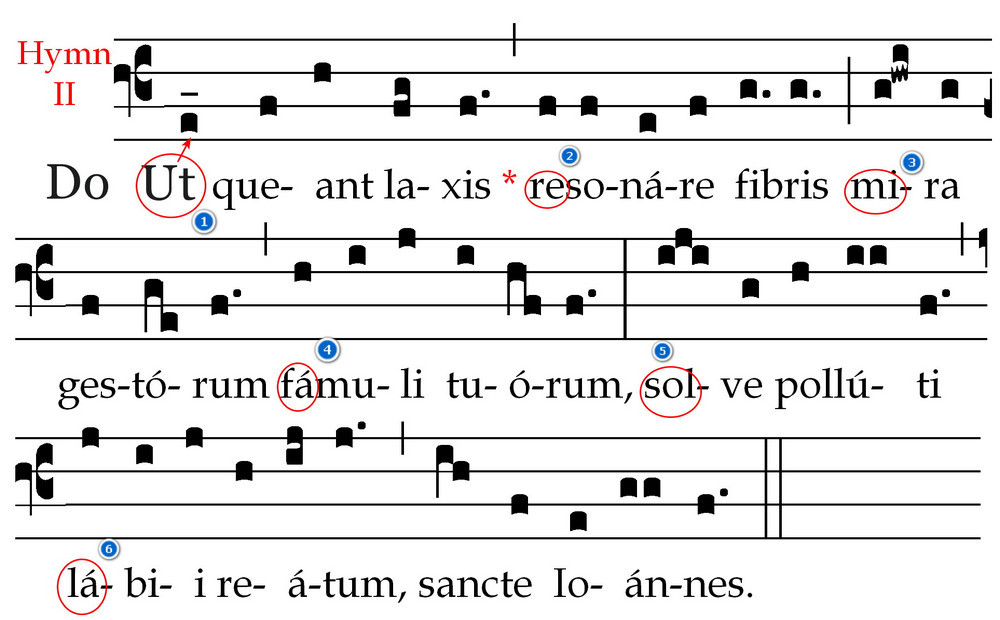
Both Music notes as letters and names also originated from special cases – the Latin alphabet (A, B, C…) despitе the fact its original creators (church clerks and monks) actually used a few hellenic (greek) letters especially the first note Г and for the notenames (Ut\Do, Re, Mi, Fa…) they used the lyrics of a well known psalm at that time which had its first 6 notes matching those exact sylables from the lyrics.

This has been 1000 years of… indoctrination. Learning without understanding.


Pianissimo

Yes, it's all about finding the right balance, it depends on the priority. The perfect symmetry in the tails is not our priority, and it's achievable only if you make a very small octave span. In Pashkuli case, he managed to make symmetrical tails, but he didn't tell us that the span of his octave is only 130mm, instead of 165.5mm. That's a toy, not a grand piano. If you make such a small octave, you end up with a total span of only 1003mm. From the bass side of A1 to the treble side of C88, including all the spaces between keys, a modern piano span can go from 1216mm to 1240mm. Every brand has a different span, and even within the same brand the total length can vary. But if you ask a good pianist to play with something as small as 1003mm he would laugh at you, it would be considered just a toy.


PASHKULI

Pianissimo The perfect symmetry in the tails is not our priority, and it's achievable only if you make a very small octave span.

In fact, the symmetry does not depend on the span at all. It is present in most (but not all!) well build pianos whos builders know how to do it.

The problem is by default on top of those two symmetries the typical pianos divide the keys in two groups as well. That is where the different widths of the tails come from – not from the symmetry, which many builders have not spotted anyway (let alone piano players).

Regarding the span. You will have to agree that a shorter span will allow you to play wider chords and make usual chords (and especially their inversions) much easier (less strtessful on the fingers) to play.

Now, here is the main consideration. Originally pianos (first ones, called suare or based on clavichords\cymbalum) had narrower keys. They had less strings per note as well (up to two).
With the concert orchestras and pianos having to play along, there was a need for more strings per note besides extending the range to 88 keys for the piano.
Certainly they could have had two pianos and pianists on stage (similarly to 1st and 2nd violin, and so on other instruments) but that would have lead to less definition of notes between two pianos and more rehearsals with two pianists for better synchronicity.
Thus the piano got wider to accommodate for mor strings per note.

Here is onther fact of physics:
with more strings per note and if we'd like to keep the keys\span as narrow as possible the construction of balance pins and lenghth of keys to accomodate for the more and more complex and heavy action (Erard's double escapement) and mass involved… narrower keys would be prone to torque\twist oleng their length, especially after the weakened spot past the balance pin, besides the risk of snapping there. Yes, the balance pins could be thiner but with teher is another problem…

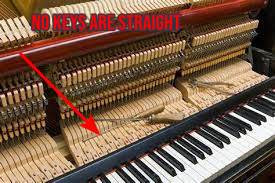
The piano keys are not straight after the 'ivory' covers and the back of the black keys end!
This is as such because with a heavier construction (both action and string count wise) there was a need for sturdier support frame, which has legs that inevitably would step between the keys (usually past the balance pins). Therefore the force from the fingers and the belenca pins are not on the same line as the castan pin (screw) which pushes up the whippen and jack and hammer (where weight is concentrated). This leads to torque in the key's lenght.

This is why current pianos get fitted with narrower keybeds (see DS6.0 and DS5.5 by Steinbuhler\Donison) which have even more off‑centre ballance as they are fitted to a wider and heavier action and strings. Especially on the lower notes Steinbuhler had a lot of trouble with that torque or any keys in the midrange hit with a forte which leads to loss of dynamic feel for the player besides touch friction to the adjacent keys.

Mozart played on a "toy" piano if we can use your terminology. Beethoven also. Just around the 1820s piano got bigger and especially bigger after Liszt got famous. And he had big hands compared to Chopin and others. Rachmaninov also was a big guy (200 cm tall).

So, there is your answer. With current digital hybrid pianos there are no such issues. I undestand… you need an acoustic. But I doubt you need it to play with an orchestra. Yous a lighter acoustic piano won't sound as full as the 'three notes per string' pianos. But why should they?


Pianissimo

Even the early harpsichords and pianos had an octave span bigger than your 130mm. Modern piano range is now more or less standardized close to 165mm. Here is some data from various sources,regarding the history of one octave span:

Cristofori (1726) = 164mm

Pohlman (square, 1770) = 178mm

Stein (1780s) = 156, 158, 160mm

Schiedmeyer (1780) = 156mm

Schiedmeyer (1785) = 180mm

Longman & Broderip (square, 1790) = 169mm

Schantz (1790, 1805) = 160mm

Schmid (1794) = 158mm

Clementi (1805) = 163mm

Erard (Beethoven's piano, 1803) = 162mm

Walter (1795) =159mm

Walter (1803) =153mm

Walter (1815) =160mm

Streicher (1814) = 158mm

Kirckman (1820) = 162mm

Broadwood (Beethoven's piano, 1817) = 166mm

Broadwood (1819) = 164mm

Boehm (6 oct) = 158mm

Fritz (in workshop of Paul Poletti, c1825) = 167mm

Graf (1826, similar to Beethoven's Graf) = 161mm

J.B. Streicher (1841) = 158mm

Pleyel (1852, cf Chopin's Pleyel of 1839) = 164mm

Steinway (Hamburg, 1937, modern range) = 165mm

Bluethner (modern range) = 165mm”

As you can see, the span didn't change, what changed was mainly the passage from smaller hammers to bigger hammers, and the passage from a wooden plate to a cast iron plate. These two things had a big impact on the sound, and that's for the good, because honestly (with all the due respect towards the early pianos) a modern grand piano sounds better than a Piano used by Cristofori Mozart or Beethoven. Having a narrow keyboard is not an advantage, simply because you increase the chance of pressing unwanted keys, especially when you play near the fallboard. Technique also evolved alot thanks to Beethoven and Chopin. The grand pianos we have today are just a dream come true, I wouldn't change a single thing. But the experiments never stop, for example in the case of upright pianos, having 2 or three strings per key it might be overkill, which is why one string per key (like the Una Corda from Klavins) is becoming more popular, it offers a less powerful and more gentle sound, but it works so well considering the limitations of an upright (shorter bass strings, smaller soundboard).


PASHKULI

Pianissimo

Having less strings is going to sound quiter as uprights are not exactly suited for orchestra.
The renova ("octave") span is and has been fluctuating. There are bespoke pianos of famous pianists who used special shorter spans to their advantage but more likely to suit their hands.

Not going to mention the alleged tales for pianists who tried to overstrecth their fingers.

Acoustic piano is terribly designed instrument. From its keys, through its action and lack of expressiveness: vibrato, pitch bend and volume of a faster notes (you can not play fast and quiet unless maybe change to 'una corda' or 'other pedal' who lifts the hammers).
On top of that if we account for dexterity (left and right handedness) it completely dismisses that natural property of humans. It forces one way of dexterity as the layout is one directional contrary to the symmetry of the finger from hand to the other.

No one can give any explaination why the notes go ascending only from left to right.
Yes, you can reverse them but does it mean one is "right‑handed" and the onther "left‑handed"? If yes, then on what merit? Same question is valid for the accordions by the way (not so much about vibra and xylo as they are played with sticks\mallets up to two on each hand but we can discuss handedness there to some extent as well).

I have given the answers and offered the solutions.
Manufacturers and actual players do not dare to even think on the possibility because both parties have invested so much time, money and attention to the current status quo, they can not see anything else. Even in digital domain it is all about sound presets and LED lights.

On a more specific and contemporary state of the art, in my opinion, if I had the resources to build pianos, I would not go for a full acoustic build with multiple strings per note and so on. I would go electro‑acoustic with single pickup per single string per key, but most likely hybrid – no actual strings but again some velocity and after‑touch sensors (for vibrato + pitch bend and volume on a single note). This is a different topic. Completely acoustic pianos are a bit limiting in sound.

Oh, but it won't be a pianoforte. I beg to differ. By definition it will be as it will be play quiet (piano) and loud (forte).
Just like an acoustic guitar to its electric counterpart from 70~80 years ago could be compared.


RIP

Pianissimo In Pashkuli case, he managed to make symmetrical tails, but he didn't tell us that the span of his octave is only 130mm, instead of 165.5mm.

As I wrote earlier in this thread (I won't repeat myself), I think this layout is bad unless proven otherwise (which it hasn't happened). Of all the problem this layout has in my views, I would not mention the octave span against it. Yes, even myself agree that 130mm is too small but….

Pianissimo Modern piano range is now more or less standardized close to 165mm.

That's a bad thing as we have discussed in other threads. There should be no "standard" like there is no standard for violin, and people should be able to purchase what fits them best. For me, that's a 140mm. I'll stop here because this is already a "monster thread", but invite you to that other small octave thread if you'd like to discuss further.

Pianissimo Having a narrow keyboard is not an advantage, simply because you increase the chance of pressing unwanted keys,

If you have large hands yes. If you have small ones, quite the contrary.

Pianissimo especially when you play near the fallboard.

In this layout, yes (one of its bad defects, IMHO). In traditional layout, not at all, because the black keys naturally allow you to align your hands correctly with the intended key.


PASHKULI

RIP In traditional layout, not at all, because the black keys naturally allow you to align your hands correctly with the intended key.

Incorrect.

Who said 130mm span is what I advise. I do not. It is such on the uniform layout but there intervals fall differently under the fingers. It is shown (even withot any stretch you can play a so called mni7 chord in root inversion), no need to repeat it here.
With my curved design, I prefer the 'tails' and 'blacks' to be about 10.5 to 11.5mm wide. This gives a span of about 138mm to 144mm overall for small to medium size hands.

The design is completely following Chopin's instruction for better ergonomics on certain scales\phrases\chords with regards to raised 'black' keys for the longer fingers (index\miggle\ring) where thumb and pinky are on a lower level (usually 'white' keys). You have to discuss this with Chopin. Then, the same instructions are applied when the whole configuration and hand moves\transposes the thumb to a 'black' key… because that is the other case (other type of key), so the config. should be preserved. It is a simple and elegant solution.

Now, whether pianist who had played the old design would like it is a completely different thing. At first, they won't. Then they will oppose it, even ridicule it. Then – will finally accept it and swear by it.

If you can't play an instrument, practice more.


PASHKULI

Now, let's get back to left-handed or right-handed fortepianos.
In the next fosts I will try and prove that current layout of notes on pianos are more suitable for left-handed players. Also will have to strictly point out that despite this suitability the notes for the left hand go in the wrong direction. This means that the notes for the left hand should also ascend in pitch from thumb to pinky! Then the piano will be 100% suited for a left-handed players. For right-handed players the configuration should be mirorred: left hand playes higher notes, right hand playes lower notes. Th enotes ascend in pitch from thumb to pinkie for either hand again.


PASHKULI

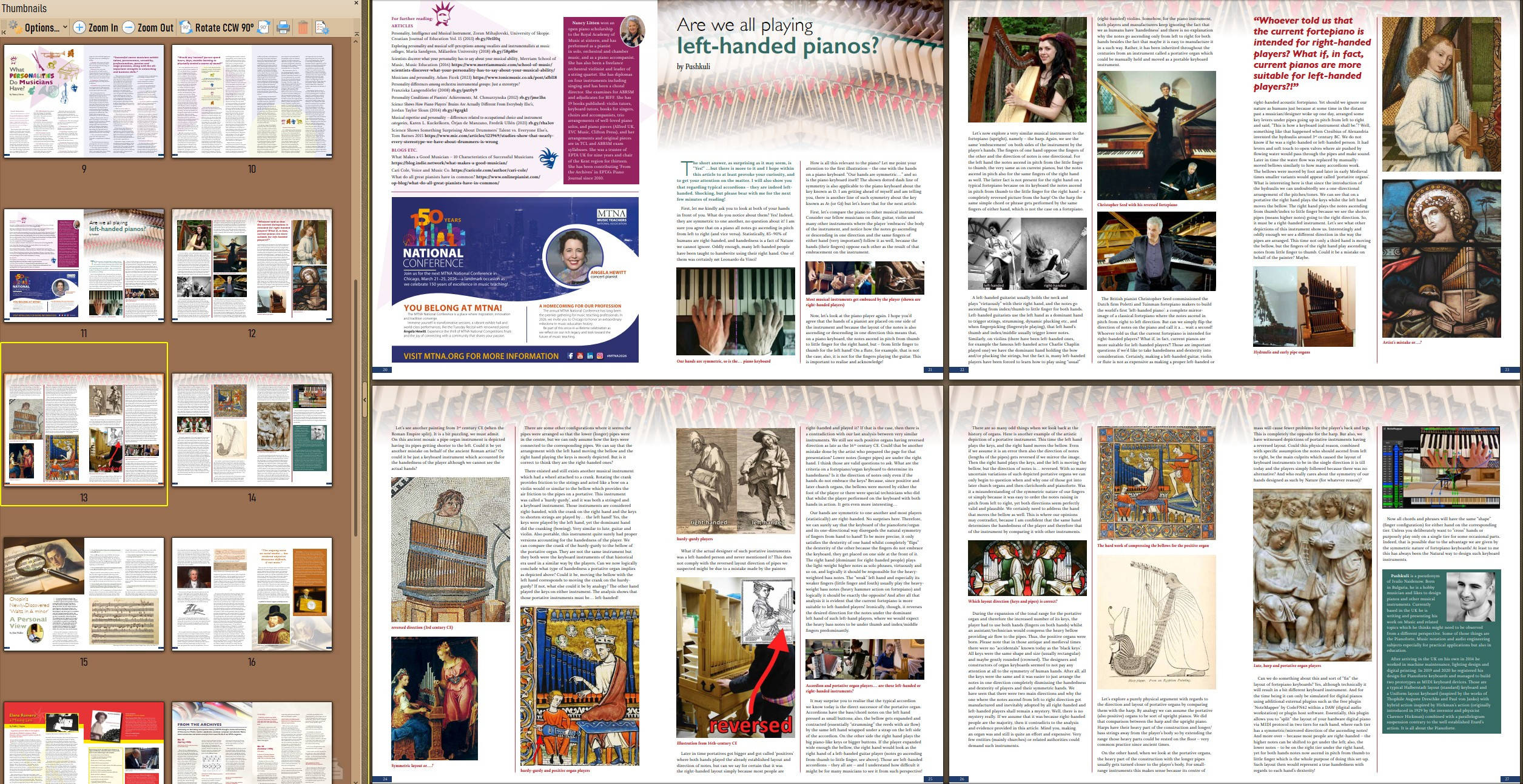
My article titled "Are we all playing left-handed pianos" has been published in the British piano magazine 'Piano Journal' (#135 April 2025). It is the UK's oldest piano magazine and the international flagship publication for European Piano Teachers.

Here is a preview:

3 more articles to follow (summer, autumn and winter 2025)

It will be available to read online (for members) at some point or order in print on their website. https://epta-uk.org/?s=Piano+Journal

I am waiting for it in the mail maybe end of this week (19-20th April 2025).

Happy reading!


xooorx

Fancy melodica with mirrored keyboards:


PASHKULI

xooorx

Do you have access to my email correspondence???
I was in the forum of Melodica a few days ago and sending this video to the editor of the magazine and Christophfer Seed. WTF?
But regardless… if you are interested you might find this really eye-opening:

It was not only I who had seen this as a possibility. This is from 1878. I simply translated it and edit out the non-essential parts.


PASHKULI

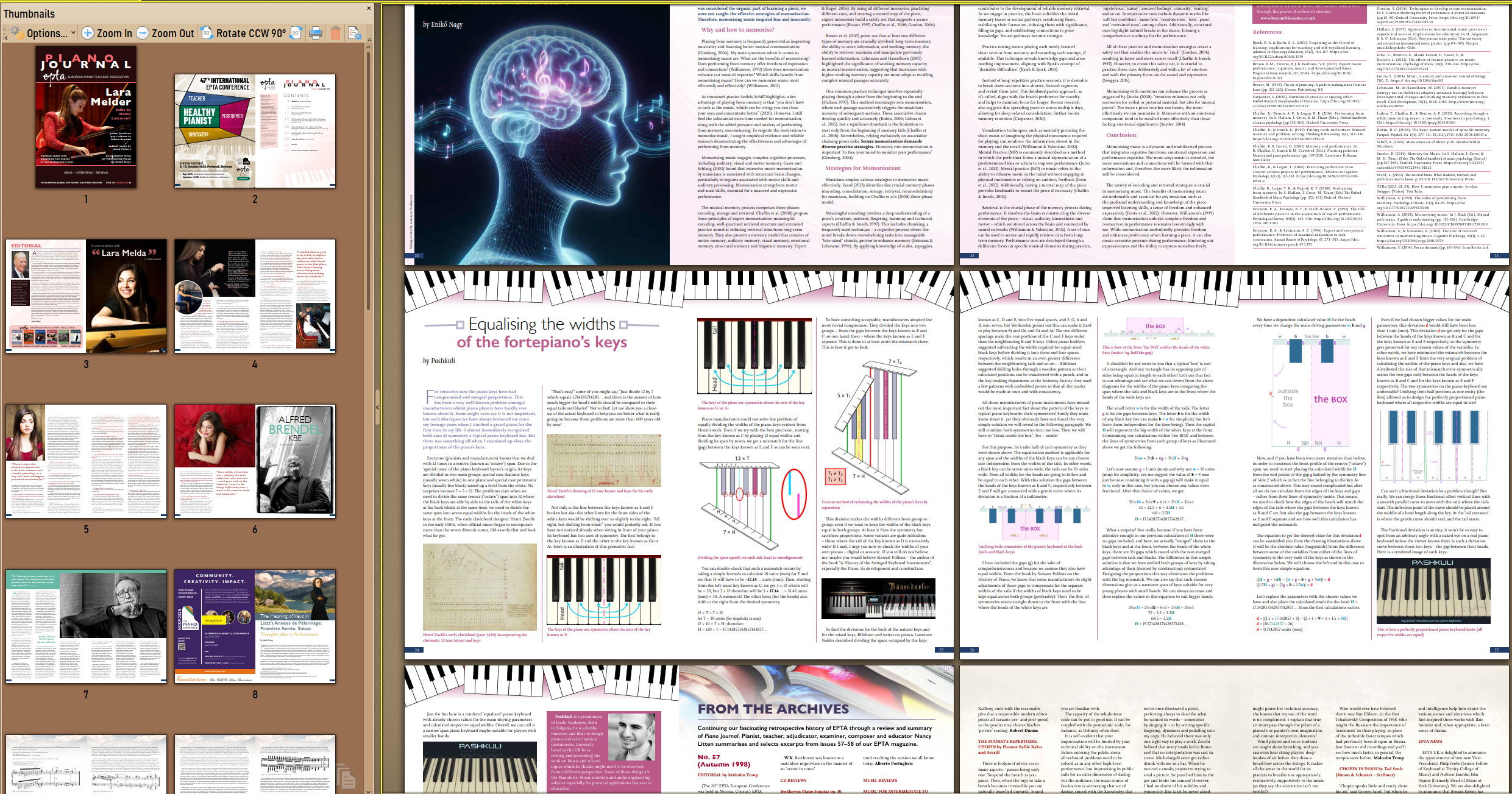
My second article regarding the discrepancies in piano's keys (widths and proportions) is in edit and pre-print for the next edition of 'Piano Journal' UK. The article is titled "Equalizing the widths of the pianoforte's keys".
After fore than 15 years of waiting (well, blatantly knocking on door to door) it happened. In 2025.

I also submitted a request to participate in the conference of 'Modern piano in the 21st century' organized by The Royal College of Music (UK, London) around mid December this same year but no response yet (the deadline is 18 of July, so they might not have a time slot for me). Three days to go. 30 min per presentation is not much though but even that is enormous for my endeavor.


PASHKULI

I am thrilled to inform you that my second article has been published by 'Piano Journal UK' in the #136 edition of the magazine coming out in 14th August 2025.
This all has been made possible by Anthony Williams who was kind enough to publish my ideas for the pianoforte so we can "ruffle some feathers" in the community.


« Previous Page Next Page »