Skip to content

Pianos (keys) are badly designed!

PASHKULI

Of course, the keyboard (digital in this case) should have a bit different design – as such:

Left hand plays high notes. Right hand (especially thumb) plays low notes! All respective chord shapes betwen hands are the same for either hand – that is how Nature has designed our hands to be – symmetric!

Global Pitch and Mod Weels go dead center for quick access by either hand (or can be assigned to foot\pedals controller – better option). Similarly, drum pads go in that centre as well for quick access.


PASHKULI

ambrozy

This has been written on the current layout. I can not tell unless transcribed for the symmetrical one.
I can try but I am not a pianist and you will always say – it is wrong.

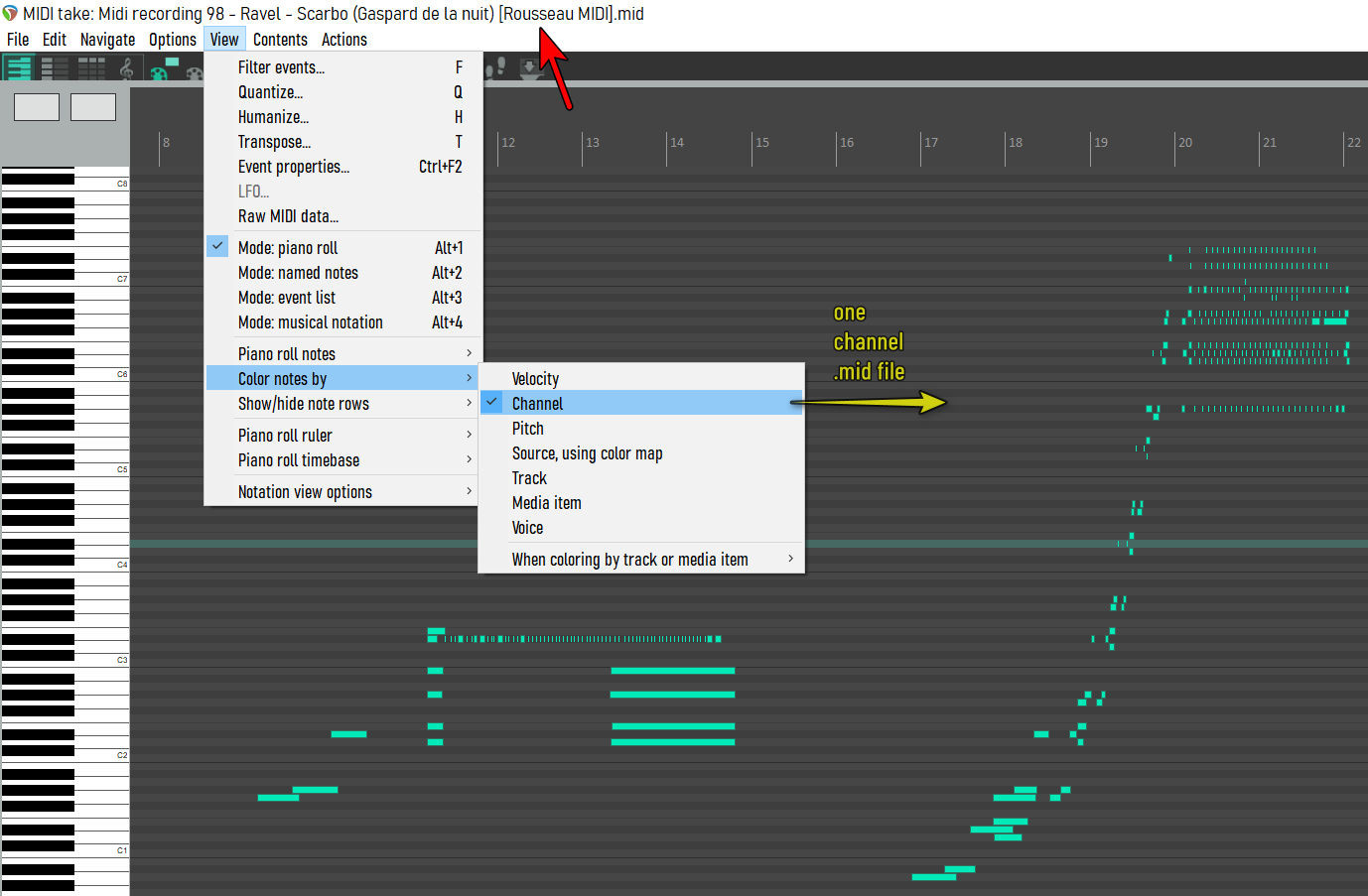
I have that performance in .mid (midi) file format as I was a memeber of Rousseau's YouTube channel.
Unfortunately, as manny other (99%) of such files on the internet the hands (notes performed by each hand) are not separated into different channels – iti s very difficult to "decode" them (as a non pianist) or tell what finger playes what on each hand. I can see on the video but note for note separation will take me months to do that!

The great thing about thy symmetric piano layout is that the notes of both hands will be separated… for the most part… unless the pianist wants to play close together notes at very high (left tier) or very low (right tier) section of the keyboard.

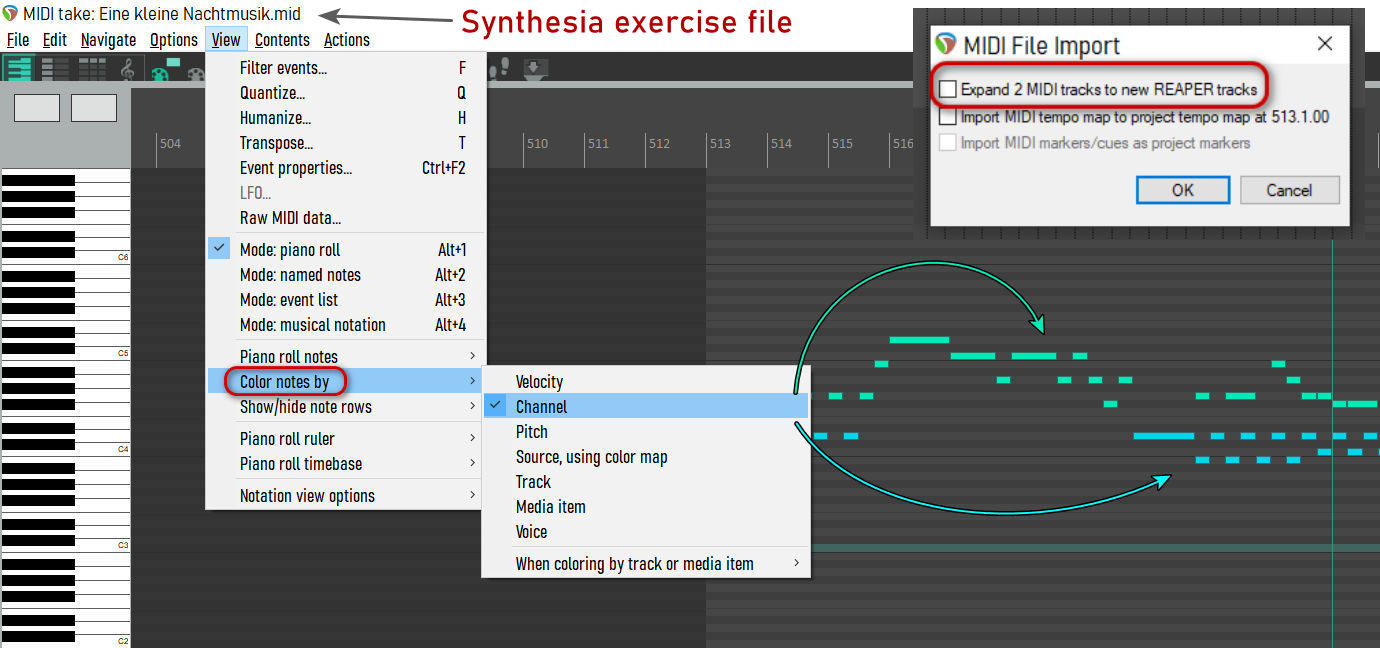
Finding properly separated hands for many baroque, classical, romantic works is tough. I have some but they are from Synthesia.
I hope you know what I am talking about.


PASHKULI


CyberGene

@PASHKULI do you play any instrument? Have you recorded any music on it, a well-known piece, or just an improvisation in an established form or genre? If so, do you mind sharing it with us? I have a reason to ask that question but I can elaborate only after your answer.


Mindbullets

PASHKULI All respective chord shapes betwen hands are the same for either hand – that is how Nature has designed our hands to be – symmetric!

To each their own, but the harmonic symmetry is already present. Symmetrical doesn’t mean identical, it means it’s mirrored. Each chord shape already has a symmetrical counterpart. Flip C Maj around the symmetry of the keys and you get A minor, etc. You can kind of cut your work in half once you start thinking in terms of symmetrical counterparts and using your hand symmetry to reinforce that as you work on training your “lizard brain”, but that seems like advantage would be lost if you’re making each hand play the same thing.


PASHKULI

CyberGene

Do drums count? But I have no recordings of myself playing a drumkit (no smartphones back then).
Guitar I also play but have not played someonelse's music in ages… probably 18~20 years by now.
I have some recordings in a DAW using a guitar (drums are VST or samples though but "composed" by me) somewhere in the old hard drives (have to hook them up to see what is still there).
Do some of those count (it is my own music though, so it might put you off pretty quickly)?


PASHKULI

Mindbullets

Yes, but D maj's symmetry is G min. And inversions… completely different correlation amongs notes.
So, geometrically – yes chourds have counterparts – can not be otherwise but what is the connection in this case of one overall directional layot of notes? Myabe you as a pianist can find such as a reseasch project. It might be something unexpected.


Mindbullets

PASHKULI

PASHKULI Yes, but D maj's symmetry is G min. And inversions…

Yep, you got it. It’s what happens when you center the keys over D/G#. There’s are limited numbers of these pairs and they are all harmonic mirrors over that axis. Inversions work the same, you just need to think of it more like “butterflying” out and around the keys rather than linear ranges of octaves. Phil Best has an entire methodology around learning the keyboard map like this and it’s very simple/intuitive, IMHO.


PASHKULI

CyberGene
do you play any instrument? Have you recorded any music on it, a well-known piece, or just an improvisation in an established form or genre?

Just for you, here (Google Drive folder) I uploaded some pieces (they are literally just pieces of ideas) of my own attemts at recording\making Music. There are two covers (and me also "singing" just for the sake of audio recording\mixing).
The quality of guitar\vocal recording is questionable. Those are 15+ older, some even 20. I used one of those portable\sticky Skype microphones you would attach to your display monitor. But overall I tried my best to mix them.
Listeners discretion is highly adviced as these music is not genre specific, rather… eclectic? Anyway… enjoy!!!

Music from the Past


CyberGene

PASHKULI thanks, I really enjoyed some of them, especially the one where you sing.

My question was specifically related to live performance, not sequenced compositions. Because what matters is music and musicianship, it’s what makes you hooked up and keeps the fire. I know no musician who is obsessed about symmetry and dimensions of their instrument layouts 🙂 With you I feel it’s the opposite. Unless it makes you feel good. But I rather see frustration in you from the bans and the dismissal.


PASHKULI

CyberGene

Ah, live music – no. Last time I was on stage was probably around 2004~5 (20 years ago) and I just played drums and one song (I think it was Pearl Jam's… "Even Flow" or "Alive"). I consider myself a drummer at heart.
Other than that, I am not a musician – who would rehearse and have a show on a local or venue stage during friday\weekend nights (and possibly get paid). No one has ever paid me to play – quite the opposite – we paid for the rehearsal space and rented equipment. Once I played guitar for a TV show but it never got broadcasted (not because of me or anything, some pruducer\director clash on what songs were suitable, etc.). And I have a bit weird moves when I play guitar as I usually headbang in an offbeat\polyrhythmic fasion. I can not explain it.
It is not a 'big ban' (obviously), rather a gentle 'push under the rug'.

I am obsessed with Design for Music. I have done my research since I was 14~15 (and still continue). There are still questions I could not answer or find the source of the reasoning behind. So I've been asking other musicians and researchers. There are plenty of books who "analyse" such subject but they are rather documentaries as preservation of information than questioning the methods used.

My perspective is from a 'blank sheet' point of thinking. Of course, I can not escape the fact that today we know (collectively as humanity) much more than they knew (in the past). I am on my quest for answers and if I can not find them, I try to come up with one myself.


PASHKULI

ambrozy and how am I suppose to play that?

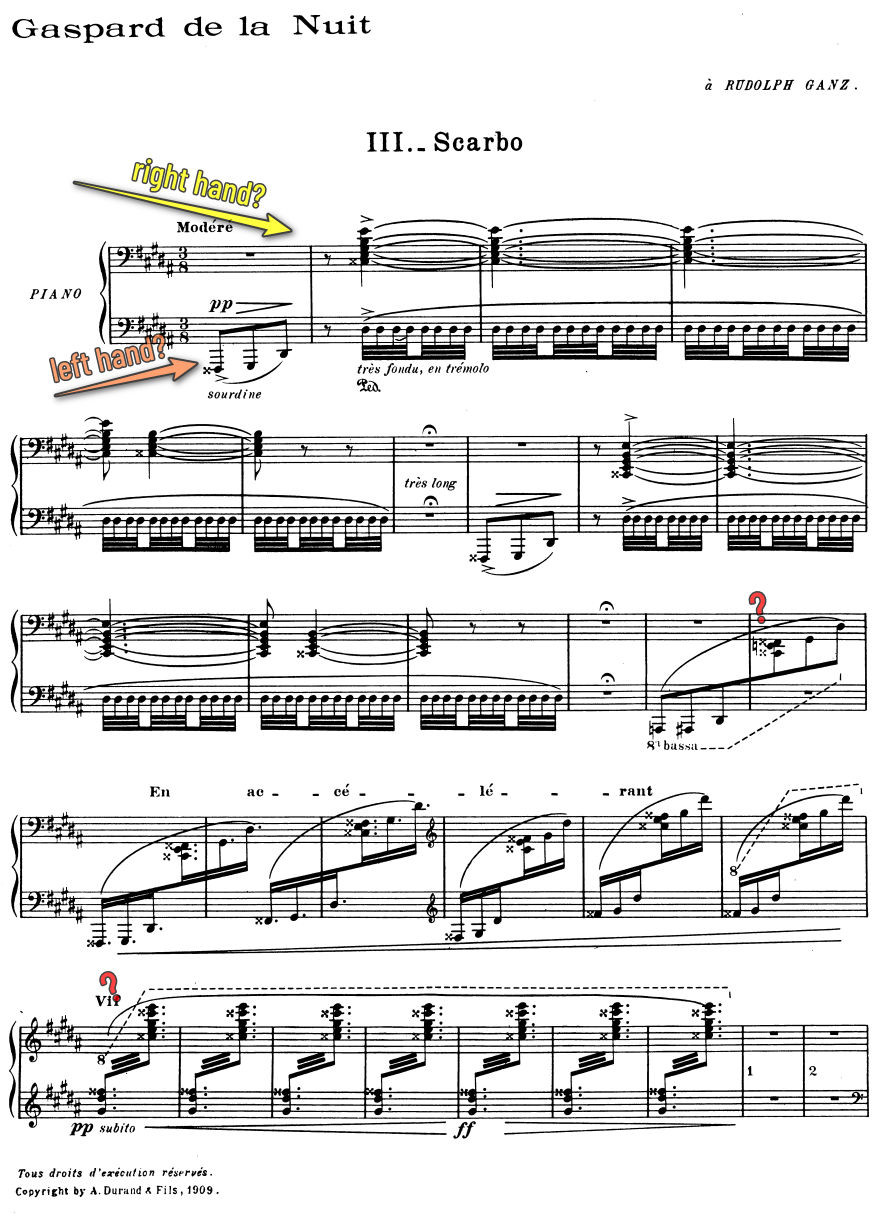
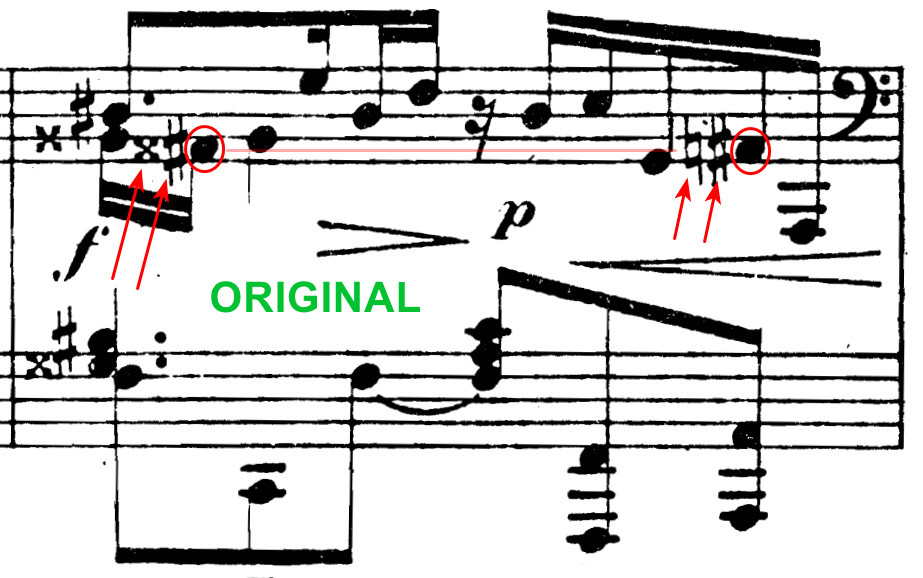
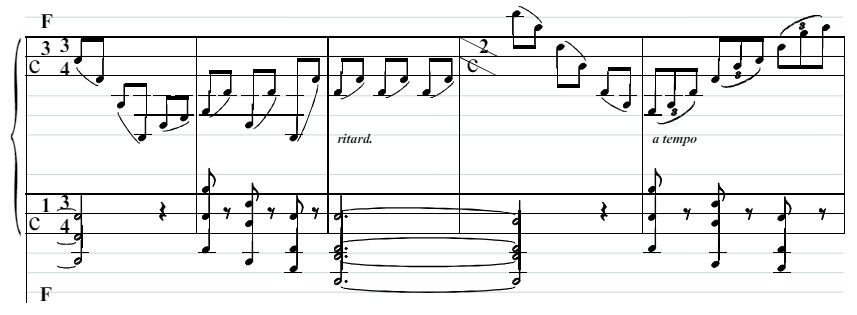
Right. Here is whet I have from Rousseau (it is a .pdf of the "Gaspard" but from year 1909). Maybe he used that score to play the piece – I have no idea:

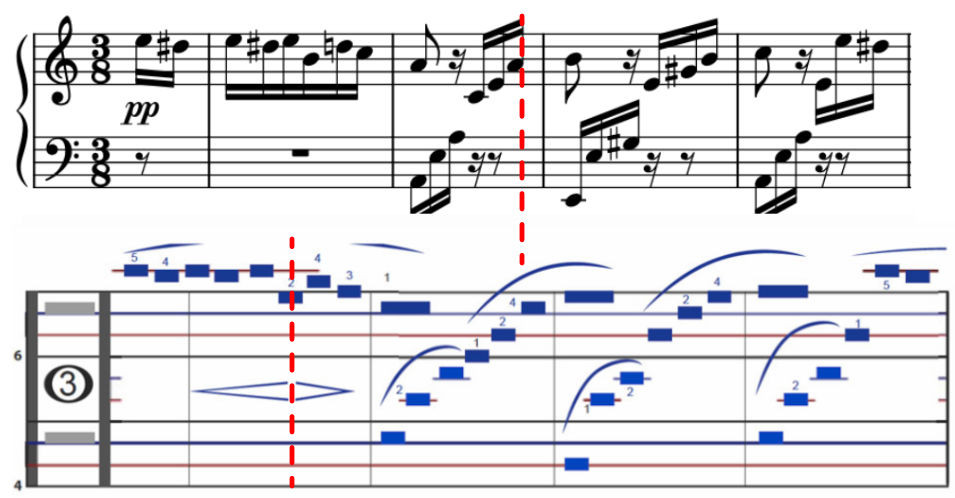
So, if I run it through a score OCR scanning software can I expect the midi exported file to have separate "hands" channels? It is quite interesting to see what will happen. But it won't tell me the individual fingers. I know, itis because I am not a pianist and you see the score and know what finger goes where, but is it really that easy to tell? I doubt it.
For example… those repeated notes (on the page 1 above) – I assume u play them with two fingers alternating? WHich ones? 'Thumb and index' or 'index and middle'? I doubt it is 'middle and ring'. Ah, this…
https://www.youtube.com/watch?v=8fcy2X06VH4

Ravel really did try his best to represent 'flamenco' style on the piano. Quite challenging indeed.


ambrozy

PASHKULI So, if I run it through a score OCR scanning software can I expect the midi exported file to have separate "hands" channels?

That is not always the case but you can assume that it is in this case

PASHKULI But it won't tell me the individual fingers. I know, itis because I am not a pianist and you see the score and know what finger goes where, but is it really that easy to tell? I doubt it.
For example… those repeated notes (on the page 1 above) – I assume u play them with two fingers alternating? WHich ones? 'Thumb and index' or 'index and middle'? I doubt it is 'middle and ring'. Ah, this…

No, sometimes the fingering is written in the score, but this is just a suggestion, each player must come up with his own fingerings that suits him while learning the piece, the same goes for which hand plays which notes in some cases.

https://www.youtube.com/watch?v=MbMvOjtcsRU
Here is an example, normally you play this with finger 1 (thumb) on A, finger 2 on A#, finger 3 on B and finger 4 on C but then you have to play in the order: 32413241… fingers are out of order and so it is relatively hard to play but he swaps fingers 2 and 3 and then sequence is 23412341… in which fingers are in order and it's very easy to play the notes in correct order, but you have to cross the fingers 2 and 3 which for me doesn't work, I barely can do that and I lose control of the keys (on piano you don't just press the keys at the correct time, you have to controll dynamics and articulation, how hard and how long each key is pressed) so I play this as originally intended, it just needs a little PRACTICE. This is very simple example, you can even try it yourselve!


PASHKULI

I have a licence for Overture 5 (by SonicScores) – really great piece of software for score music notation.
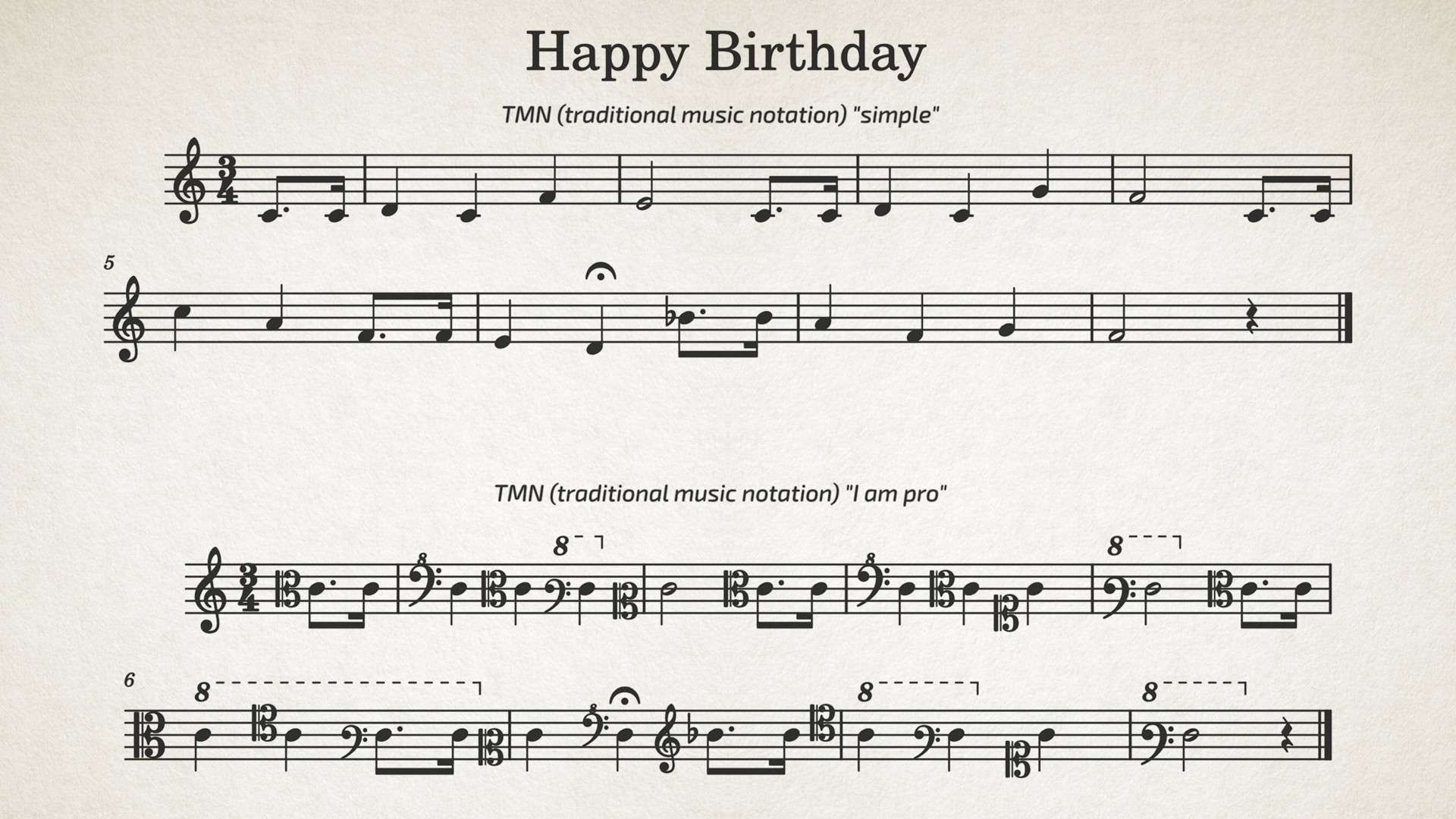
Also have one for Notion 6 by PreSonus. MuseScore is free and it is quite powerful where with the other two I have struggled to achieve this masterpiece:

The problem is with all those programs I can ever hardly find any collection of works from great composers and simply open them in the software to get the score. There are some 'openformat' MusicXML files but they are terrible (mostly) when opened!

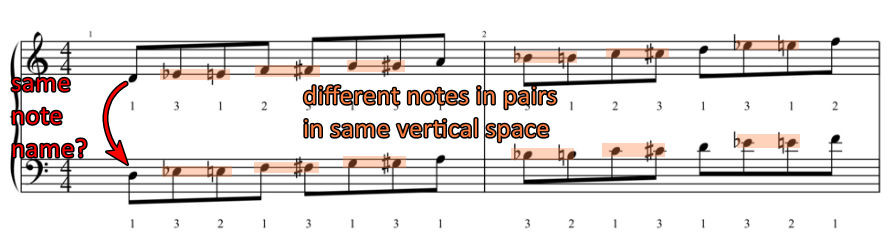
All these score programs (and their proprietary format) seem to "not speak" to each other. Probably inheritad by the terrible standart music notation and its tripple\quadruple ambiguity (see above).
But I guess, it is part of the business. If you'd like scores in "our format" by them from here and there. Or, why do not simply get a teacher to do it for you as they have already mestered it.

Really discouraging. Maybe one of the reasons I never liked the idea of learning to play the piano. Anyway…
"Decoding" such works form .pdf scores is guing to be painful. That is why I created my own Music notation which is based on such from 2000+ years ago with a modern finish. Technically – it is a TAB for any instrument (even drums).


PASHKULI

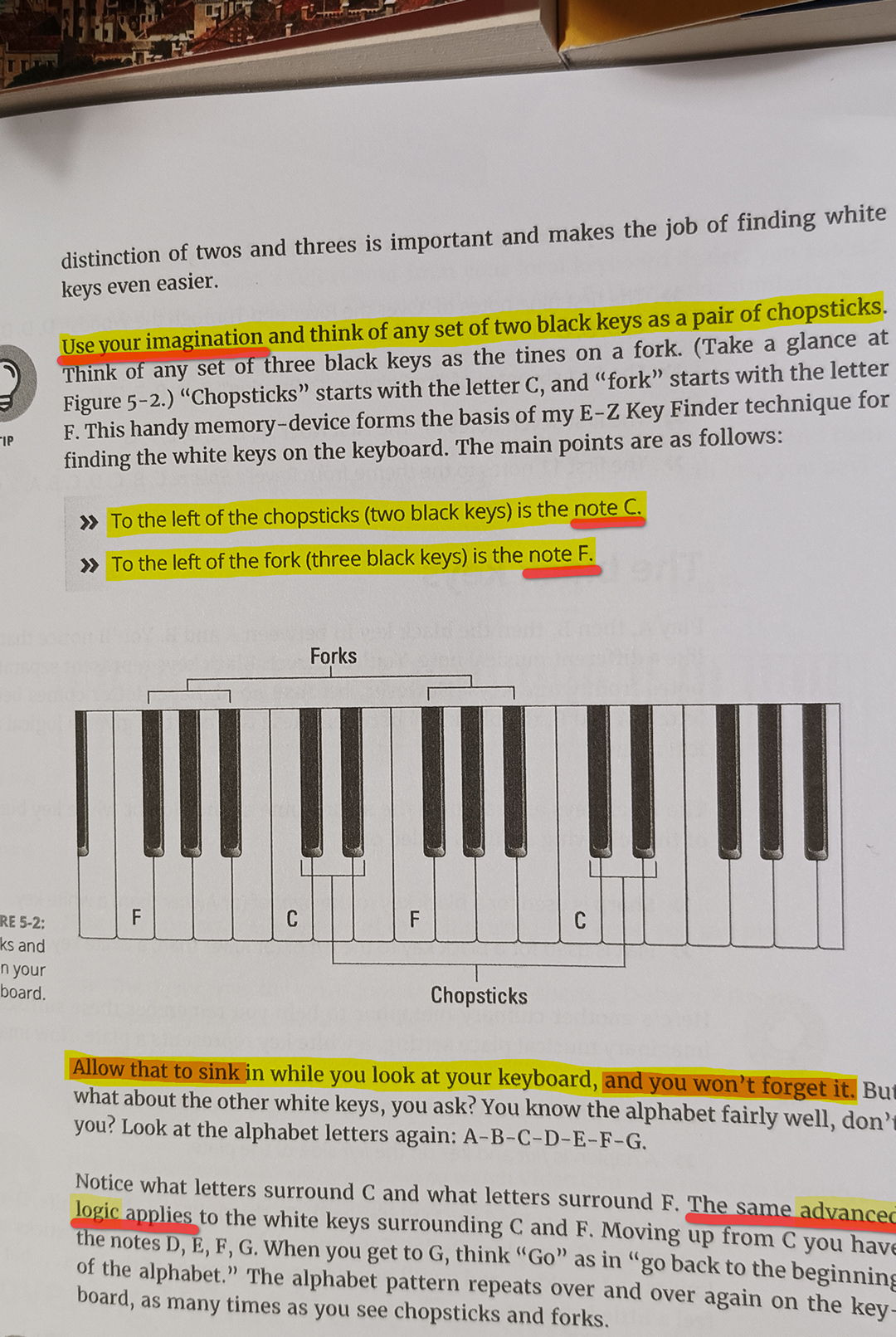
I was in London (UK) today to get my new passport and later went to one of these Music stores.
Found some books regarding Piano and how to learn, study Music notation with the piano. This one was about 600+ pages (not joking!). I had to take out my phone!
A picture is worth a thousand words…

What can I say (I laughed and still shake my head):
• undisputable use of the… imagination – could not be better than that!
• advanced… (I kid you not!) …logic


xooorx

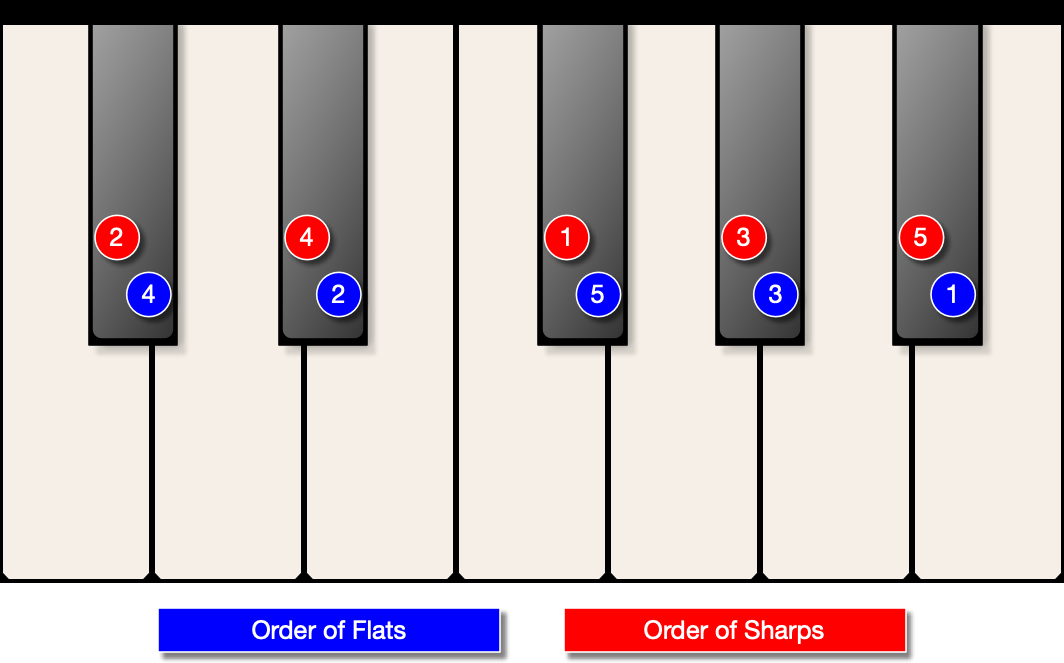
Pianissimo [...]but there is a new problem now: the F# is almost sitting on the middle of the entire F head, and the Bb is sitting almost entirely on the middle of B head. This is not good when you play chromatic passages, because the shift of your thumb underneath your middle finger, will encounter different distances in those two areas.

This is true also on the standard keyboard layout though? In our "mental map" of the keyboard the F# is in the middle between the F and the G, and it is often drawn this way in diagrams (e.g. see the book page photo above). But on the actual physical keyboard it's mostly over the F.

And this is (arguably) a good thing! Sure, it makes chromatic runs and clusters slightly trickier, but it makes the normal western scales easier. Because F# is the "first sharp". If you are in a key with any sharps at all then you are using the F# key instead of the F key. Having F# almost over the F makes the E-F#-G spacing similar to the E-F-G spacing. Meanwhile the same key's role as Gb is relatively rare: It's the last of the black-key flats and you have to be all the way out in Db major before it replaces the G in the scale.

With Bb its the symmetrically opposite situation: It's mostly used as Bb, rarely as A#, and you find it out over the B key.

The second sharp and second flat are also shifted over the keys they most often replace, but not by quite so much.

Only the G#/Ab key, simultaneously the third sharp and the third flat, sits exactly between the keys it replaces.

If nothing else, all of this means you don't have to mentally go through "F-C-G-D-A" or "B-E-A-D-G" when sat at the keyboard: You can see the orders of flats and sharps written in the displacement of the keys.


PASHKULI

I promised to not open any other threads so here we are (I am… it will be a monologue for sure) discussing the problems of Music notation:

. . . : : :  M U S I C  N O T A T I O N  : : : . . .

To understand the current Musical notation (please note, that understanding it is completely different from learning it!) one should first know how it came to be, its origin and what it represents. What makes (or had to be made) the need for distinguishing certain 7 notes from 5 at least in 12 TET (12 tone equal temperament).

Is it a special case? Yes, it is.

Can it (flat\sharps) seen clearly seen anywhere? Yes, it can – on a Halberstadt ("standard" piano keyboard).
• the 'black' keys are representing such "accidentals"
• so, there must be a correlation… and there is!
• so why call them "accidentals"… well, those keys were not present there and when they were introduced they were used quite "accidentally" as a 'chromatic' colorising mode (see, ancient hellenic genera from Pythagoras\Aristoxenus and Alypius times)
• but not every musician is a pianist, therefore it is yet another special case
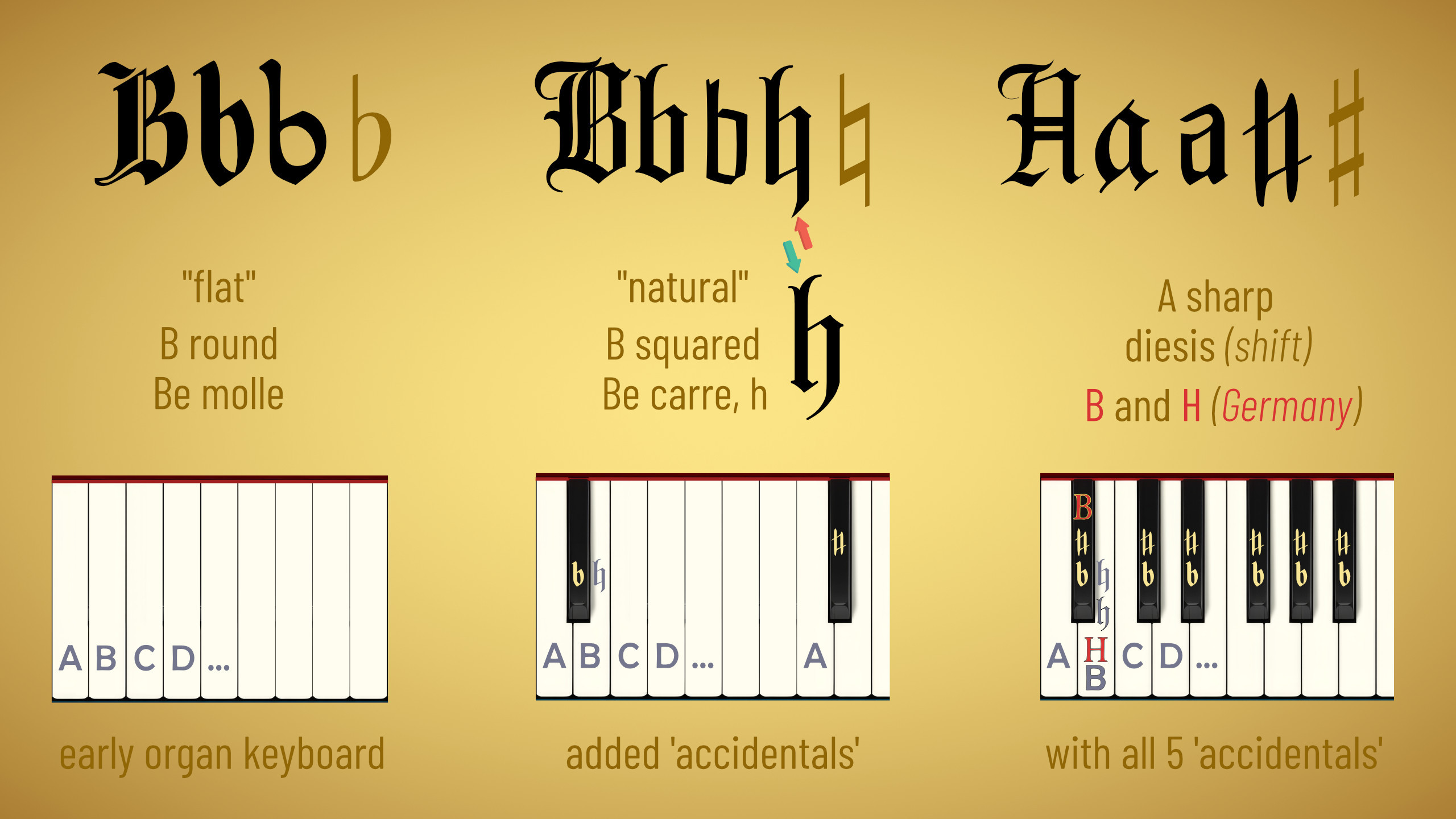
• at the very beginning of creating the "standard" music notation (year 1017) B (♮) and B♭ (♭) were both considered accidentals for the Roman church (catholic) chants. That was not the case in other parts of Europe and certainly not in folk music!

Does it lead to ambiguity? Yes, it does.
• a 'black' key can have two accidental sufixes or prefixes (♭ or ♯) depending on the chosen modal structure (already included notes as written symbols); same is valid for yet another special cases of double alterations to escape structiral ambiguity… and that is the irony of it!
• this all originates from the special case of naming only 7 of the notes (originaly only 6 as explained about ♮ and ♭) as the eraly church chants were strictly modal or diatonic (to use the hellenic terminology)

Similarly, at the very origins staff had 4 lines, later a 5th was added. Then the introduction of clefs made each staff lines and spaces between lines represent different notes (mismatch).

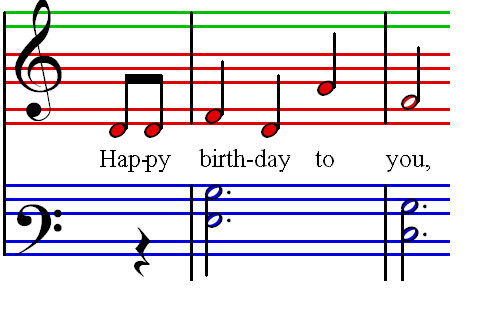
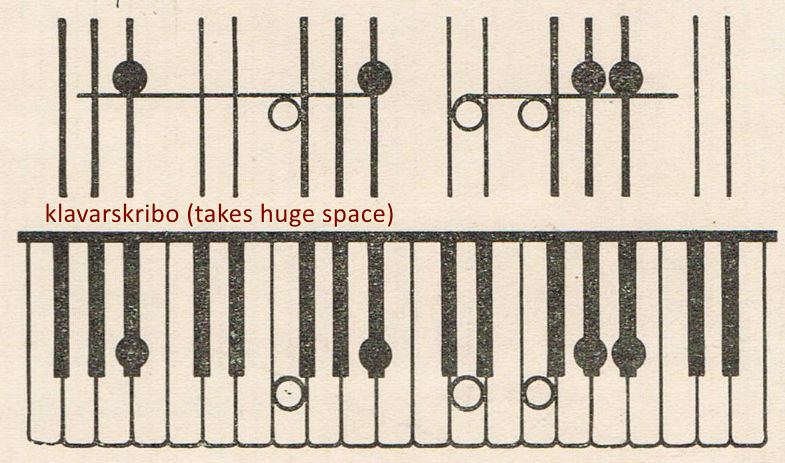
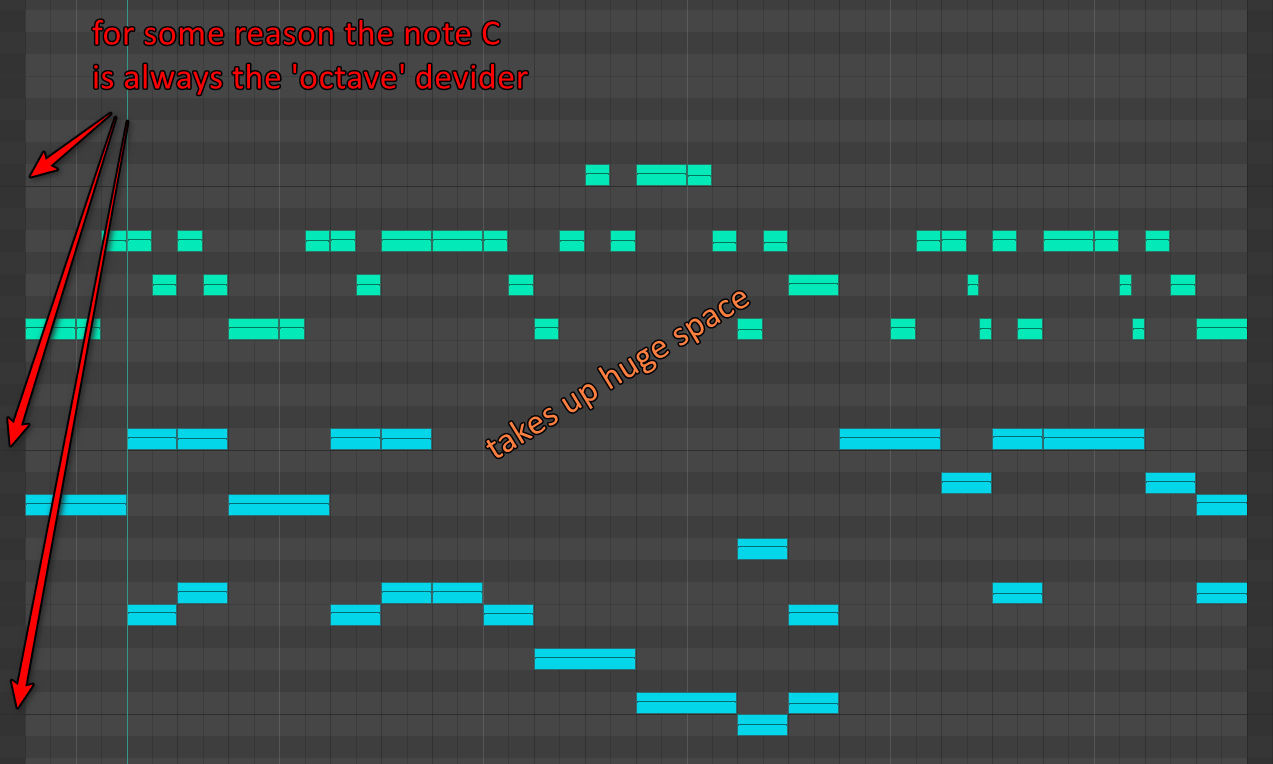
Some modern (pianolla roll and MIDI) type of 'chromatic' staves eliminated such problem (mismatch). The problem is they would take enormous space.

The typical stave with 5 lines sacrifices 42% of that space (as 5 out of 12 notes are not represented vertically!) but if we take into consideration the 'double accidentals' and 'octave' designations this % goes to 50% and a bit more.
So, no… The "standard" music notation does not give us a correct interval structure vertically but a special case one.

Introducing key signatures makes it even worse as they have to be imprinted and shown but usually learned. Then there are rules for an alterated note within a bar which would be valid for any note on same line but not 'octaves' of same note till the end of the bar. Then it has to be written again (otherwise it stops affecting the notes).

Such problems are inherited by the special cases mentioned above.

But all those chromatic notations, besides taking up much more vertical space (MIDI roll is not good for human reading from paper anyway!) and paper or screen estate (turning of pages), they also are either bound to the piano layout (Klavarskribo and Clairnote, Muto and others) or using quite a lot of ledger lines – which does not make them any more good than the typical music staff.

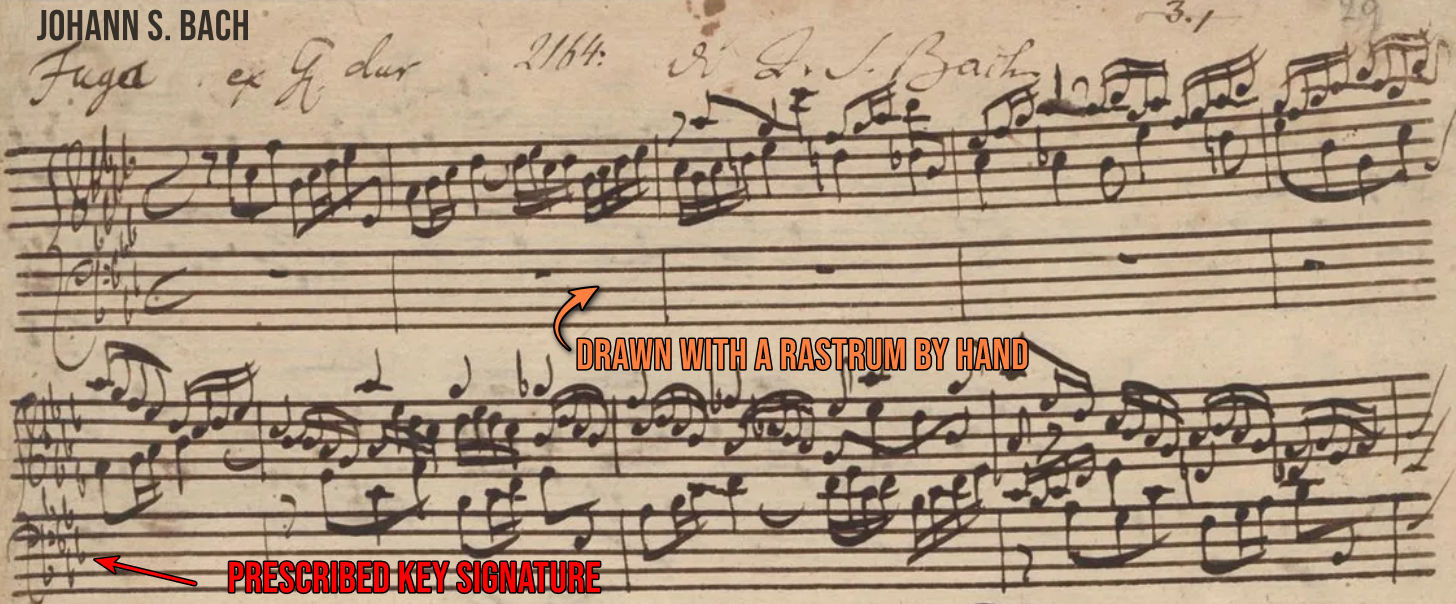
All those require pre‑rendered or pre-engraved staff lines – special paper (score paper). Bach used to draw his staff lines with a 5 pointed rastrum (special pen-like instrument) before the printing machine and engraving tablets for Music application got implemented across its country of origin Germany and subsequently in Europe.

The key separation and accidentals are sort of a 'geocentric' model view on Music.
MIDI‑roll is a modern tool and its Music notation based derivatives (Dodeka and ) but it only suits computers, not humans. Print out a MIDI‑roll and you'll understand what I mean.

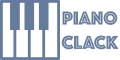
Both Music notes as letters and names also originated from special cases – the Latin alphabet (A, B, C…) despitе the fact its original creators (church clerks and monks) actually used a few hellenic (greek) letters especially the first note Г and for the notenames (Ut\Do, Re, Mi, Fa…) they used the lyrics of a well known psalm at that time which had its first 6 notes matching those exact sylables from the lyrics.

This has been 1000 years of… indoctrination. Learning without understanding.

Pianissimo

Yes, it's all about finding the right balance, it depends on the priority. The perfect symmetry in the tails is not our priority, and it's achievable only if you make a very small octave span. In Pashkuli case, he managed to make symmetrical tails, but he didn't tell us that the span of his octave is only 130mm, instead of 165.5mm. That's a toy, not a grand piano. If you make such a small octave, you end up with a total span of only 1003mm. From the bass side of A1 to the treble side of C88, including all the spaces between keys, a modern piano span can go from 1216mm to 1240mm. Every brand has a different span, and even within the same brand the total length can vary. But if you ask a good pianist to play with something as small as 1003mm he would laugh at you, it would be considered just a toy.


« Previous Page Next Page »