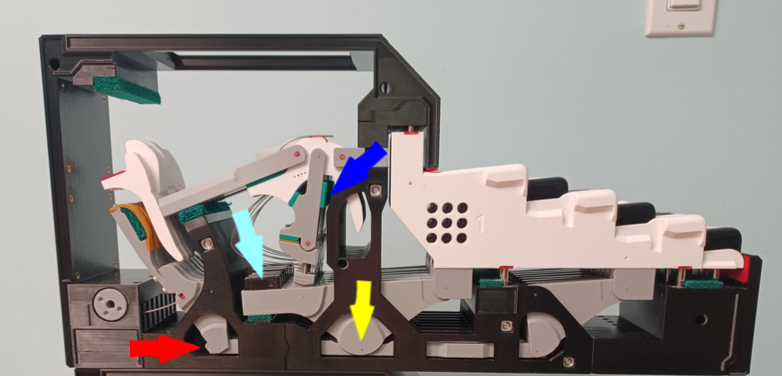
Well, the entire hickman action is a rabbit hole in and of itself, even without the extensive modifications I needed to make in order to replace the regular piano keys with the rotor based janko variants (which are of my own design - the original janko version relied on parallelogram style keys that actually pushed down on regular 'key-levers'… yet another rabbit hole).
The best place to start looking into the hickman action would likely be at mechanical music digest. It has a (rather badly) ms-paint drawn animation that at the very least gets the point across, but also provides an explanation of how the action works and links the patents (with drawings) for the action.
This video, and others from that author, offer the look from the perspective of someone rebuilding the action - he apparently got it in working order in the past couple weeks, so grats to him!
This video is the only video I found of the action in action. I tried to tune my action accordingly, but I had to make changes when I realized that the video's action is a bit badly tuned - the back check is set a bit too low. Still, it gets the point across.
There are also these two posts talking about the action, but keep in mind that all of their discussion is purely theoretical, such as the very heated debate on whether or not such an action would even work in real life (completely ignoring that pianos with such an action were made… though there is VERY few of them - probably single digits)
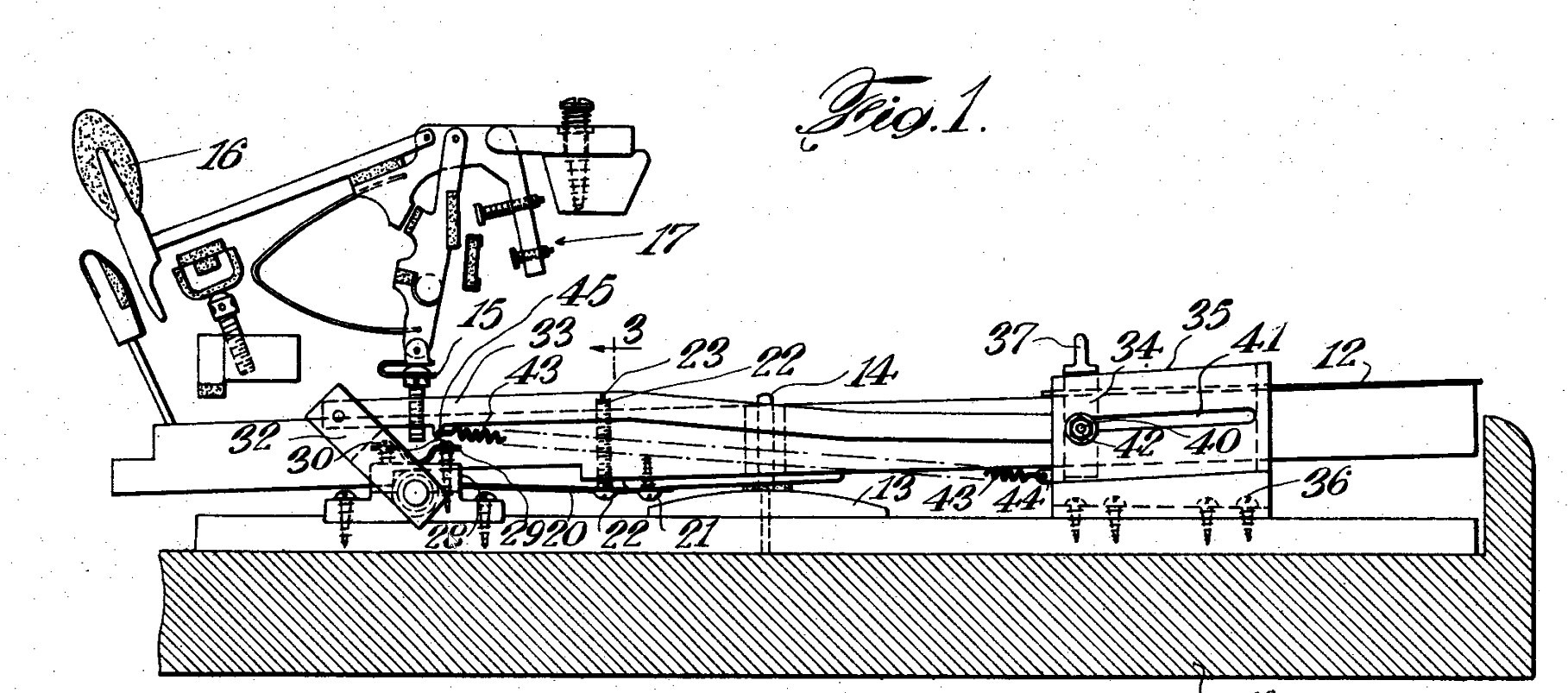
Here is a picture from the patent papers showing the action with the full key:
![]()
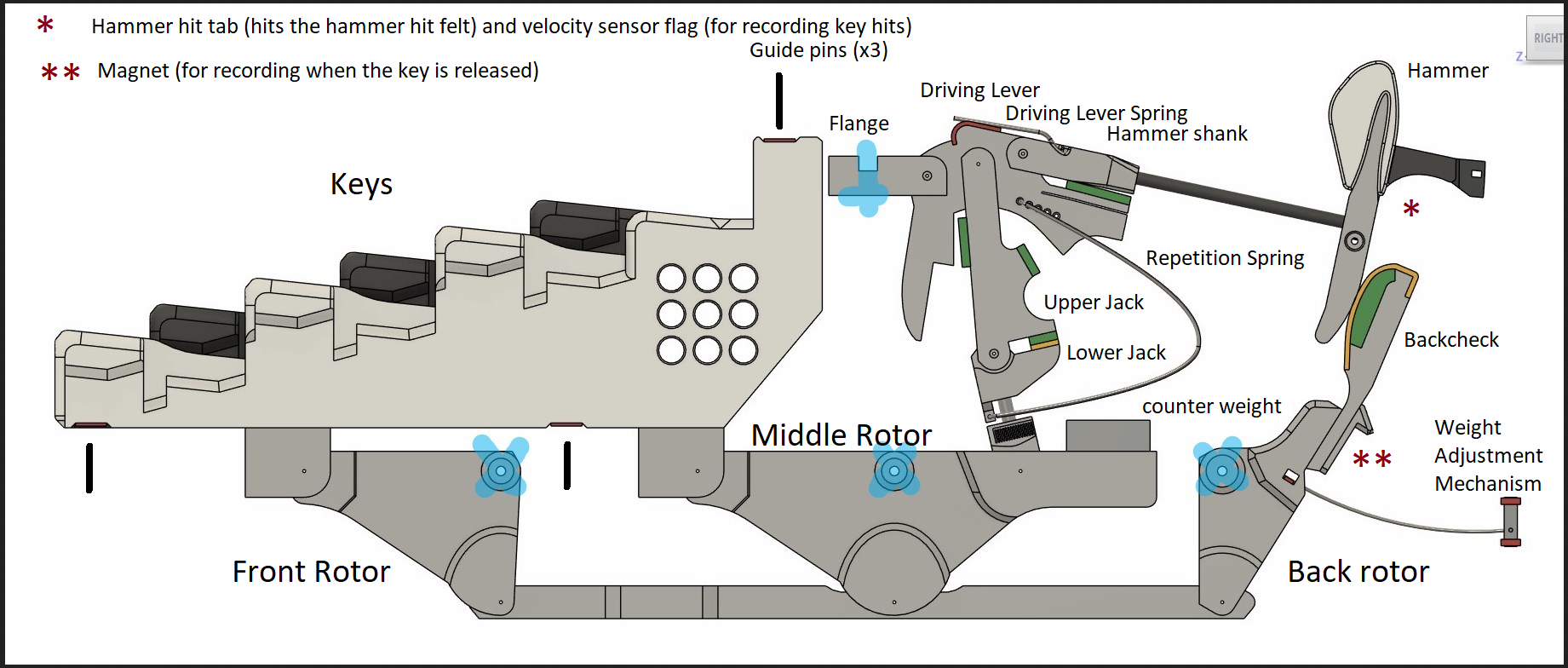
And here is my action with labels. The blue X marks are where the action is connected (via center pins) to the frame, and the upside-down t is where the flange is screwed to the frame.
![]()
Now to try and answer your questions:
- I set up the convoluted rotor assembly for the keys because I wanted the entire action to fit a more compact space and thus couldnt fit a full key lever. You can refer to the hickman action picture above, but the actual pivot point would be much further towards the right. It is also because of this that I needed to add a second rotor for the backcheck, because otherwise the backcheck would move way too far (since my 'key lever' rotates much more than a regular piano, closer to 8 degrees as compared to under 3 degrees of a grand piano). The vertical displacement however is the same - 9.5mm key dip, and around 6mm capstan movement.
- See the action image above. When the key is pressed (10mm), the front and middle rotors rotate. The middle rotor then pushes up on the jack, which pushes at the driving lever (which is connected to the flange), which in turn rotates the hammer. The backcheck is attached separately to the back rotor, since if I attached it to the middle one it would move way too far.
- Yes, I removed the two regulation screws that adjusted the maximum hammer height and the start of letoff. I didnt have enough space (due to the keys) to fit the screws while having access to them, which was further compounded by the shrinkage of the action from ~16mm wide (grand piano) to 9mm wide (my piano) due to the 5.1 inch octave span. I ended up regretting this decision as while the start of letoff isnt as important (in my case - essentially I per-calibrated that value and just print the parts to sub 0.1mm accuracy), but the maximum hammer height is still vital and I had to add an extra screw for that, though I added it to the point in the driving lever where the hammer shank rests on. The repetition springs are regulated the typical way (press on them), but also have 5 positions on the driving lever for when larger adjustments are needed (to account for different hammer weights).
- Yes, they are car wheel balance weights and act as key-counter weights. In the new version (top) I removed half of them and replaced them with a spring based system as that is what was originally used for hickman action and allows for adjustable key-weight by the player (turn the dial, change the action from light to heavy weight! said their advertisement papers).
- This was my 8 key prototype, so I selected 8 keys from the full 88 key range to try and see how the action will behave throughout the entire range. So I have keys 1, 13, 23, 37, 49, 61, 73, 88.
- The 8 key prototype is 86.4mm wide, which ends up being 129.6mm for an octave (or 5.1 inches)