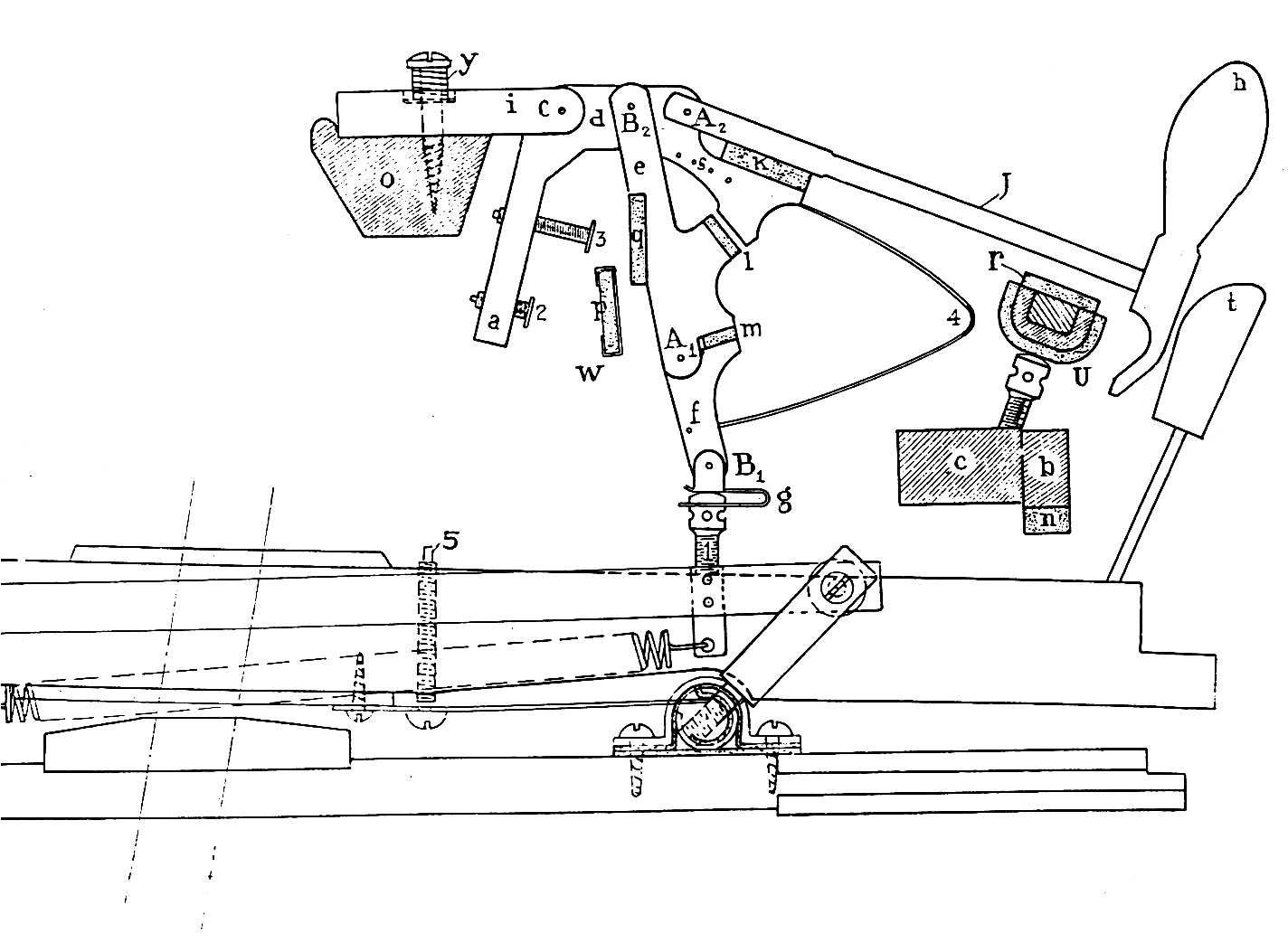
RIP First question: in the quest of simplifying your work have you considered making the hammer (A2) just one piece with the driving lever (d)? Doing so removes one regulation point (the stop rail)
There are several issues with this:
- In my particular case (and with a full acoustic action) the hammer needs to be disconnected from the driving lever in order to be free to fly up. In my case this zone above the maximum limit of the driving lever is where I position the velocity sensors, so if the hammer lever was welded to the driving lever there would be problems with recording key-hits. I could bypass this issue by using the magnetic sensors for the key-hit recordings (essentially removing the optical velocity sensors at the hammers), and is something I am thinking of doing for the 'simplified' action - though at that point it makes more sense to not just simplify the hammers but the entire action (aka: replacing the hickman action with just a single 'weighted hammer').
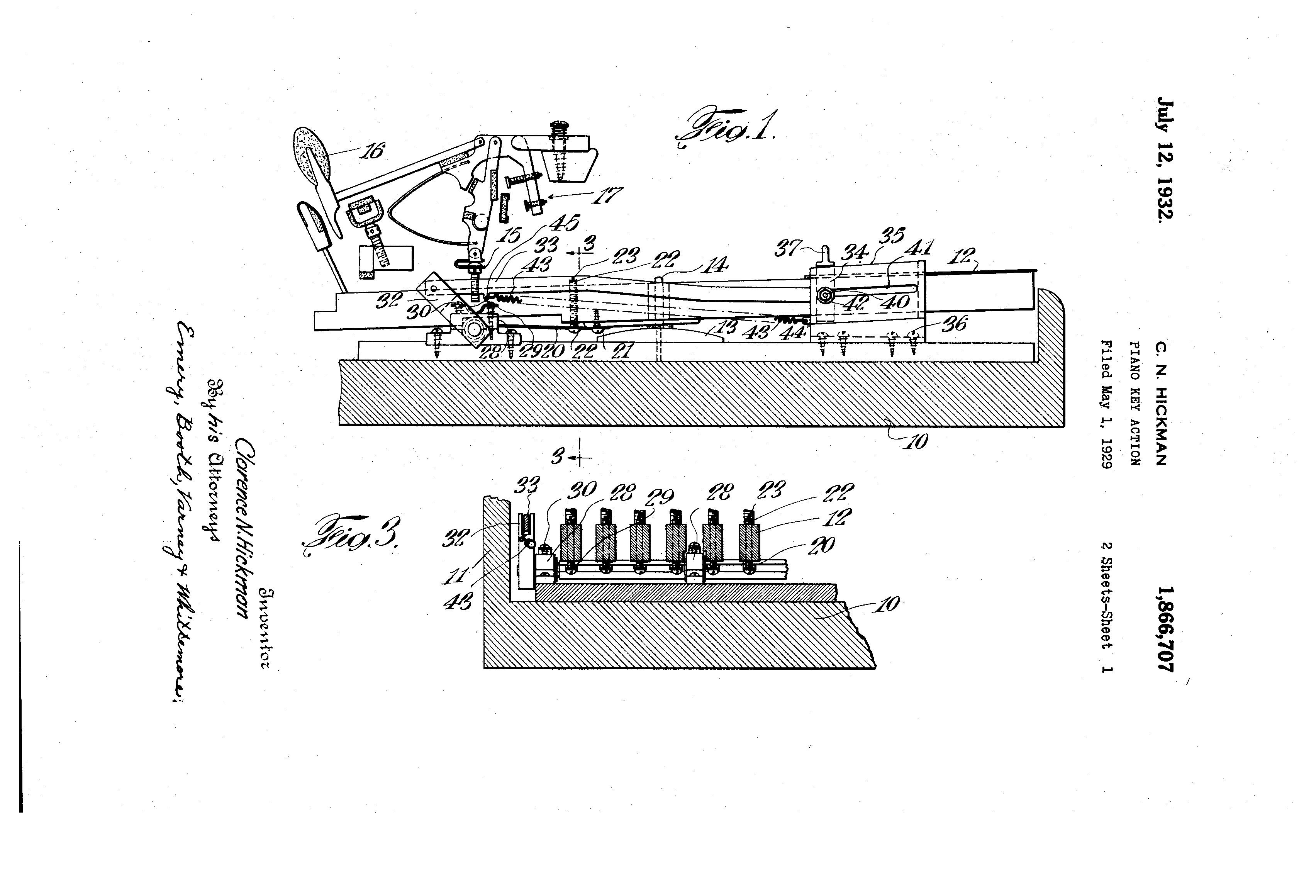
- In the hickman action description there is actually a mention of having the two parts be joined more solidly, basically relying on the natural flex of the hammer shanks & flange to allow the hammer to hit the string. I am not sure if it would work all that well, but keep in mind that I do bush that attachment extremely tightly - to the point that a 'hammer drop test' will not just not swing, but will stop at ~20 degree angle without making even a single swing.
- The way I print out the driving lever (flat on the build plate), it actually wouldnt make too much of a difference if I was to combine it with the hammer lever or not - in either case I would need to print them separately and then combine. Yes, there is a difference between doing a proper bushing connection rather than just super gluing the parts, but still.
RIP On a similar vein, have you consider replacing the hinge in B1 with that complicated attachment with a custom capstan with a traditional heel
In this case its unfortunately not possible. You can see from the original hickman action that the joint is fully connected (with a 'clip on' attachment to a custom capstan screw) and thats because the action relies on this solid connection to allow the jack parts to lock and unlock properly. The only alternative would be to attach the bottom of the jack to another lever connected to the frame (and thus free the connection to the key to be a traditional heel), but that just overly complex for little gain.
Think about it this way - in the Erard's piano design the heel can be left 'floating' from the capstan since its attached to the whippen assembly directly - so the heel only has a single path it can take - rotating around the centerpin of whippen->frame. In the case of the Hickman action the 'heel' (g) is connected to the lower jack, which is further connected to the upper jack, which is connected to the driving lever, which is connected to the flange. This 4-link design essentially means that the heel is free to move however it feels both up/down as well as left/right, so some sort of lock is required; be it by attaching it firmly to the capstan screw or adding another link/lever that would connect it directly to the frame (in some way).
In the end the key-lever assembly is probably ~60% of the complexity (with the hickman action being 40%), so if I was to try and simplify the design in order to make it be easier to assemble (and obviously cheaper as well) I would likely:
- Replace the key-lever assembly with a simple parallelogram design (likely with the 'bendable links' made from PETG)
- Remove the 2x optical sensors for the velocity measurement and just rely on magnetic sensors for both key-on and key-off measurement. I already plan on having an 'alternate' input for key-on so as to be able to select between optical sensors and magnetic sensors in firmware, so for a 'cheaper' option just removing the optical sensors altogether (and thus allowing a simpler action) just makes sense.
- Replace the hickman action with just a simple 'weighted hammer' action.
- Remove the inbuilt PC, DAC, touchscreen, etc…. basically convert the design to a pure MIDI keyboard that relies on an external device for producing sound.
RIP Oh, great to hear that after our other conversation on this topic. Nice that they're working well for you!
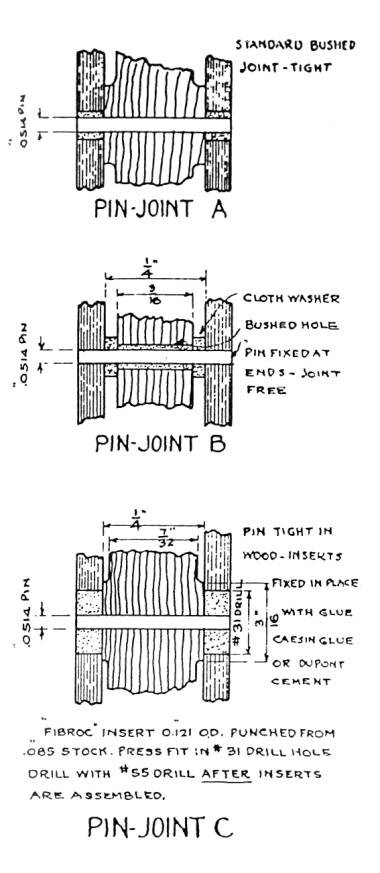
Yep, thanks for that! the back rotor that hold the backcheck was always a bit too 'loose' in terms of side-to-side sway… not enough for me to really worry about it, but still an annoyance as I had no option but to use the 'felt bushing in the middle' (type B) joint. When you mentioned the PTFE tubing I found some 1.5mm ID, 3mm OD that fit just beautifully. 30 min later I replaced the 3 1.5mm joints I had on a single key with PTFE tubing and it worked out great. Cant feel a difference between the felt bushed and PTFE bushings, but the parts are more rigid in terms of side-to-side sway.
Really too bad I cant find any 1.3mm PTFE tubing. You posted the link to one, but that doesnt seem to work for me and I cant find a working alternative on amazon / aliexpress. Seems like the sizing goes 1mm, maaaaybe 1.2mm, 1.5mm, 2mm, etc. Would have preferred to switch the other 3 pins of the key-lever assembly to PTFE bushings as well (at least to see how it worked out), but unless I find 1.5mm piano center pins or 1.3mm PTFE tubing that seems like a 'wish it was so' option.
Now if only I had access to a markforged printer… I tested one previously (work related), and its ability to print out parts with inlaid carbon fiber (as in - a second extruder that lays down a string of carbon fiber after the plastic to work much the same way as iron bars do in reinforced concrete)… The parts are basically at the aluminum level in terms of strength, so if I made (for example) the flange, driving lever, and hammer parts out of it I would likely have a much more structurally sound design with much less side-to-side sway than I do right now.