I'm listening to lectures by Dan Gelbart, and from my understanding, as far as high accuracy sensing is concerned -
any measurement which can be converted to time measurement can be measured to a much higher degree of accuracy.
Most things - with great care - can be measured to about 1 part per million. 1micron to 1meter, 1volt to 1microvolt, 1mg to 1kg, except time, time can be measured to orders of magnitude higher accuracy (think atomic clocks). Comparitively 1s to 1microsecond(1Mhz) is very easy and cheap to measure. Any bargain bin MCU will do.
For signals that are AC and you're measuring frequency, that becomes a measurement of zero crossing time (ie. time measurement).
This is why FM has way better noise immunity than AM, it only cares about zero crossing time (not noise on amplitude and other distortions of the signal)!
If signal is AM modulated (data is in the amplitude not carrier frequency), you can get rid of lot of the noise by building a band pass filter around the carrier frequency F.
If you amplify DC signals you get DC drift, every amplifier has an offset voltage which drifts.
DC drift is a problem if you work with low level signals in mV. AC doesn't have this problem.
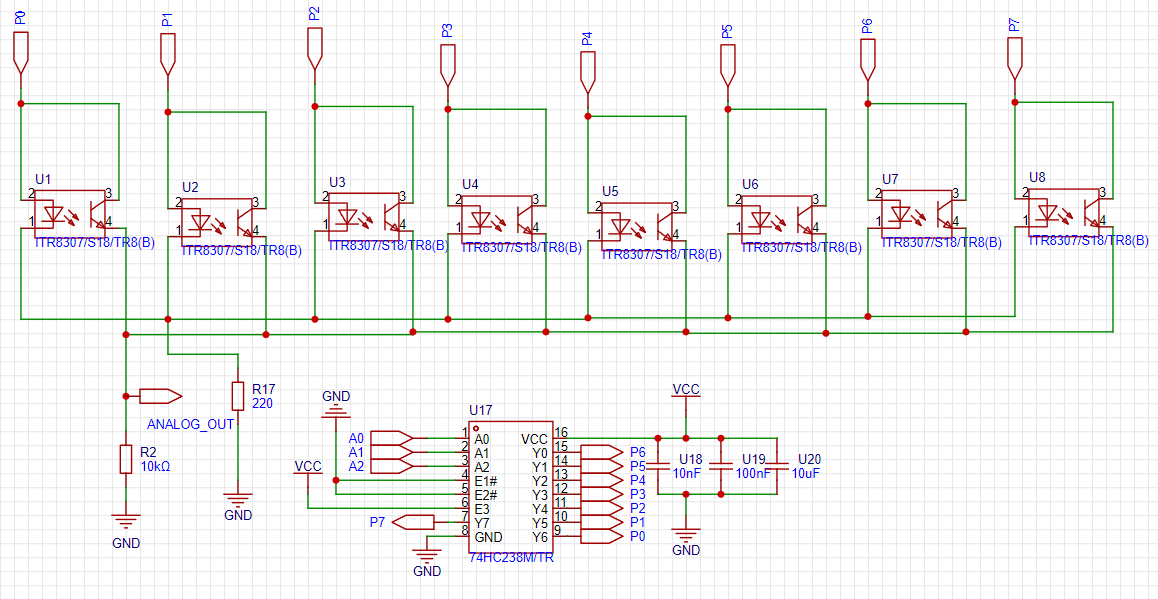
Optical sensors, the ones we use, typically have peak wavelength of 940 nm. They have a built in optical band pass filter
(colored glass/colored material which filters for that wavelength).
But there are other sources of 940nm ambient light other than the IR-LED itself (room lights, outdoor lights, etc)
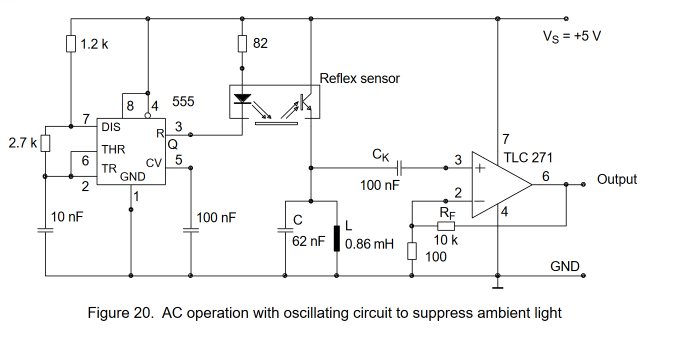
Working with AC also provides a way to filter out other sources if IR-LED is shone modulated with certain frequency F (10kHz-100kHz).
Then we can bandpass filter modulated frequency, thus eliminating other sources of ambient light that operate at different frequencies.
If you have an analog sensor, you want to put amplifier right next to it (if you put it on the other end, you will amplify noise, etc).
Distance sensing can be used to measure many parameters, some of them:
- Force (deflection of a cantilever spring, F=kX, if we can sense X we can sense F)
- Acceleration (deflection of a cantilever, F=mA, mass is known, F can be measured from (1))
- Mass (deflection of a cantilever, F=mg)
- Pressure (deflection of flexible diaphragm)
Many accelometer IC have silicon micro etched springs that measure distance capacitively.
For highly accurate measurements ideally you want differential sensor that eliminate drift in other parameters of the sensor.