
Skip to content

New Yamaha retrofit silent unit and grade up unit.

Paulo164

RIP

Ah, nice find !

To my modest knowledge, Yamaha is the only keyboard manufacturer that would enrich standard midi data with this kind of subtleties.

So it would be worth for Modartt (or any other VST company, although I think only a modeling approach could benefit from this) to implement this subtle changes in sound in their own way.
cambpiano

Queue99 I am interested in obtaining a Yamaha silent system. Thank you James


Paulo164

RIP

I have found some very interesting information regarding Grand Expression Modeling, which may be also very good news for us, enthusiasts :

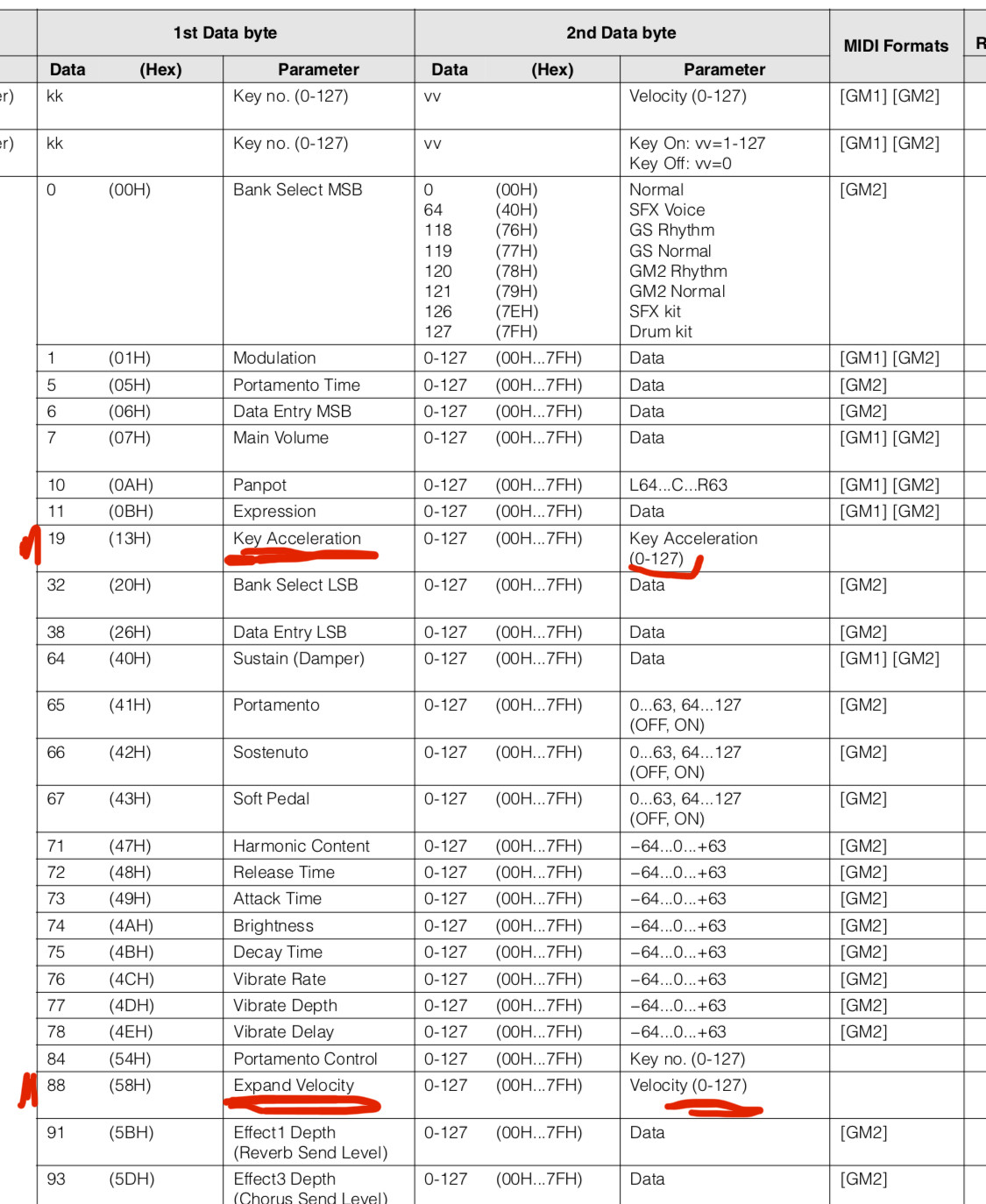
  • SC3 transmit “key acceleration” in CC#19 coded on 7 bits
  • SC3 also transmit “expand velocity” (hi-res velocity) on CC#88 coded on 7 bits (so a total of 14 bits for velocity)

This is mentioned in the MIDI reference spec sheet of the Silent SC3/SH3 & Transcoustic TA3/TC3 models :

https://fr.yamaha.com/files/download/other_assets/5/1784935/ta3_tc3_sh3_sc3_en_mr_b0.pdf

So there are strong evidences that SC3/SH3 are sending midi events containing the 2 components of Grand Expression Modeling, namely “key acceleration” and “expand velocity”.

Some precisions of a CLP785 user on Modartt’s forum (CLP785 sharing the same specs as SC3) :

https://forum.modartt.com//viewtopic.php?id=5897&p=2

Yamaha CLP785 records them (extended velocity with controller 88 and touch acceleration with controller 19) and transmits them through midi (I receive them on Cubase, and I can read them too in the midi files I recorded with only the CLP).

Only 7 bits per controller is used (128 values possible), so we have 14bits velocity and 7 bits acceleration, which is 21 bits of resolution per key touch (2097152 values, or more than 2 millions).

With hours of recording, I checked, all 14 bits of velocity are used, and all 7 bits of acceleration are used.

The acceletation seems to have more frequently the lowest, middle and highest values, which I believe are the most negative value, 0 and the most positive value.

I can tell the difference, and the nuances are really really great to hear.


vagfilm

One question from a non-engineer guy… If the distance from the key to the sensor is roughly 1cm when at rest, and the distance from the same sensor to the neighboring key at bottom is roughly the same 1cm, how can this system prevent crosstalk between keys? Is the induction strictly axial (ie, vertical detection more sensitive than lateral?). Do they only measure speed and acceleration in the last couple of millimeters before bottom? If so, is this suitable for playing "above escapement"?


Paulo164

vagfilm

Very good question I asked to myself also (you are not so “non engineer” as you may claim).

Well, I am purely speculating here but I would say :

  • yes, the induction is probably (much) more axial than lateral, to reuse your own words
  • when I played in the piano store, I remember I tried specifically to play staccato without reaching the bottom of the key (I would say half way) and the sound was coming out nicely with the same hit and miss behavior that I could get with the acoustic counterpart (you know, when the hammer is just on the edge of hitting the string)

Now you are about to think : okay, easy with playing just 1 key. But what if there was an interaction between 2 adjacent keys ? Induction of key#1 should interact with induction of key#2 and vice versa ?

So : I tried to play trills of 2 adjacent notes, deeply and shallowly, and did not notice any kind of crosstalk that could alter the consistency and precision of velocity measurement. That’s how it is. Well done Yamaha.


vagfilm

I asked this because in the past I also thought about using hall sensors instead of optical sensors, and after a 10 minute breadboard/arduino experiment, I felt it would be a nightmare to calibrate and ensure key specificity. Maybe it ia doable, afterall…


yoz

Very interesting topics. I want to install a new silent system on my piano, I will look at Yamaha because ad-silent and co. have not convinced me.


skywalker

Queue99

Hi there, I have an 1994 M100 (seems to be pretty much like an U1 produced for the European market with an optical Silent System). Have moved this to the US now, but the Silent System has been acting up (some keys not playing others very loud), and several US technician (Yamaha experts) told me a few years ago <2018) that this is an electric board issue. Now with the new VSH3 option, I am wondering if I can upgrade my system with VSH3 rather than trying to 'repair' the optical one (as I have no idea how - apparently the electrical board is no longer produced).
Do you know if the VSH3 would work with the M100 (M100 is not on the official list of compatible devices - maybe because it is an European and not a Japanese Model)
If you think that VSH3 is compatible, I would be very interested to purchase one.
Thanks in advance for your help


swolk99

Paulo164 Thank you for this review, very helpful! Just wondering if you've compared the SC2 to SC3? I ask because I'm thinking about purchasing a gently-used C3X TA2 grand piano, and just wondering how the silent sensor mechanisms SC3 - magnetic sensors vs SC2 - optical and gray-scale shutter, compare? Also, does anyone know if TA2 can be upgraded to TA3? I figure they share same controller box (SHx and TAx)…

Thanks,

Scott


Queue99

skywalker

The M100 is the same as the Japanese version of the U100SX, so the VSC3 can be installed.

I believe the M100 is a first generation silent, so the key sensor board is corroded.

I've been experiencing this symptom a lot lately.(U5AS、U30AS、U300S、U100SX,U300SX,etc)

Parts were no longer in supply.

I guess vintage synthesizer repairman may be able to fix it.

I guess RSH3 is better than VSC3, the reason is that the old silent mechanism is also replaced and the touch when silent is better.


Paulo164

swolk99

Hi,

On the paper, the SC3 has this over the SC2:

  • "Articulation Sensor system" to detect force/acceleration in addition to velocity for staccato/legato playing (CC19)
  • Binaural samples for Bösendorfer Imperial
  • MIDI bluetooth
  • Added arranger to be accompanied by bassist and drummer
  • -30% of current consumption (12W -> 8W)

Also, looking at the MIDI specs sheet, it seems that:

  • the SC2 doesn't handle CC#88 (so no high-res velocity)
  • does handle Poly-Aftertouch (for smooth release), like the SC3

On the field, I can't tell you which one performs the best but I would go with the SC3 anyway, should it be for maintenance easiness alone.


swolk99

Paulo164 Thank you very helpful! Just wish the Yamaha's were less expensive in the US. The dealer markup is unbelievable. 🙁


skywalker

Queue99

Thanks a lot for the details! Super helpful. I inquired with Yamaha in Germany and was told the MP100 Silent should be compatible with the VSH3-10. I am a bit confused that you say RSH3 is better than VSC3? Do you mean RSC3 being better than VSH3? Is the VSH3/VSC3 not replacing the silent mechanism?

I assumed the VSH3 would be the same as the RSC3, but without the silent rail?


skywalker

Queue99

Can you elaborate on the 'key sensor board' being corroded? How could a synth repairman fix it? I might try to find someone like this here in San Francisco, but am wondering if the sound / reliability in the new VSH3 is not so much better than the old system, that the upgrade is worth anyway?


Paulo164

skywalker

It was a typo. It’s RSC3 or VSH3 only.

And yes, RSC3 = VSH3 + hammer stop bar - some features on the control unit.

Otherwise, same quality.


Paulo164

skywalker

Yes, the upgrade is worth anyway.


Queue99

skywalker

As you can see from the photos, the board and components are corroded due to liquid leakage from the capacitor on the sensor board. The microscopic patterns and through holes are broken and cannot be repaired by simply replacing the components.

Vintage synth craftsmen and board restorers are good at this repair.

The first generation silent stoppers were board-like and difficult to adjust section by section.

It would be preferable to replace them with new silent mechanisms in the RSC3.

SH3 has a better SPEC than SC3.

https://photos.app.goo.gl/oDwHRuH2jsSurRkp7


skywalker

Queue99

Thanks so much for the details and clarifications, will have a detailed look at my unit this weekend, but guess it is anyway better to upgrade to the new system.

Just need to find a way to get one shipped to the US. Will see a Yamaha store on Saturday - maybe they can find a source… otherwise they seem to be available in Germany.


Dirk

Queue99

Hi there,

In the Netherlands Yamaha sells the VSC3 but not the RSH3. Can you explain the difference in components in the 2 sets like:

  1. Mute rail
  2. Sensor rail
  3. Control unit
  4. Other things?

Thanks!

Regards,

Dirk Appel

The Netherlands


« Previous Page Next Page »