Paulo164
RIP Is your adSilent using the "flag" system you describe?
No, light intensity.
To my knowledge, the “flags” are used exclusively by Yamaha.

RIP Is your adSilent using the "flag" system you describe?
No, light intensity.
To my knowledge, the “flags” are used exclusively by Yamaha.
CyberGene But on the N1X there are also hammer sensors. They only interrupt light through metal notches and produce binary on/off signal.
Okay, so the precision of speed measurement itself is the same as with key-only sensors but the hammer on/off sensors add reliability regarding whether the note should be triggered or not and when it should be triggered.
Paulo164 I believe that’s correct. If I’m not mistaken, most of the time it’s the key sensors that determine velocity, however in certain (edge?) cases it’s the hammer sensors that are used instead (or in combination). I believe the reason is, the two hammer sensor points are 10mm apart and that’s too much to be used as the only measurement source because:
P.S. I’m still not sure how one can eliminate the infamous loud note issue through key only sensors, unless some advanced prediction logic is implemented that models the key-to-hammer mechanical system and can predict that a repeated key is not moving the hammer. Which is why on the NU1XA they introduced hammer sensors too (if I remember correctly).
CyberGene Yes , you are probably right. By today’s standards, scanning rate is already at the lower limit we need to track very precisely the key when moving it very fast.
So tracking the hammer, which moves 10 times faster and on an only 2 mm course, is out of reach with this kind of optical technology.
This is where the new electromagnetic sensors, reacting to fluctuations of the electromagnetic field (so a direct measure of speed/energy) at a very localized point, could enter in the game.
Worth noting that the SC3 is supporting the “grand expression modeling” feature.
From Yamaha website :
The simulation technology that reproduces this variety of tonal changes is "Grand Expression Modeling." As a result, we have achieved expressive power that faithfully reproduces the detailed nuances envisioned by the performer. In addition to changing the strength of your finger's touch from the time you press the key until you release it, you can also change the tone depending on the speed of your touch and the depth of the key you press, so you can express the tone to suit a variety of playing styles, making it an authentic instrument. You can enjoy a unique performance.
As I understand it, this means that for a same output velocity value, you could trigger the note either with a small/shallow key press (which corresponds probably to staccato touch) or a deep press up to the keybed (legato touch ?).
Technically, there may be a second stream of data conveyed along the regular note-on velocity data stream that is processed by the sound engine to alter the tone character.
I wonder if this additional data stream is exposed outside of the Yamaha box, in the standard midi message (maybe on a specific CC like it is for hi-res velocity). And if yes, if program like PianoTeq could take advantage of this. I don’t think so as it is non standard and proprietary format of Yamaha (which does not collaborate with Modartt, as we see no Yamaha nor Bösendorfer approved models).
Anyway, if proven to be effective, this could give Yamaha the edge over even high quality VSTs that cannot access some intricate details hidden in hardware.
I finish just by saying that I was aware of this feature before my visit to the piano store. So I specifically tried different kinds of touch (ie. staccato vs. legato) to see if I could detect a change in the sound. I confess I was not able to clearly notice this like in a A/B test. But maybe the outstanding feeling I had when playing the SC3 was simply the result of this grand expression modeling taking part in the recipe, contributing to the magic without necessarily being able to intellectualize it.
Thanks again for this additional wealth of information, we really appreciate your time and effort to explain your experience with these instruments.
I still need to internalize everything you say which is quite a lot and very interesting, and will come to this thread once and again to do so. It may even inform/change my plans for my own DIY project.
Small correction / addenda:
Paulo164 I wonder if this additional data stream is exposed outside of the Yamaha box, in the standard midi message (maybe on a specific CC like it is for hi-res velocity). And if yes, if program like PianoTeq could take advantage of this. I don’t think so as it is non standard and proprietary format of Yamaha (which does not collaborate with Modartt, as we see no Yamaha nor Bösendorfer approved models).
Yamaha does not directly collaborate with Modartt, but does have a so-called "dialect" of MIDI with proprietary extensions. I am not sure about what is the license for using those extensions, but PianoTeq does use them (I believe they call them something like "MIDI Disklavier XT version"). So what you say is possible, and anybody with the instrument can easily verify what is happening by inspecting the MIDI packages (if anybody wants I'm willing to help).
That leads to another question (sorry) which you might have an answer for: the Japanese specs for the RSC3 say "no" on the MIDI line. I assume that means "no" for the DIN-MIDI plug, and I was expecting to see a line saying MIDI-over-USB with a "yes" but there isn't such a line (even though there is USB-to-host and USB-to-device and the former might mean what I mean by MIDI-over-USB). Do you know that for sure?
CyberGene Which is why on the NU1XA they introduced hammer sensors too (if I remember correctly).
You do. From https://usa.yamaha.com/products/musical_instruments/pianos/avantgrand/nu1xa/specs.html#product-tabs the specs for the NU1XA say
Non-contact continuous detection electromagnetic inductive type
for both Hammer and key sensors (the NU1X is also included in the table and the only one without hammer sensors). The N1X and N2X both have $Non-contact optical fiber$ for both hammer and key sensors. Interestingly the N2 has no sensors either for keys or for hammers, so it must be working by telepaty.
RIP That leads to another question (sorry) which you might have an answer for: the Japanese specs for the RSC3 say "no" on the MIDI line. I assume that means "no" for the DIN-MIDI plug, and I was expecting to see a line saying MIDI-over-USB with a "yes" but there isn't such a line (even though there is USB-to-host and USB-to-device and the former might mean what I mean by MIDI-over-USB). Do you know that for sure?
I had exactly the exact same interrogation :-)
So I asked very specifically to Queue99 if it was possible to connect the RSC3 to an iPad through the USB-to-host plug (located on the rear panel I think) to send MIDI data via wired connection and not bluetooth MIDI and his answer was "yes" without any ambiguity. The VSH3 has this same ability but, in addition, includes also the legacy 5-pin DIN IN/OUT connectors (which I would not use anyway in my specific case).
RIP Yamaha does not directly collaborate with Modartt, but does have a so-called "dialect" of MIDI with proprietary extensions. I am not sure about what is the license for using those extensions, but PianoTeq does use them (I believe they call them something like "MIDI Disklavier XT version"). So what you say is possible, and anybody with the instrument can easily verify what is happening by inspecting the MIDI packages (if anybody wants I'm willing to help).
Okay, thank you for this precious info.
I should have tried, during my visit to the store, to connect my iPhone via bluetooth to the SC3 to monitor incoming MIDI events. Too bad…
So for now, what would be interesting to know is :
According to the manual, available at https://jp.yamaha.com/files/download/other_assets/4/1618034/ta3_tc3_sh3_sc3_en_om_c0.pdf at page 53
On an actual acoustic piano, subtle changes in the sound can be produced by changing your
playing touch from when you press a key to when you release it. For example, when you press
a key all the way to its bottom, the key hits the keybed underneath and the noise reaches the
strings, changing the sound slightly. Furthermore, the tone when the damper is lowered onto
strings to mute the sound is changed by how quickly you release the key. Grand Expression
Modeling technology recreates these subtle changes in the sound that respond to your touch.
This allows you to add accents by playing strongly or add resonance by playing softly to
produce superbly expressive sound. A crisp tone can be heard when playing staccato as well
as a lingering sound produced when releasing the keys slowly.
and then page 64
When transmitting MIDI data from this instrument to an external MIDI device, unexpected sounds may occur because of data related to the Grand Expression Modeling function
I am convinced that it does send these "internal" information as MIDI. Now for how VST companies could use those, your guess is as good as mine.
EDIT: the MIDI pdf file at https://jp.yamaha.com/files/download/other_assets/5/1784935/ta3_tc3_sh3_sc3_en_mr_b0.pdf has lots of information (probably too much 🤣 ) and it's not clear to me if this Grand Expression is included (there is a CC called "Expression" which could be it, and a quick Google search hits mostly Steinberg stuff talking about "note expression")
Ah, nice find !
To my modest knowledge, Yamaha is the only keyboard manufacturer that would enrich standard midi data with this kind of subtleties.
So it would be worth for Modartt (or any other VST company, although I think only a modeling approach could benefit from this) to implement this subtle changes in sound in their own way.
Queue99 I am interested in obtaining a Yamaha silent system. Thank you James
I have found some very interesting information regarding Grand Expression Modeling, which may be also very good news for us, enthusiasts :
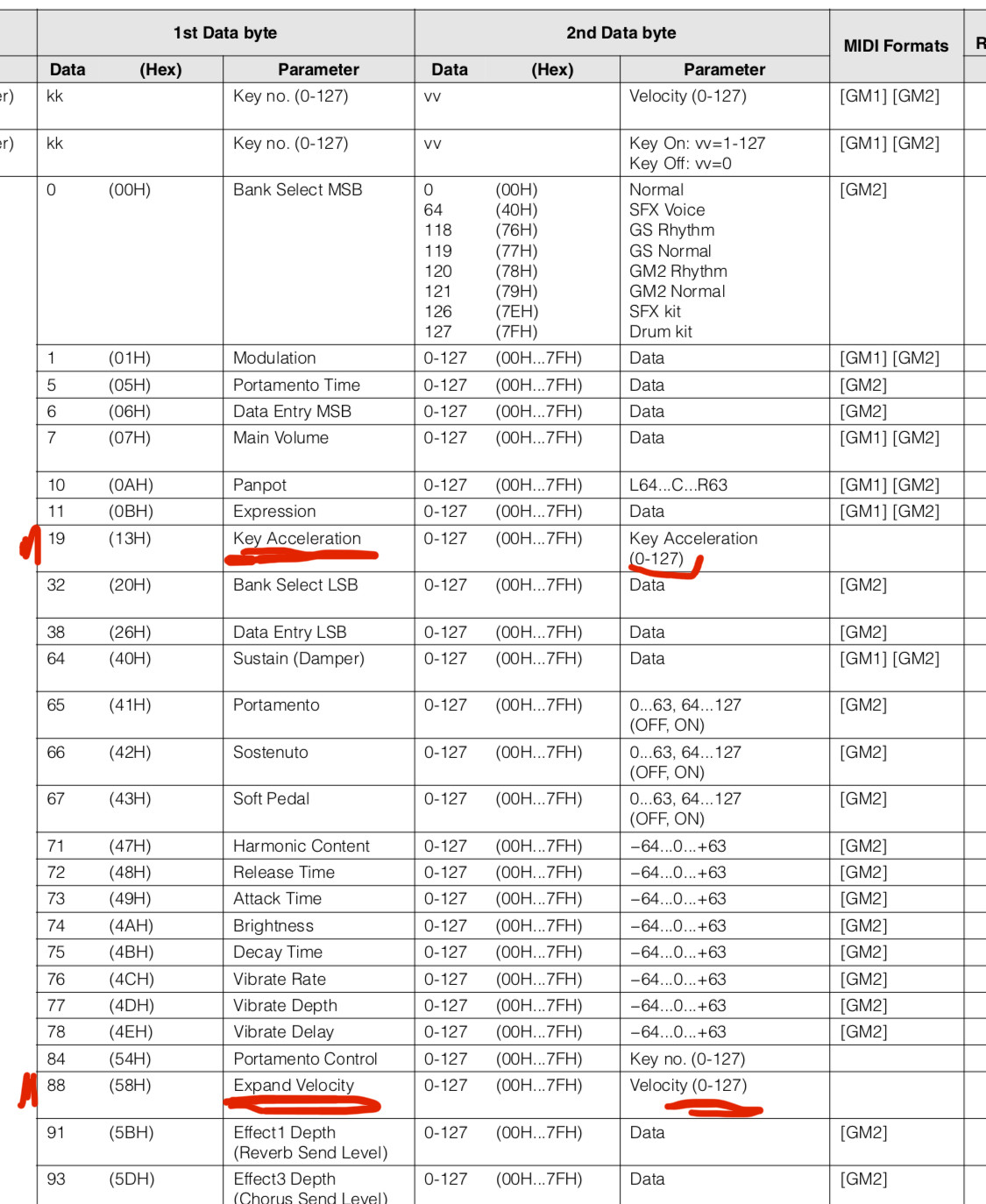
This is mentioned in the MIDI reference spec sheet of the Silent SC3/SH3 & Transcoustic TA3/TC3 models :
https://fr.yamaha.com/files/download/other_assets/5/1784935/ta3_tc3_sh3_sc3_en_mr_b0.pdf
So there are strong evidences that SC3/SH3 are sending midi events containing the 2 components of Grand Expression Modeling, namely “key acceleration” and “expand velocity”.
Some precisions of a CLP785 user on Modartt’s forum (CLP785 sharing the same specs as SC3) :
https://forum.modartt.com//viewtopic.php?id=5897&p=2
Yamaha CLP785 records them (extended velocity with controller 88 and touch acceleration with controller 19) and transmits them through midi (I receive them on Cubase, and I can read them too in the midi files I recorded with only the CLP).
Only 7 bits per controller is used (128 values possible), so we have 14bits velocity and 7 bits acceleration, which is 21 bits of resolution per key touch (2097152 values, or more than 2 millions).
With hours of recording, I checked, all 14 bits of velocity are used, and all 7 bits of acceleration are used.
The acceletation seems to have more frequently the lowest, middle and highest values, which I believe are the most negative value, 0 and the most positive value.
I can tell the difference, and the nuances are really really great to hear.
One question from a non-engineer guy… If the distance from the key to the sensor is roughly 1cm when at rest, and the distance from the same sensor to the neighboring key at bottom is roughly the same 1cm, how can this system prevent crosstalk between keys? Is the induction strictly axial (ie, vertical detection more sensitive than lateral?). Do they only measure speed and acceleration in the last couple of millimeters before bottom? If so, is this suitable for playing "above escapement"?
Very good question I asked to myself also (you are not so “non engineer” as you may claim).
Well, I am purely speculating here but I would say :
Now you are about to think : okay, easy with playing just 1 key. But what if there was an interaction between 2 adjacent keys ? Induction of key#1 should interact with induction of key#2 and vice versa ?
So : I tried to play trills of 2 adjacent notes, deeply and shallowly, and did not notice any kind of crosstalk that could alter the consistency and precision of velocity measurement. That’s how it is. Well done Yamaha.
I asked this because in the past I also thought about using hall sensors instead of optical sensors, and after a 10 minute breadboard/arduino experiment, I felt it would be a nightmare to calibrate and ensure key specificity. Maybe it ia doable, afterall…
Very interesting topics. I want to install a new silent system on my piano, I will look at Yamaha because ad-silent and co. have not convinced me.
Hi there, I have an 1994 M100 (seems to be pretty much like an U1 produced for the European market with an optical Silent System). Have moved this to the US now, but the Silent System has been acting up (some keys not playing others very loud), and several US technician (Yamaha experts) told me a few years ago <2018) that this is an electric board issue. Now with the new VSH3 option, I am wondering if I can upgrade my system with VSH3 rather than trying to 'repair' the optical one (as I have no idea how - apparently the electrical board is no longer produced).
Do you know if the VSH3 would work with the M100 (M100 is not on the official list of compatible devices - maybe because it is an European and not a Japanese Model)
If you think that VSH3 is compatible, I would be very interested to purchase one.
Thanks in advance for your help
Paulo164 Thank you for this review, very helpful! Just wondering if you've compared the SC2 to SC3? I ask because I'm thinking about purchasing a gently-used C3X TA2 grand piano, and just wondering how the silent sensor mechanisms SC3 - magnetic sensors vs SC2 - optical and gray-scale shutter, compare? Also, does anyone know if TA2 can be upgraded to TA3? I figure they share same controller box (SHx and TAx)…
Thanks,
Scott