vagfilm
dore_m you can just do it in Reaper for free (demo license).
Dore, the Reaper Wizard... No idea that Reaper could do that... Very helpful.

dore_m you can just do it in Reaper for free (demo license).
Dore, the Reaper Wizard... No idea that Reaper could do that... Very helpful.
vagfilm Dore, the Reaper Wizard... No idea that Reaper could do that... Very helpful.
oh, hopefully that midi file was playing the correct C (second from lowest). Just made a midi output of what was left on my screen, and last night I was moving the note around to see how well the velocity increases were in different parts of the KB. In any case, if it's wrong, either let me know or just transpose to the correct note.
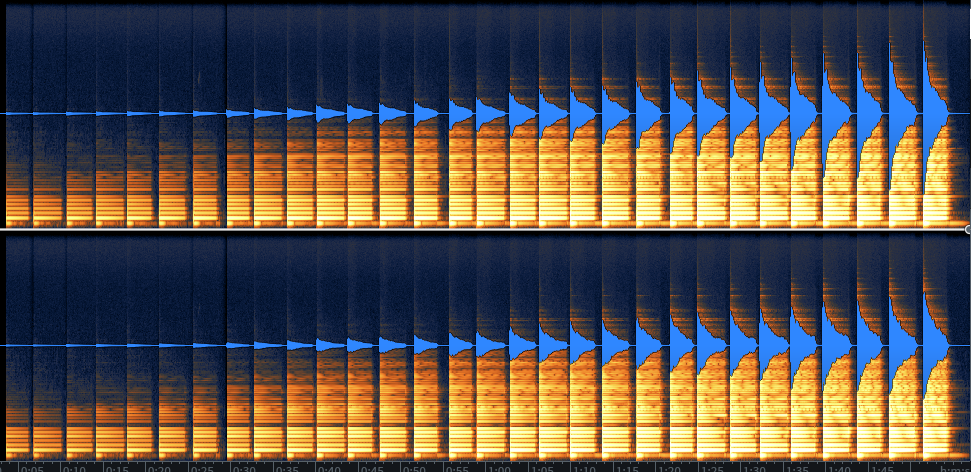
This is the amplitude and frequency plot for VSL Steinway D274 (I was unable to get both traces superimposed, and my spectrogram seems more blurred than yours. And I could not find any setting for spectral analysis in the Preferences). Anyway, for my untrained eyes, both the amplitude and timbre look to have a very smooth progression (with Steinway's unbridled low frequency dominance...)
@vagfilm Post me a wave or mp3 file and I can make a iZotope plot. I'm interested at seeing the vel curve compared to my other plots.
Here is the link to the WAV file:
https://we.tl/t-0B4ha3X3RW
Wow. That's very consistent. I have to ask @vagfilm , is this the default velocity curve? Because I have always thought that the VSL Steinway was especially bright, and you've told me before that a KB's velocity curve needs to be adjusted when using the D274. I can see what you mean, I think. The blue waveform increases more linearly than the others (especially from the midway point to the right). The other libraries are more parabolic. I think normally it should increase parabolically (inverse square law?). I think the graphs show that the loudness and brightnesses increase differently than the other ones.
VSL Steinway:
What I want to see is the VSL Fazioli. I want to see how bright the lowest velocity is - I sampled at around p and not ppp, and I wonder if I could have gotten a darker sound out of it if I had recorded the hammers barely touching the strings.
dore_m I have always thought that the VSL Steinway was especially bright, and you've told me before that a KB's velocity curve needs to be adjusted when using the D274. I can see what you mean, I think. The blue waveform increases more linearly than the others (especially from the midway point to the right). The other libraries are more parabolic. I think normally it should increase parabolically (inverse square law?). I think the graphs show that the loudness and brightnesses increase differently than the other ones.
That is an interesting graph and observations. Why would this be different from those of other VIs?
I'm reconsidering what I wrote. Last night I listened to the audio file that @vagfilm made, and I think he had his MIDI renderer at a slower BPM, so the audio file he provided is X times longer than mine. Thus the curve looks more flat. I still believe that VSL makes their source recordings as true to the instrument as possible, and with a robot, it should be dialed in. I guess that means that the particular Hamburg D274 was voiced particularly brightly.
My math/graphing brain is fuzzy - the MIDI file was time stretched, but the max attack amplitudes should be the same, and then I scaled the graph back to the same size to compare with the others. Should it still be parabolic? I'm flip flopping.
dore_m I think he had his MIDI renderer at a slower BPM
That is probably true because I happened to paste the midi file into an existing 40 bpm track (or maybe even 20bpm...). I was aware of that, but as far as I understand, it will not affect the output: lower bpm only increases the inter-note interval, not the spectral or peak amplitudes of the rendering. So, the only difference is that each note lasts longer. There should be no difference in the linearity of peaks progression.
Its great how I confuse myself. I agree.
@Jose EB5AGV , if you have time, can you render the VSL Fazioli and post a wave or MP3 file for me to analyze? Midi file is up in this thread:
Way back when, you mentioned that my Fazioli wasn't so great in the lower velocity range, and after re-visiting the Kontakt 'coding', I see I left a special EQ for you to darken the lower velocity range (it's bypassed by default). Now I'm wondering if VSL's lower range is just as bright.
This whole discussion is way over my head, but here is your MIDI file rendered with the VSL Fazioli - hope it's helpful:
Thanks for the mp3 jdg78
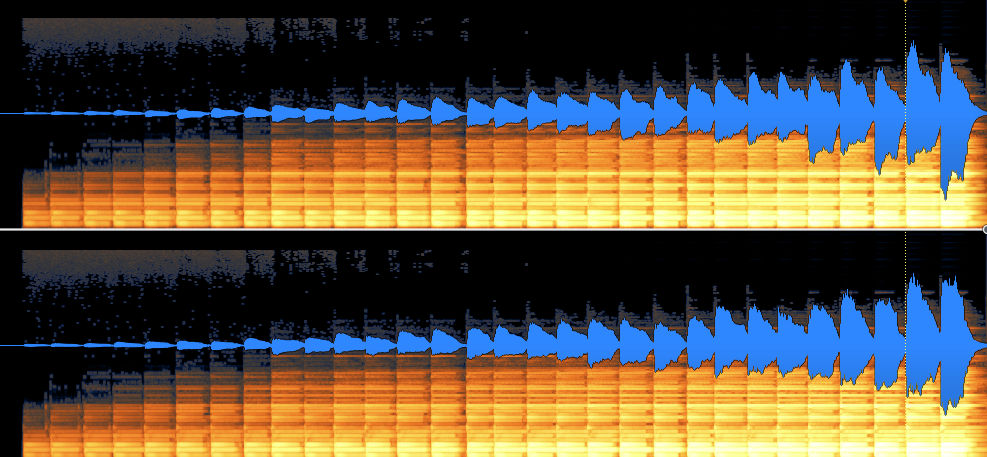
VSL Fazioli:
I'm wondering if the mp3 compression is causing a different spectral profile. There's much more black, indicating either they totally cut out noise (like I do sometimes) or the high frequency noise was taken out by the compression.
dore_m I'm wondering if the mp3 compression is causing a different spectral profile.
Well, here it is as a wav file:
Much better.... I'm seeing that the low velocity is darker than mine, and highest velocity is almost as bright as mine. I'm not sure I mentioned it, but I did not record a ppp layer, I started at about p, so I wasn't sure how dark the sound gets. I'll try myself if I get to the same piano again.
jdg78 One last question - which microphone setup did you use, and where there any EQ's applied? A screenshot of the mixer screen would help, if possible. (Thanks again)
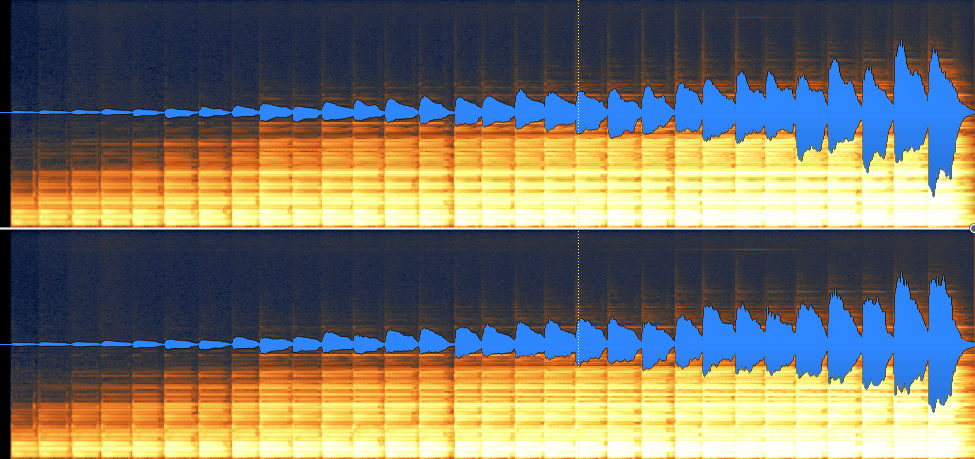
VSL Fazioli wav file:
The first (leftmost) 8 notes of the VSL Fazioli (midi 4 to 30s) show a distinct step-like increase in amplitude (blue trace), that is absent in the VSL D-274. In the D-274 any midi value below 20 sounds the same.
On the other hand, the Fazioli ff range is all over the place and looks like a rollercoaster. VSL guys are so technically skilled that this is probably a piano characteristic rather than a sampling mistake.
Supposed it's much easier to see a change in timbre than to hear it: Its generally all very smooth.
The different timing in midi-file causes the more pronounced fade-to-black at some levels. This pretends a change not really there.
At first i was puzzled by the irregular spikes in forte. I guess it's an phase effect of the sampling. The energy increases but as there is a very pure fundamental the center of the amplitude depends on timing of samples.
@dore_m , did you see similar effects with other pianos?
-Rhodes74
Excellent thread, very nice discussion. I have very small things to add.
dore_m I'm wondering if the mp3 compression is causing a different spectral profile.
Of course it does. The whole point of the MP3 compression is using the "masking" psycoacoustic properties that some frequencies become inaudible when there are other nearby frequencies loud enough. Without doing any math, I think that in these graphs an MP3 file will look like much lower resolution in the vertical axis of the golden plots, and probably more black everywhere that was already dark.
n-player dore_m I have always thought that the VSL Steinway was especially bright, and you've told me before that a KB's velocity curve needs to be adjusted when using the D274. I can see what you mean, I think. The blue waveform increases more linearly than the others (especially from the midway point to the right). The other libraries are more parabolic. I think normally it should increase parabolically (inverse square law?). I think the graphs show that the loudness and brightnesses increase differently than the other ones.
That is an interesting graph and observations. Why would this be different from those of other VIs?
I speculate that's the European vs American style of pianos that the guy from Living Pianos always talk about? I his most explicit video about this topic he says that on one style (the one with the linear curve in this context) the player has to "work hard" to reach higher volumes. On the other hand, that's much easier on the other style (the one with the exponential curve in this context) it's easy to get these higher volumes, but it becomes obviously harder to get to the intermediate volumes, causing a good player to change the "interpretation" rather than fighting the instrument to get a predetermined one.