CyberGene
RIP There are some intriguing things that I would like to learn about it
Like, why it has waterfall keys? 😀

RIP There are some intriguing things that I would like to learn about it
Like, why it has waterfall keys? 😀
RIP Oh, I thought he was Greg! :-P Gonna check his project too.
RIP Do you know what piano that action came from?
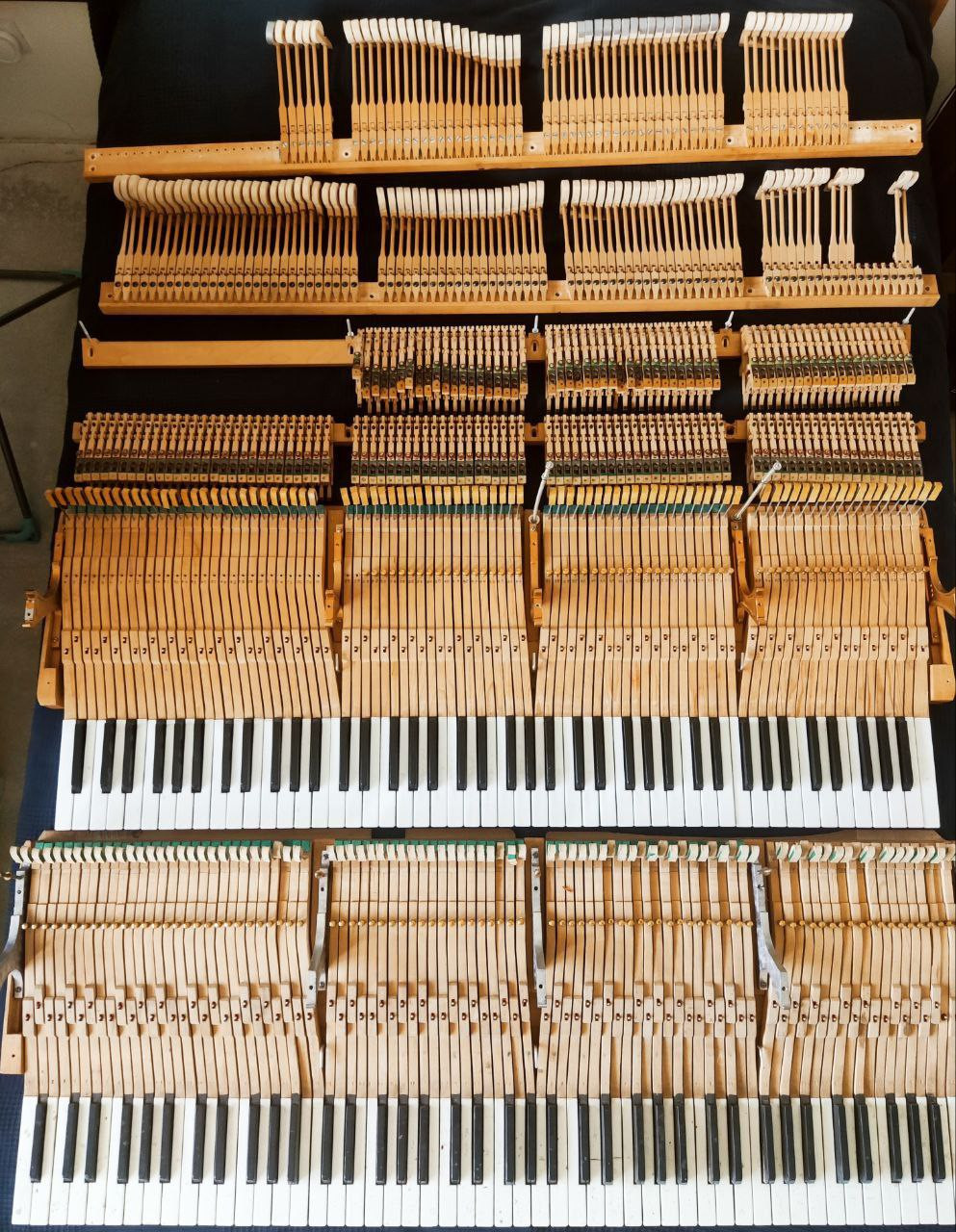
This is a keyboard mechanism from a Red October grand piano. He was missing a lot of pieces and hammers. A year ago I managed to find and purchase another keyboard (slightly broken) from a similar instrument and I thought that they could be interchangeable. I made a mistake. It turned out that the places where the figures were installed had grooves of different sizes. The screws from one tool had metric threads, while the other had inch threads. The fastening of the mechanical parts had different holes in different, non-interchangeable places. The hammers are slightly different sizes. The drums on the hammers are located at different distances from the axes of rotation. This blew my mind, but nevertheless I managed to assemble Frankenshain). Reassembling and adjusting the mechanism took almost the entire fall. This keyboard does not shine with its capabilities. Due to the lack of hammers and mechanisms in the instrument, three upper notes and two lower ones do not work. Still, I'm glad I have it. And now there is an opportunity to look at the sheet music at home that needs to be played at work.
scherbakov.al This is a keyboard mechanism from a Red October grand piano.
That’s interesting. For the last few days Valentina Lisitsa has been teasing about a mysterious grand piano she obtained recently and it appears to be a Red October grand. From the comments she made, there’s a speculation that it’s the grand piano Horowitz played when he recorded a recital at the Moscow Conservatory in 1986. I even read about Red October and its history because I heard the name for the first time. Seems it’s the legacy of a German piano builder who settled in Russia and made some fine pianos.
scherbakov.al This blew my mind,
Yeah, that's pretty common. Before embarking into this project myself, I too thought the pianos actions were all interchangeable. They are not! Even from the same manufacturer, even from the exact same model, there are some adjustments that are not drop-in interchangeable but needs adjustment. Yamaha is an exception, they have very tight tolerance in their process that you can almost replace the whole action from one piano to another (of the same model!!) with very minimal adjustment.
but nevertheless I managed to assemble Frankenshain)
Alright, that explains some of the things that I saw. Congratulations of making it work, that's not an easy feat!
scherbakov.al This is a keyboard mechanism from a Red October grand piano.
CyberGene Like, why it has waterfall keys?
Still I have never seen a piano with waterfall keytops and even a google search for images of R.O. pianos did not turn anything like that. Quite interesting....
CyberGene For the last few days Valentina Lisitsa has been teasing about a mysterious grand piano she obtained recently
I saw that but I have not watched the videos just yet...
Some selection process.. what can be collected from what..
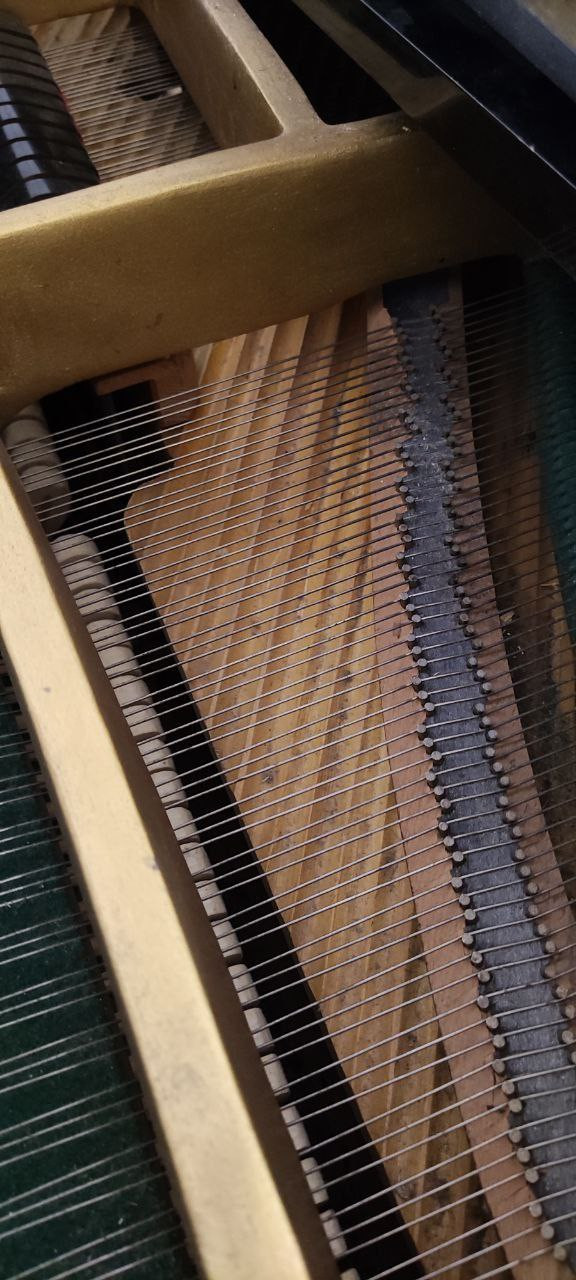
At work, in the corner of the hall, a large old Red October grand piano with an unusual soundboard shape was discovered
CyberGene Seems it’s the legacy of a German piano builder who settled in Russia and made some fine pianos.
Once upon a time they were quite good. But later the pianos were produced in such huge quantities...simply millions, at that time in a collapsing country, and the quality was sometimes like that of a cheap cabinet with strings
RIP They are not! Even from the same manufacturer, even from the exact same model, there are some adjustments that are not drop-in interchangeable but needs adjustment
absolutely right!
So far, it seems to be working somehow..
scherbakov.al Do you have a video?
Melinoe There is only a general review video and it does not explain anything. It is located in the 17th message from December 19 in this branch.
scherbakov.al Oh that is exactly what I was looking for. It seems to work quite well.
"learning how Git"
Did you ever end up starting a git for the project?
Edit: You mean like right above your post? I'm dumb.
Melinoe "learning how Git"
Did you ever end up starting a git for the project?
Please clarify the question. I didn't really understand because of the translation.
Now we plan to add automatic switching on of the power supply and sensors using a relay when the microcontroller is turned on. So as not to pull the power plug in/out of the socket every time. There will also be a migration to the stm32h723 board with a display. It has a slightly higher clock frequency (550 MHz). I have already learned how to connect a display and display information on it. An encoder will also be added to change some settings. So that you don’t have to reflash the microcontroller from the computer every time to change some internal number.
So, some changes:
- moving to the STM32H723 board with a display. The project was rebuilt in CubeIde
- added a display to display some information
- added a relay. Now there is no need to pull out/plug the plug into the outlet
- an encoder has been added. You can adjust some parameters and turn off the piano
- added saving of parameters in non-volatile memory
- added standby mode. When you turn on the piano, it goes to sleep. It is activated by a button on the controller board. In case of inactivity, it turns off after 10 minutes. It can also be disabled using an encoder. Now there is no need to disconnect the USB cable
- an error has been identified and fixed due to which every 8th key sometimes played a slow speed
- keyboard scanning has been slightly accelerated. Now the keyboard scanning speed is more than 300 kHz (~310)
- the light indicates that the speed is exceeded
I like these projects.
Starting from tiny ones that just add a LED strip to show the keyboard splits, from big projects such as the Netherblade.
VSThost I like these projects.
Starting from tiny ones that just add a LED strip to show the keyboard splits, from big projects such as the Netherblade.
Great video with Eric Netherland, thanks for linking it. It is more than just a keytar on a screen. There are some interesting software features. I don't think there is any tactile feel on the screen so it seems one would need to look at the screen 100% of the time when playing.
I have to say that these new-age MIDI controllers knock down limits but seem to struggle to sound "musical", to my ears.
My favourite controllers are the Hakken Continuum & the Linnstrument.
Some of these fancy MIDI controllers seem to promote un-natural hand movements and tension so I would be worried about hand injury.
Some of the footpedals, mice gizmos, and breath controllers get around these issues. The breath controllers for winds seem awesome.
https://www.hakenaudio.com/slim-continuums
https://www.rogerlinndesign.com/linnstrument
Ah, yes, those are great! Don't forget Eigenharp! 🙂
I saw most of these cool things in practice with this guy Antonio Machado - https://www.youtube.com/@AntonioMachadokeyman/videos
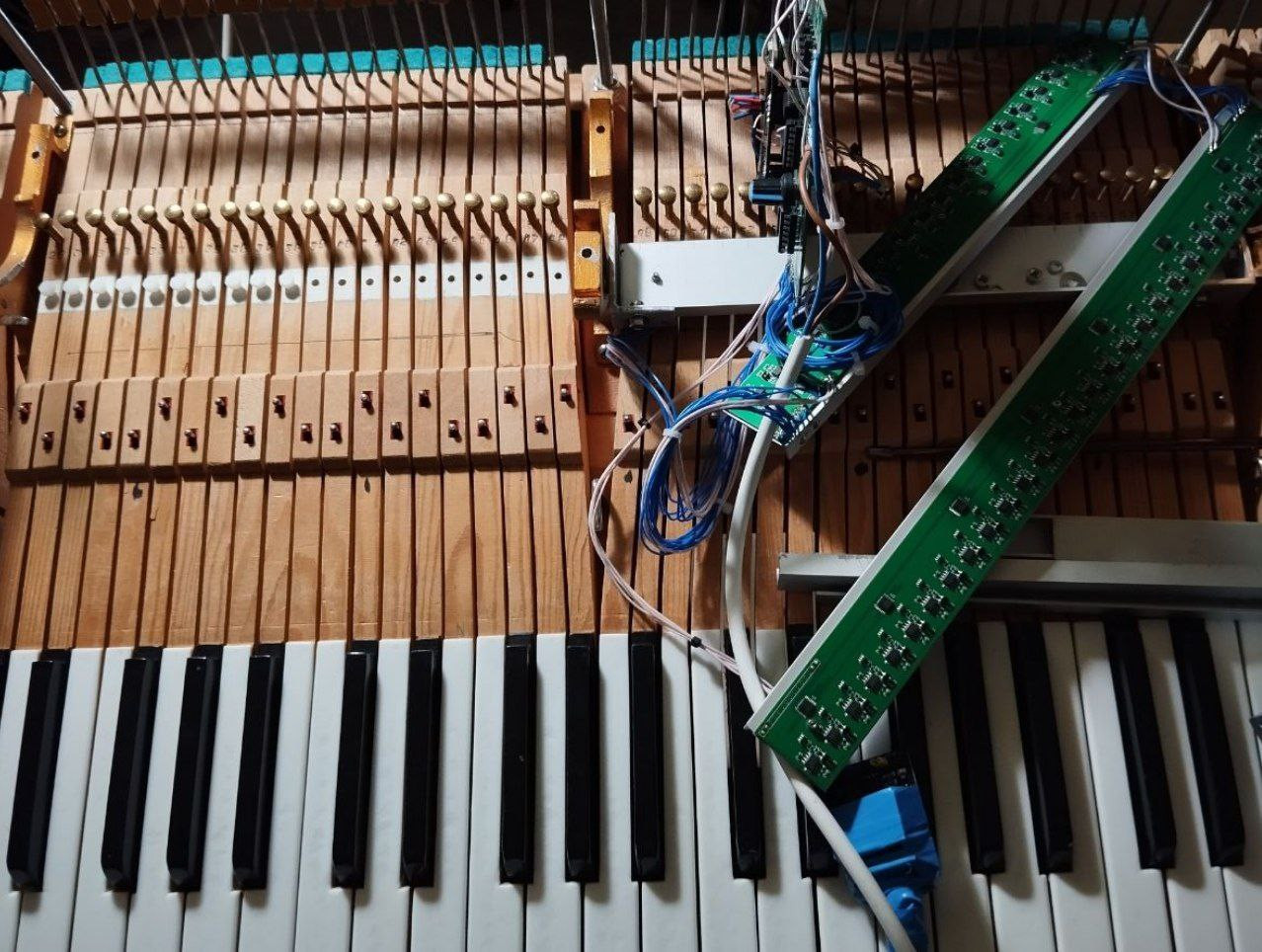
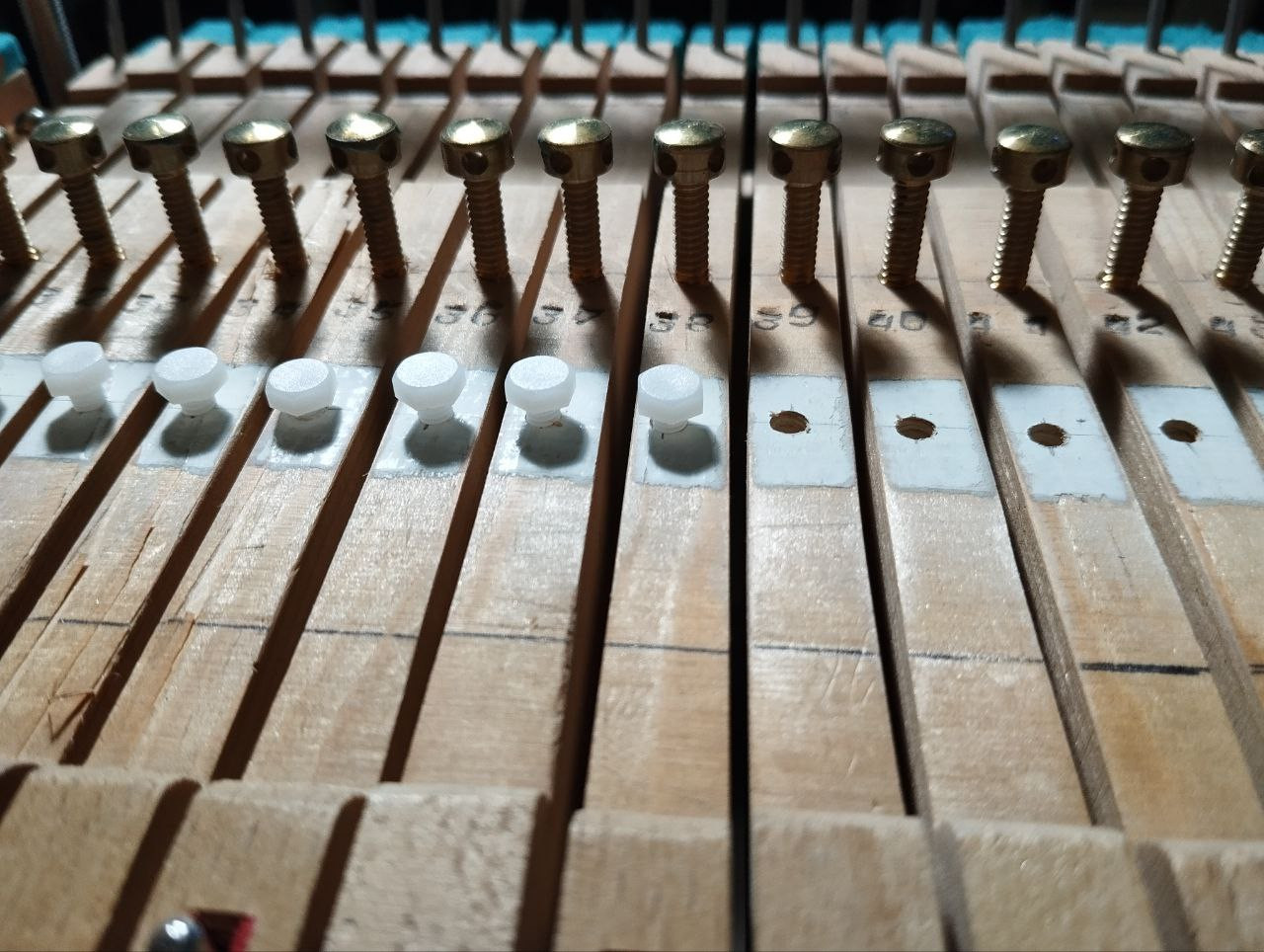
So, it's been a while since I last updated my theme. Overall, the optical system has performed very well for me. I used it to prepare programs for speaking with school students at competitions and exams, and after studying at home, I didn't experience any difficulties or problems when moving to a live piano.I also used Pianoteq at home, and it was surprising how the sensors above the hammers behaved quite evenly and predictably despite not having any adjustable resistors or a calibration system in the circuit. While there may be some unevenness in the speeds between notes if you look closely, it wasn't critical. However, the sensors for the damper system didn't work as expected, and in the beginning, I even painted the areas under the sensors with white paint, but it didn't improve the situation.. Then I added plastic adjusting screws, the heads of which I coated with a patina so that they would not be detected by optical sensors (polyethylene was found to be transparent to the sensors).
In the process of adjusting these screws using a micrometer, it became clear that this did not significantly improve the situation. There is a wide range of parameters in the damping system. Now, I am considering the need to add an automatic calibration system. This would require a revision and extensive redesign of the electronic circuit. I would need to go through the PCB manufacturing process again. However, I am determined to do so. I hope to have a perfectly functioning design in the summer that will meet my expectations in all respects!
I also found another piano mechanic (now there are three in my small apartment). This one has been in use for a long time and needs some felt parts to be replaced and retuning parameters. Unlike previous keyboards, it has all the keys and mechanisms intact. And it's the same brand as my other piano, so all the board sizes are the same.
Another improvement I'd like to make in the future is to have a more attractive and user-friendly screen menu. It's not essential, but I think it would be a nice addition.
Also, it's absolutely necessary to change the aluminum-polyurethane stop rail for a wooden one with a rubber stop for the hammers. A neighbor from the apartment next door complained about the noise of tapping behind the wall, so I think that would solve the problem.
That's all for now. Let's start the new year with fresh plans!
Happy holidays to all!