Skip to content

VSL Concert D 1887 Review

jdg78

David B @jdg78 I know you got a great deal on this piano, even better than my +50% off. How often do you play it now?

I love the 1887 Steinway, and have been using it quite a bit lately. It's got a beautifully warm, mellow tone with just enough vintage character to sound recognizably from a different era, but still modern and versatile enough to work in more contemporary music (as your demo amply demonstrates). The playability is great, the recording is faithful and present, and overall I think it's VSL's strongest piano release in years.

Speaking of which, I've actually been having a bit of a renaissance with the VSL pianos in general recently. I hadn't been using them as frequently over the past year, ever since the Modern D and (more recently) the Korg SGX-2 were released, both of which seemed to offer a slight edge in overall playability. In particular, they felt a little more immediate under my fingers and more responsive in fast passages, trills and ornaments, etc, which is important to me as I play a lot of baroque and classical era repertoire.

However, since the latest Synchron player update about a month ago that introduced controller-specific velocity curves, I've been able to get the Synchron pianos to feel just as quick and responsive under the fingers as the Modern D and Korg. The trick for me was to try a new velocity curve in combination with a boost to the "MIDI response" level and corresponding adjustments to the dynamic range. The difference is extremely noticeable and feels closer to playing a real piano than it ever did before.

I've always strongly preferred the sound of the VSL pianos over the Modern D (which I was never really wild about sound-wise), but now that the playability gap has largely disappeared, I don't really find myself having much desire to go back to the Modern D, as it just sounds somewhat bland and dull in comparison.

I would say the Modern D still has an advantage in that the pedaling feels a bit more natural and they have real una corda samples, but apart from that, I find myself preferring VSL in almost every other aspect. They've even now included MIDI recording and playback functionality within the Synchron player, which is super useful and something that no other sampled piano software (apart from Pianoteq) includes, at least to my knowledge.

I also really appreciate the fact that they are continually updating and improving their products and adding new features at no additional charge even years after the initial release (unlike say, Pianoteq, who expects you to shell out another $50 or whatever it is every time a new version comes out with only marginal changes). It shows a commitment to improvement and level of respect for their customers that I don't think any other major developer matches.
David B

jdg78 I love the 1887 Steinway, and have been using it quite a bit lately. It's got a beautifully warm, mellow tone with just enough vintage character to sound recognizably from a different era, but still modern and versatile enough to work in more contemporary music (as your demo amply demonstrates). The playability is great, the recording is faithful and present, and overall I think it's VSL's strongest piano release in years.

My feeling also.

jdg78 However, since the latest Synchron player update about a month ago that introduced controller-specific velocity curves, I've been able to get the Synchron pianos to feel just as quick and responsive under the fingers as the Modern D and Korg.

Now this is interesting because nothing has changed in the way the velocity curve editor worked before the update besides the input/output being displayed while you run the pointer along the curve line (which is very helpful). Essentially, though, nothing is different. Was it the inclusion of the sample curves that helped or inspired you to tweak your curve?

jdg78 I would say the Modern D still has an advantage in that the pedaling feels a bit more natural and they have real una corda samples, but apart from that, I find myself preferring VSL in almost every other aspect.

I remember you not feeling too impressed with the Una corda samples on the 1887. I can hear the difference in timbre and volume when the pedal is pressed. It's not very dramatic, but it's clearly there to my aging ears. I believe the Una corda samples are authentic and not an EQ effect like on the rest of the Synchron Pianos. Do you think they are not authentic samples?

jdg78 I also really appreciate the fact that they are continually updating and improving their products and adding new features at no additional charge even years after the initial release (unlike say, Pianoteq, who expects you to shell out another $50 or whatever it is every time a new version comes out with only marginal changes). It shows a commitment to improvement and level of respect for their customers that I don't think any other major developer matches.
Agreed. Now if they would just add a sus2 feature - or something comparable to improve string and pedal resonance - like on the Vienna Imperial, VSL would be king of the virtual piano hill.

God Bless,
David


jdg78

David B Now this is interesting because nothing has changed in the way the velocity curve editor worked before the update besides the input/output being displayed while you run the pointer along the curve line (which is very helpful). Essentially, though, nothing is different. Was it the inclusion of the sample curves that helped or inspired you to tweak your curve?

Yes, that's true - all these capabilities technically existed before. It was more a case of me discovering a new way of optimizing them spurred on in part by the new velocity curve presets. Having a bunch of velocity settings pre-loaded in the system allowed me to quickly and easily cycle through a whole variety of different cures that I hadn't really considered before, and I found that some of them (rather counterintuitively) worked better than what I was coming up with on my own.

I also found a user that encouraged experimenting with the MIDI sensitivity setting for optimal resuits. I had previously left the MIDI sensitivity setting alone as I assumed it was just a cruder, less precise version of the velocity curve editor, but I found that adjusting this in conjunction with the velocity curve actually made the touch a lot more precise and responsive than relying on the velocity curve alone, at least on my particular keyboard. All together, these adjustments substantially raised the playability for all of the Synchron pianos, and put them on more of a level footing with the Modern D and Korg engines.

David B I remember you not feeling too impressed with the Una corda samples on the 1887. I can hear the difference in timbre and volume when the pedal is pressed. It's not very dramatic, but it's clearly there to my aging ears. I believe the Una corda samples are authentic and not an EQ effect like on the rest of the Synchron Pianos. Do you think they are not authentic samples?

I was speaking more generally of the VSL pianos as lacking real una corda, and not the 1887 Steinway in particular. The 1887 does have indeed real una corda samples, although I find the effect more subtle than you typically get on a modern grand. Still, I'm very glad they included them, and I really hope this means they will start including sampled una corda on all their new releases going forward.


QuasiUnaFantasia

David B @QuasiUnaFantasia You seem to have a refined taste and are knowledgeable on a broad range of subjects, does this 1887 appeal to you?

A comment such as that one is sure to boost my ego beyond its already inflated level. 😁

I do like the sound of vintage instruments; I grew up with a grand from that same era, and I much prefer the "old" style of sound (actually old styles, because there was more diversity in earlier times). I also like this particular Steinway, but I felt the bass part of the frequency spectrum was too dominant, and I would have wanted the bass equalized somewhat down. Also, you have applied more reverb than I would have done, so there is relatively more of the room to hear and relatively less of the instrument itself, than I would have chosen. All in all, I would love to play that virtual Steinway regularly.

Also, I have to mention that I too am impressed with your playing. It's very sensitive and beautiful.


David B

QuasiUnaFantasia I also like this particular Steinway, but I felt the bass part of the frequency spectrum was too dominant, and I would have wanted the bass equalized somewhat down.

I felt the bass was a bit too boomy as well and that's why I removed the tube mic from the Player surround to stereo preset. It seemed to remove some of that boomy sound. I don't know if you got a chance to hear some recordings of the actual instrument, but the bass is more natural sounding to my ears in the video below. I don't know why that is. Maybe once you lose some of the sympathetic resonance during the sampling process, more of the fundamental is left, and that's why the bass seems a bit more boomy in the finished product? I'm ignorant and I really don't know what I'm talking about but I'm sure there is an explanation for the difference.

God bless,
David


_sem_

David B Now if they would just add a sus2 feature - or something comparable to improve string and pedal resonance - like on the Vienna Imperial, VSL would be king of the virtual piano hill.

Yes I think they could improve by adding a little bit of modelling. In particular, a new string resonance thing that would basically leave the sound intact, just make resonance work 😉 Their current resonance is toned down or off by default, because it wrecks the sound if dialled up to suitable resonance level. The same thing that I was experiencing when experimenting with simple sidechaining of Ptq resonance to other VSTs. They don't even support silent keypress for resonance.

Tweaking the input curve sure improved my VSL experience. I've noticed you've adjusted a few keys individually. I was too lazy to fiddle with this, but have noticed that several of their models would benefit from certain response equalisation, I assume this could be done automatically, perhaps in different ways (I've never experienced such a thing with a built-in piano engine). Otherwise, the playability is mostly okay with me.

It will probably be difficult to get una corda samples to pianos that lack them, but perhaps they could cheat, offer ways to mod the default samples for una corda.

I find the 1887 in the top half of the VSL pianos I've tried. Synchron B. Imperial would be my top pick (haven't tried the Studio version), followed by the F307. But I've got Modern D and and G.CFX and don't think hoarding piano VSTs makes much sense to me, especially if they're not perfect in all aspects. Will likely succumb come next discount season if they fix these things 😉


Tozen

Lately, I have been enjoying putting the resonance at -10db. It still isn't a contest with Modern D or Pianoteq, but I still like it more than without it. I got the idea from a video that VSL Vincent did.

I 100% agree about the boominess of the bass on the 1887, but I also like the texture added by the tube mic. My current thinking is that the problem can be solved with EQ or an external reverb engine that changes color.

My problem is that I really should be doing all the mic mixing at recording time instead of worrying how it feels to play live... But playing is my favorite part. 😊


David B

_sem_ Will likely succumb come next discount season if they fix these things 😉

Succumbing to the 1887 is like getting cotton candy at the fair. However, the 1887 is a special treat that you can enjoy every day if you want. 🍭


johanibraaten

David B Thanks for the review, it sounds great. I downloaded a demo of the 1887, I haven’t really played it properly yet but it seems like an interesting instrument.


David B

johanibraaten I downloaded a demo of the 1887, I haven’t really played it properly yet but it seems like an interesting instrument.

With the help of David Lai listening to several recordings for me, I've changed my preset slightly to make the piano a bit more forward like a typical player preset. You can download it below. Give it a try and let me know what you think. I favor the Sphere mic for the cleanest sound.

david-2vsynpreset.zip
9kB

God Bless,
David


johanibraaten

David B Thanks, I'll try it out this evening.


jenpal

Thanks for sharing, David B. Your velocity curve seems to work well with my N1X for the VSL 1887. I like your custom mix without the tube, but I also like it with the tube in the default player surround to stereo mix.

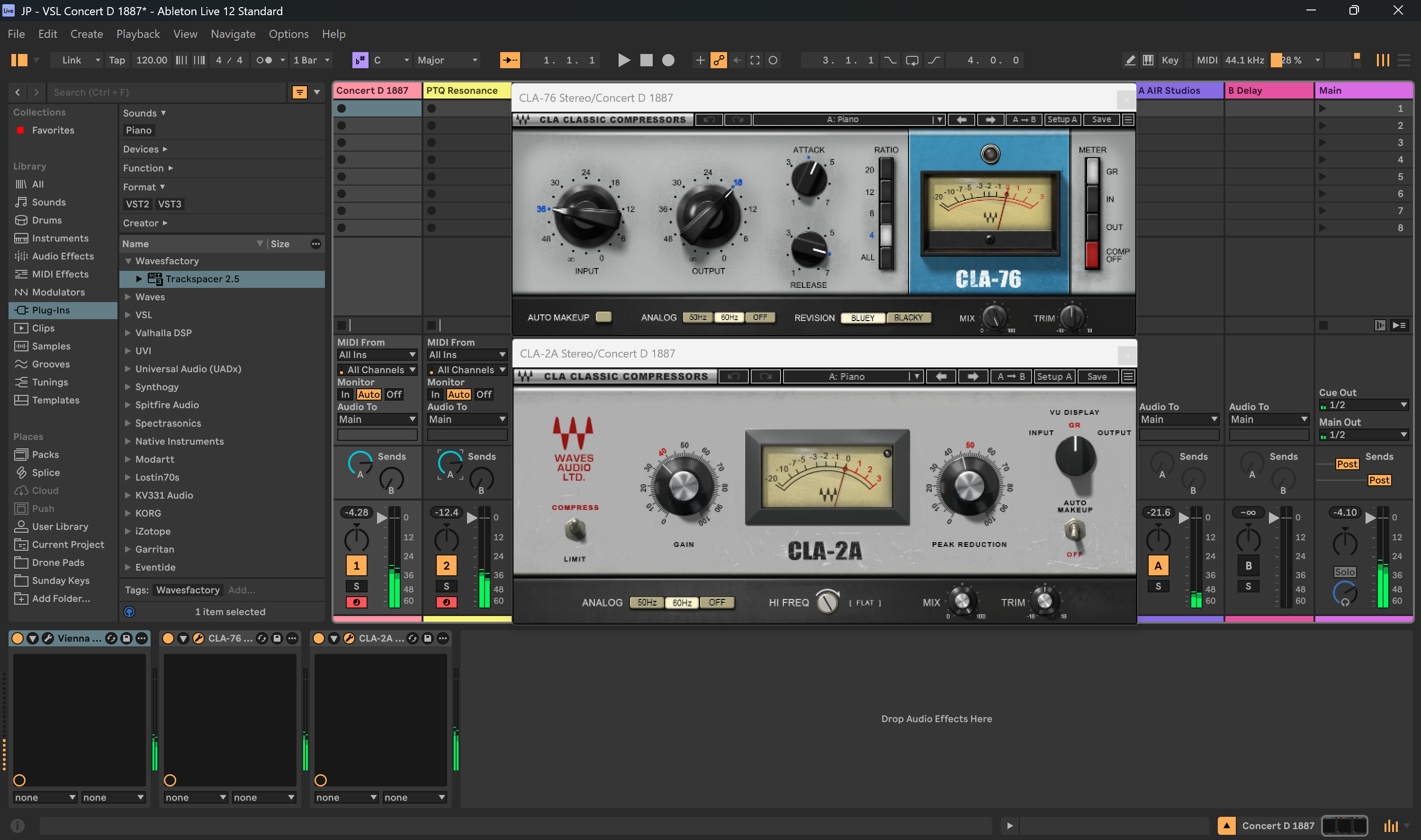
If I want it to move the piano sound forward, I stack the Waves CLA-76 (blacky/bluey) and smoothen with the CLA-2A together. I think these compressors might help reduce the boominess of 1887 and the piano tone seems unchanged, but I can’t be sure as my hearing is not great. Although, these compressors could be more useful when mixing with synths. 🤔


johanibraaten

David B Hi David, I was not able to open your preset in the Synchron piano player. As I understand it it should be possible to drop it on the interface but it doesn’t work, any ideas?

Anyway, I played with the microphones myself and found a mix of the sphere mic and mid2 to work fine for me. I must say I like this piano, and I get some really nostalgic feelings when playing it. I used to be a part of a piano quintette for many years and where we used to rehearse they had an old Malmsjö (Swedish brand) concert grand from around 1900. That piano had the most lovely vintage sound and the VSL 1887 reminds me very much of that piano. I’ll have to play it some more but I can see myself buying it this autumn when (if) VSL have their yearly 40% discount for educators and students😊.


David B

johanibraaten Hi David, I was not able to open your preset in the Synchron piano player. As I understand it it should be possible to drop it on the interface but it doesn’t work, any ideas?

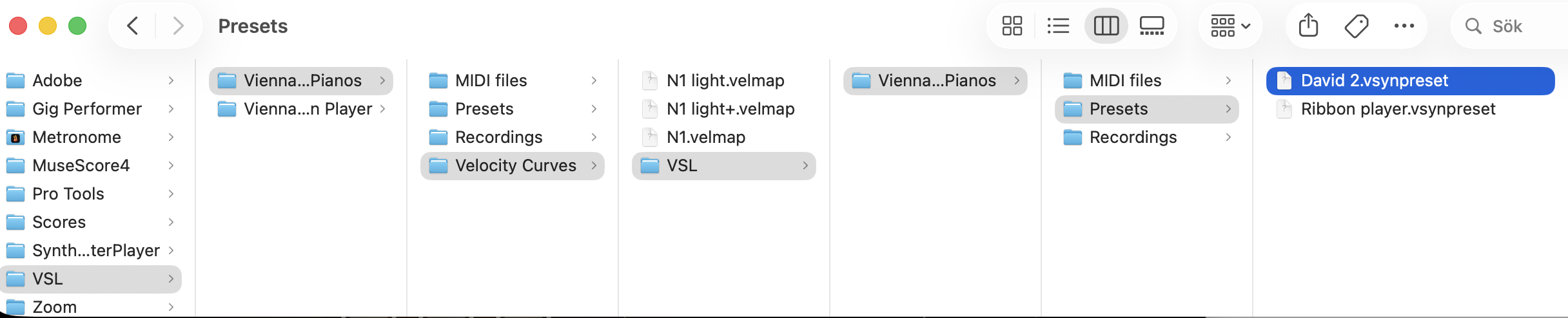
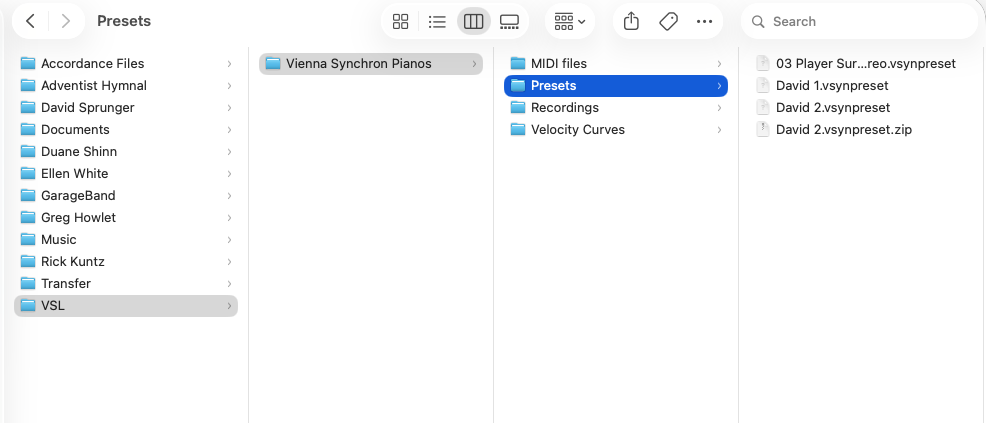
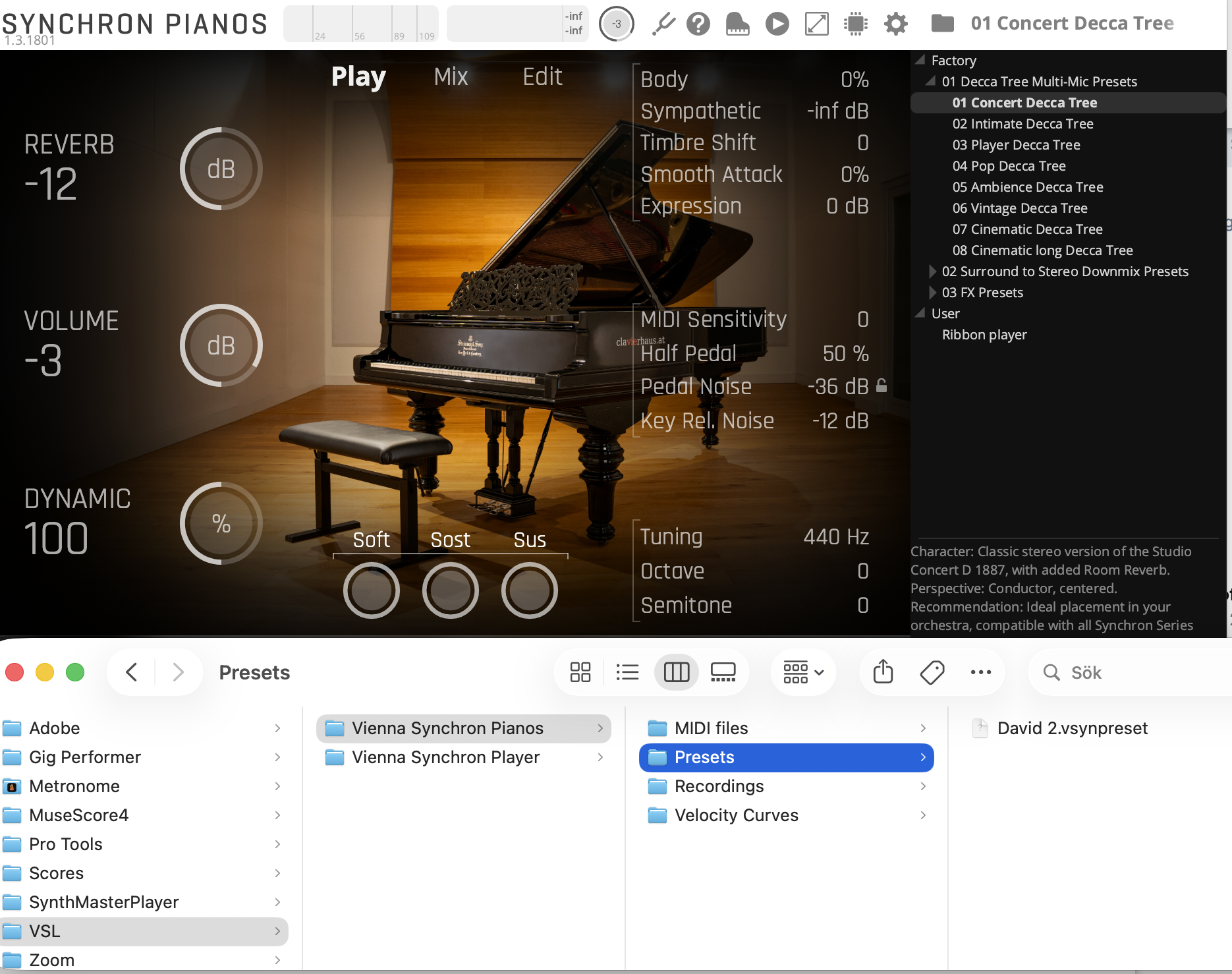
Add it to the folder that VSL creates for presets. The location on my Mac is in Documents and it says VSL. Follow that until you get to presets and drop it in with your other presets. It then should show up in the Synchron Piano player under the user section.

johanibraaten That piano had the most lovely vintage sound and the VSL 1887 reminds me very much of that piano. I’ll have to play it some more but I can see myself buying it this autumn when (if) VSL have their yearly 40% discount for educators and students😊.

I don't have any experience with real vintage instruments so there is no reference point for me. I did own the VSL Bluthner 1895, and while it sounded unique, I found the tone and dynamic range limited. I don't find that at all with the Steinway 1887. The tone is unique but contemporary enough and the dynamic range is very impressive. Soft, delicate, rounded tones to blooming, rich overtones. I love it.

God Bless,
David


johanibraaten

David B Add it to the folder that VSL creates for presets. The location on my Mac is in Documents and it says VSL. Follow that until you get to presets and drop it in with your other presets. It then should show up in the Synchron Piano player under the user section.

Thanks, but I actually just did that and it didn't show up. Also my own presets that I've made isn't in that folder and I have no idea where they are located😊 Maybe VSL have changed something in a recent update?


David B

johanibraaten Thanks, but I actually just did that and it didn't show up. Also my own presets that I've made isn't in that folder and I have no idea where they are located😊 Maybe VSL have changed something in a recent update?


johanibraaten

dikrek Thanks but I don't use a DAW for just playing, only the standalone player.

David B Hmm, I did put it in that exact folder and it doesn't show up. And my other custom preset isn't in that folder.....strange🤔


Vlad


johanibraaten

Vlad Thanks, found it! The preset folder has ended up in the velocity curve folder for some reason. I put David presets there together with my other custom preset and now it works. Is there a simple way to restore the default path?


« Previous Page Next Page »