Jay Lane
OlivierW I always use a multi band compressor on VSL pianos. This really helps things. I don't use the compressor in the actual VSL mixer.

OlivierW I always use a multi band compressor on VSL pianos. This really helps things. I don't use the compressor in the actual VSL mixer.
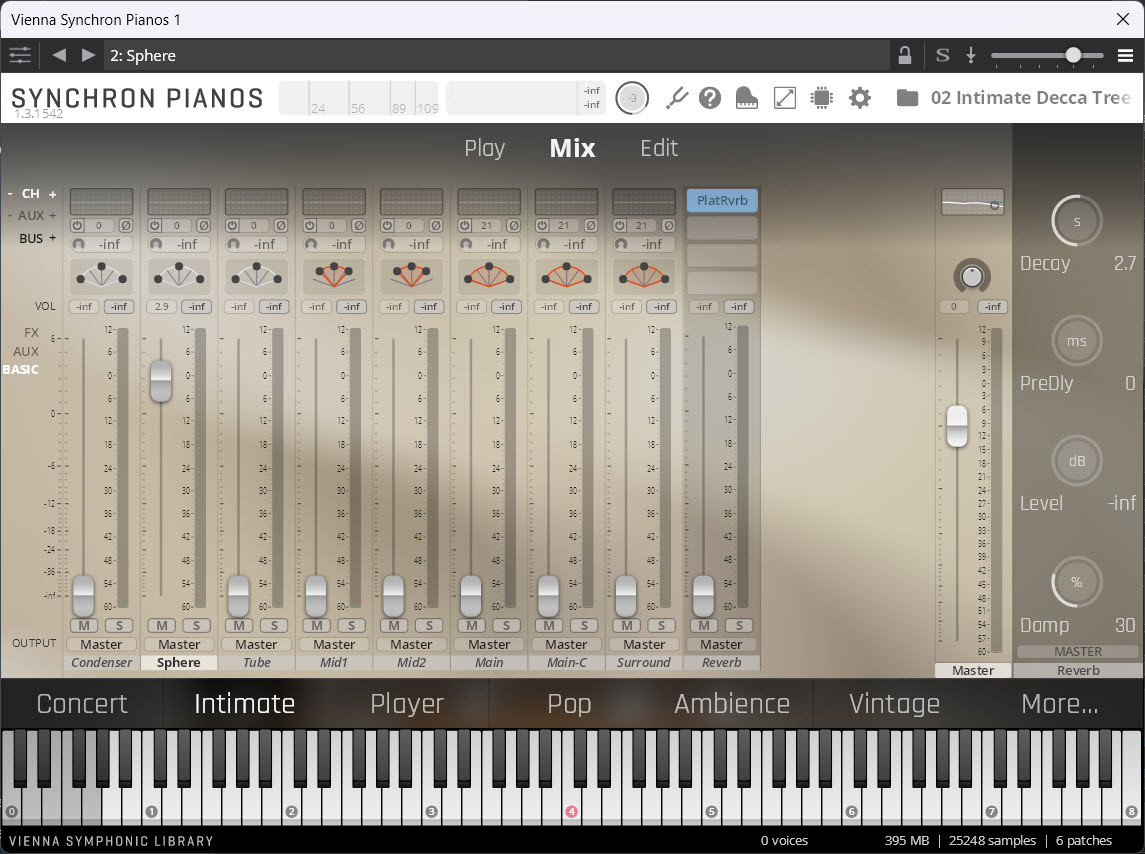
I wish they would change the mic position names. They're all condensers.
We can not mistake virtual stuff for the real ones, modeled, sampled, or AI-trained.
No matter what they do, they can only present similar feelings instead of real physical world.
Pianos are pianos. Libraries are always distinguished from the real stuff. Don't lose our mind.
Jane Wonderful playing Jane. damn it, I had convinced myself to steer clear of another high priced VSL piano but now I will have to get the trial. The timbre is clearly gorgeous and I love the intimate sound. In my case I’ll be testing for dead notes which I feel are present in most of the VSL pianos I own. It does sound like they may have finally gotten their act together in terms of piano preparation and recording. Out of curiosity Jane, what model MIDI controller are you playing, which 1887 presets are you using, and did you make any adjustments (vcurve, note editor…)?
JonFromMaine Wonderful playing Jane. damn it,
Oyyyy... Thanks for the undeserved praise, Jon. My casual sit down was so sloppy I hesitated to post it. But it isn't about me... it's about the piano. I did use una corda in a few places (like the chords in the sans lourdeur section).
I've played with the VSTi a bit more. At this point I don't think I'll be putting $400-ish into it. For me, it would be more of a character piano than an everyday driver. Others may agree with my mother, who often told me that my taste is only in my mouth 😉
If I have time tomorrow or Thursday I'll try to post a recording of just a few chromatic scales so you can get a better sense of the naked notes.
You asked about settings. I've previously posted a mishmash of screenshots but I'll post below what I used for the uploads.
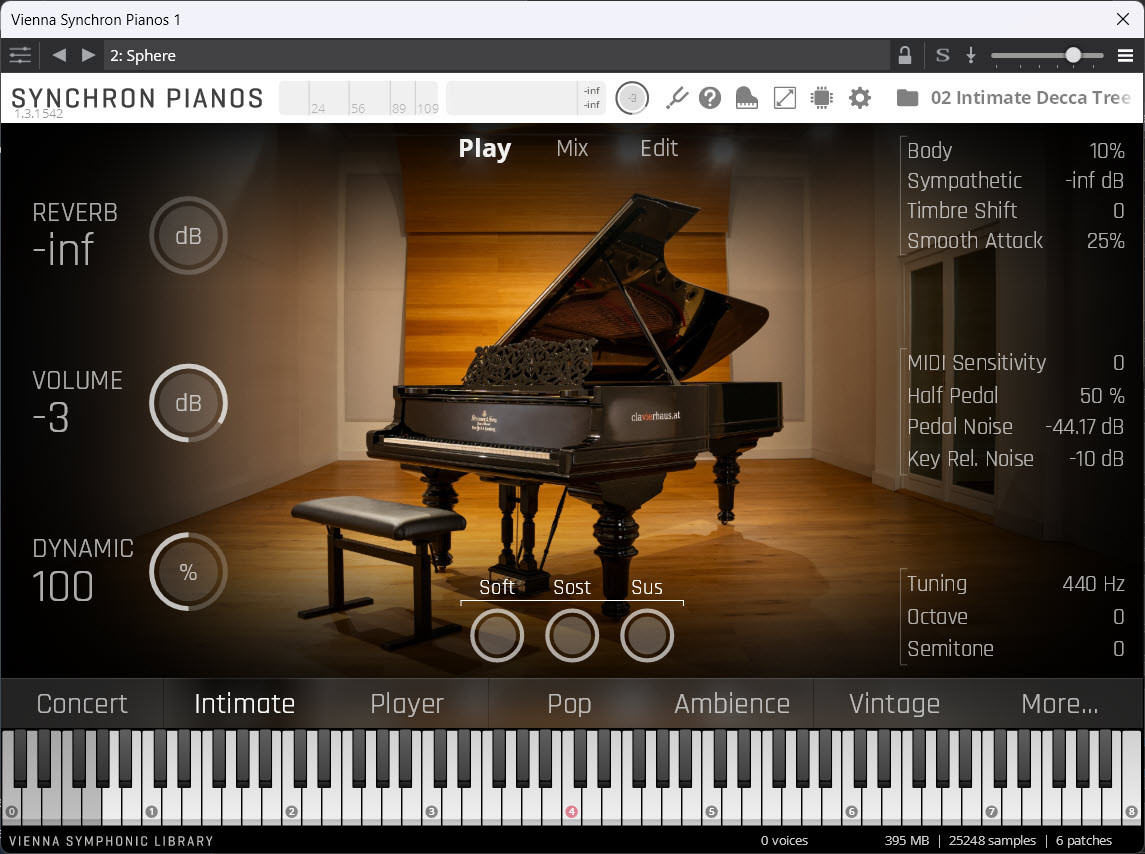
I originally started with the "concert" setting. After that, @clavierhaus remarked that I had uploaded mono recordings.
The "concert" setting changes the width and orientation of the close mics (the red and black lines and dots at the top of the fader in one of my earlier screenshots) and the first things I posted did sound mono.
I removed those original recordings and re-uploaded with the settings shown below. I started with the "intimate" preset and then killed all mics but the one I was demoing, and killed all reverb.
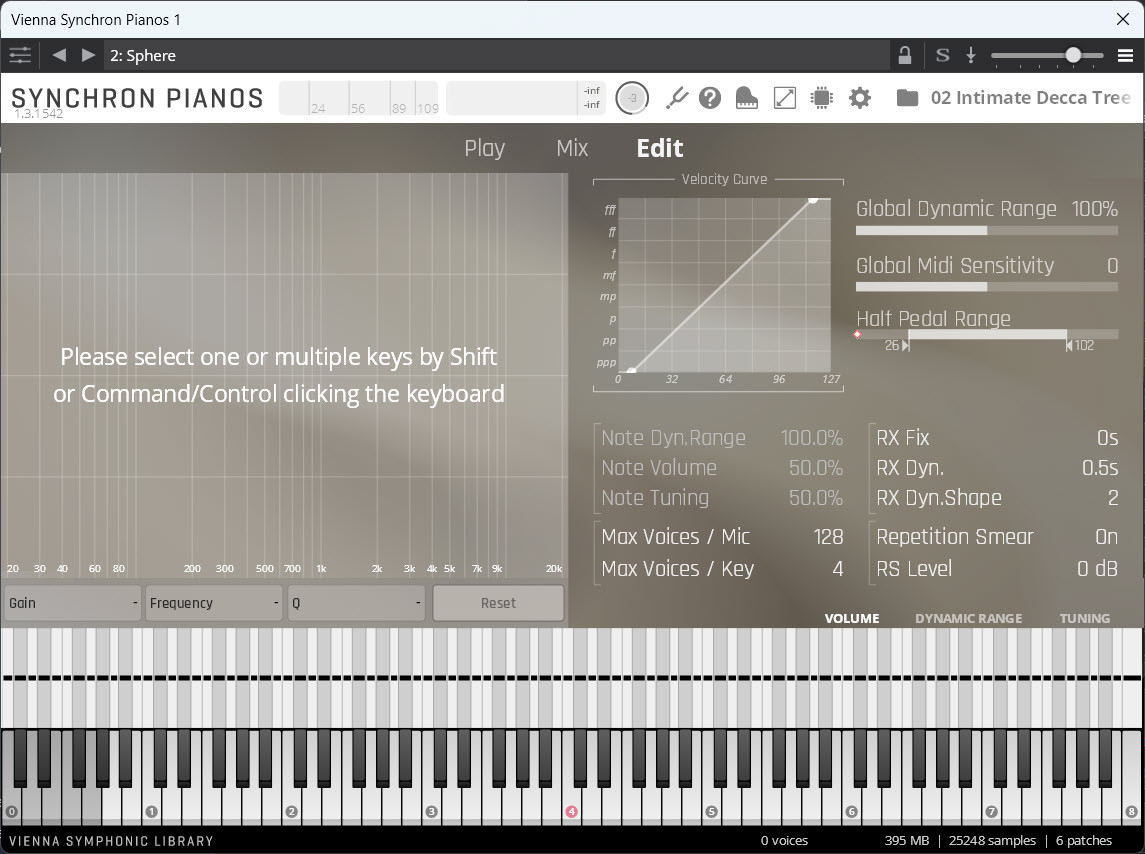
My controller is an N3 (not N3X) which doesn't put out the full MIDI range, so I squish the velocity slope a bit at the top and bottom, as shown in one of the screen shots.
No per-note editing. No EQ. Recorded into Audacity and normalized the audio to -2.5db.
Hope this helps.
CyberGene It doesn't work exactly like that. It's only the loud attack portion of a note that has enough energy to excite the open strings (when all dampers are open). However, if you first play a note without the damper pedal and hold it and then press the damper pedal, the resonances will be much lower, especially if you pressed the pedal after the attack portion. In practice you might not even hear them once short time has elapsed. Just switching from the non-sustain sample to the sustain one is wrong and will lead to audible artifacts.
This works very well in Vienna Imperial. It's not an immediate transition to the pedal-down samples. The note "swells" like it does on a grand. It's quite subtle, but audible. If you touch the soundboard on a piano you can always feel vibrations as long as the sound is audible, and they'll excite the other strings as long as a note sounds. Vibrations are transmitted to all the strings whether the dampers are used or not -it's just that you can't hear them with the pedal up. In real life it takes a short while for the other strings to "catch up" when the dampers are lifted.
Incidentally, on some pianos the strings are never fully damped as the dampers are quite light. Staccato notes are just as short, but there's a tiny reverb tail afterwards. Old Bechstein grands are known for this. Duplex scaling on modern pianos has a similar effect, where the undamped pitched parts of the string ring out slightly after the note is stopped. A piano without duplex scaling and with heavy dampers can sound very dry. Duplex scaling can sometimes cause a dissonant whine. I often hear this on performances of Beethoven's Op.111 during the trills.
Jane Thanks Jane. This info is perfect! I’ll be trying this on my NV10s. If it sounds anything like what you’ve posted I’ll be happy.
Thanks for your contributions to this thread and the great playing. Interestingly, I ended up in a similar place to you. For the recording I want to do, this instrument has more character/vintage sound than I want for modern music but not as much as other instruments in the VSL library when I want to go wild on character. I love the German Upright, which is also an older instrument.
As such, the main reason I would want this is that it is beautiful on its own merits and the romanticism of the vintage and well-preserved instrument is lovely. I try to limit myself to one VSL piano per year, so I will revisit next year. For this year, I decided to spring for the Fazioli 308.
Having said all that, this instrument was a treat to try out. I can see why that blend of pristine sound with some vintage character could be perfect for some users, and the playability is fantastic. In my opinion, it is a much more balanced pick for general application from the studio series than all the other studio pianos except maybe the Bosendorfer 280vc, but that instrument is so bright in comparison that it comes down to which tone you like more. There aren't any genres that would sound bad on this instrument with the right present and reverb engine, and it adds its own charm and magnificence.
Paul/team, if you read this, please don't do the massive 50% deal before the new release next year lol. I feel like I missed out, although I love supporting the company, so not a huge deal. 🙂
Jane I'll try to post a recording of just a few chromatic scales so you can get a better sense of the naked notes.
This is quick. I tried to be even but obviously my touch is not.
Single chromatic notes and octave chromatic, with each of the three close mics.
Jane Thanks for this Jane. The chromatic note recordings should be very helpful for anyone who hasn’t installed and is curious about the existence of VSL piano dead notes.
Reddit Ask Me Anything with Paul Kopf and me.
CyberGene I didn’t mean there’s no resonance at all 🙂 But I’ve tested this on real pianos and after the initial loud attack, the excitation energy and the resulting resonances are rather low.
I did think there was no resonance at all, because I didn't hear it when I raised it from default -Inf to 0 dB (which I'd expect to be a "normal" level). But recently I installed the Fazioli studio demo and found an "easter egg", there is sympathetic string resonance after all if the knob is raised to +10 dB 😉
Is there a trick to make the key produce no sound if pressed very slowly? Moving the bottom-left point of the input curve doesn't seem to work.
_sem_ Is there a trick to make the key produce no sound if pressed very slowly?
https://forum.vsl.co.at/topic/55281/feature-suggestions-for-synchron-pianos
https://forum.vsl.co.at/topic/60430/silent-key-still-sounding-in-synchron-pianos
https://forum.vsl.co.at/topic/48702/synchron-piano-sympathetic-resonance-and-silent-key
https://forum.vsl.co.at/topic/53025/missing-silent-key-function
https://forum.vsl.co.at/topic/58779/synchron-pianos-silent-key-press-and-sympathetic-resonance-how-to
What would you consider the appropriate level of string resonance that would match the real instrument?
It appears to me that the expected effect of already faded, still pressed key an octave higher, is when the resonance is somewhere around +10..+20 dB. However, the overall sound with the resonance setting that high appears degraded (as if we're somehow getting a double dose of resonance, one in the resonance effect and another already recorded in the samples without the effect).
Good morning All, I hope you will be able to help me.
I just started using the demo of 1887 studio. I love how it starts so quickly and the interface is very straightforward.
Coming from Pianoteq and then Vi Labs Modern D I am used to "too perfect" instruments and that's likely why I love this humanity/fragility of the 1887. However, when I press heavily the keys, I get quite a metallic sound. Particularly true for the D5 note. When I play piano, this unpleasant tone disappear. It a bit like a very light coin was lying on the string.
Because there is something I very like in this piano, I would like not to give up too soon and would be happy if you could explain to me what happens.
Thank ytou so much for your help.
Given C4 the middle C, I've found annoying D6 in many sampled pianos. Maybe it's the issue of my humble speakers. I tried to switch left channel to right channel. The distortion seems to disappear. Not all virtual pianos provide player and audience flap options. I have to do manually and exhange the position of my speakers as well. So, again that's bottom on the left and top register on the right. I only let Garritan CFX always sit in audience position ‘cause I feel that's more natural for my ears.
One thing left, VSL has a "Body" percent option on UI. Maybe that could fix a little bit.
Florian75 However, when I press heavily the keys, I get quite a metallic sound. Particularly true for the D5 note. When I play piano, this unpleasant tone disappear. It a bit like a very light coin was lying on the string.
I also notice the metallic coin-like sound on the D5 note. However, it doesn’t bother me when playing, and perhaps this is the vintage character of the piano, making it sound slightly imperfect.
Florian75 However, when I press heavily the keys, I get quite a metallic sound. Particularly true for the D5 note. When I play piano, this unpleasant tone disappear. It a bit like a very light coin was lying on the string.
Hallelujah ratamahatta!
I also notice the metallic coin-like sound on the D5 note.
perhaps this is the vintage character of the piano, making it sound slightly imperfect.
Nothing "vintage" here, it is just rattling (from symph. vibration) of the equipment caused by loud sound.
All sample libraries suffer from such problems. All of them!
I noticed that VSL has an audio export feature, which is quite handy. I’m not sure if this is new. I recorded some Christian music using the Concert D 1887, and I think the quality is great without needing mastering through my Ableton Live.