Skip to content

A brand new Steinway from VSL: 1887 model D concert grand

clavierhaus

Jane I am not sure how you recorded those three pieces, but what I am sure about is that all three of them are monaural recordings - unless my headphones went the way of the Dodo all of a sudden.

This is not how you I hear the 1887 D - and I play on it every day, listening with two ears.


Jane

clavierhaus Let me see if I can figure out what happened in my rendering.
Thanks for waking me up 😉
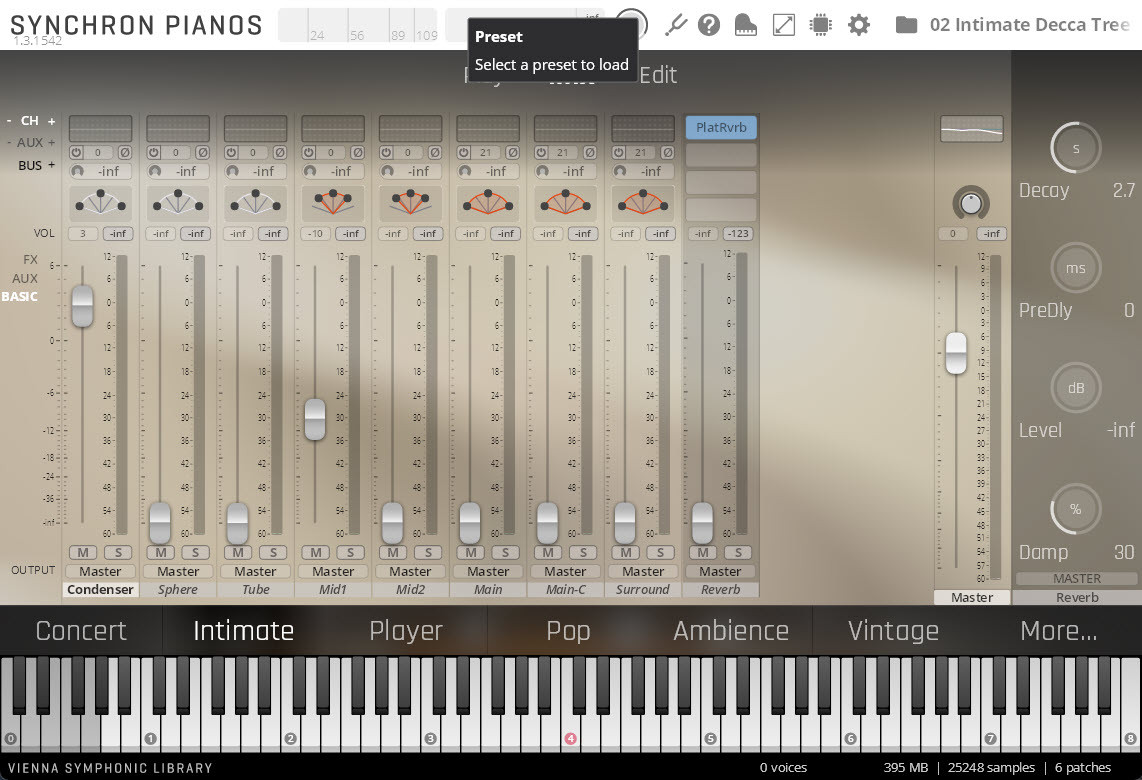
I started from a "wrong" preset to represent the mics correctly.
Notice in my third screenshot that above the volume slider, the phase dots are in red.
I'll try to correct that and re-upload.


Jane

I'm not allowed to edit my prior post.

OK.
Here's a link to re-uploaded tracks.
I had started from the "concert" preset in VSL, not noticing that the mic phase setting is tweaked (observe the three red dots above the Condenser fader in my previous post).

As Clavierhaus pointed out, it sounded like mono.

I've re-uploaded the tracks. Note that the phase setting is not reversed and is set to full wideness in the screenshot below.


David Lai

Jane I like the Sphere and tube mics a lot, but sadly, they're not in the standard library. My least favorite is condenser…


Jane

David Lai I like the Sphere and tube mics a lot, but sadly, they're not in the standard library. My least favorite is condenser…
My preferences are the same as yours, David.

I confirmed on VSL's website.
The 30-day demo comes with everything.

Standard includes Condenser (Close 1)
Mid 1
Decca Tree Stereo
Decca Tree Mono

Full adds
Sphere (Close 2)
Tube (Close 3)
Mid 2
Main Surround


David Lai

Jane Great, thanks for letting me know, Jane! 🙂


pc-king

clavierhaus As a classically trained pianist, I regularly use the sustain pedal. Amazing. Therefore, it's important that the correct samples are played. So if I release or press the sustain pedal while holding down a key, the other sample must be switched to. This isn't a nice-to-have; it's absolutely essential, like the half pedal. I understand that you're proud of your work, but unfortunately, since Modern D, the product has ultimately become outdated and uncompetitive. Given that these deficiencies have been reported to VSL for years, it's astonishing that such a product is being released now.


Tozen

Jane

That was great! Thanks. I really like the sphere mic as well and hope it is used on future products. It is wide and enough and full enough to enjoy on its own, whereas I feel like the other ones require additional mics. I continue to dream of a day when we can pick and choose mics we want in a custom package. The pricing continues to be the biggest obstacle for these libraries.


David Lai

Tozen And the best mics are in the more expensive option, that's to be expected… Yeah, if I could choose, I'd just get one of the mids, and one of the close. That's it. 🙂


CyberGene

pc-king Therefore, it's important that the correct samples are played. So if I release or press the sustain pedal while holding down a key, the other sample must be switched to.

It doesn't work exactly like that. It's only the loud attack portion of a note that has enough energy to excite the open strings (when all dampers are open). However, if you first play a note without the damper pedal and hold it and then press the damper pedal, the resonances will be much lower, especially if you pressed the pedal after the attack portion. In practice you might not even hear them once short time has elapsed. Just switching from the non-sustain sample to the sustain one is wrong and will lead to audible artifacts. This is one particular behavior where Pianoteq is apparently better (or even some digital pianos with modeled resonances such as the recent Yamaha pianos, maybe Kawai too). But IMO, switching from non-damper to damper sample should be done only if there's a re-pedaling immediately after the note is played. Half a second later and it better stays with the original non-damper sample, that would be more realistic than switching to a full-blown damper pedal sample.

The opposite: playing first a note with the damper pedal, holding the note with your finger and then releasing the damper pedal, is a valid case where the samples can be switched though.


pc-king

CyberGene "It's only the loud attack portion of a note that has enough energy to excite the open strings (when the damper is open)." No.


pc-king

CyberGene "Just switching from the non-sustain sample to the sustain one is wrong and will lead to audible artifacts." Yes, that would probably be too easy.


QuasiUnaFantasia

As the amplitude of the string is lowered, the energy in the high frequency part of the spectrum is lessened. Therefore strings associated with higher frequencies are excited less by lower amplitude signals from a struck string.


pc-king

CyberGene The pedal resonances and their implementation in Modern D sound very good to me. So it's kind of possible.


CyberGene

pc-king I didn’t mean there’s no resonance at all 🙂 But I’ve tested this on real pianos and after the initial loud attack, the excitation energy and the resulting resonances are rather low.

As to Modern D, I’m wondering if they actually switch samples or use some other way. I sold it already and never really got to know it in depth, does it support string resonance (as an effect probably, not to be mistaken with damper resonance)? I think there was a checkbox? If so, maybe that’s how they do it.


pc-king

In 20 years, we'll certainly have over 100 velocity levels, and 100 release samples for each of them, for the various release points, the same for half-pedal. That's already 1.8 million samples. Additionally, there are resonance samples for each key, which the software mixes in when that key or the sustain pedal is pressed and another one is struck that generates resonance (octave, fifth, etc.). Again, for 100 velocity levels. Another 88*30(?)*100, a total of at least 2 million samples. That'll be great; it could certainly be automated, and the recording session would then take a few years.


pc-king

CyberGene If I remember correctly, the resonances in Modern D are artificial, but still quite realistic.


pc-king

Long story short: As a physicist and pianist, I claim that Modartt’s approach is a dead end.


OlivierW

In VI Labs Modern D, the sustain pedal effect is not achieved by triggering separate “pedal down” sample sets, nor by switching between samples. Instead, it’s designed more realistically — only the sustain resonance has been captured and is added dynamically when the pedal is pressed, including true pedal transition effects both between pedal-up and pedal-down and between pedal-down and pedal-up states.

This is something the VSL software cannot reproduce, as it follows a completely different approach. UVI’s programming for VI Labs pays close attention to the fine details of how a real piano behaves, down to the subtleties of pedal interaction and sympathetic resonance.

Speaking of which, the sympathetic resonance in Modern D is outstanding. Everything in a real piano is about resonance — and a well-programmed piano doesn’t need to be drowned in artificial reverb to cover up design flaws. Another well-designed virtual piano is the Garritan CFX, although in that case, the sympathetic resonance is modeled, not sampled — a detail that’s rarely mentioned but very significant.

It’s a shame, because VSL has truly beautiful pianos — excellent recording engineers, and highly skilled piano preparation teams — but their software player hasn’t been developed or updated in years. And when you bring up these realism-related topics with their support team — not about the samples themselves, but about how the software implements them — you often get dismissed. They even treat such discussions as off-limits.

Even something as simple as a silent key option (velocity 0), which would be extremely useful for hybrid pianos, is considered a forbidden subject when talking to VSL support. And if you dare to suggest an improvement or express a different opinion, you’re treated like a black sheep — or even an enemy. It all feels like a lack of humility, which is disappointing given the talent and potential behind their instruments.

pc-king

OlivierW Yes, that's how I've experienced VSL customer service, too. They leave everything as it is, and that's it. If you can't have a professional classical pianist test a product before selling it, you should at least listen to your customers. It's no use promising the moon ("sounds like heaven") or having the product "tested" by amateurs in embarrassing videos.


« Previous Page Next Page »