CyberGene
Khuja Wangtishvili you know him? 😃

Khuja Wangtishvili you know him? 😃
Nope. As we in Bulgaria say (proverb):
"A crazy man knows no rest. He just gets sweaty."
CyberGene However, if you tend to create a lot of unnecessary new threads on the same topic, or post your ideas on other non-related threads, or frequently cause friction with other members, it can be understandable…
This is totally understandable, and truth be told, I’m getting fed up with the trouble-makers ‘round here!
Perhaps we should create a “special” place for them trouble-makers; not quite as bad as hell, but neither cozy as heaven; you know, something in-between……🤔
@PASHKULI I'm dying to know, in your opinion, how should piano keys be designed? Thanks.
God Bless,
David
David B
Pashkuli has a video series on this topic: https://www.youtube.com/watch?v=bs95pJGccNc
It has some very interesting ideas!
I do agree that piano keys are "badly designed" - the "standard size" doesn't fit and are way too large for 50% of the population. And even such obvious improvement is very slow on the uptake unfortunately!
I'm getting quite a lot of marketing emails from Narrowkeys Athena mailing list - which makes me suspect they aren't selling out as quickly as we'd have liked. What if Yamaha, Kawai, Roland, etc have been right... what if the market simply doesn't care?
(I do like to think it's simply a marketing and awareness issue regarding narrow keys, and people simply don't know about it)
I haven't watched the video in great details, I scrolled to the end and just looked at the final proposal. So, I'll be making mostly a few general comments towards this (and any other similar) idea of "improving" the standard piano keyboard.
Hello, pianoclack members and readers!
TL; DR (please scroll down for the links to my 'Google Drive' repository and my YouTube channel)
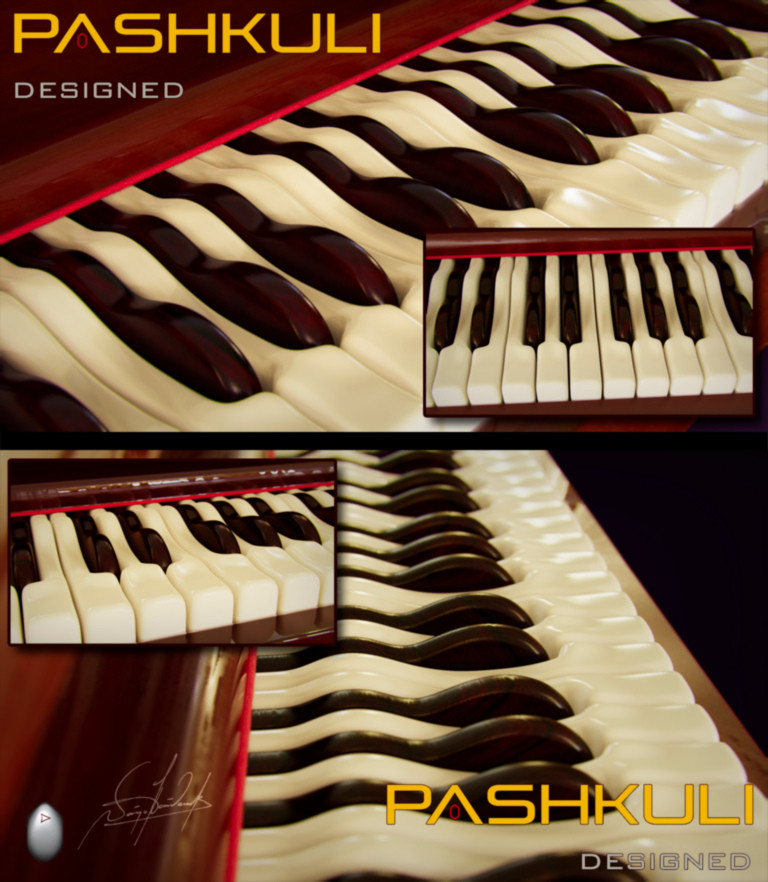
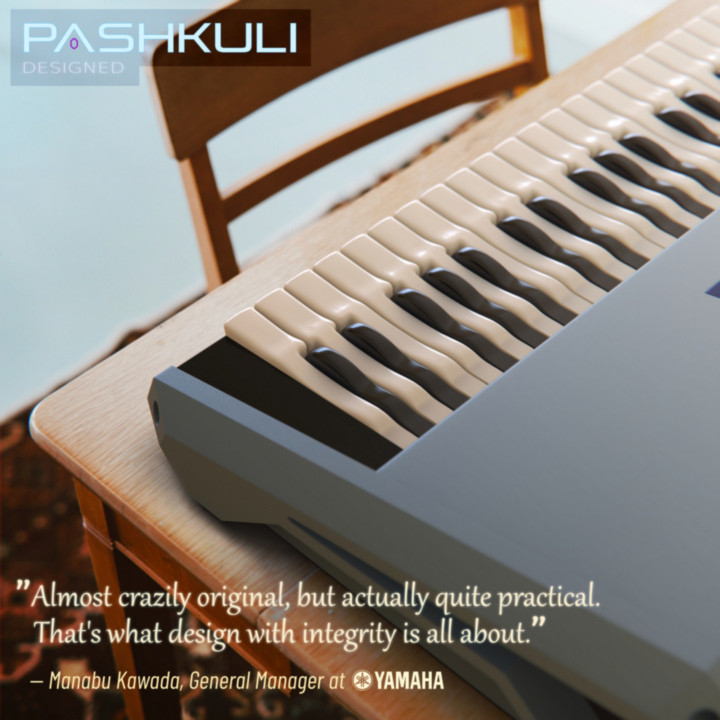
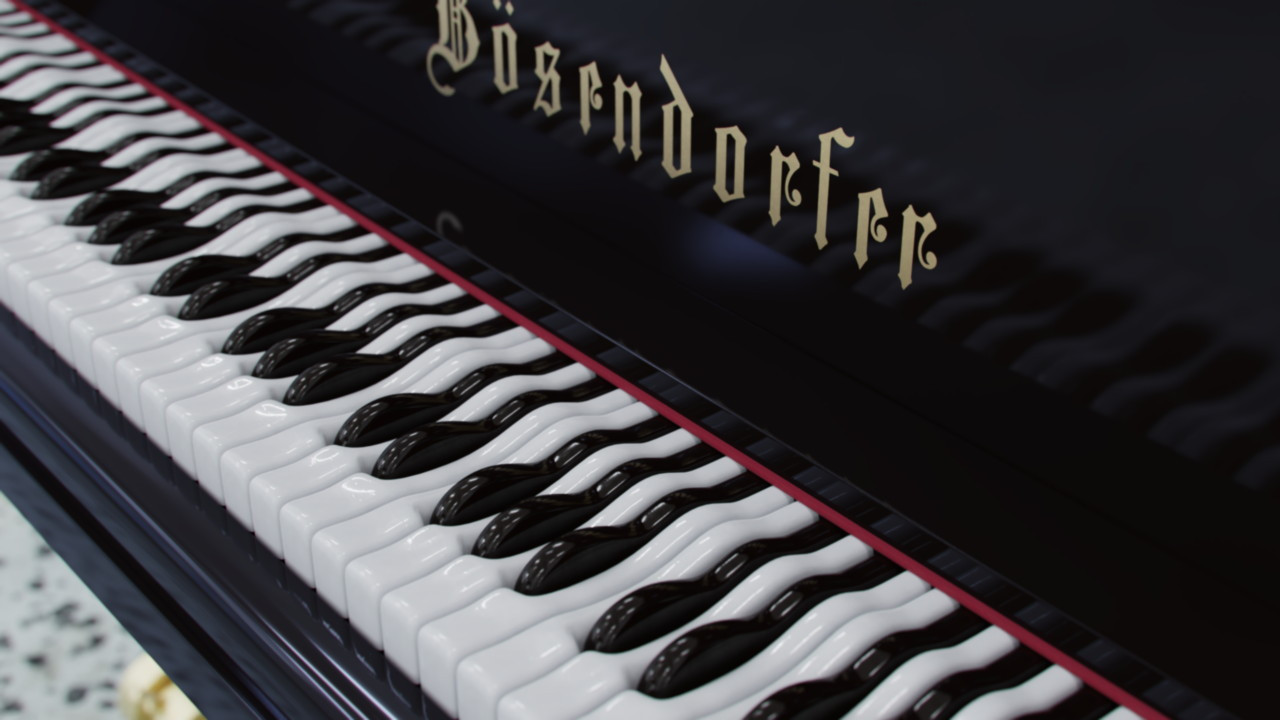
I design pianos (as a hobby) as you can see on the photos. My journey started when I was 14 years old when I saw a real acoustic grand piano in my home town's local theatre.
Of course, I had seen pianos on the TV, but never up-close and under my hands. I opened that grand piano and its details, especially the keys, almost immediately grabbed my attention.
I got extremely puzzled about the discrepancies that big piano and its keyboard had. I tried to "play" something (I had no idea how to play piano as I started to take drums lessons in the same theatre – that is how I had the chance to come close to that grand piano) and it was obvious to me something was not quite right…
The re-Design of the Standard Piano Keyboard
In the following years I had a schoolmate who had an upright piano she had started learning to play at age 5 (I found that a bit shocking to be honest). We spent hours and hours every week when she practised for competitions and stage performances so I had a chance to look at her hand movements and take measures and observe. Overall, I started to search for answers to the questions emerging in my head.
• the discomfort of the standard piano keys •
I could not grasp the reasons for such unpleasant discrepancies and overall discomfort when touching the keys ('blacks' on a elevated level up)… especially when Pianos were considered to be a luxury music instrument (more or less).
I developed some ideas about re-designing the piano keyboard but never spoke to anyone about it (besides sharing my thoughts with my piano player schoolmate) at that time till I graduated and went to Uni. Internet gave me access to many sources of info so the re-design began. I wanted to somehow make the 'equalised' (equally tempered design… if you'd like the pun) piano keyboard. So I did my solution:
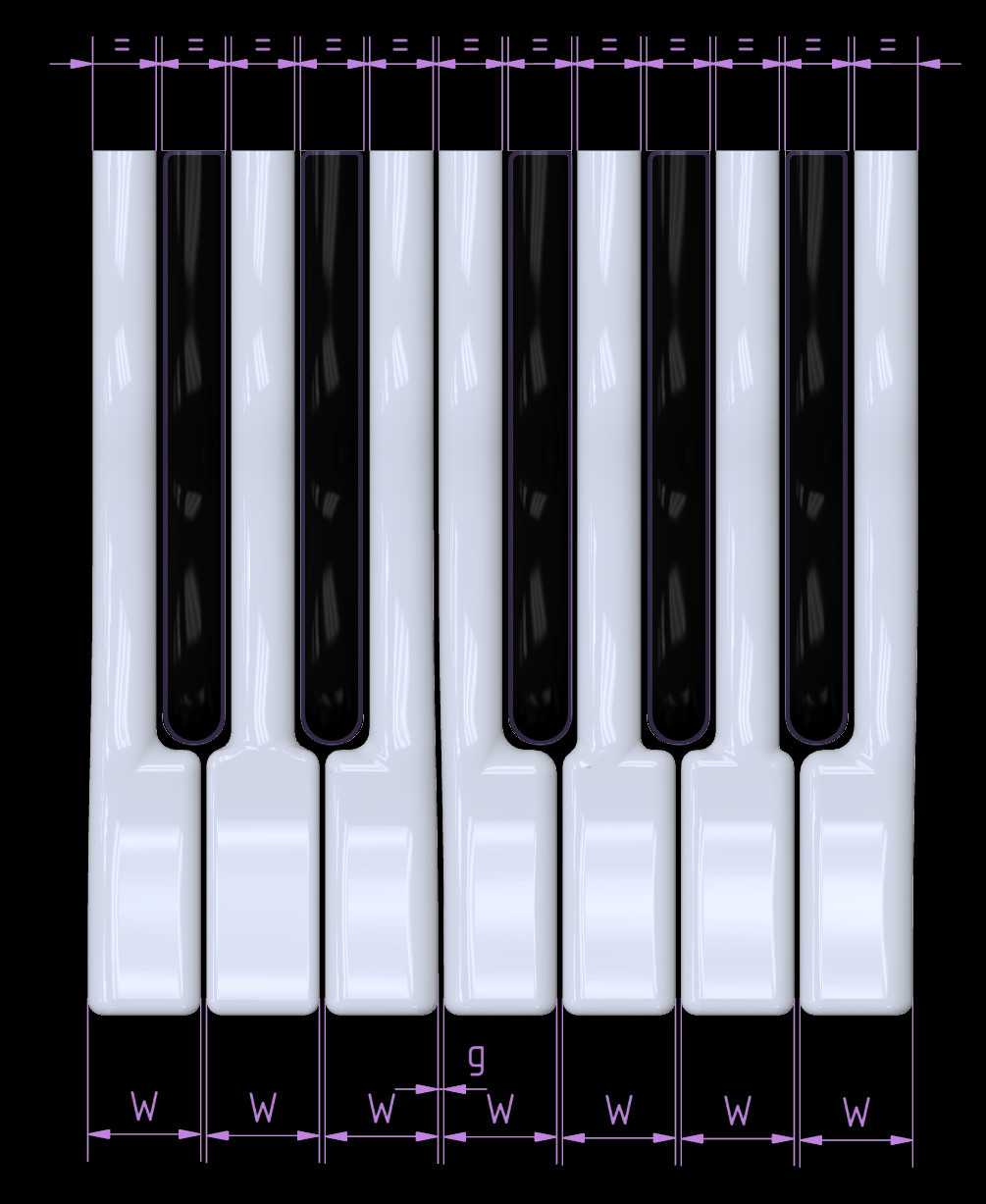
• equally tempered standard piano keyboard •
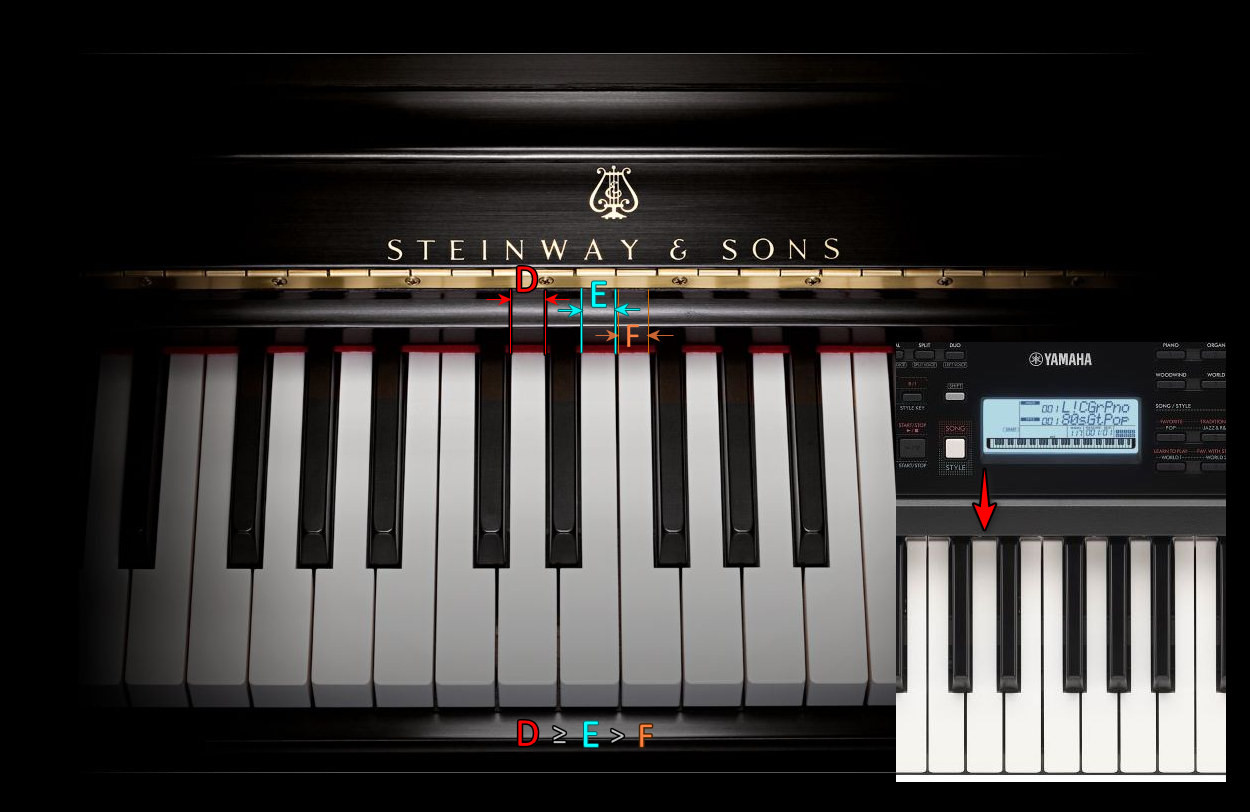
On one hand, all respective widths are equal, and on the other – the keyboard could be made narrower for smaller hands! Everyone involved in such measurements knows that usually piano keys get divided in two groups: [C to E] and [F to B]
It leads to a deviation between the narrow areas juxtaposed to the front\wider areas between the keys [E] and [F] – the gap is not dead straight. My redesign 'splits that difference' sharing it between the two vertical gaps, namely between [В] and [C] and the already mentioned [E] and [F]. We are talking about a fraction of a mm (millimetre) depending on the chosen overall width\span of the hand (small or big "octave" span).
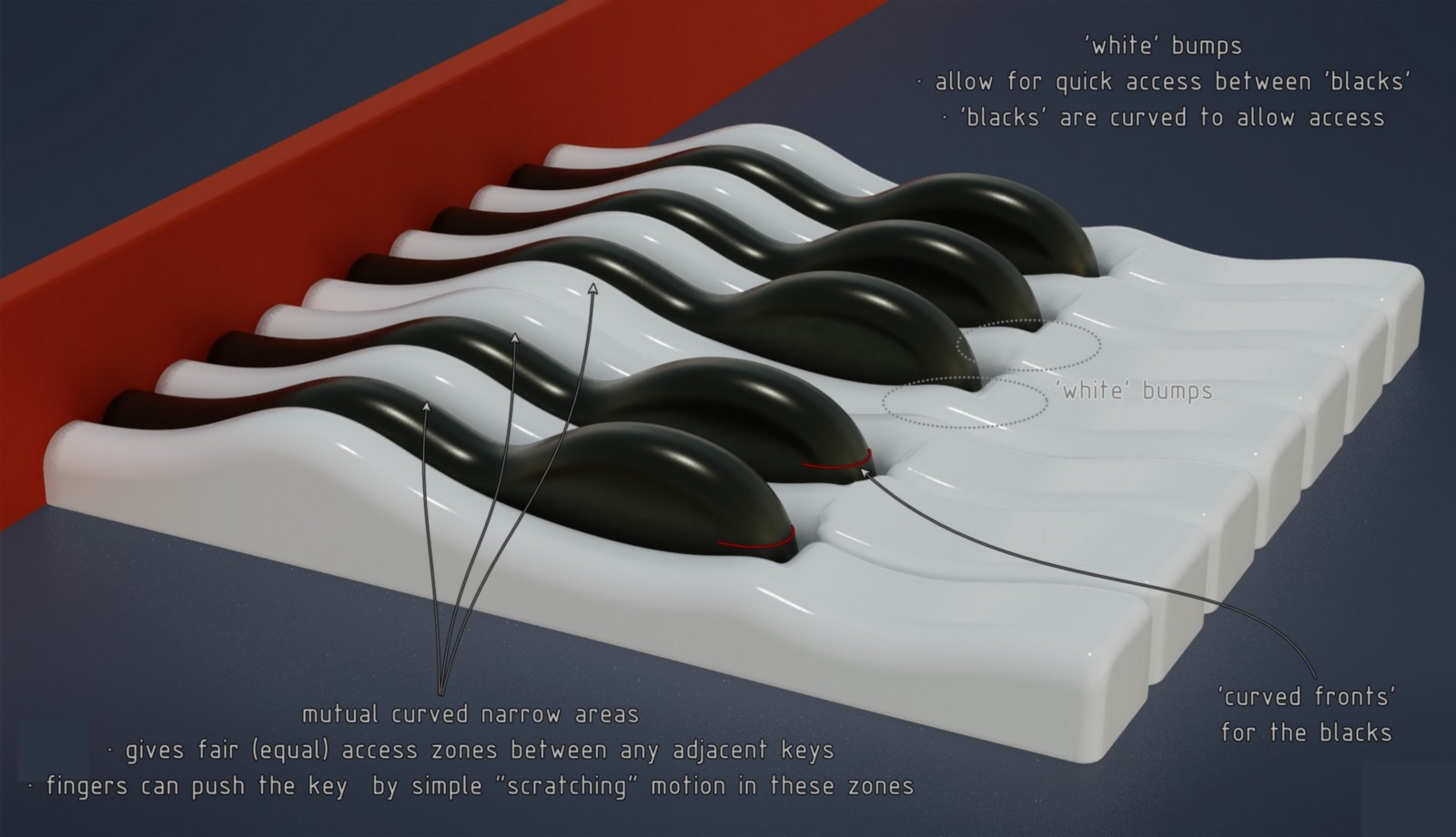
That was one of the main reasons. The next reason was the uncomfortable separation of elevation between both type of keys 'black' and 'white'. If you know the history of how early pianos were constructed as a set of levers and that there were no 'black' keys (who knows why called "accidentals" – no such thing in Pythagoras time) and how the 'black' pentatonic set of keys were added… by the way it is one of the reason in Germany the key [В] is known as [H] but that could be discussed later. So, I fixed that as well.
• the re-Design of the Standard piano keyboard •
• some of the consideration about such a re-Design •
• …what can I say •
• a simple concept as a real grand piano keyboard •
The re-Design of the Uniform Piano Keyboard
• such keyboards are known as Jankó and Dreschke type of piano keyboards •
Well, we could include the Bayan accordion keyboard here as well but Bayans can have different interval layout structure between the rows of keys.
Generally, those uniform layout keyboards are known as 'Janko' because Paul von Janko managed to build a few of such keyboards, whilst Dreschke did not built any. I had seen Bayan keyboards of course, they are not a novelty but info about Jankó (1882) I first read on the Internet in 2010. His keyboard was definitely similar to the earlier Dreschke (1846) and Bayan (1830).
Jankó, being a Hungarian, as his friend and world renown pianist and composer Liszt, showed his keyboard to Liszt who got really impressed and wanted to have another piano playing career using that keyboard.
During the 20th century there were some few attempts at reviving Jankó but I found them to be a step back… or aside from the right direction. So, I did my re-Design of the Dreschke not so much Jankó but all inspired probably by the Bayan more or less. Not going to delve deep into the technical differences between Dreschke-Janko-Bayan as they are obvious for those interested in the subject. Here is my solution:
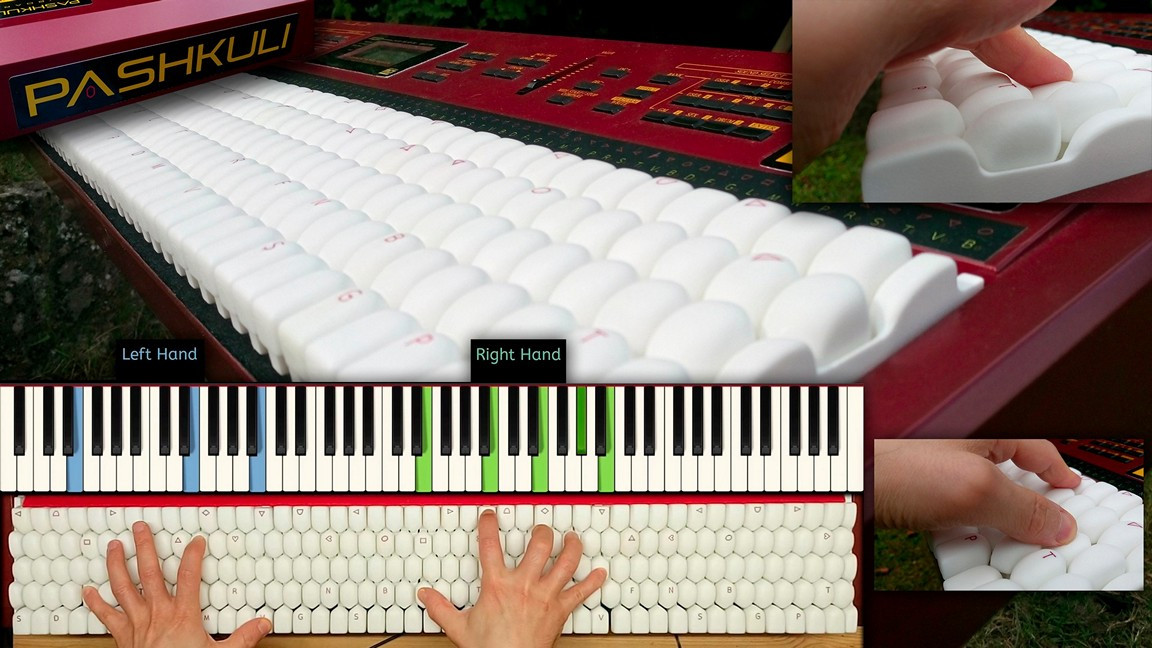
• an overall view of the Uniform re-Design compared to its Standard piano counterpart •
• it is all about the comfort of the human hand
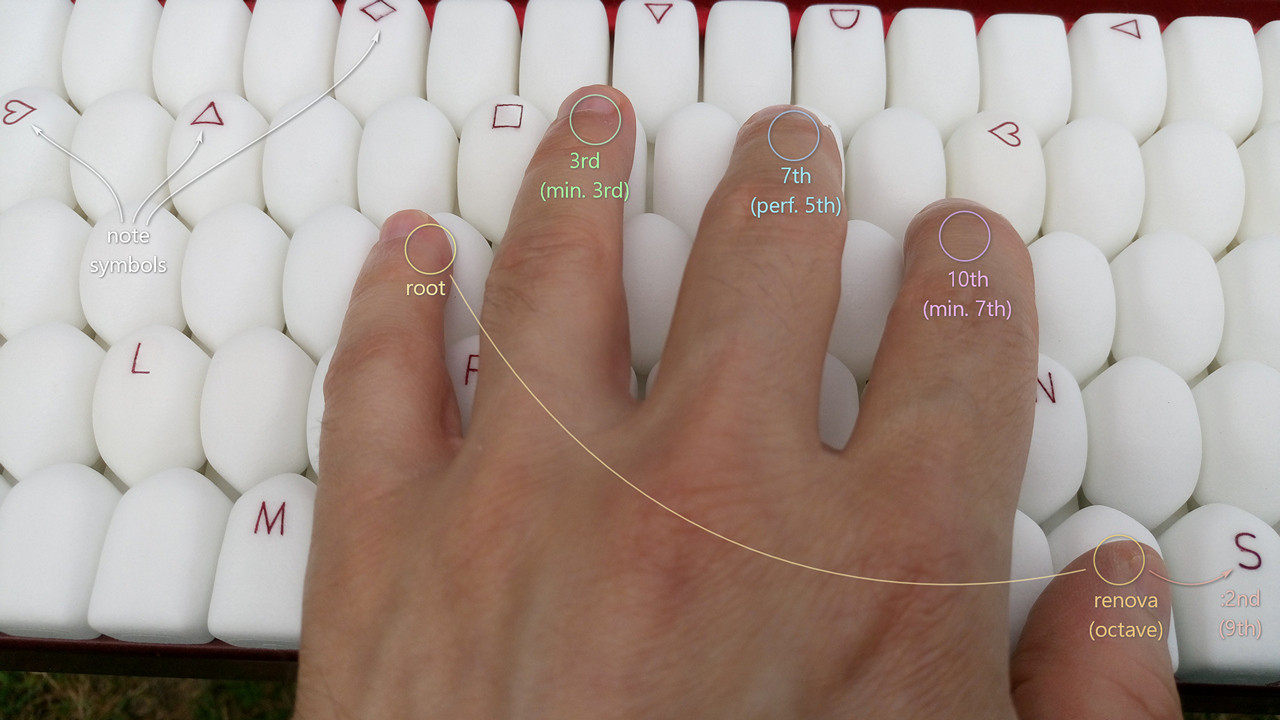
• just put your calm hand on it and you got a chord as shown! •
• renova ("octave") span is ~130mm
• ok, maybe a few technical info won't hurt… •
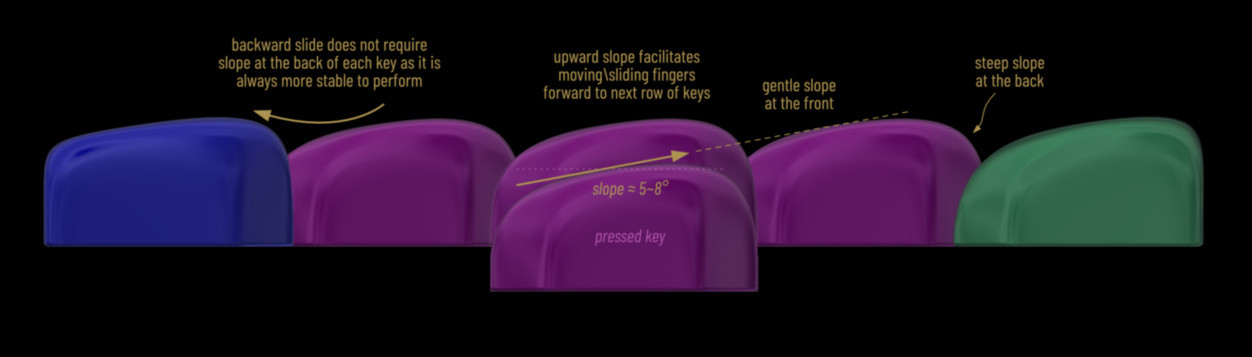
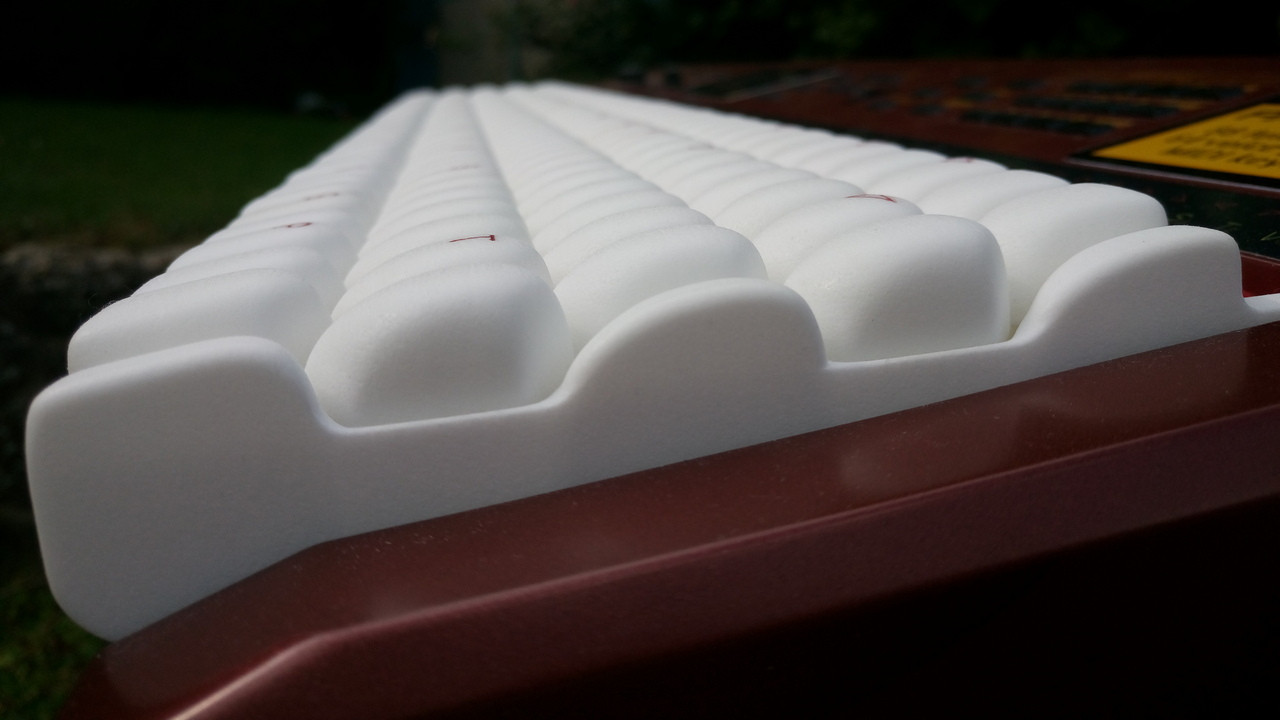
• side view of the PASHKULI Uniform piano keyboard •
Yea, this is an obscure topic and only intended as an introduction post to this forum. History of the piano as a musical instrument is huge as well. I hope this topic at least raised your curiosity in the subject and give you an idea what has been missed or left unsolved in the past few centuries. Not that it matters – many players are clueless about the reasons and state of the art. After all Mozart did not invent the Pianoforte. Bartolomeo Cristofori did. Chopin did not invent the 'escapement lever', Erard did. But piano players have the right to know about their instruments and eventually to have a choice when make informative decisions. At least a choice. We would like to accommodate the piano to the player as we all have different hand size (even when growing up). Certainly, piano (acoustic) is not a cheap musical instrument, but with its digital alternatives we have the advantage to make a choice.
And we have not even talked about the Music notation… although there is not a forum section about it as it is not about the piano, although its origin has been tightly connected to the piano.
But that is a completely separate discussion (you can find some of it in my 'Google Drive' in the links bellow). If you are interested and the admins allow it, I can start a topic about Music Notation. It is a great joy for me to discuss such problems with other musicians.
presentations (.pdf) work in progress
While I'm fascinated by Janko, isomorphic layouts and all sorts of interesting ideas and improvements people come up with - atleast on conceptual level. I recognize that making keys narrower is probably the only thing general public might actually find palatable enough for it to have a staying power. Because for all intents and purposes - it looks like and plays a regular piano - but simply with narrower octave size!
And even such minute change might or might not garner widespread appeal, as the industry is truly very conservative.
If a piano maker targets those who already play the piano, then they will favor regular keyboard layout, because otherwise their potential customers would go elsewhere. If, on the other hand, they target those who do not already play piano, they might indeed favor a different layout.
It is anyone's guess who the piano makers consider their primary target. but my bet is on those who already play piano.
Oh, tell me about the conservative industry. I spoke with Richard Dain (a 96 yo engineer, owner of Phoenix pianos) as he lives 20 min. from where I live here in the UK. He told me about it.
Then (last year or so) I got invited by the 'Edelweiss pianos' in Cambridge, UK and we talked for about an hour+ but they said there is no "industry" anymore really in the UK, mostly technicians and maintainers of old pianos and those from the far Euast (Japan\China), and small percentage German\Austrian\Italian\French. All parts – imported and they just assemble them and make the finish colour\texture on the wood\enclosure. All as if we ari en the mid 1800s but with modern materials and look.
Pianists on the other hand – they are clueless. They play what's been given to them. And brand fanboys. I am neither.
I just observe and do my own conclusions. Stay tened, there is more…
PASHKULI Pianists on the other hand – they are clueless.
What a ridiculous statement.
I've deeply explored Janko and even your idea which I found advertized somewhere. I was initially greatly enthusiast about them, because of the simplification of learning (not anymore 24 scales and 24 arpeggios to learn etc). That was my opinion as somebody who struggled to learn the piano.
In my current opinion, the problem is not the keyboard. In fact the keyboard is genius and works wonderfully well (besides being too wide for the average hand). The problem is how the keyboards and key signatures are taught. There is a double hidden symmetry in the keyboard which is essential for knowing exactly where you are. Having the black keys in groups of two and three allow one to know exactly what one is doing, without need to use vision, nor muscle memory. Once one consider this in the appropriate way, the 24 scales and arpeggios become merely 3. Anybody can learn three simple patterns. The problem is, they are not taught that way, and some people (like my daughter) intuitively discover them while some others (like myself) bang their head on the keyboard for years (until I met Phil Best who showed me the path, but I digress…)
Janko completely destroys the keyboard symmetries, and that is a major flaw of that design. The Pashkuli design does not completely destroy that, so it's an improvement compared to Janko, but in my opinion it is a step in the wrong direction because it does make the keyboard isomorphic in the back of the key, and I am strongly convinced that isomorphic layouts are very bad for piano playing. In my opinion, the very key aspect of the Pashkuli design, namely the "fair/equal access" to adjacent keys is exactly what makes it bad. Keys need to be different for the player to be able to know and learn them for what they are. Heck, even apparently isomorphic string instruments such as the guitar and the violin are not: the frets (or note spacing) are unequal, and the open strings are used extensively.
So count me not interested.
That said, I appreciate and admire the efforts made into bringing this design to life. Beautifully made prototypes and pictures. If one has really strong feeling about wanting an isomorphic keyboard, and if I were unable to convince them away from that idea, I would nudge them to Pashkuli rather than Janko.
DavisB which makes me suspect they aren't selling out as quickly as we'd have liked
In my opinion they made too many things wrong. The most clear ones:
relatively high price
announced when it is not available yet for a long time
pay in installments rather than in one shot
lots of distracting buttons / dials / display -- should have been a VPC1-like instead
big case not taking advantage of the smaller keyboard (I've always struggled to put keyboards in a car and that would have solved that!)
speakers of dubious quality, like all speakers embedded in pianos (maybe they are fine, but if so they should have posted audiofile-like graphs and specs, but even so it'd have been better to omit them and reduce the price)
not clear what sort of action they use "full weighted hammer action" means close to nothing, see next bullet
I'm really debating if I should write that (I have intentionally not done so thus far, but I can't resist now, and I think it's okay since it's buried inside a differet obscure thread): People who know anything about manufacturing in China, know that the manufacturing costs are at least 10x less than what they are asking. See for example
CyberGene you know him?
Yes.
This spammer is flooding forums with his ideas, that noone is really concerned about, as everyone knows its stupid from the ground. This is his second or third attempt here, he is posting the same thing since few years and is completely resistant to any advices given. It's complete loss of time trying to discuss anything with this man.
Hey, Khuja
please, I am opened to any advice! I have never heard\read one from people speaking about giving me advice and never write a word about it (pretty much in all other forums). What kind of advice? On what subject and ithas to be very specific not a generic one such as "I have not played that keyboard, therefore my advice is to make it as the one I have." as such advices have no meaning.
The main topics I tackle in my work regarding anything related to Music are:
• "standard" piano keys discrepancies and origin of design (why they are the way they are today and why it has come from an ignorant\medieval point of veiw)
• uniform keyboard layouts such as Janko, Dreschke, Bayan and so on – shapes, rows, symmetry, keybed, suspension and so on
• Music Notation – again why it has come from an ignorant point of view (predilections and subjective point of view) in medieval times and imposed by the Church in education not only in Europe
• anything related to recording and mixing Music – I am a huge fan of Binaural setups on headphones as I only use headphones (not to disturb others\neighbours) – such as BRIRs, EqualiserAPO, ASH-Dataset etc.
• anything related to design for manufacturing (wood, metal, plastics) maybe even hint on electronics and programming
Any advices or opinions are most welcome. No need to tell me my designs suck because you've never tried them (let alone spend at least ⅓ of the time you've spend on whatever you have been given\taught on). It means nothing.
You are mentioning 'symmetry'. This is a really interesting topic and I have not finished my third video (for my YouTube channel, I had recent Windows OS issues and had to clean my PC).
When you speak about 'symmetry' I can only suggest you to look at your hands. What do you notice about them?
Yes! Indeed, they are symmetryc to one another… yet, that is not the way you play it on a piano. On a piano all notes go from left to right (ascending in pitch) and vice versa. Put on top of that the dexterity phenomena: left or right-handedness! It is a fact of Nature, you can not object nor can you ignore it.
Look at flute, guitar, violin and many more instruments where the player sort of 'embraces' the body of the instrument – for each hand the notes go in one direction because the hands oppose to each other as the result of the embracement.
Now look at piano and such accordions. I see the problem, hope you see it as well.
The current status quo on those instruments is… they are costructed to fit the dexterity of left-handed players!!!
Here is my proof or train of thought regarding this:
A left-haded guitarist usually holds the neck and plays "virtuosly" with their right hand and the notes go ascending from index\thumb to pinky for buth hands (yes, I know there are odd balls such as Eric Gales, Seal and maybe a few more but they are exceptions which has its explanation in their youthful ignorance of just taking a "regular" guitar and symmetrically flip it to hold it as a left-handed players by nature).
Left-handed guitarists use the left-hand as dominant to trigger strings, strumming, dynamic pluck etc. or when finger-picking that left hand thumb and index/middle usually trigger lower notes.
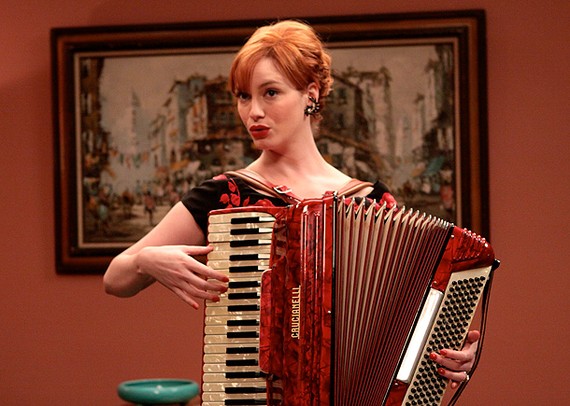
Take an accordion with a Halberstadt ("standart") piano keyboard. What do you notice?
The bass notes are on the left hand, The bellows (air compartment) gets expanded and compressed thus "strumming" the reeds by the same left hand (onder a strap on the left side of the accordion). Where the right hand if you expand wide enough te bellow will look as the right hand of a left-handed gutiar player (notes go ascending from thumb to pinky).
This is a left-handed accordion (they all are)!
Now lets see\analyse the typical piano:
It has its lower notes on the left (left hand) usually used as a bass, chord foundation notes, mode\root.
The right hand has its notes ascending from thumb\index to pinky and are usually the higher notes. Exactly how it is with a left-handed guitarist. But here is the problem!
Your hands are symmetric! Most people are right-handed! On a piano fingers of each hand do not oppose, rther they play on one side of the layout of notes.
Therefore, piano disregards the natural symmetry of fingers from each hand! And it forces you to use your left-hand where the heavier\bass notes are on the weak fingers (pinky and ring). And after all that analysis it is evident piano is more suitable to left-handed players! But that is not all.
Pianos should be split in two tiers for each hand – where each tier has a symmetric\mirored direction of the ascending notes! And more over – because most people are right-handed – the higher notes should be on the left and the lower should be on the right tier yet for both hands notes should asscend in pitch from thumb to pinky.
All chords and phrases will have the same shape for eather hand on the respective tier. Unless you want to cross hand and play on either tier some occasional parts.
PASHKULI Your hands are symmetric! Most people are right-handed! On a piano fingers of each hand do not oppose, rther they play on one side of the layout of notes.
Therefore, piano disregards the natural symmetry of fingers from each hand! And it forces you to use your left-hand where the heavier\bass notes are on the weak fingers (pinky and ring). And after all that analysis it is evident piano is more suitable to left-handed players!
The bass parts of music usually require less dexterity. That's the nature of western music. The treble part is the one that requires more dexterity when playing most piano music. Whether the music is being played by a single person or an orchestra, the treble usually moves more. This gives right-handed pianists a huge advantage -at least early on.
If the piano keys in the bass are too hard to play for the weaker fingers, there's something wrong with the piano.
Piano keys are heavier on the bass side (weight wise) as the treble ones have more percussive sound and if heavier it will be not a treble sound rather a… clack, forte clack.
What makes you think then that legato and virtuoso right-handed guitar players shold use their right hand as your logic suggests? They do not. Right handed guitar players use ther left hand to do the fretboard passes, phrases, legato flows. The right hand is picking, responsible for dynamic volume\picking\strum.
If you match that to the piano – just place your left hand and sort of try to pretend the keyboard becomes a guitar fretboard – that hand is the one that should play higher notes (from thumb to pinky).
Who ever (in History) said that piano notes should ascend from left to right? Why? What is the logic behind it?
It does make sense mostly if you are a left-handed player.
The topic itself is interesting.
Meanwhile, while I am impartial about the following (about whether they should be kept/banned), I could see why OP might’ve been banned in some forums, and it’s probably due to the posts seeming to be of business interests versus purely for sake of discussion.
Notice how the first post seemed innocent in nature and then bam— long post about what the OP has been working on. Look at the YouTube channel description where there’s info about partaking in a business venture on this effort.
I for one will be ignoring this particular thread from here on out, but wish the OP the best in their business endeavors on the product that they intend to eventually monetize.
PASHKULI Who ever (in History) said that piano notes should ascend from left to right? Why? What is the logic behind it?
It does make sense mostly if you are a left-handed player.
Your theory posses a minor dilemma:
What if I’m ambidextrous?
Doesn't seem like playing virtuosic classical repertoire would be very ergonomic or even possible on this, but that is most likely because the music is wrong, right?