PASHKULI
Khuja Wangtishvili Why don't you simply call Chris Maene and tell him that his piano designs are lazy and simply wrong?
Guess what! It has been done. All sketches above has been sent to him around the end of summer 2024.
Khuja Wangtishvili Why don't you simply call Chris Maene and tell him that his piano designs are lazy and simply wrong?
Guess what! It has been done. All sketches above has been sent to him around the end of summer 2024.
I specified (like an exercise):
only examples of a bar long phrase not more than 8~12 notes.
Chopin's whole pieces are not for a total beginner such as myself. Please, be more specific.
PASHKULI Guess what! It has been done. All sketches above has been sent to him around the end of summer 2024.
Did you get any answer?
BTW @PASHKULI
Do you have a car?
And do you know, that in most cars the pivot of the steering wheel is moved to the right vs the pivot of the drivers seat? Should we than stop driving the cars because of it, or do you think there is some well thought reasoning behind it?
And do you know that 99% of drivers are not aware of it, but somehow magically can drive the cars?
It all started in 2007 when I sent my work to both Yamaha and Steinway or Bosendrofer.
No prototypes back then, only drawings and a bit basic renderings.
No answer. Yamaha returned the parcel intact stating IP policy and that a japanese attorney (representing me, hired by me) can only open them but the hearing most likely was not going to be held because it first has to go throuh R&D dept. etc, etc.
In 2024 I contacted Petrof, Bechstein, Kawai, recently C. Maene.
2022~2023 Roland, Fatar, Kurzweil, chinese brands… German, here in UK spoke with Edelweiss (bouitque baby grands, they had no idea what I was talking about, but spent more than an hour there, last words form the owner was: "You seem very enthusiastic but who are you?", I found it a bit weird so I just said "Nobody." and it was not meant to be a joke at all).
No answers. Petrof's owner Susane Petrof gave me the email of their Lead designer but no response, so aftor my second email to him I lost interest, but they have the .pdf files and photos (as in the Google drive links above)
Khuja Wangtishvili
Do you have a car?
And do you know that 99% of drivers are not aware of it, but somehow magically can drive the cars?
No idea as I do not know anything about cars.
PASHKULI I specified (like an exercise):
only examples of a bar long phrase not more than 8~12 notes.
Chopin's whole pieces are not for a total beginner such as myself. Please, be more specific.
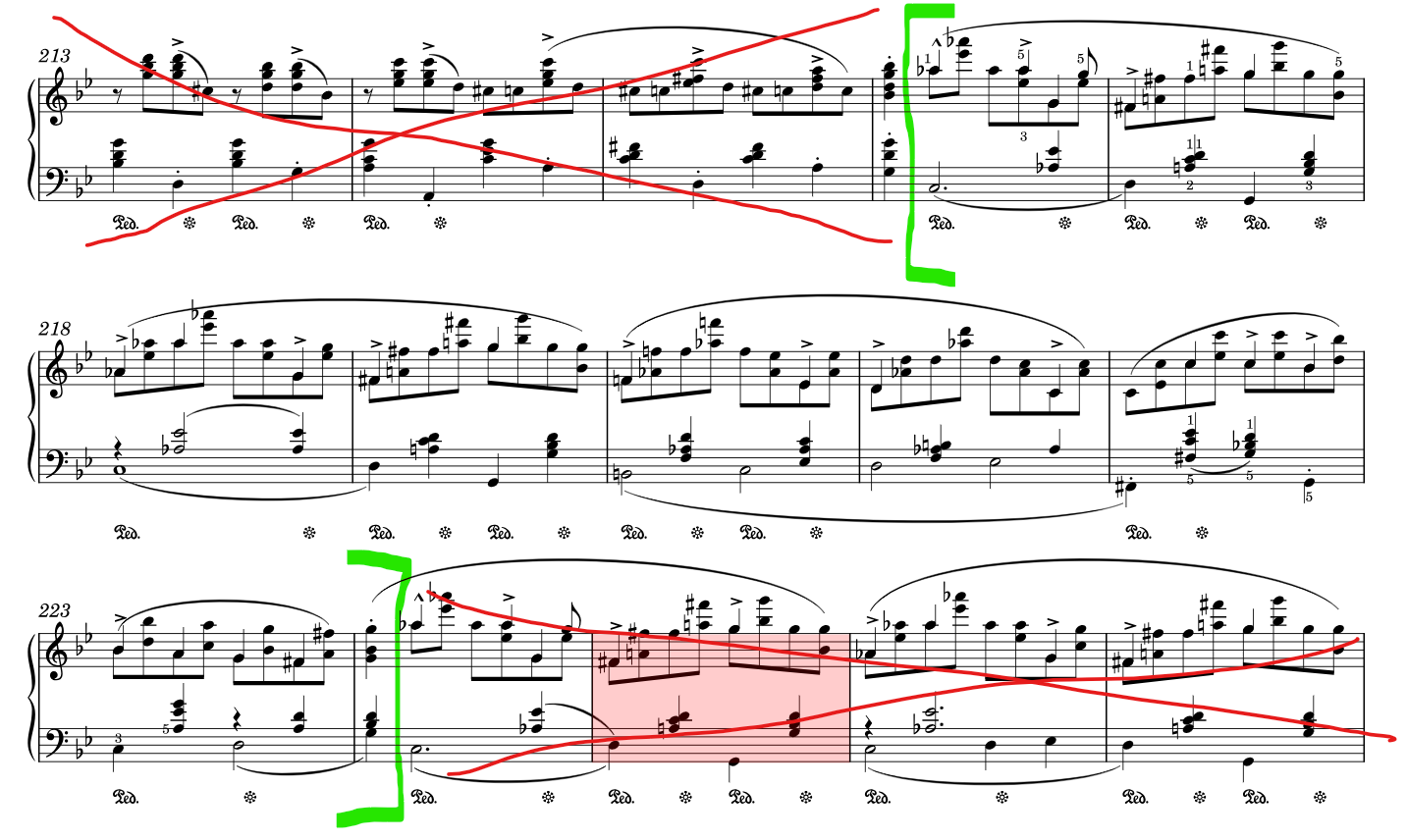
Ah, that must have been in a different post. I'm not trying to be antagonistic, but a bar is hardly long enough to put together a complete musical thought, especially in challenging passages. You argued that nothing is difficult to play, I would argue that the coda above (a small part of his Ballade in Gm) is difficult to play. 4-8 bars might even be enough to sell me, as I imagine it's particularly difficult on a keybed where it appears to be more difficult to feel the topography.
Perhaps you could persuade a fluent pianist to put together some demonstrations? You seem to be struggling to sell your idea to fluent musicians, so perhaps you need to recruit one to help you demonstrate. Whether it's true or not, this whole idea feels theoretical beyond a total beginner's skill level.
Mindbullets You argued that nothing is difficult to play
It was regarding something about F♯ chord or phrase will be difficult on my curved keys or something Del Vento wanted to show but never did.
PASHKULI No idea as I do not know anything about cars.
And it is the same with pianos. No difference.
If you could elaborate that would be great. At least will learn something about cars and their relation or association with the piano. You got my curiosity, let's see whether you will get my attention.
PASHKULI If you could elaborate that would be great. At least will learn something about cars and their relation or association with the piano. You got my curiosity, let's see whether you will get my attention.
Yes it's made for safety reasons, was most important in older days without airbags. The aim of it was to move steering wheel center out of the middle of our chest, and more specifically from our heart if there would be an accident so the direct impact wouldn't be almost directly in the place where heart is located
I really do not know. From my father I have heard that actually the driver's seat is usually the safest in case of full front collision (and the deadliest is the seat next to the driver). But I assume even with a seatbelt and no airbag the driver's face will be all smashed by the wheel (inertia of upper body – neck – head). Otherwise airbags would not be also in the steering weel. I am not a keen driver. If I drive for more than 15~20 min. I get that panic feeling that the car controls my time and attention (thoughts\survival).
Statistically, in a car (moving\driving), your safety (life) is only 25% in your hands. The other 3×25% are in the hands of the car's driver in front of you, the one behind you, and the one comming from the opposite direction. Plenty of videos on YouTube.
open questions to all participants (in case you missed them above):
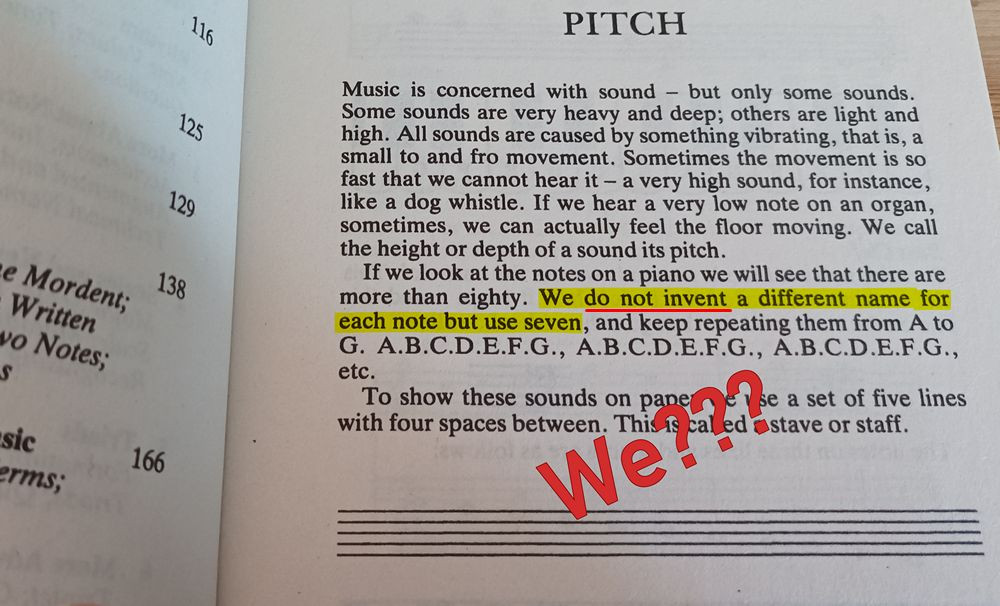
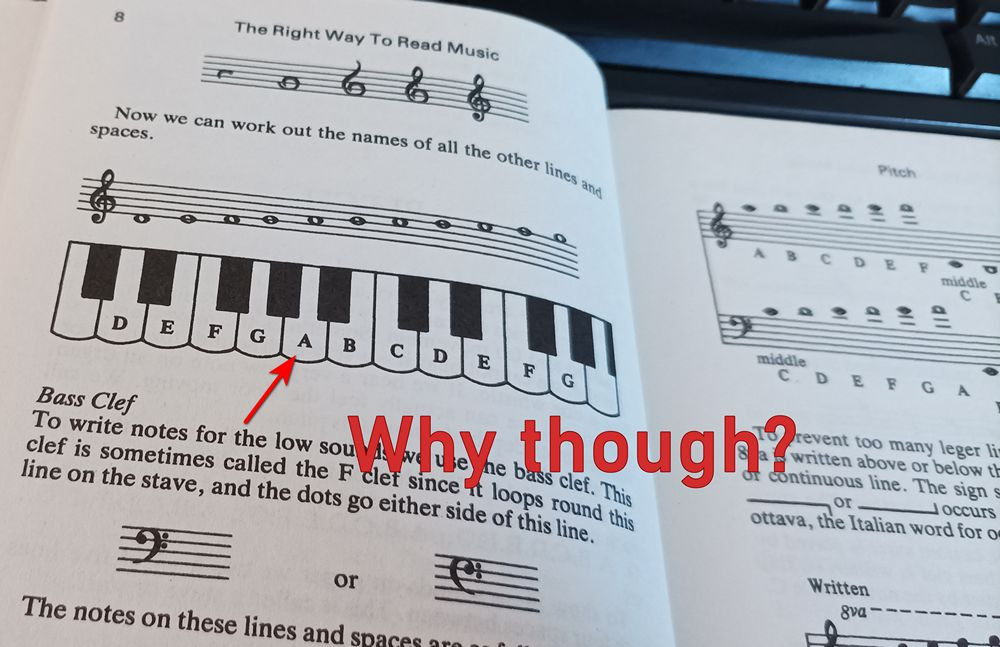
- Who said that the note A should be there on that key on the Piano? Why, for example, A is not where C is?
- Why we then "separate" ranges from C to C (you can even see it in digital realm, MIDI rolls). Why not A? After all A is the first letter in many (if not all) European alphabets (even hebrew, but it has a bit different letter). Why "middle C", not "middle A"?
- Why is it the sequence of the Latin\English alphabet assigned to those exact notes? Why not Greek, Cyrillic… Hebrew?
PASHKULI It was regarding something about F♯ chord or phrase will be difficult on my curved keys or something Del Vento wanted to show but never did.
Well a chord in isolation (or an easy passage) isn't going to be difficult to demonstrate on any keybed, regardless of how ergonomically (in)efficient it is. Fluently/naturally shifting between different tonalities/hand positions as part of a complex musical phrase seems like it would be particularly challenging on your keybed (though I could be wrong -- hence the desire for a demonstration).
A single phrase from the coda above that seems like it would be further complicated by your keybed would be something like this:
Obviously that's more than 8-12 notes, but if someone could demonstrate this (or similar) on your keybed, that might pique my curiosity. Otherwise it feels purely conceptual, and I'm having trouble imagining the practical advantages vs the traditional piano keybed.
PASHKULI Who said that the note A should be there on that key on the Piano? Why, for example, A is not where C is?
I assume it was someone who favored the Aeolian / natural minor scale.
PASHKULI Why we then "separate" ranges from C to C
I assume it's because the major scale / Ionian mode eventually became the generally preferred scale/mode in western music. To be clear, I don't personally separate ranges from C to C.
In my mind, the keyboard "butterflies" out from D and G#/Ab symmetrically and those are my "default" anchor points to intuitively grab hold of the circle of 5ths from any angle.
D is at the "top" of the circle of 5ths (go out 2 5ths in each direction from D to get C maj pentatonic, go out another 5th in each direction to get the notes for F Lydian, the "brightest" mode of major because it's just stacked 5ths straight up from the tonic). G#/Ab is at the "bottom" of the circle of 5ths. The physical topography makes more sense than the arbitrary note names.
PASHKULI Why is it the sequence of the Latin\English alphabet assigned to those exact notes?
I'd assume it's because western musicians (maybe because of the Catholic Church?) eventually standardized on Italian as the language used for notation, and Italians use the Latin alphabet. All just guesses.
That score example (I can not read it, unless in MIDI file). Ok, I might try to score-recognise it and export it as a .mid file and see the notes in Synthesia, than try to play it, but by the looks of it, it seems rather advanced (to me).
Regarding the answers on the questions:
• yes, could be, but then I can follow up your answer with: "Then, why everyone complied with that guy's pref, why has it stuck till today?"
• D is good from piane layot point (symmetry from white's persp) really glad another person has noticed it, but you can not deny C has been the main (maybe) only such 'reference' to ranges, yet A is the so called concert pitch, tuning fork (camertone) although it had a lower pitch value in earlier times?
• Yes, Church could have had major role in it, also by that time the diff. two main denominations of Christianity – Catholics (dominated by Romans\Italy\Spain) and Orthodox (Greece, Egypt, Balkan) were in sort of rivalry for influence, but the "Holy Inquisition" won (at least in terms of global expansion)… could it be out of fear, dogmatic education? Quite possibly…
PASHKULI it seems rather advanced (to me).
Indeed it is -- and the movements seem (to me) like they would be easier on a traditional keybed. I'd be curious if you could find a local pianist to attempt this on your keybed and understand how the waviness of the keys affects things like sliding up the keys, proprioception on the strides, etc. compares to a traditional keybed.
PASHKULI you can not deny C has been the main (maybe) only such 'reference' to ranges
Agreed it is where beginners often start, and that's probably why it's used. You could also ask why we don't go F to F, as that's even brighter than major.
I don't know that I've met any advanced players that think primarily in terms of C-to-C, though there could be some. That's just the hardest area of the piano to grasp physically as there are no topographical "footholds". Chopin used to teach the "black note" scales first for that reason. A more contemporary instructor who teaches symmetrical tonal mapping is Phil Best (mentioned earlier):
https://www.playpianofluently.com
PASHKULI why has it stuck till today?
The value proposition of changing the status quo either isn't there or hasn't been made convincingly enough. Probably the same reason most international communication tends to be in English, and the US still uses Imperial units.
PASHKULI I am not a keen driver. If I drive for more than 15~20 min. I get that panic feeling that the car controls my time and attention (thoughts\survival).
Would you describe yourself as somewhat obsessive and neurotic? Have you considered pursuing other interests?
How about learning to play the piano? As you stated somewhere above in this endless rabbit warren of pointlessness, "humans adapt!". So the vagaries of the piano keyboard are something you can conquer.
Just a fraction of the time and mental energy you have spent in your fruitless quest would probably have seen you develop into a very proficient musician. Think about that for a moment.
EssBrace I tend to think such a behavior is an excuse for doing the real (and mundane) task of learning something. It’s much easier to declare it bad/wrong and launch yourself into the endless spiral of pretending how the status quo is the one to blame.
EssBrace ... this endless rabbit warren of pointlessness ...
Poetic ... and correct.
Yes, interesting indeed. But you will have to agree that someone just sat one day and said:
"This key will be… I do not know… can not think about names, so I speak Latin and know Latin alphabet, so why not, that key will be A, the next B, then C and till G.".
The History tells us a different story. Since 500 CE when Boethius (latin speaking clerk and Music theorist) when he worked on Music related subject he named the intervals, contrary to what many people assume that he named the notes, and he used the Latin alphabet. Because of that and the extended musical intervals bigger than a renova ("octave") he used more than 8 and 12 intervals therefore letters (the letter J did not exist in his time, by the way).
They had no concept of pitch as vibration per second (Hertz) as Hertz would be born 1400 years later.
There were no "white and black key" pianos back then either – merely some leves on portable pipe-type organs with a bellow at the back or a crank to move it, so they used only one hand to actually trigger notes on the levers.
So, we have to "travel" back in Time in our minds to understand the picture. In those medieval times they had no notes at all. Boethius used the diatonic genera (we can say on the 'white keys only' as there were no "black" keys) although it was not the typical music among people\folk (euronean church music was only emerging in his time) where folk music existed thousands of ears before that. But those portativ organs had levers where you could write a symbol – other instruments did not have (even on flutes\whistle instr. you can not do it becuase a note is usually a combo of a few fingers). Yet, there were no note names despite the fact that Apypian notation existed 200+ years before Boethius and most likely he knew about it as he mentions it in his work. That system used chromatic (wrongly known as half-tone passages) and enharmonic genera (the latter today we associate with micro-tonality but it was not off of n-Equal temperament nature).
The actual naming of notes started by an ignorant application of both Boethius interval naming and Aristoxenus' 'division of genera' by the church monks\clerks Odo ("Musicae artis disciplina"), then Guido and Theodaldus around year 1017 (500 years after Boethius).
They started with a string (not keyboard+pipes) only "god" knows at what pitch and started dividing it in order of bigger to smaller (contrary to how Pythagoras started) because they used the divisions already documented by Aristoxenus (no written work\evidence we have from Pythagoras anyway). Oddly enough (as ironic fate can be!) they named the string with the greek letter Г (it is the third letter in Greek alphabet, which phonetically in Latin is G – the seventh letter) because, I kid you not, this is what they say to each other:
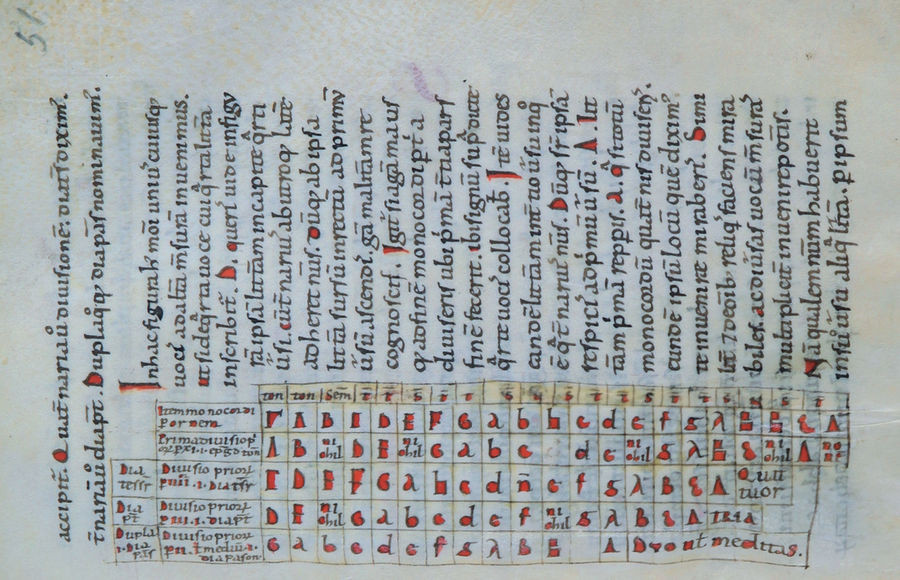
"On the monochord string, at the attachment pin, make it as the letter Г (gamma), that is – the Greek G, which, because no one knows it here.". Then they proceed without any understanding and explanation how to match the diatonic genera starting with what Aristoxenus called 'a tone' and call it A (in their Latin alphabet but also it is in Greek an Cyrillic). The ignorant thing is that in the first half they do not encounter what is known as B♭, but in the next renova ("octave") they see it in the ratios (they get smaller → better "resollution") and have no idea how to call it. So they write it es a 'square' shaped b:
"Et dum voces per medium diviseris,
dissimiles easdem litteras facere debes.
Verbi gratia, dum a Г per medium dividis,
et pro Г scribe G, et pro A mediata pone
similiter a, similiter quoque et pro B aliam ♮.
Praeterea et a voce sexta F per IIII divide,
et retro B aliam ♮ ivenies b quam dicimus rotundam." (the round b is actually known to you as 'B flat')
"Alius vero dividendi modus sequitur, qui etsi memoriae minus adiungitur, eo tamen monochordum velociori celeritate componitur, hoc modo:
Cum primum a Г ad finem novem passus id est particulas facis,
primus passus terminabit in A, secundus vacat, tertius in D,
quartus vacat, quintus in a, sextus in d, septimus in aa, reliqui vacant.
Item cum ab A ad finem novenis partiris, primus passus terminabit
in B, secundus vacat, tertius in E, quartus vacat, quintus in ♮, sextus in e, septimus in a', reliqui vacant."
in English:
"And when you divide in half, write the same, but not exactly the same, letters. For example, when you divide the other half from G, write G instead of Г; dividing A in half, write a, and likewise, instead of B, put ♮. Also, divide the sixth step by 4 and before that B [square] ♮ you will find the other b, which we call round." (the latter is what you know as B flat)
"There is another way of dividing, which is not so easy to remember, but it measures the monochord faster. First divide the whole string from Г into 9 segments or equal small parts: the first segment is as A, the second is skipped, the third on D, the fourth is skipped, the fifth on a, the sixth on d, the seventh on aa, the rest are omitted. Now divide in 9 parts the remaining part of the string from that A to the end: the first segment ends on B, the second is skipped, the third on E, the fourth is skipped, the fifth on ♮, the sixth on E, the seventh on a', the rest are omitted.
It is obvious they were doing it as a perscribed method without any understanding and placing letters on the go.
Still, can we assume that they tuned the Г to the key on a portativ (where later in time wold be G)? So the next higher note would be A and then even later in Time they will make the key 'B flat' an 'accidental'?
At the time of those dialogues and instructions among those church clerks, they rarely used B♮ (h in German music notation) and B♭.
They ruined all the work of Aristoxenus and Alypius. I would even argue that they had no idea about their work and used only the diatonic ratios as instructional method for finding the diatonic notes.
Still, we (at least I) have no idea why A on a piano is where it is today?!
Because, lets say you have already fulli developed piano (7 white + 5 black) keys and you are given the chance to name the notes, what will you do and how will you procede?
Because I did exactly that. And I do not care what some "academic" established copy-paste (historically) teacher tells me in the Music theory notebooks. They do not explain why. They just tell me it is as it is. This is how indoctrination works!
I do not buy this. At all.