Mindbullets
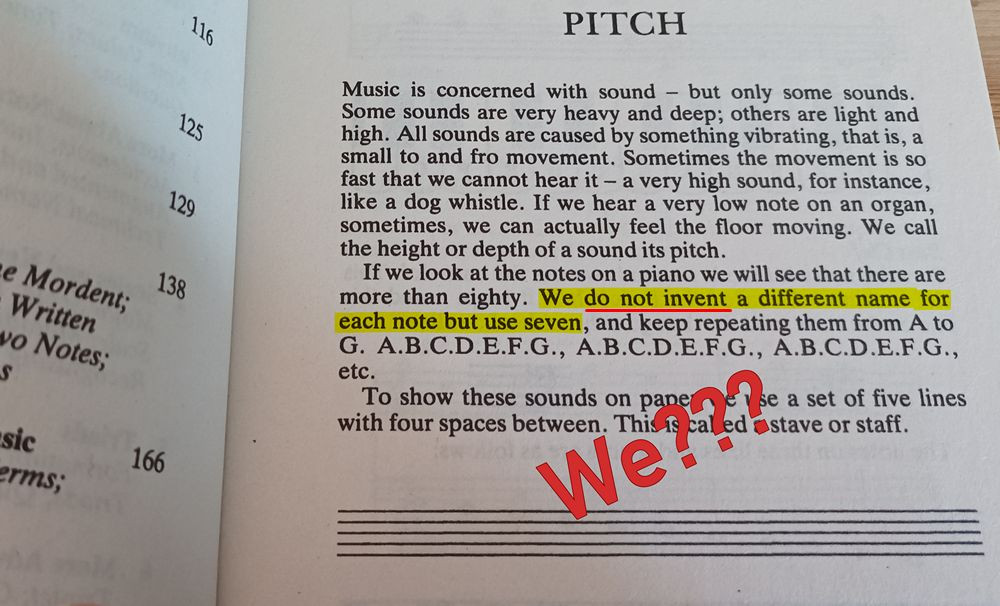
Yes, interesting indeed. But you will have to agree that someone just sat one day and said:
"This key will be… I do not know… can not think about names, so I speak Latin and know Latin alphabet, so why not, that key will be A, the next B, then C and till G.".
The History tells us a different story. Since 500 CE when Boethius (latin speaking clerk and Music theorist) when he worked on Music related subject he named the intervals, contrary to what many people assume that he named the notes, and he used the Latin alphabet. Because of that and the extended musical intervals bigger than a renova ("octave") he used more than 8 and 12 intervals therefore letters (the letter J did not exist in his time, by the way).
They had no concept of pitch as vibration per second (Hertz) as Hertz would be born 1400 years later.
There were no "white and black key" pianos back then either – merely some leves on portable pipe-type organs with a bellow at the back or a crank to move it, so they used only one hand to actually trigger notes on the levers.
So, we have to "travel" back in Time in our minds to understand the picture. In those medieval times they had no notes at all. Boethius used the diatonic genera (we can say on the 'white keys only' as there were no "black" keys) although it was not the typical music among people\folk (euronean church music was only emerging in his time) where folk music existed thousands of ears before that. But those portativ organs had levers where you could write a symbol – other instruments did not have (even on flutes\whistle instr. you can not do it becuase a note is usually a combo of a few fingers). Yet, there were no note names despite the fact that Apypian notation existed 200+ years before Boethius and most likely he knew about it as he mentions it in his work. That system used chromatic (wrongly known as half-tone passages) and enharmonic genera (the latter today we associate with micro-tonality but it was not off of n-Equal temperament nature).
The actual naming of notes started by an ignorant application of both Boethius interval naming and Aristoxenus' 'division of genera' by the church monks\clerks Odo ("Musicae artis disciplina"), then Guido and Theodaldus around year 1017 (500 years after Boethius).
They started with a string (not keyboard+pipes) only "god" knows at what pitch and started dividing it in order of bigger to smaller (contrary to how Pythagoras started) because they used the divisions already documented by Aristoxenus (no written work\evidence we have from Pythagoras anyway). Oddly enough (as ironic fate can be!) they named the string with the greek letter Г (it is the third letter in Greek alphabet, which phonetically in Latin is G – the seventh letter) because, I kid you not, this is what they say to each other:
"On the monochord string, at the attachment pin, make it as the letter Г (gamma), that is – the Greek G, which, because no one knows it here.". Then they proceed without any understanding and explanation how to match the diatonic genera starting with what Aristoxenus called 'a tone' and call it A (in their Latin alphabet but also it is in Greek an Cyrillic). The ignorant thing is that in the first half they do not encounter what is known as B♭, but in the next renova ("octave") they see it in the ratios (they get smaller → better "resollution") and have no idea how to call it. So they write it es a 'square' shaped b:
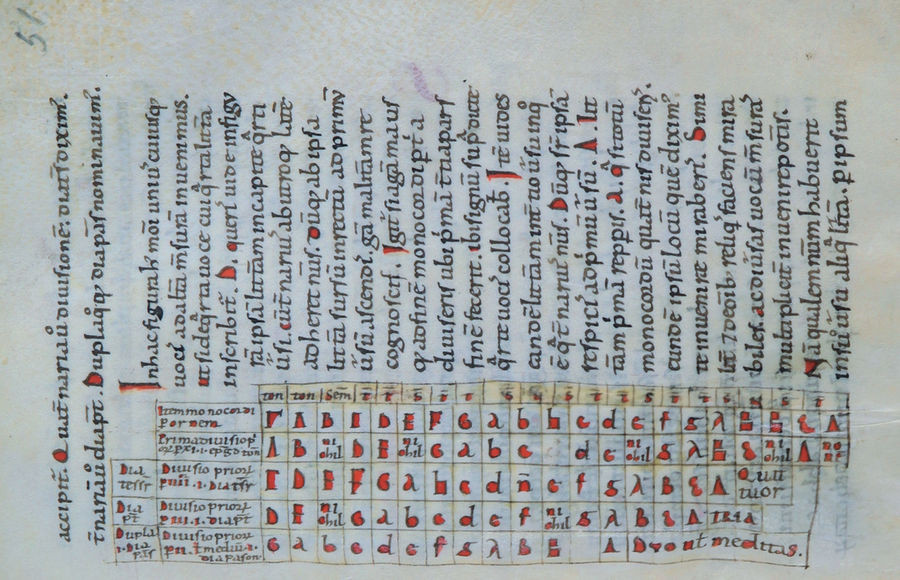
"Et dum voces per medium diviseris,
dissimiles easdem litteras facere debes.
Verbi gratia, dum a Г per medium dividis,
et pro Г scribe G, et pro A mediata pone
similiter a, similiter quoque et pro B aliam ♮.
Praeterea et a voce sexta F per IIII divide,
et retro B aliam ♮ ivenies b quam dicimus rotundam." (the round b is actually known to you as 'B flat')
"Alius vero dividendi modus sequitur, qui etsi memoriae minus adiungitur, eo tamen monochordum velociori celeritate componitur, hoc modo:
Cum primum a Г ad finem novem passus id est particulas facis,
primus passus terminabit in A, secundus vacat, tertius in D,
quartus vacat, quintus in a, sextus in d, septimus in aa, reliqui vacant.
Item cum ab A ad finem novenis partiris, primus passus terminabit
in B, secundus vacat, tertius in E, quartus vacat, quintus in ♮, sextus in e, septimus in a', reliqui vacant."
![]()
in English:
"And when you divide in half, write the same, but not exactly the same, letters. For example, when you divide the other half from G, write G instead of Г; dividing A in half, write a, and likewise, instead of B, put ♮. Also, divide the sixth step by 4 and before that B [square] ♮ you will find the other b, which we call round." (the latter is what you know as B flat)
"There is another way of dividing, which is not so easy to remember, but it measures the monochord faster. First divide the whole string from Г into 9 segments or equal small parts: the first segment is as A, the second is skipped, the third on D, the fourth is skipped, the fifth on a, the sixth on d, the seventh on aa, the rest are omitted. Now divide in 9 parts the remaining part of the string from that A to the end: the first segment ends on B, the second is skipped, the third on E, the fourth is skipped, the fifth on ♮, the sixth on E, the seventh on a', the rest are omitted.
It is obvious they were doing it as a perscribed method without any understanding and placing letters on the go.
Still, can we assume that they tuned the Г to the key on a portativ (where later in time wold be G)? So the next higher note would be A and then even later in Time they will make the key 'B flat' an 'accidental'?
At the time of those dialogues and instructions among those church clerks, they rarely used B♮ (h in German music notation) and B♭.
They ruined all the work of Aristoxenus and Alypius. I would even argue that they had no idea about their work and used only the diatonic ratios as instructional method for finding the diatonic notes.
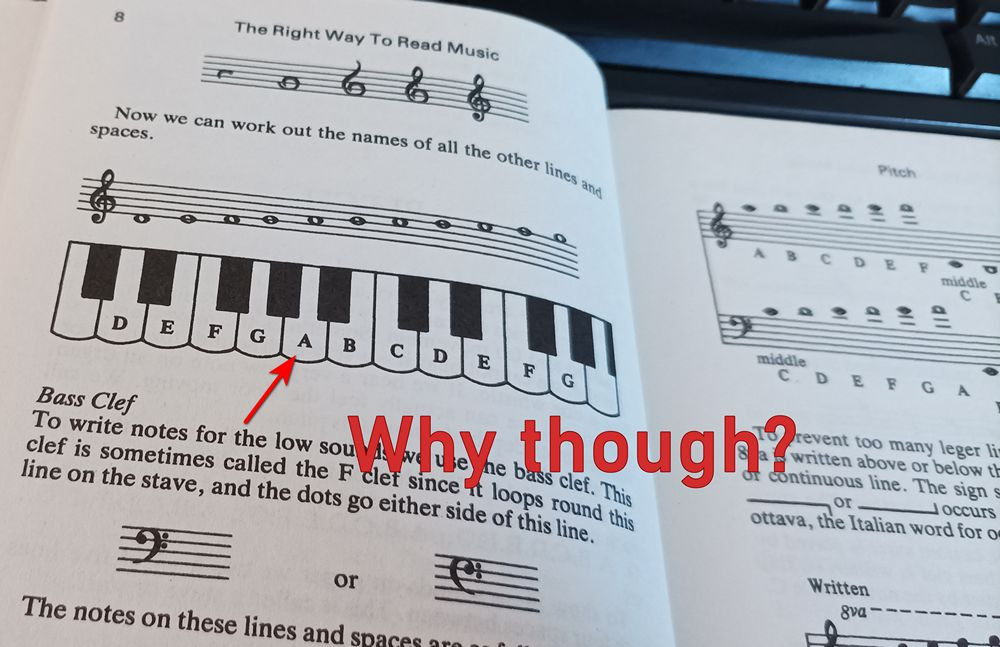
Still, we (at least I) have no idea why A on a piano is where it is today?!
Because, lets say you have already fulli developed piano (7 white + 5 black) keys and you are given the chance to name the notes, what will you do and how will you procede?
Because I did exactly that. And I do not care what some "academic" established copy-paste (historically) teacher tells me in the Music theory notebooks. They do not explain why. They just tell me it is as it is. This is how indoctrination works!
![]()
![]()
I do not buy this. At all.