Hello everyone;
Ive gotten into a bit of a rabbit hole last year that started with learning chords and improvisation, continued to music theory and isomorphic keyboards, and spiraled out of control into janko keyboard layout and a DIY project for a fully custom digital piano with realistic (or as realistic as I can get) action.
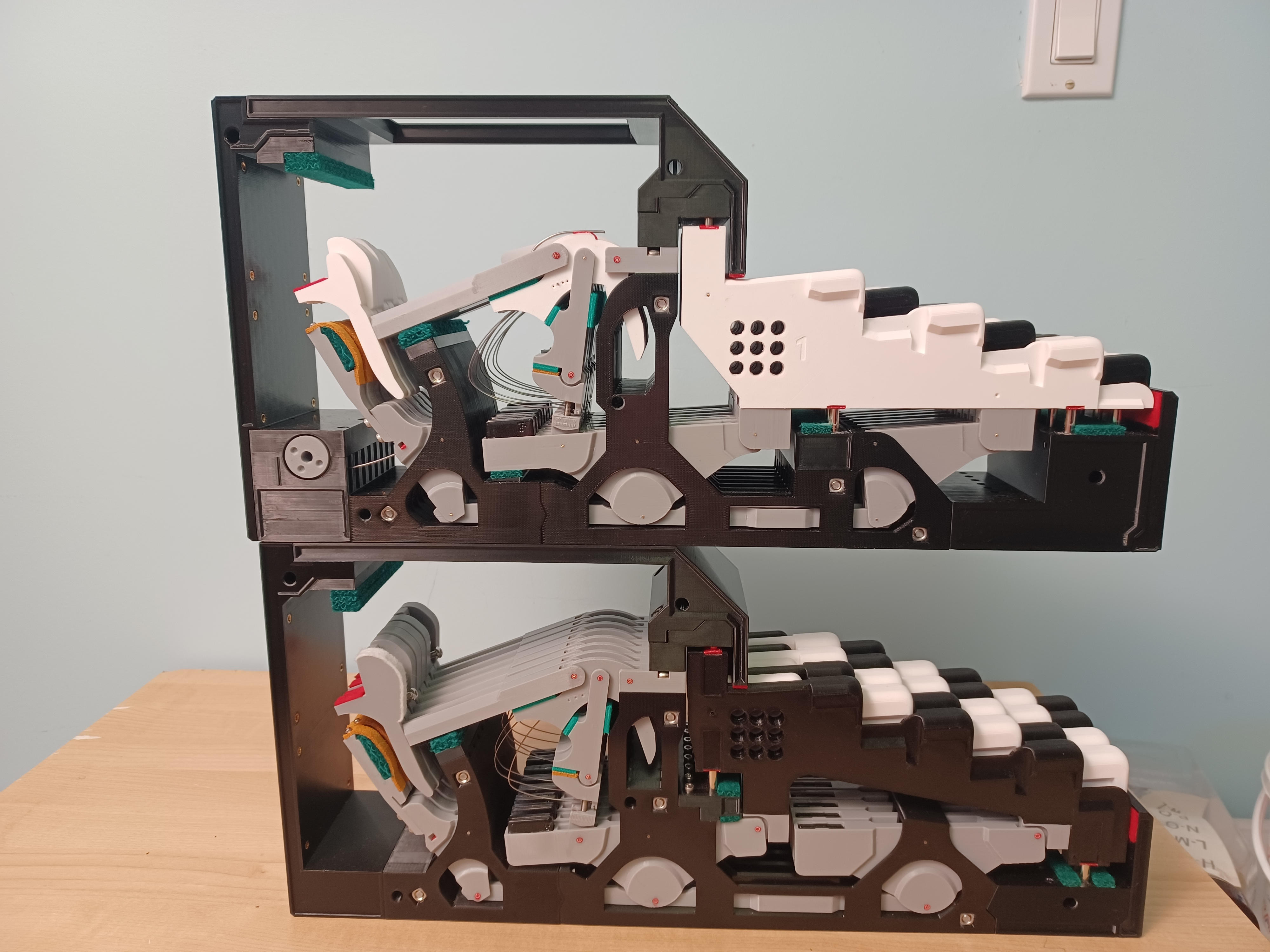
Gotten to the point I have a prototype action (with sensors and everything) working, so I started posting some progress reports and putting together youtube videos about the project.
Some of the posts here (CyberGene's original designs and the stem-piano) were exceptionally useful, though I ended up going with something different for the electronics.
I cant exactly post images here yet, but I wanted to start this post to talk about the design as well as post updates, along with the following locations:
Its a janko piano group, but due to the nature of isomorphic layouts Im pretty sure nearly everyone is a bit of a DIYer here. Have also been lurking in the background the past year and only recently started posting about the progress. Its got some pictures of the design right now, plus a couple videos.
I just recently put it together, so at the moment it just has a single 'promo' clip that I will be using as the opening or intro to the other videos; but I plan to start adding the actual videos to the channel after new years. Already got a couple clips talking about the project, janko layout, and the piano action; just need to finish editing them.
About the design (Janko Layout)
So I am a bit of a self-taught pianist, having started playing piano in university when I transitioned to it from guitar (for which I did have a year or so of lessons, though none of it focused on theory). Up until now I relied mostly on learning pieces through muscle memory and 'hearing' when a note sounded wrong in context. Last year I decided to learn music theory so as to be able to learn pieces 'better', which lead to 12TET tuning and isomorphic keyboards.
The Janko layout was where I ended up - its an alternative piano layout invented in 1882 with was supposed to be the 'next big thing', so much so that even Franz Liszt thought it would it would take over the piano market… but yea - turns out that switching keyboard layouts isnt easy. Since then there have been several attempts at a similar concept, but obviously nothing can push the piano off its pedestal.
PS: quick explanation about isomorphic layouts:
the 'big idea' is that on a regular piano (which is non-isomorphic) you have to memorize 6 different positions for each chord - so a C major is all white keys, while D major is white-black-white, and so on. This makes transposing a song (or a piece of a song) difficult as the fingering will be completely different, and makes it less intuitive to play (same shape corresponds to different intervals, so at least personally this meant that as I was memorizing pieces I could remember which keys to press, but not recognize that I was playing an F major arpeggio).
With a janko layout (as with all isomorphic keyboards), the 'shape' of a given chord is the same - so if you play a C major and want to play a D major you just have to shift your fingers one key down the keyboard without modifying your hand's shape (C# would be the same shape, but up on a diagonal).
For a 'simpler' isomorphic keyboard think about what would happen if you moved the white keys C,D,E into the back row and the black keys C# and D# into the front row (so your 12 key octave will have 6 keys on the front and 6 on the back - here is an example); so a C major would be upper-upper-lower shape, and D major would also be upper-upper-lower (C# would be lower-lower-upper… so not true isomorphic, but instead of 6 shapes you have 2 mirrored shapes - bit easier to remember; the janko is basically this concept just with adding more rows of the same keys so as to make 1 shape instead)
About the action (Hickman action)
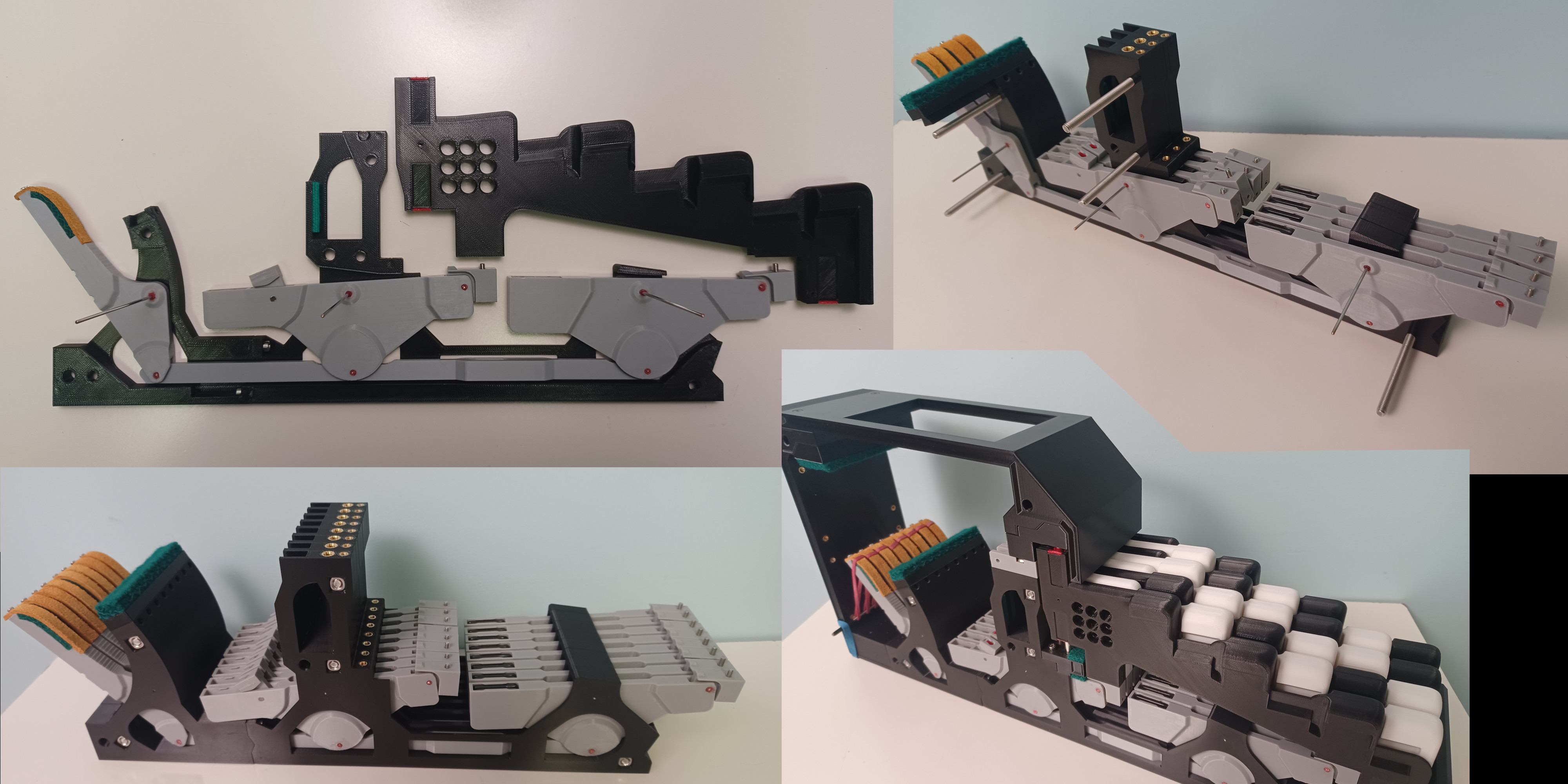
After trying out a bunch of digital pianos in the shop I came away preferring the acoustic actions, so ones like Novus NV10 and similar. Once I started working on the DIY project it seemed only natural to try and incorporate that instead of going with the simple 'weighted hammer' approach.
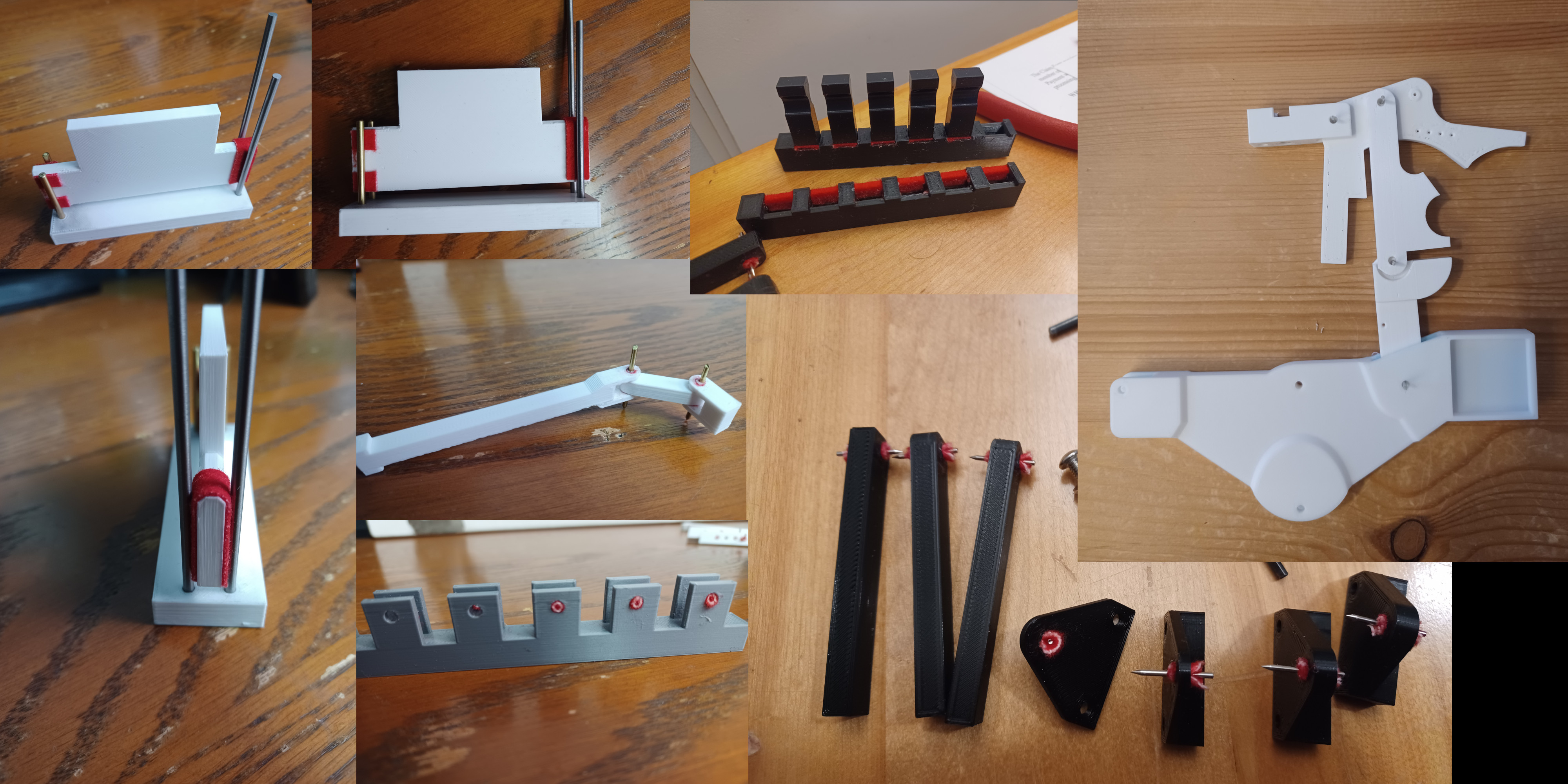
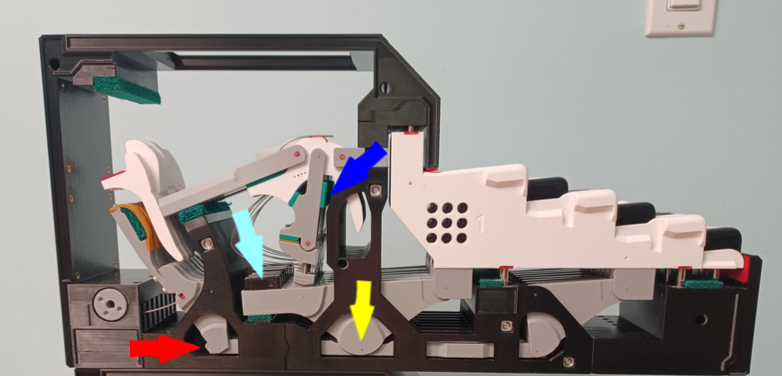
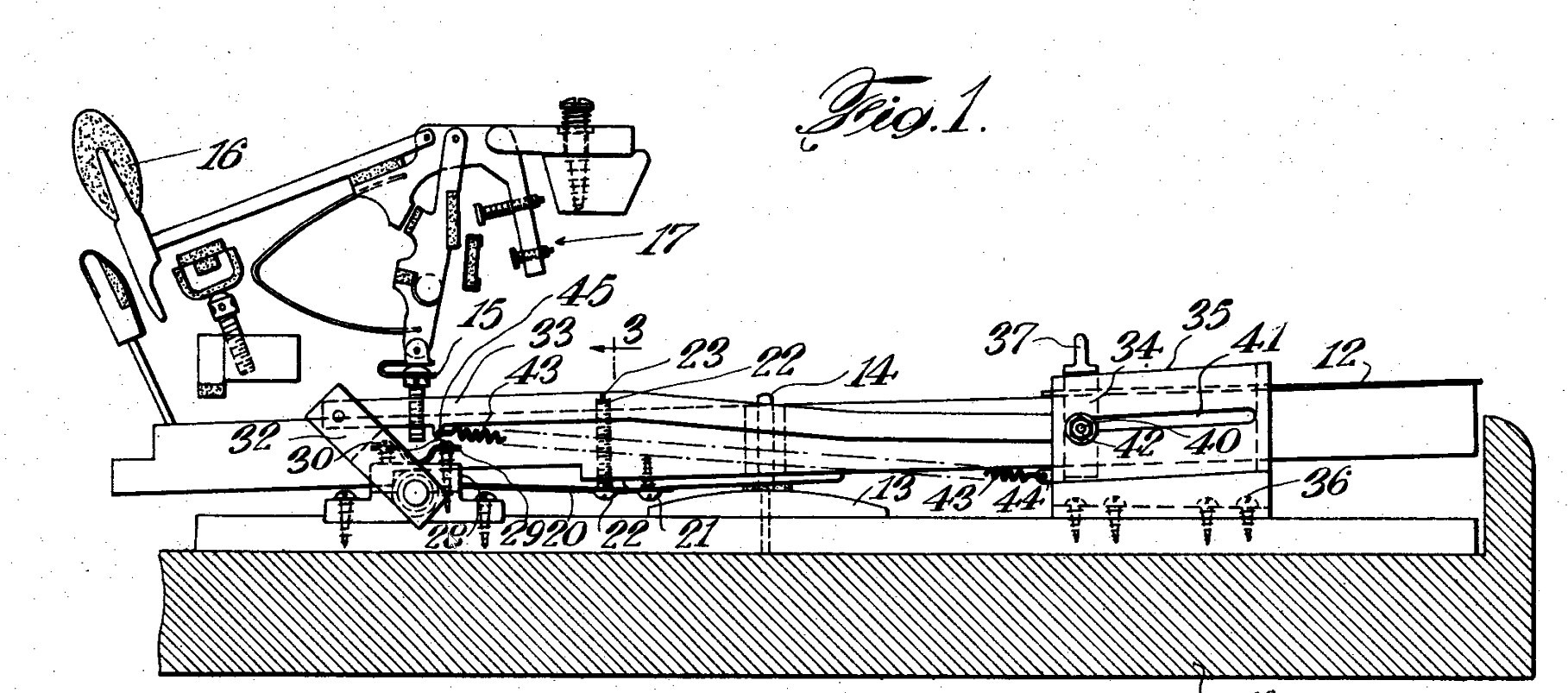
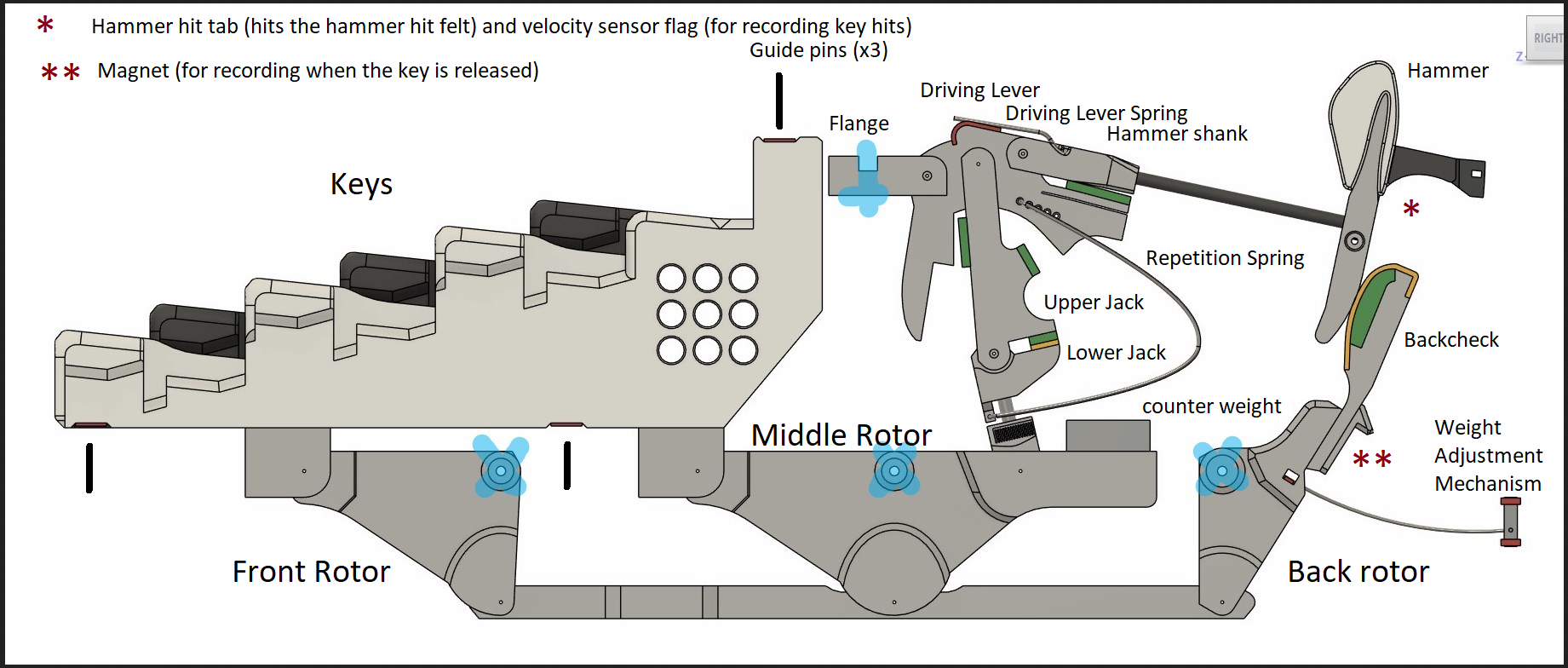
This posed issues, as the janko layout necessitated narrower action (in the acoustic janko layout the piano keys were placed on angled levers to shrink the octave span, but I figured just narrower action parts would be easier), meaning I had to make custom action parts… which would be difficult with the complexity of the Erard double escapement action. Around the time I was starting my design in fusion 360 I came across the hickman action. This offered a much simpler design while retaining the 'realistic grand action feel' that I was chasing, so I pivoted to it instead.
This did end up meaning that I had to learn all about key guide pins, center pins, action bushings, and all the rest…
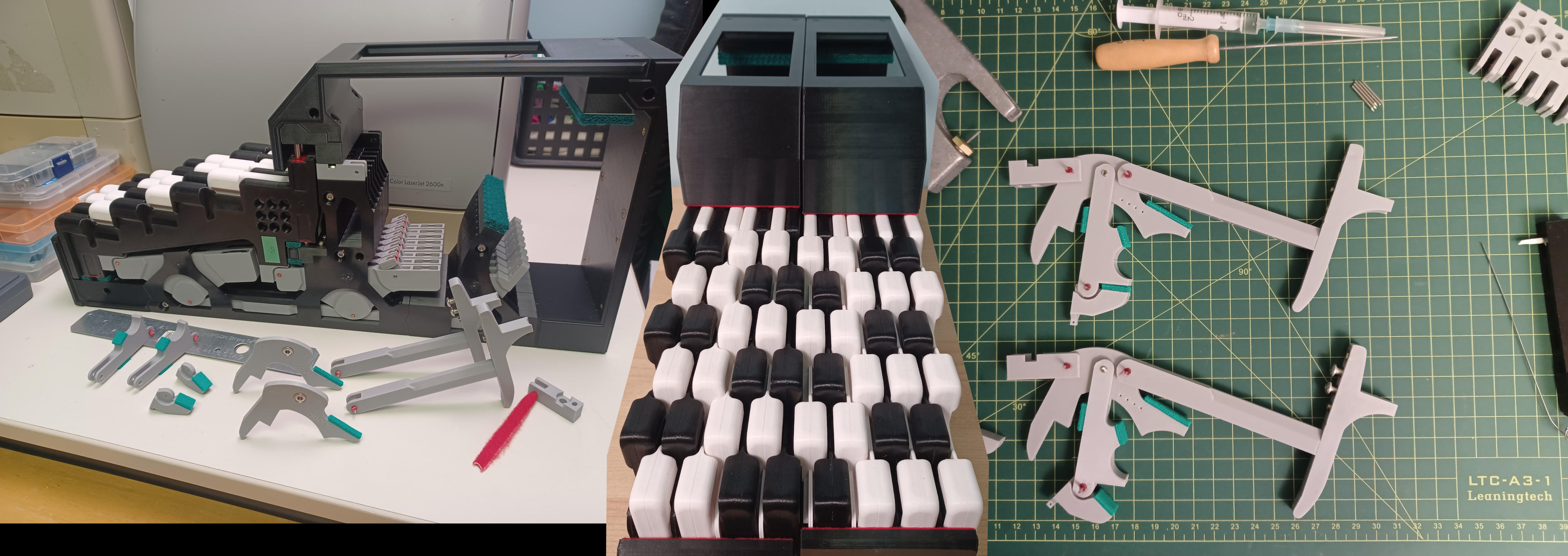
So now my workshop is a mess of piano felt + hardware and 3d printed parts + tools.
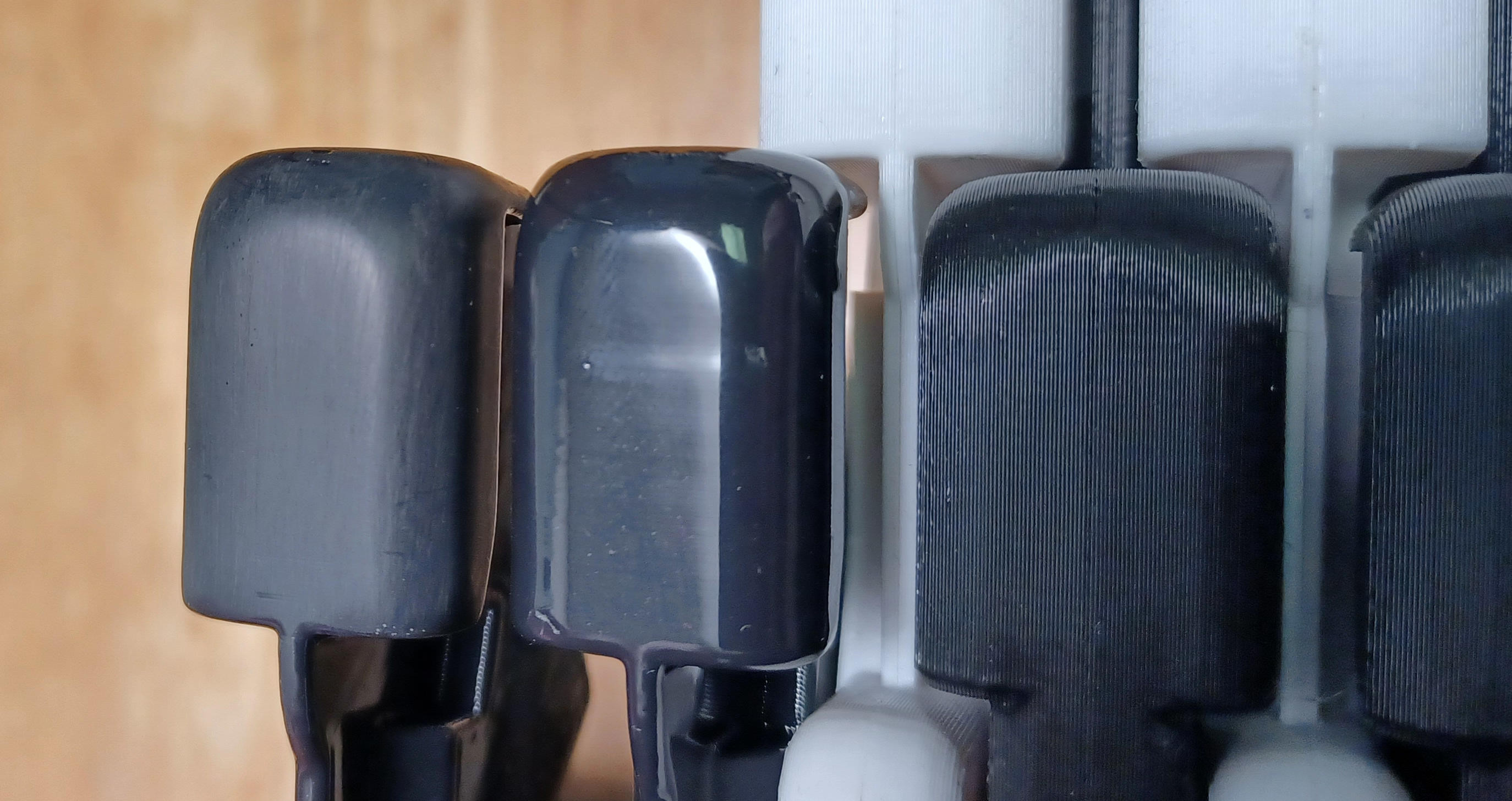
The action did turn out to work beautifully, so I have that going for me at least.
About the electronics
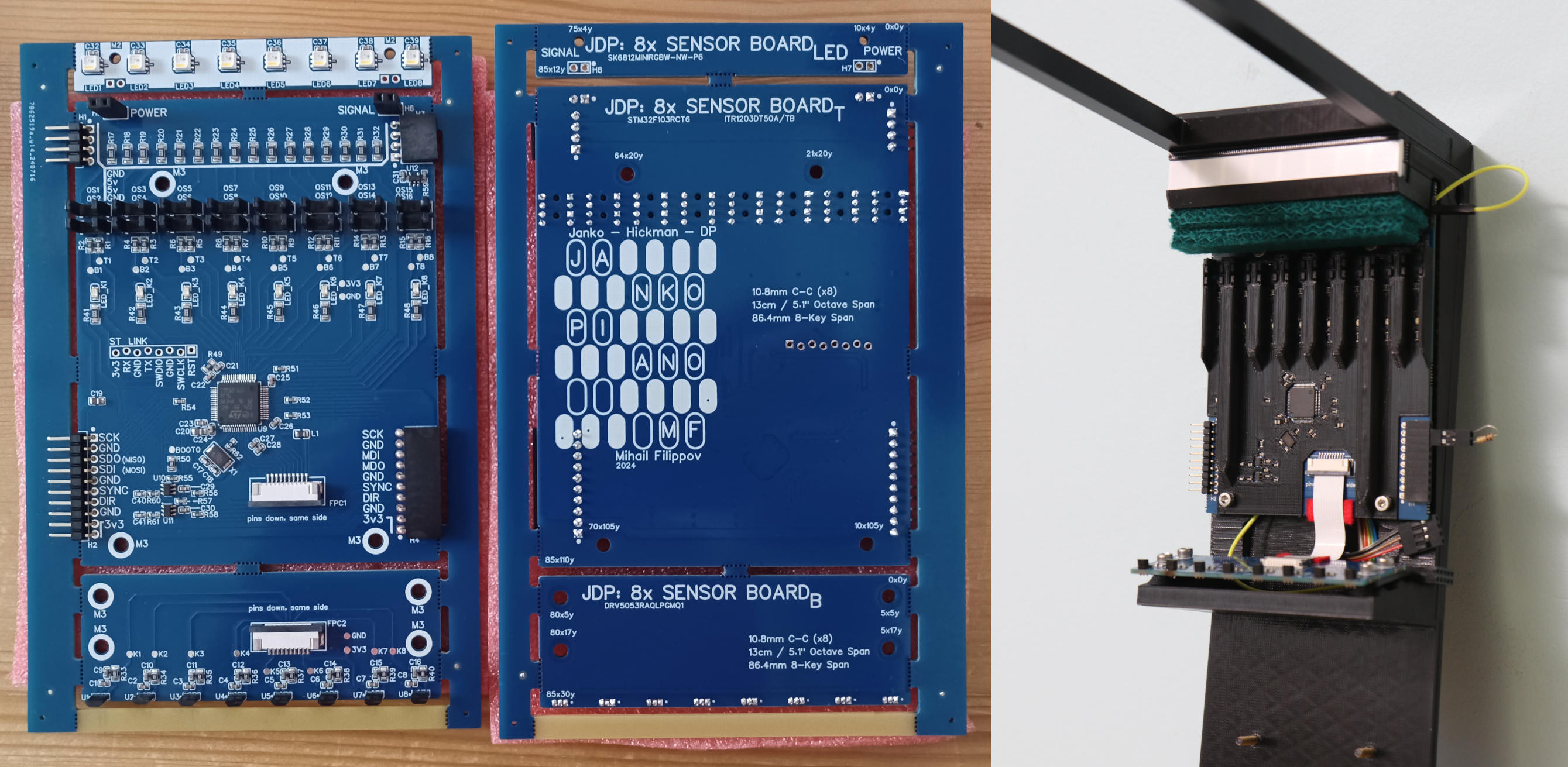
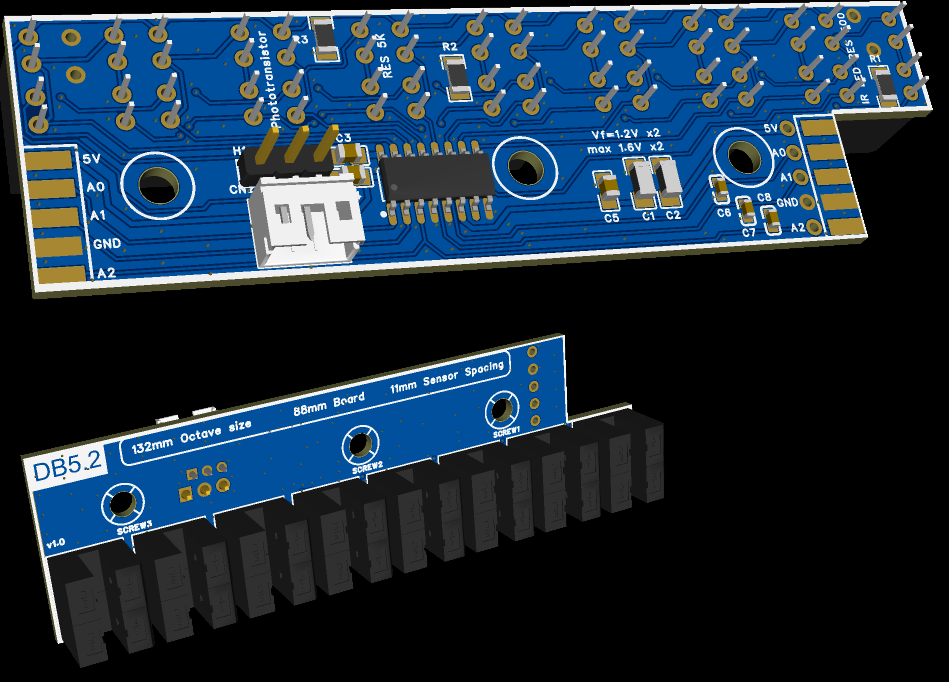
Initially I took inspiration from CyberGene's work and started working on an 8 key double-optical slit sensor board that would be connected in series with a main board that would scan through each board consecutively to read the sensors, but one thing lead to another and I ended up with each 8-key sensor board having both 2x optical sensors to pick up hammer velocity and a hall-effect magnetic sensor to read the (analog) key position (so 16 optical + 8 magnetic sensors). These sensors would be read by a dedicated STM32 microprocessor that would talk via 2x SPI channels to the boards to the left and right of it, with a single 'controller' board placed at one of the ends that would 'request' key data (with that request being echoed by each board down the line), and the receive the data (once again, echoed by each board back to the controller). The controller would then package that data into a MIDI format, accounting for things such as velocity curves and pedal input.
Essentially the sensor boards would be in charge of keeping track of the key states and accurately measuring the velocities with timing down to a couple microseconds, while the controller would just get a 'key press' or 'key release' data every millisecond or so and send it as MIDI to the mini-pc running pianoteq.
Current state of the project
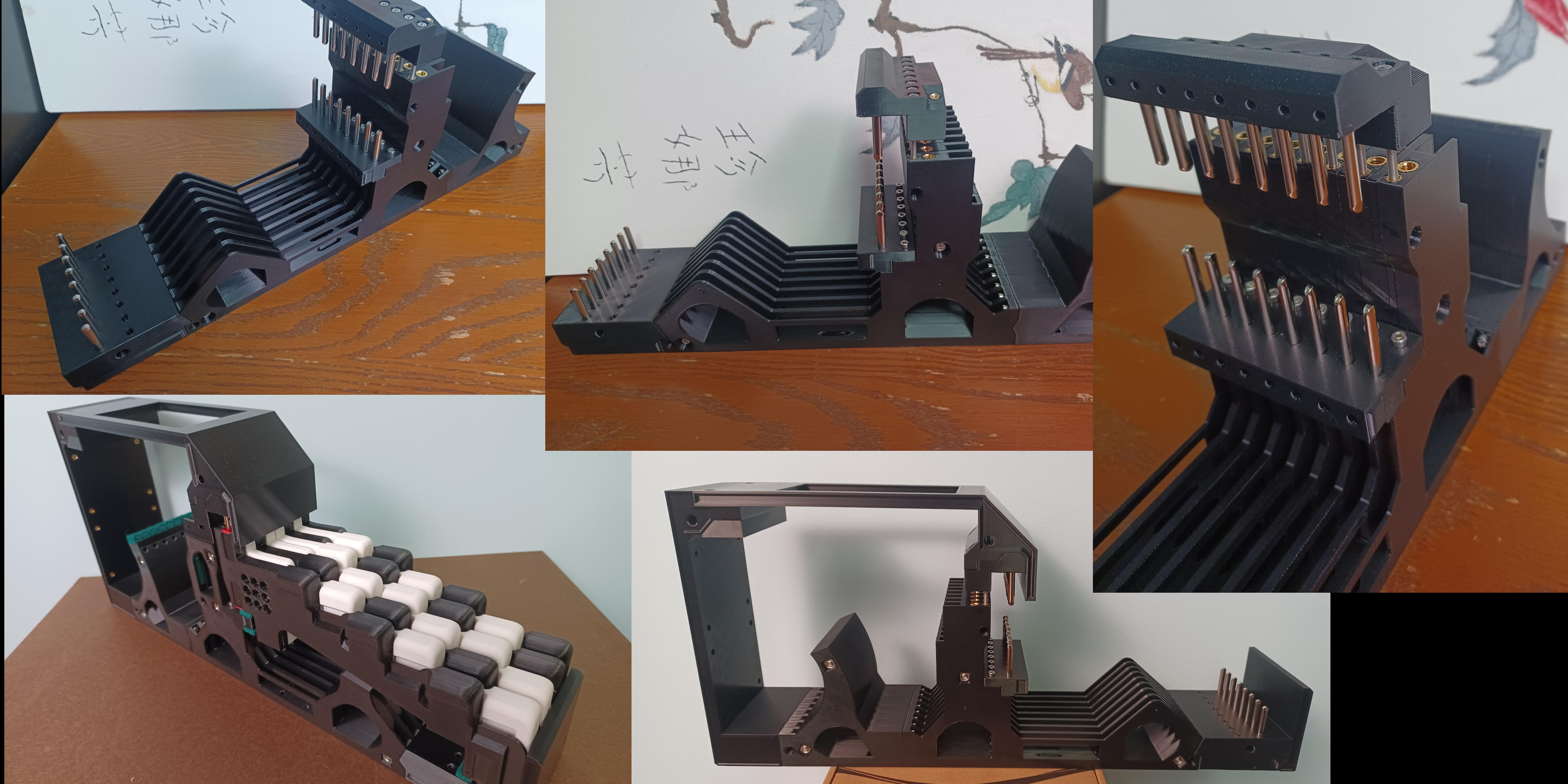
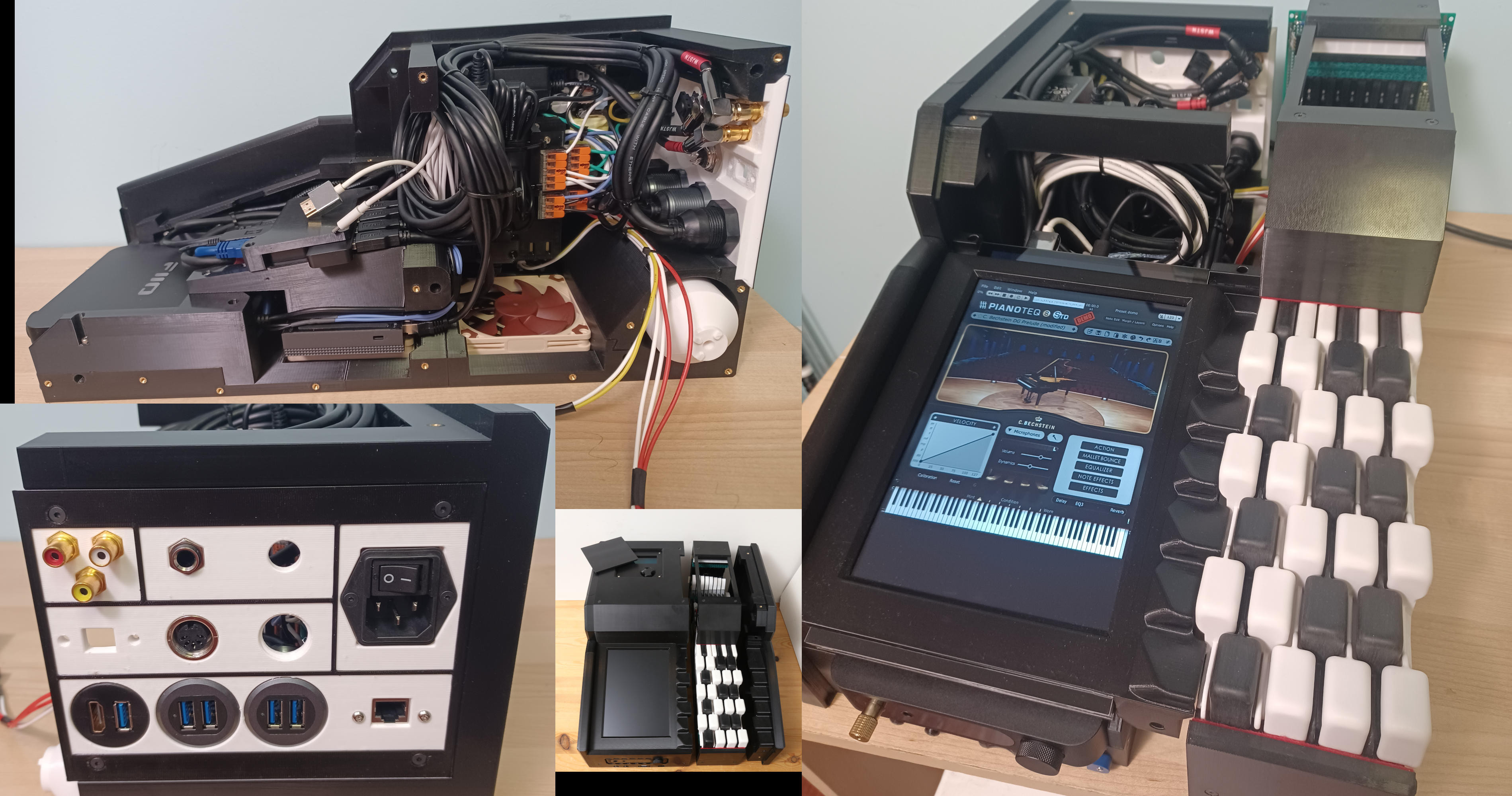
At the moment I have finished the final design of the 8-key prototype and am printing out the parts needed for a full piano. I have the prototype working with the control board & mini PC running pianoteq, though with only 8 (chromatic) keys Ive only really got the first 5 notes of the A major scale to play with - enough to play the 'beginner' version of ode-to-joy, but not much else.
Ive taken the prototype over to a piano technician in the Toronto area, which they marked as being 'quite good, almost feels like an acoustic grand', though we did spend quite a bit of time tuning the letoff mechanism in-shop.
As of right now I am mostly taking the time to finish up the videos talking about the project instead of working on the finished build, mainly because I have thoughts of making a 'timelapse' video of it being put together, which means I need to knock out the other videos first…
Design files and CADs
I have plans to release the fusion 360 files along with the electronic board designs (made in easy eda), though at the moment its all just stored locally on my computer (or at least as 'locally' as fusion 360 and easy-eda with their cloud storage can be). I think I can make them 'publicly viewable', but doing anything like that is just extra work on top of this project so it depends on when I get around to it.