CyberGene
Intro
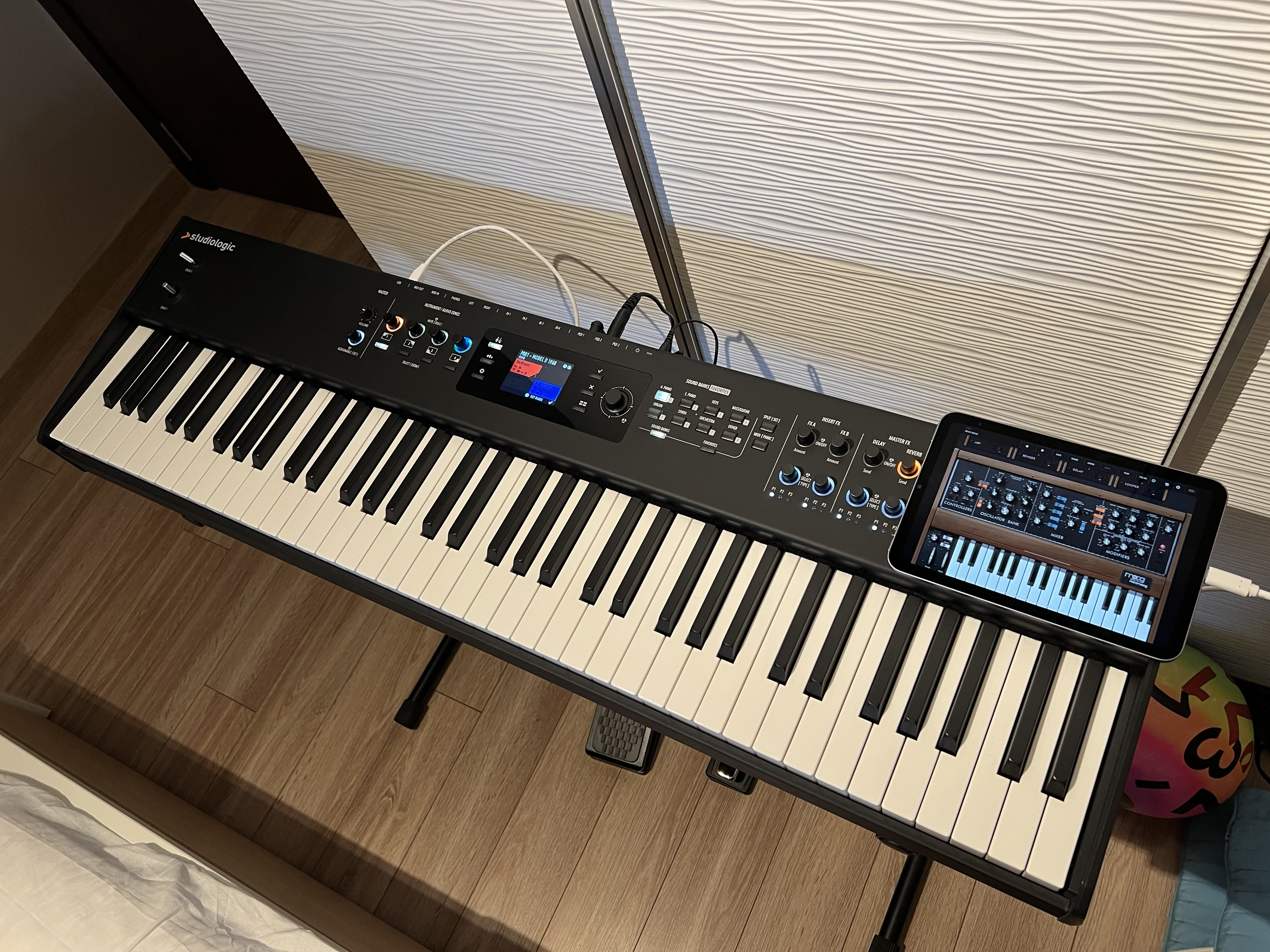
I received the Studiologic Numa X Piano one week ago, had one rehearsal with it and gathered some impressions. At the bottom of this review I've put a background section about how I ended up with it after changing numerous stage pianos and keyboards for the past 2 years and ultimately downgraded from a wonderful Yamaha CP88 that costs more than 2 times the price of the Numa.
First Impressions
The piano looks very compact and at a first glance it gives the impression of a 61-key keyboard. Funnily enough I also purchased a 61-key soft bag that happened to be a perfect (albeit a bit tight) fit for it, the Gator GKB-61 Slim. So, they managed to squeeze a 73-key stage piano with a hammer action in the absolute minimum dimensions which is fantastic. It fits sideways in the trunk of my car. Even if it was 1cm longer it would have been too big already, so a great luck to have one of the shortest possible 73-keys pianos at 105cm. Also it's very light at 11.7kg and my back is thanking me. Looks very solid, all metal body with two plastic side panels. The two sticks look flimsy and I'd prefer proper mod/pitch wheels but I can forgive it considering how compact it is. The included piano style sustain pedal is also very lightweight. It's not a half-pedal though. However the piano supports continuous pedals, and there's an optional triple-pedal that can be purchased separately.
And here comes the first surprise: I couldn't turn the piano on. I tried, I checked the adapter, the cables, the connection, all seemed good but the piano just couldn't turn on. There's a very small power button that's just a "soft" button you push (it won't stay pushed, instead there's electronics that's supposed to detect that you're pushing it). So, that made me experiment a little and it turns out I have to press it very slowly for the piano to turn on. The detection happens halfway through the travel. However turning the instrument off is the opposite: it happens regardless of how quick you press the button and again it happens halfway through the travel. I wrote an email to Studiologic describing this and other observations (see further) and received a quick response from their product manager Gianni Giudici who is very responsive and friendly. He explained they implemented a protection logic and so this behavior is expected and there's no issue. I haven't noticed the same behavior with my Numa X Piano 88 when I had it, so I believe there's certain variability or they changed the detection logic. I also find it a bit odd that it's so difficult to turn the instrument on and so easy to turn it off, should be the other way around. It would have been great if they used an internal power and not an adapter but in that price range that's the norm.
User Interface, controls
There's a nice color OLED screen. A lot has already been posted about the new concepts of the Numa X Piano called UXLogic and how intuitive it is. I can confirm that. Of course, it's not as intuitive as the Yamaha CP88 where you have many encoders and buttons for most of the functions, however given the limited number of knobs and buttons on the Numa they managed to make it very easy to follow and get used to the main concepts which include encoders that can be both rotated and pushed, the main one can even be tilted up/down/right/left, etc. and you can always see on the screen what functions can be used by each control (push, rotate, tilt sideways, press and hold). Each zone is color coded and the LED-s around knobs change to denote the zone. I have a red-green color blindness (protanomaly) and was worried if I may have difficulties with the zone colors but that's not the case, although I have some problems distinguishing between the yellow and the green colors... But you can always see which zone is selected through the corresponding button anyway.
The encoders have a nice tactile click on rotation, so it feels very nice and easy to scroll through menus, change instruments, values, etc. However I must admit that the main encoder that is used for navigating between sounds, would very rarely click backwards before going one click forwards and thus it negates itself. That's annoying and I think I've read other people mentioning this problem too, so unfortunately it spoils a bit the good impressions about solid and firm feel of the controls.
Keyboard Action
This is Fatar TP-110 which is the successor to the TP-100LR. Since I've owned a SL73 with TP-100LR which I hated for being extremely heavy and sluggish, I can confirm the TP110 is an apparent improvement and feels much better. It's still on the heavy side but is certainly not sluggish to play, bottoms out harder than before and I like that very much. It feels lighter than the action of CP88 which some people find too heavy. I love the action in the CP88 although it has pretty high initial resistance. There's something in the CP88 action that makes it more realistic and more reminiscent of a real piano action than TP-110. On the other hand I still find TP-110 better than most entry level actions such as GHS, so ultimately TP-110 is a good middle ground action that should be pretty universal. It's easy to play fast, as well as to play soft and expressively, with a good dynamic response. It also uses triple sensor and you can replay keys without releasing them fully. I could repeat keys as fast as I could. They have improved the touch response with their newer firmware versions and I found it pretty good, although by default it might be slightly on the overly-sensitive side but this can be tweaked.
Surprisingly for a hammer action, it also supports channel aftertouch and it's very easy to control, you don't need to break your fingers to activate it. It's not smooth as my Hydrasynth, however for a hammer action it's great and I used it to control a software synth for which it worked good (had to smooth out the response in the synth though). Name any keyboard with a hammer action in the €1000 price range that supports aftertouch!
Since it's a 73 key version, the range is E-E which I understand is how the Rhodes pianos are. As a classical pianist used to 88-keys, I find it slightly confusing, I'm not used to that and I often find myself pressing the wrong keys in the two ends. I'd much prefer if it was C-C, having slightly more bass keys down to the nearest C, and won't mind sacrificing the high keys instead.
Sounds
Pianos - first the good part. There's a huge variety of piano samples to cover different characters, bright and dark, modern and classical, upright pianos, etc. They all have high quality to them and I can easily find myself using any of them for different purposes. There are also optional sounds that you can download from the website and install and there's around 1GB of user memory for those. As a matter of fact I found the best piano sounds to be the optional ones, especially the Japanese C-183 (apparently a Yamaha). However there's a certain dullness in all pianos when played quietly in the bass. I understand it's a mix of sampling and modeling, and AFAIK the piano engine is inherited from the (now defunct) GEM brand and includes some sampling/storage/compression optimizations that make it possible to fit a lot of samples in a small footprint (the optional pianos are around 100MB each) and this is a speculation but I think they do some spectral compression stuff or something which I'm afraid is responsible for the slightly odd response when playing quietly, especially in the bass. I get the feeling the pianissimos in the bass are just the regular mp samples but replayed quietly, I don't get a soft and dark character. It's not the end of the world though, since it's a stage piano, so these details would be hard to hear in a live situation. You need to be nitpicking with headphones at home. However I think you may have to test it thoroughly yourself if you're looking for the ultimate piano replacement at home. It may work for you or not.
The piano resonances are modeled and to my ears they sound very nice. There's only damper resonance (which confusingly they call string resonance) and no (per key) string resonance. There are also pedal noises which are absolutely annoying when used with the included pedal, way too loud and almost machine gun-like if you press/release the pedal quickly. Furthermore, the default degree of that effect for all pianos is too high and there's no global way to turn it down, so whenever you start creating a new performance, you have to turn that down. If you save the performance it will get saved though. I recorded an example of the machine-gun pedaling and sent it to Gianni and he responded that indeed it doesn't sound good because the piano pedal is only a switch and the pedal noises would sound much better with the optional triple-pedal where a degree (hence velocity) of the pedal can be detected. He said they may add a global setting to turn down the pedal noises.
Electric Pianos They are fully modeled. I'm a huge sceptic about modeled acoustic pianos, and by an extension the electric ones. However the three Rhodes models sound rather good. I think the default presets they created are a bit too bright and bell-like for my taste but due to the modeling I was able to change crucial parameters of the hammers and tines and make my own Rhodes sound which I really love. I still think the sampled Rhodes pianos in the CP88 have an edge but it's not a really big difference. On the other hand I was able to hear the sample switching in the Yamaha, whereas here all is smooth thanks to the modeling, there's nice bark, I hear some randomness simulated. Maybe modeling is already there when speaking about electric pianos (not yet for acoustic pianos but that's another topic 😉). I'm not a huge fan or Wurlitzer, so can't speak whether it's good or not. There are also some so called "Hybrid FM" pianos where a (sampled?) attack from FM pianos is followed by the modeled Rhodes engine. Some of those are interesting, others are rather lame.
Other sounds - Haven't dug too much into them, the tonewheel organs sound good to me and the Rotary simulation is pretty good with smoothly changing low/fast speed assigned to the mod stick. Gianni himself is a top-notch Hammond player (look him up on YouTube) and he said he programmed those patches himself. There are some synth sounds, including lead synth sounds but those don't have portamento and are not monophonic which makes them really not fun to play. There are some nice pads and strings though and many other sounds which I haven't had chance to use so far.
Features
The most important feature for me about this keyboard, and I need to stress this out, is an absolutely terrific 4-zone external MIDI implementation with class compliant USB-audio support. It just blows the CP88 out in the wind! Although the Yamaha also has 4 external MIDI zones and USB audio, those are buried in the menus and are very hard to use. On the Numa X these zones can be treated in the same way as the internal ones: you can easily turn them on and off during a live performance from the main zone knobs, you can control their volume through the same knobs, you can assign each of the four knobs (in zoom mode) to configured MIDI control changes, you can easily set splits. Basically, there's no difference between an external and internal zone. This is just the perfect stage piano to integrate with software synths! I'm so pleasantly surprised that this fact alone makes me a huge Studologic fanboy! I played a rehearsal where I had two internal zones (Rhodes and an acoustic piano) and two external MIDI ones going through the USB (carrying both audio and MIDI) to my Mac running Logic Pro X with two instances of U-He Diva. It was divine! I could easily turn on/off each of these zones thus creating splits and layers on the spot and Diva is probably the best sounding plugin I've ever heard, so it was all a dream to me. The other guys noted how well I sounded.
Another mind-blowing feature on the Numa X is that when you switch off a zone (internal or external) and if you have some keys held, it won't cut them off as on the Yamaha CP88 where the zone on/off buttons would just interrupt the entire sound including effects instantly in a very ugly audible way. In the Numa though, it's very well made with the zone just paused for receiving further keyboard input, however the currently held keys would still keep sounding and any note releases will be preserved, along with the effect reverb tails, etc.. And when you combine that with what I described above: turning zones on/off while I was playing, it just made for the smoothest possible experience. Kudos to Studiologic!
The various effects are very high quality and equivalent to those in the CP88. However switching between effects while playing would lead to some click and pops which is unfortunately something where it's worse than the Yamaha but I believe changing effects that are applied to a sound during playing is not a very common scenario anyway. There are two effects per zone + global delay and reverb + EQ. The various reverbs are of especially high quality. The drive/amp simulations are also pretty good.
The Numa X has 4 mono inputs that can be combined into two stereo inputs and those can go through their separate effects, a mixer and EQ, unlike the Yamaha which just routes the audio input to the output.
There's a software manager for updating the firmware, uploading optional sounds, managing performances, etc. and it looked nice and intuitive.
Part of the "features" is how responsive Gianni Guidici is, their product manager. He responds quickly through email and answered all my questions, he promised they will review my suggestions and he even invited me to their headquarters when I visit Italy next time 🙂
Conclusion
In my previous review of the Numa X Piano 88 I approached it as the ultimate piano, from my point of view of a classical pianist looking for the best piano experience and that was wrong. And I was disappointed. However this time I purchased it, and am reviewing it, as a gigging stage piano. It doesn't disappoint and impressed me enough to keep it and love it! The Numa X pianos are stage pianos for live performance (solo or in a band) and they have some terrific features that are unmatched for the price. They nevertheless have some quirks and peculiarities and I see some people having quality issues, so you should be cautious.
BTW, the highest E key on my Numa had loud thump on release. I unscrewed very slightly one of the side panel screws next to that key hammer and that solved it. Apparently the hammer was touching the screw 😀 Gianni swears this is not the way it's designed and must have been caused by transportation. I don't know what the truth is but I don't care, I fixed it and I'm OK with a screw being slightly loose after all, there are so many of them on each side panel and they have no weight bearing or structural function, they are only used to hold the side panels to the body. I love Italian things and I know they have their own mind from time to time 😉 Italians seem to posses great engineering skills but maybe the quality isn't exactly a strength. I'm glad to know that the piano is entirely made in Italy since I can't stop repeating how much I love Italy 🇮🇹❤️
Background
For those who might miss the context, here's some perspective. I needed a portable instrument for occasional jams, no professional usage. Mostly pop/funk type of music with jazzy feel, Rhodes sound being the most used sound. I would best describe myself as a classical pianist, I only like real grand piano actions, I have a Yamaha AvantGrand N1X which is my main instrument and I consider all digital pianos unsatisfactory 😀 But for my gigging purposes I didn't care much. So, for the last two years I went through the following instruments:
Studiologic SL73 Studio - awful keyboard (Fatar TP-100LR), heavy and sluggish.
Yamaha MODX6 - surprisingly playable keyboard, despite considered the worst synth action in the Yamaha line. Fantastic sounds. But very unintuitive for live playing and hard to understand all these convoluted concepts. Might have been good as a preset-machine but I didn't like the idea and sold it.
Yamaha YC61 - liked it a lot, especially the waterfall keyboard which was perfect for piano playing. Didn't want to sell it but 5-octaves were too limiting for piano and Rhodes playing.
Yamaha YC73 - great, although a bit expensive for what I needed. The action was OK. It had a defect and I had to return it. Since there were no other available units, had to find some other instrument
Numa X Piano 88 - I posted my experience here The keyboard action is OK, probably better than YC73 but not by much. Lukewarm acoustic pianos that always sounded dull to me. Pianissimos were very weird and a bit odd to control. Rhodes is OK, but the one in Yamaha is better and more varied. The interface is not as intuitive as advertised, less intuitive and direct than Yamaha. Also had some sound artifacts but I was on the initial firmware version. Returned it and decided to go back to Yamaha. But at this point the only available Yamaha stage piano was CP88.
Yamaha CP88 - fantastic instrument! Great piano action (although on the heavy side), excellent pianos and Rhodes. A dream instrument, really hard to find any complaints. But... Way too heavy and caused some pain in my back because I have a herniated spinal disc. Couldn't fit in the trunk of my car, so I had to fold down the backseat and thus lost seats and I drive my bandmates in the car. It was sad but I sold it and purchased the Numa X Piano 73.