Skip to content

SFZ

jdg78

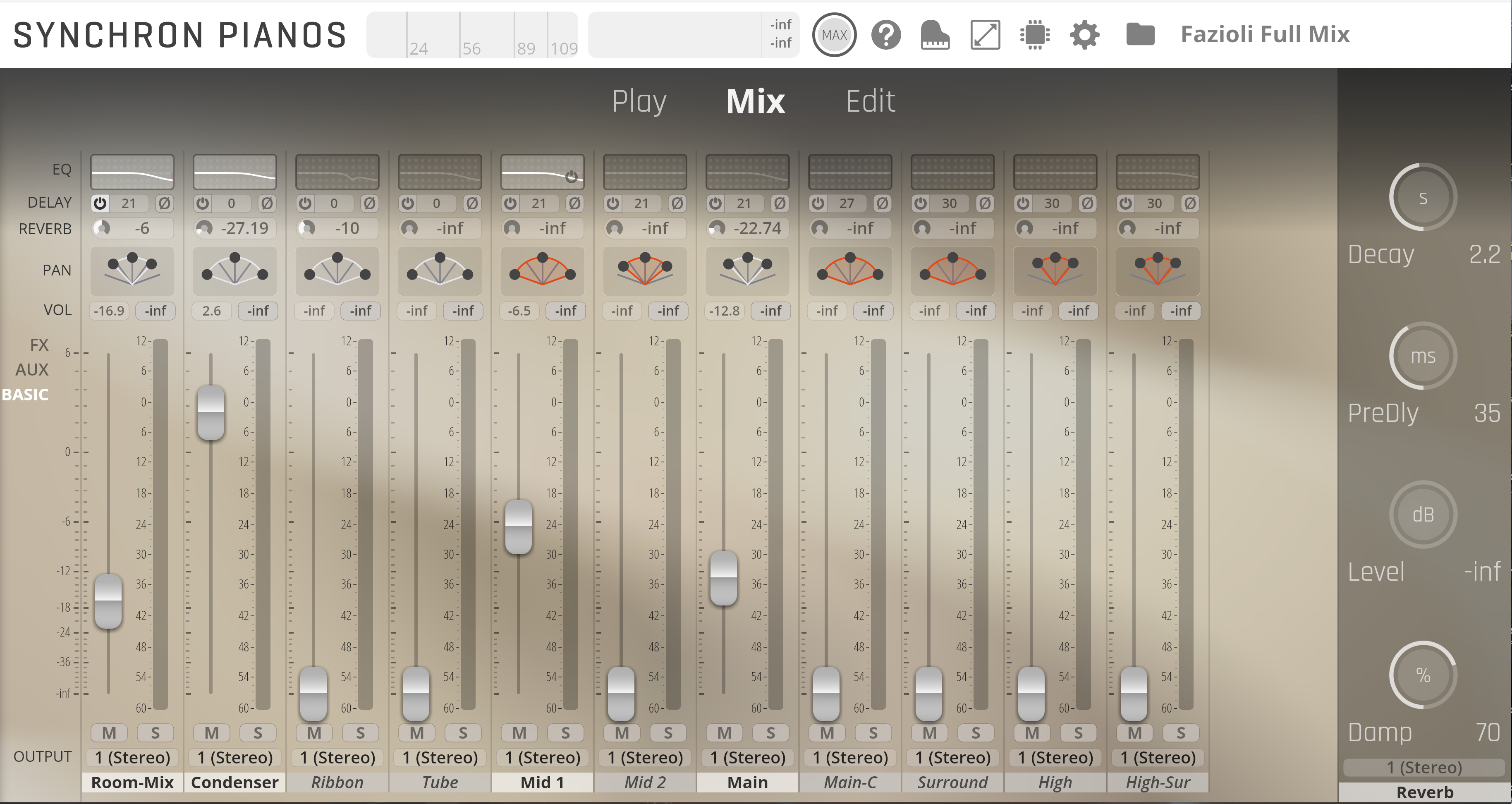
dore_m One last question - which microphone setup did you use, and where there any EQ's applied? A screenshot of the mixer screen would help, if possible. (Thanks again)

I used a custom mic mix as shown below:

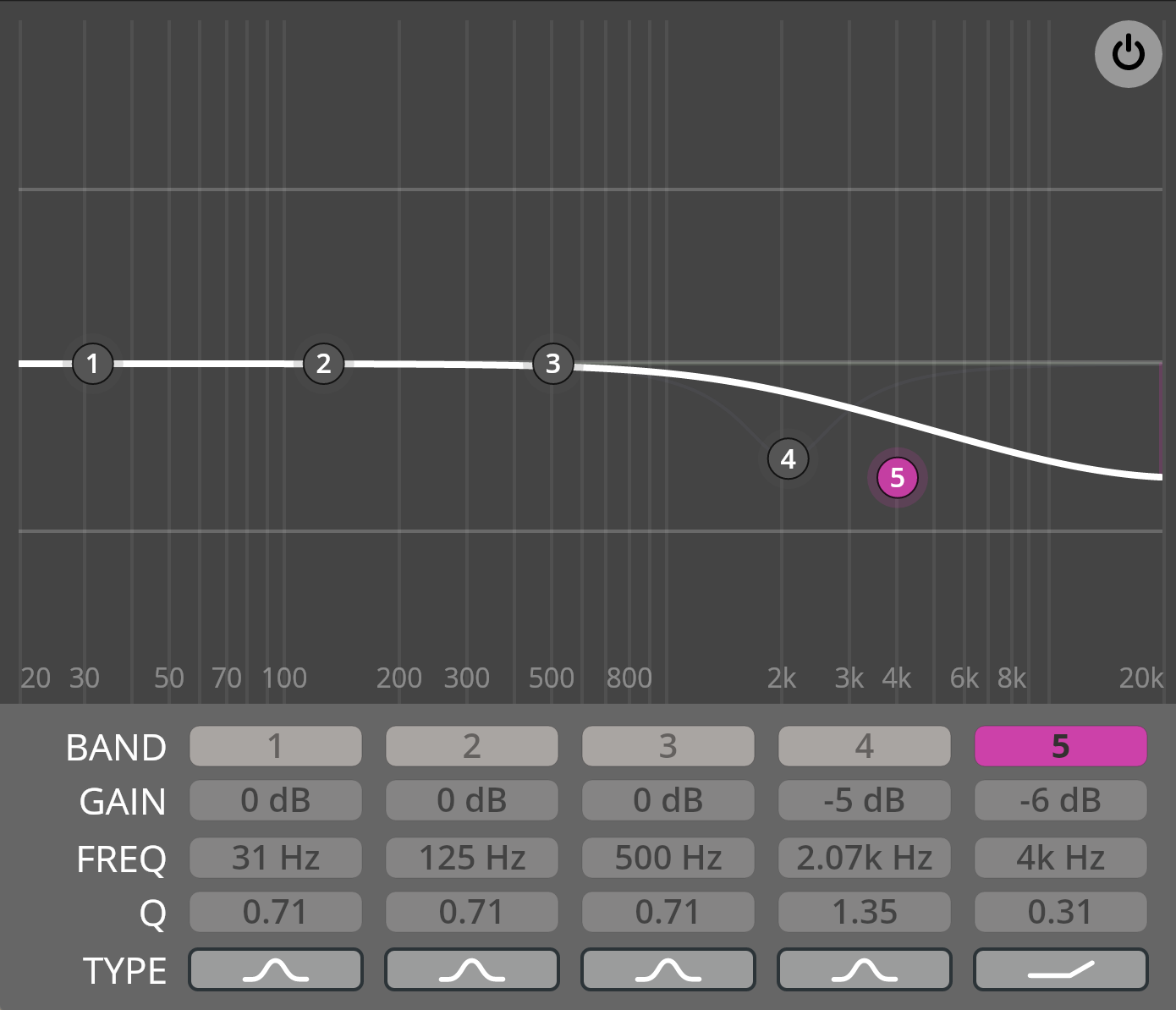
Re: EQ, I hadn't actually noticed this before, but it appears that by default VSL has applied some EQ to the upper frequencies on most of the close and mid mics. Here's what the EQ chart looks like:


dore_m

Rhodes74 The energy increases but as there is a very pure fundamental the center of the amplitude depends on timing of samples.
@dore_m , did you see similar effects with other pianos?

Funny thing is that because I don't record many layers, and because I mostly close mic everything, I haven't noticed this. I'll conjecture that these mics are the far away mics (?), that maybe affected by phase more? I noticed that in the piano placement diagram that they strangely placed the piano in the center of the stage, with the player facing the audience/far away mics. In doing so, the lid is reflecting sound to the side. Could this cause the irregular forte waveforms?


dore_m

jdg78 I used a custom mic mix as shown below:

That explains why the "brightness" on the right side of the graphs isn't as prominent as the other piano plots - the upper frequencies are muted with EQ. Interesting that the condenser (close) is the largest contributor, as condensers are the type of mic that introduce the least color.

It also somewhat shoots down my theory about the piano placement and discontinuous waveforms at ff.

I haven't used the VSL GUI much, just a 30 day demo, but the Mid1 mic I think has it's pan changed by 180 degrees (red color). Maybe that caused the discontinuous waveform (?)


dore_m

vagfilm The first (leftmost) 8 notes of the VSL Fazioli (midi 4 to 30s) show a distinct step-like increase in amplitude (blue trace),

I can definitely hear the difference between the 8th and 9th note. You can see a yellow line abruptly appear in the 9th note, seen just below the blue waveform. And the relative amplitude jumps around a bit in this range.

Rather than ask for another wave file without EQ, I just recreated the EQ exactly like the screenshot, applied it to my Fazioli instrument and inspected the waveform. I'm not posting the screenshot, but it's now apparent to me that I should have recorded a lower velocity, so I should use the (disabled) EQ curve simulating the darker ppp samples. It's not true to my recordings, but more true to the instrument. My question is basically answered.


GPG

Apologies for a dumb question - is it possible to adjust velocity when using The Experience Fazioli on sfz? I can’t see a control for this.

Thanks and thanks for great instruments.


dore_m

GPG Apologies for a dumb question - is it possible to adjust velocity when using The Experience Fazioli on sfz? I can’t see a control for this.

Unfortunately there aren't any onscreen controls with SFZ. I wish there were, or Plogue would release their SDK extensions for my use. However, there is a way - but it's a bit manual. You have to edit with a text editor.

As you probably know, velocities range from 0-127. Each block of samples (I think called a group) is placed within a velocity range with the following lines:

lovel=1 hivel=39 amp_velcurve_1=.48 amp_velcurve_39=.87

lovel is the low velocity of the range, hivel is the high velocity of the range. if you change, for example, hivel=51, then those sounds will play within the velocity range 1-51. You should also change amp_velcurve_39=.87 to amp_velcurve_51=.87. This is the EQ that opens up in the velocity range.

Hope that makes sense. You just go through and do a find/replace with a text editor. You literally can say replace "=39" with "=51" and _39 with _51. That would surgically replace the correct numbers.

QuasiUnaFantasia

Also, if you have the Aria player (which comes with Garritan CFX) then you can play Dore's instruments through that, and Aria does enable changing the velocity curve easily.

I only realized that you could play other sfz VI's through it rather recently myself - after years of owning it. 😂


GPG

Many thanks, Dore, for the detailed response - and then to QUF for the tip re Aria.

PS - I think the Experience Model B vst is the best yet.


GPG

Sorry, new question. How do I access the Aria Player (I have Garritan, but I can't see how to load the The Experience files?

thanks,


dore_m

GPG Sorry, new question. How do I access the Aria Player (I have Garritan, but I can't see how to load the The Experience files?

thanks,

I just tried - you open garritan and drag the sfz file onto it. However, the velocity curves didn't work for me.


HZPiano

dore_m

Hello,

My suspicion would be that the velocity controls are part of the Garritan CFX script, and not of the Aria player itself?

This is just a hunch though, I do have some experience with SFZ scripts (using Sforzando) but no hands-on experience with Garritan or their specific version of Aria.

Cheers and happy experimenting,

HZ


theodorn

I haven't used the Sforzando player in many years, but I know that the Garritan Aria Player and Plogue Sforzando Player, are not the same. You will have to correct me if I'm wrong on this, but I believe you have to install the Plogue player to use SFZ based sample libraries like The Experience from Dore, even if you have Garritan installed.

I remember I could open Garritan CFX in the Plogue player, but some of the settings that were available in the Garritan player, were nowhere to be found in the Plogue player. The two players are both based on the Aria engine (or whatever it's called), but are not the same altogether.


theodorn

Thank you for confirming that Dore. I see now that HZPiano said basically the same thing as me, that the settings in the Garritan CFX are specific to only the Garritan CFX. So the Plogue Sforzando is needed for your great libraries.

It would also be strange if free libraries would require that the user owned Garritan CFX. Then they wouldn't really be free, though you (Dore) wouldn't be getting a cent, only Garritan.

Oh yes, and Merry Christmas to you all, and a happy new year. Been a pleasure having conversations here in this year that's coming to an end, and may they be many more in 2023.🎄🎉


QuasiUnaFantasia

I just tried it out again, and loading the Fazioli (audience perspective) into Garritan CFX works fine, and all the controls seem available. But, some of them don't seem to actually do anything. Any velocity curve can be chosen, but it appears to result in the same touch sensitivity, and the equlizer does not appear to function as intended either. But the reverberation engine works perfectly fine, and I just created a preset for the Fazioli using the "Standard concert hall" setting. Loading this preset into Plogue sforzando results in the Fazioli being loaded along with the concert hall reverb. But again neither velocity curve nor equalizer seem to be functioning.


dore_m

QuasiUnaFantasia But, some of them don't seem to actually do anything.

Truthfully, SFZ players are a hot mess. The reverb is a function that is in the player and not in the SFZ coding. Sforzando also has a reverb knob that I don't have any control over. The rest of the functions, I imagine, are GUI elements that are connected to the SFZ code, and because I don't have the developer extensions/guide, I can't implement anything.

It's all in the way SFZ developed. There was SFZ v1, then V2, then custom Cakewalk extensions that only work in the Cakewalk SFZ player, then Sforzando with ARIA extensions. Sforzando remains the best SFZ player because it supports all of the prior commands. Other SFZ players support only a subset of the commands/extensions, so, for example, things don't work in SFfizz or other SFZ players sometimes.


« Previous Page