
RIP
Ok, this is the step I am tackling after #276 (and you might want to check also #542 if you haven't already).

In hindsight, doing cables after building the electronics was a mistake. Cable management should have been designed in full details before producing the electronics, instead I just said "I'll figure out the details later". Huge mistake.
First of all, a mention of the scale. Piano has 88 keys. Each key has two sensors (one for hammer, one for key/damper). Each sensors need two cables, so 4 cables per key. Plus there are a few more sensors for the three pedals, there are cables for the power supply of each board, not to mention the communication bus and other stuff. But I'm talking about sensors only here. We are talking about 400 cables (and considering a few mistakes one can make, perhaps even more). Additional 1000 words:
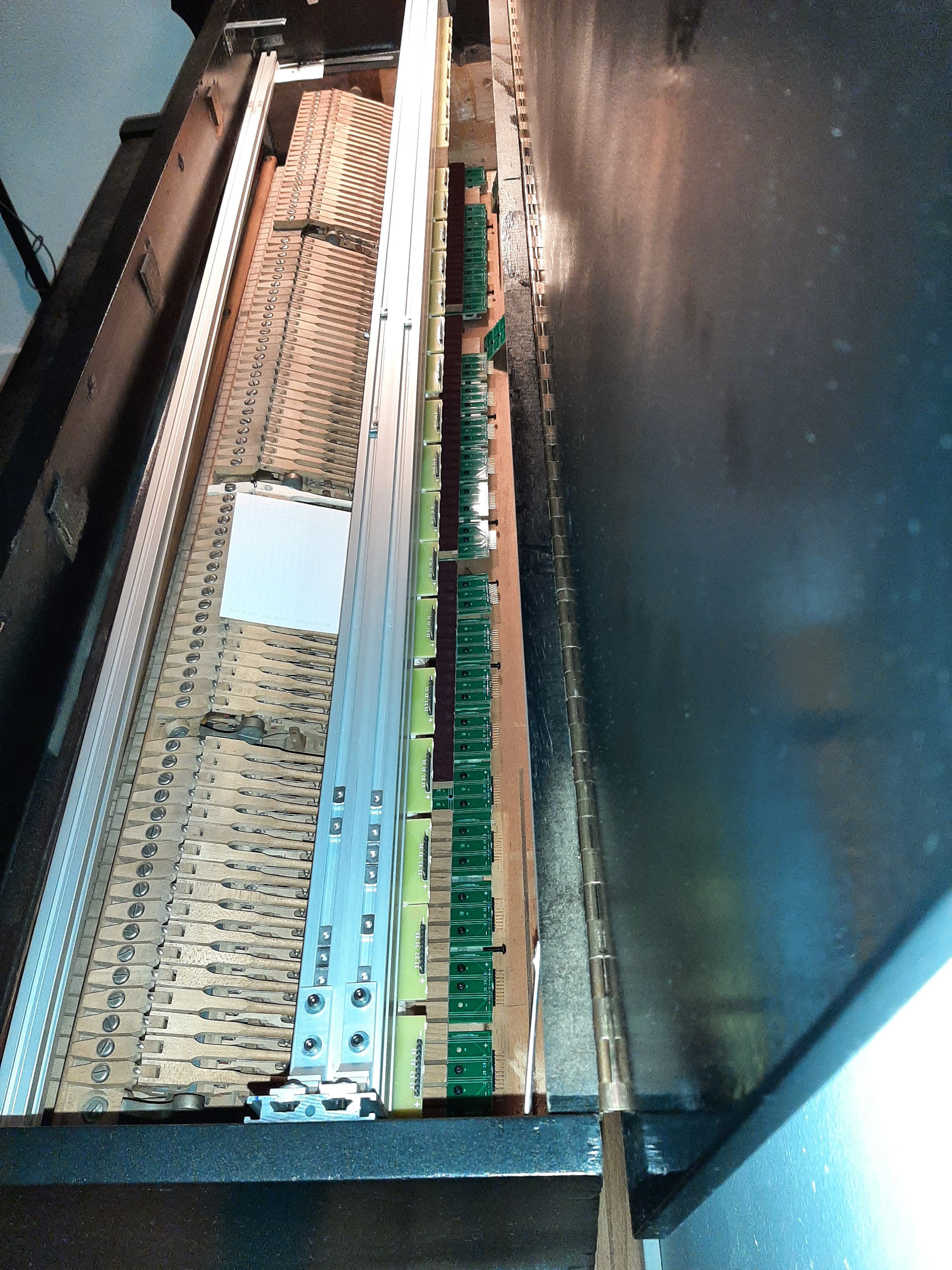
See those tiny connectors? If not, see those green boards? Each one has 8 (besides a few boards at the edge when there are no more keys) signal connectors. Each of those need to go to an ADC board. And each of those green boards also has 2 power connectors which need to the LED power supply. Lots of cables and lots of cable management to do it in an easy way which does not generate a tangled mess impossible to service in the future.
Should I have done that earlier, I could have used different connectors and perhaps different distances to be able to use a cable like https://www.digikey.com/en/products/detail/3m/1700-20BA/3866921 which I could have build much faster than instead I am stuck with now.
One problem is that the ADC board will use a two-row connector, with emettitor-collector pairs one over the other, as shown in the following picture:

whereas the sensor boards use one-row connector with emettitor-collector adjacent to each other, as seen in this other stock picture (E and C indicate where the emettitors and collectors are, respectively, and they alternate even when there is no letter).

This makes the use of IDC connectors a challenge, because the one-row ones use a 2.54mm pitch cable, whereas the two-row use a 1.27mm pitch cable. Possible, but a challenge, involving "breaking" the tightly packed ribbon and making it "larger" to match the larger pitch. Also the involved distances between ADC board and sensorboards (both the hammer and key sensorboards) are different than what is available in these pretwisted cables.
I discuss other options at https://github.com/jkominek/piano-conversion/issues/55


