
Skip to content

Build your own hybrid piano - step four, the cables

RIP

Ok, this is the step I am tackling after https://pianoclack.com/forum/d/276-build-your-own-hybrid-piano-step-three-the-electronics (and you might want to check also https://pianoclack.com/forum/d/542-update-on-piano-conversion/ if you haven't already).

In hindsight, doing cables after building the electronics was a mistake. Cable management should have been designed in full details before producing the electronics, instead I just said "I'll figure out the details later". Huge mistake.

First of all, a mention of the scale. Piano has 88 keys. Each key has two sensors (one for hammer, one for key/damper). Each sensors need two cables, so 4 cables per key. Plus there are a few more sensors for the three pedals, there are cables for the power supply of each board, not to mention the communication bus and other stuff. But I'm talking about sensors only here. We are talking about 400 cables (and considering a few mistakes one can make, perhaps even more). Additional 1000 words:
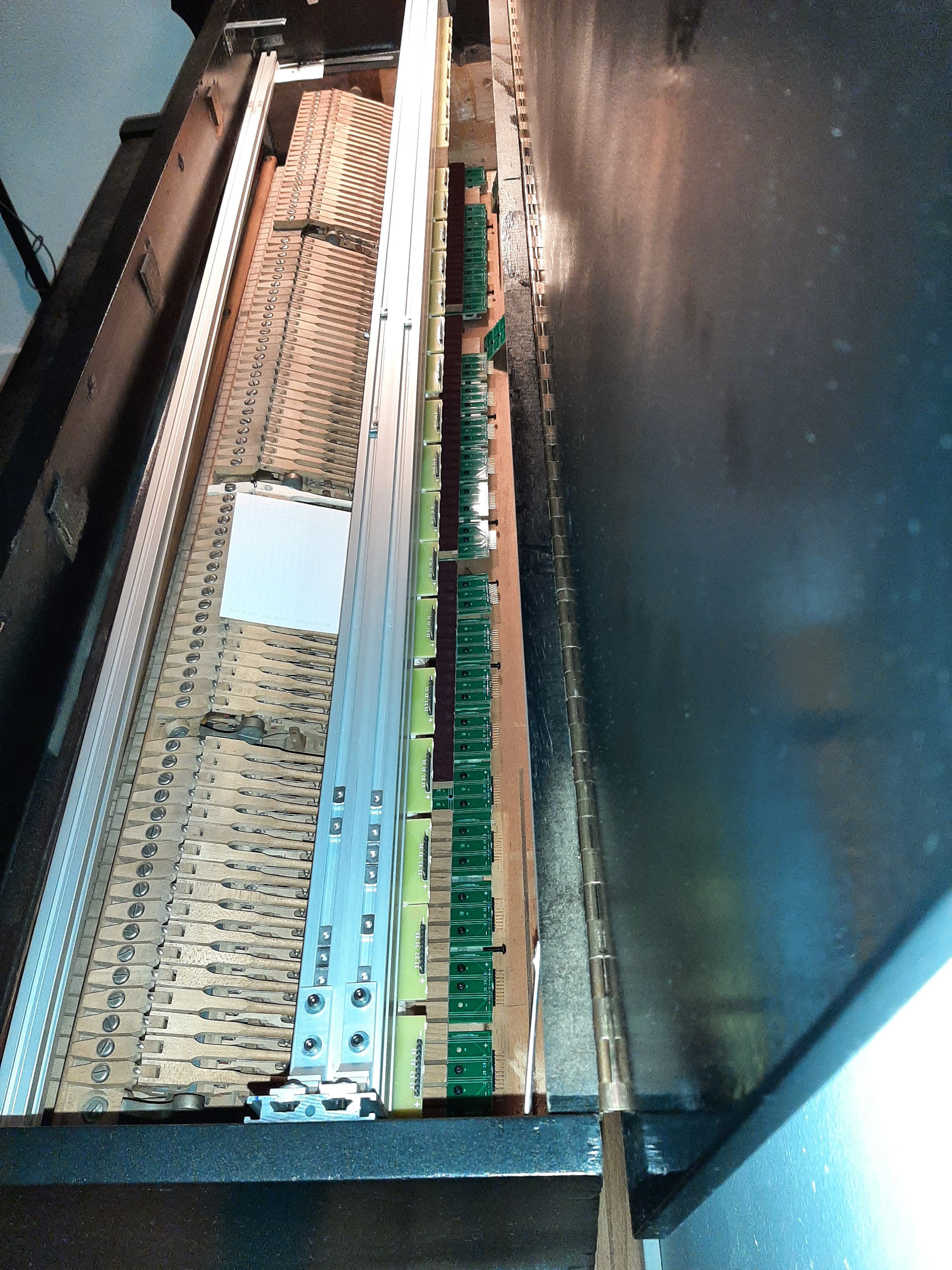
See those tiny connectors? If not, see those green boards? Each one has 8 (besides a few boards at the edge when there are no more keys) signal connectors. Each of those need to go to an ADC board. And each of those green boards also has 2 power connectors which need to the LED power supply. Lots of cables and lots of cable management to do it in an easy way which does not generate a tangled mess impossible to service in the future.

Should I have done that earlier, I could have used different connectors and perhaps different distances to be able to use a cable like https://www.digikey.com/en/products/detail/3m/1700-20BA/3866921 which I could have build much faster than instead I am stuck with now.

One problem is that the ADC board will use a two-row connector, with emettitor-collector pairs one over the other, as shown in the following picture:

whereas the sensor boards use one-row connector with emettitor-collector adjacent to each other, as seen in this other stock picture (E and C indicate where the emettitors and collectors are, respectively, and they alternate even when there is no letter).

This makes the use of IDC connectors a challenge, because the one-row ones use a 2.54mm pitch cable, whereas the two-row use a 1.27mm pitch cable. Possible, but a challenge, involving "breaking" the tightly packed ribbon and making it "larger" to match the larger pitch. Also the involved distances between ADC board and sensorboards (both the hammer and key sensorboards) are different than what is available in these pretwisted cables.

I discuss other options at https://github.com/jkominek/piano-conversion/issues/55

@JayKominek


RIP

Both crimping and IDC turned out to be too much of pain and time sink for me, so I settled on what I think is the easier and faster and does not require either. It does require a lot of twisting, and I'm investigating if I can reduce that, but otherwise, I'll live with it.

I bought a bunch of pre-crimped cables at Pololu of all the various, appropriate lengths I needed. Available here

I also bought a bunch of connector housings in one and two rows. The former for the sensorboards, the latter for the ADC boards. The number of positions also were strategically chosen so that one final cable assembly connects two sensorboards (hammer and key) to its ADC board on a staggered mode: hammer-key-hammer-key-etc

Twisting the 12" cables which go to the sensorboards at the key is a bit tricky and I am still perfecting the technique, but I'm improving. One key to the success of the "perfect twist" is to not only twist the pair around each other, but to twist each cable on its own axis too. When done properly, it results in a fast, stress-free, easy-to-bend pair, such as the orange gray on the picture below. If not done at all, it will result in a holy mess which will want to spring back in its untwisted position. When done so-so it will result in something that wants to make loops, has some internal stress, and is somewhat difficult to put in the position one may want, like the red-black and blue-yellow long pairs in the picture below. Note that the short pairs are much easier and forgiving to twist.

20221023_082618

Probably it's clear and does not require a picture, but here is the detail of the 2-row ADC connector and its nearby connector for the sensorboard going to the hammer

20221023_082705

And here is how I plan to assemble them, for now with a paper mock of the actual ADC boards:

20221023_082925

Building a cable serving 4 notes, like the one shown in the above pictures, is comprised of 16 wires: 2 sensorboards (hammers and keys) each with 4 sensors; each sensor has two wires. It took me slightly more than 30 minutes, 15 of which twisting the 12-inch wires, and 10 minutes twisting the short cables (in the picture shown is 2 inches, but in other situation I will need 1 or 3 inches). It took me total 10 minutes to put the connectors inside their own housing: when the cable is twisted it's trickier than I thought, and again there are 16 wires and each has two termination, so it's 32 insertions.

If I don't improve my skills, that will take me 11 hours of work, which is reasonable but on the "I wish this was faster" side. I suspect I could reduce the time by 30-50% by improving my skills, but again that's still about 6h of twisting, which is too much. I am thinking of a LEGO-Technic basic jig to allow me to twist the cables of the right amount (on each own axis and around one another in the pair as I mentioned above). I will report here if I get any success at that.


HZPiano

Hello,

RIP , a big WOW to all of this!!!

😎

Cheers and happy building,

HZ


CeDur

RIP

My dissatisfaction with currently available options for realistic piano MIDI controller drives me toward idea of building one by myself. I have tools and skills for welding and woodwork (most furniture in my house is DIY) and some basic experience with soldering (from when I was studying electrical engineering). I should be able to get an old acoustic piano from local classifieds - some people are giving them for free, just for the hassle of moving it from their flat.

I assume it's rather fun and self-satisfaction project and will require a lot of work, but by any chance have you calculated approximate cost of parts? Not including cost of planning, designing and manual work, just the parts (electronics)?


RIP

CeDur My dissatisfaction with currently available options for realistic piano MIDI controller drives me toward idea of building one by myself.

Good start. Make sure that

CeDur will require a lot of work,

you fully understand this part. And you can have fun with it and not trying to be on a schedule. Read the whole set of my posts on this topic (link at the top of this thread). One thing that you don't mention which is also important (unless you want to implement exactly what someone else has done and hence run exactly their code) is software. I'd expect a fair amount of work there too.

CeDur by any chance have you calculated approximate cost of parts? Not including cost of planning, designing and manual work, just the parts (electronics)?

Somewhat I have. Ballpark, a thousand dollars, plus or minus 50% (I'm a physicist so anything more accurate than 200% is a good estimate 🤣) - Note that there are many other non-electronics parts (which I am not including) such as aluminum extrusions, piano regulating tools and supplies, and of course all the audio chain since this is project for just the controller (I think I have posted some snippets about my audio chain and I plan to post more details in the future).

Back to that "just the electronics" my sensors including 3D printed protectors costed me slightly less than $500 -- I have documented more details about them in the earlier posts (again, link above), including an almost one-click option for you to order exactly the same parts. Let me know if you want to order that since I can double check exactly what I put there before you order something subpar or that it might not match the upright action (which I suspect it is what you will be getting).

If you want to cheap out, you definitely can by not having PCBs but instead soldering the sensors on snagged out boards. Sensors alone I think are in the $100 ballpark. Then you'll need the ADC and main boards, of which you need 8+1=9 if you go with Jay's piano-conversion as I am doing. You could use Nucleo boards, which are about 30 dollars each, so less than 300 (but they are in short supply…) The Nucleo boards will be without the transimpedance amplifiers and without the RS-485 (rather using direct Ohmic partitioning for the ADC inputs, and TTL-UART for board to board communication) so performance may be a bit degraded, but I can't quantify by how much and it might even be negligible for the short distances involved. @JayKominek can provide more details on this, if he has time to chime in. Finally you'll need various power supplies, which are relatively inexpensive, and perhaps a few other things such as the pedal unit, MIDI board etc. I'm not thinking hard about those yet.

If instead you want to go all out, I think you can still do it under $1500 with all PCB and assembly professionally made, which is the direction I'm leaning towards at the time (but I have done only sensorboards so far and I'm waiting for a Nucleo board to arrive to do some testing before going full throttle on the ADC and main boards).

Hope this helps!


CeDur

Thanks a lot for detailed answer. I wanted to know $$ ballpark before I start deeper investigation. The amount you've provided seems reasonable, so I'm starting reading all the previous posts. Few months back I've read about Cybrid on github, but very superficially.

Programming skills are non-issue, I work in IT. For PCB once I have the ready schema I will use https://www.pcbway.com/ The skill I'm lacking the most is piano action regulation, but I'm willing to learn.

I don't fool myself, it's a ton of work and will take time. Before I start actually buying anything I'm going to create a full project plan with as complete list of tasks as possible, to limit experimentation.


CyberGene

CeDur The skill I'm lacking the most is piano action regulation, but I'm willing to learn.

This was actually the easiest part of Cybrid, it's an easy thing to learn but it requires some experimentation and understanding the interdependence between the various elements of the piano action since changing something will affect something else. Just for instance, you can regulate aftertouch (the final distance that the key travels from when you feel the escapement until it touches bottom, usually around 1mm) through either one the following three:

  • escapement knob (changes the escapement distance)
  • key capstan (changes blow distance)
  • front rail bushing thickness (changes key dip)

In the case of Cybrid, since the most important aspect to me was to have escapement distance that is not less than a minimum value (because otherwise the sensors would start measuring a strike while the hammer is still held by the key) and I also wanted to have a very consistent key dip of 10mm, I sacrificed the blow distance. As a result the hammers are not aligned visually when at rest and that's a bit ugly (and would potentially introduce difference in the amount of work between the keys since the hammers would travel a different distance on their way to the stop rail). This is just an example of why there are some pretty simple regulation things that you can perform but they are interdependent and you have to know what each one of them is doing and which one you can prioritize/sacrifice.


RIP

CeDur Thanks a lot for detailed answer.

You're most welcome. Let me also ping @vagfilm who is in the same boat as you and you might want to connect.

CeDur he amount you've provided seems reasonable, so I'm starting reading all the previous posts.

:-)

CeDur Programming skills are non-issue, I work in IT.

Perfect. FWIW, I used to be software engineer, but now I've gone back to work as a Physicist (okay, with lots of software writing too 🤣 )

Of course you can do that, however if you want to follow the footstep of the giants, and then standing on their shoulders, using KiCad is better. Reason? Most, if not all, of the work is already done and you just have to clone the https://github.com/jkominek/piano-conversion repository and you are done. At most considering my PRs which Jay has not merged, to see if any of those changes are applicable to you.

CyberGene CeDur The skill I'm lacking the most is piano action regulation, but I'm willing to learn.

This was actually the easiest part of Cybrid,

Not sure it's "the easiest" but it's easy enough once you have the right references. I strongly recommend http://www.pianosinsideout.com/ (there are several sections available for free on the website, but you will want the whole book). If it is hard to get shipped in your country, the more available book from which the author himself learned the basic is pretty good too (don't remember its title now, but you can find it in the introduction or acknowledgments available on the website). I have both and if you want perfection and have time to study both I suggest you get both, since they do have a different points of view,

CeDur I don't fool myself, it's a ton of work and will take time.

Looking forward to seeing your updates!


HZPiano

Hello,

I would sooo much love to embark on a custom piano project like this too…

And I sooo have too many projects of all kinds already…

So I shouldn't allow myself…

Must resist… must resist… must resist…

😢

Cheers and have great builds,

HZ


CeDur

I started going through classifieds to find grand piano for action. Whether I'll start that project or not, I will buy it. Most of free stuff is unfortunately something like that: https://www.olx.pl/d/oferta/fortepian-j-l-duysen-berlin-CID751-IDRhzv6.html

PS. I've just realized that if I didn't wasted money during last 12 years on buying and selling digital pianos, VSTs etc. I would have enough to buy real, used but good condition grand or Kawai/Yamaha hybrid 🙁


QuasiUnaFantasia

CeDur In Denmark grand piano's are so plentyful that old used ones are sometimes given away (although not the premium brands). The Danish brand Hornung & Møller (which is to Denmark what Steinway & Sons is to the USA) is generally not for free, but still very affordable. This one costs 400 EUR:

https://www.dba.dk/flygel-hornung-moeller-f/id-1095583176/


RIP

CeDur I started going through classifieds to find grand piano for action. Whether I'll start that project or not, I will buy it.

What it looks like does not matter. With little care this is my before and after (have you seen my past posts??)

Before (just one of several problems, here it shows the keybed being sawed shorter and not being able to support the sides

Yet I fixed that and many other things (including in the action):

Not shown in the latter picture, but I made lots of progress since that (e.g. the lid is not bending anymore).

Read the whole "build your own hybrid" series of posts.


HZPiano

Oh boy oh boy oh boy.

Must resist… Must resist… Must resist…

😢

HZ

( 😉 )


Khuja Wangtishvili

CeDur

Cześć CeDur,

Look on ebay kleinanzeigen. Jak chcesz więcej porad to odezwij się na priv tutaj. Pozdro 🙂


RIP

HZPiano Must resist… Must resist… Must resist…

I'm going to help you.

I don't know about your skills, but I am sure you don't have the time, space, tools, family support, and stamina to start this multi-months, probably multi-year project. Don't start 🙂


HZPiano

RIP I'm going to help you.

😄

HZ


vagfilm

RIP Let me also ping @vagfilm who is in the same boat as you

Ping noted, acknowledged and appreciated, but at this moment my "boat" is on dry dock. Realistically, I won't have the time for a hybrid project anytime soon 😫. I am happy to shave a few minutes to practice every now and then.
But I keep following this and other DYI threads, full of envy for that 250 euros Renner action, and I am sure that one day my boat will head into the open sea.


vagfilm

QuasiUnaFantasia This one costs 400 EUR

Go for it. And try to negotiate into the deal the first album that is on the floor behind the piano: Elis. Someone that owns a Elis Regina album in Denmark, is certainly someone that treated well his piano...


Khuja Wangtishvili

@"Del Vento"

Just a quick question. Non digital piano is using kilometers of cables. Was it impossible to use any kind of bus rails to drive all the signals to one place? I was just thinking why to make so many cable connections if there are massive transmission protocols right now.

I do not know how this is solved in mass produced pianos, and they definitely have time and resources to design something comfortable to use, but just wondering.

Also wanted to ask, what is the advantage of your system above the optical stripe available from Kioshi, QRS, PNOscan and similar? All of them are just sensor strips put below the action and connected to the sound controller.

Just trying to understand what your massive work is for, while there are ready solutions (quite costly though).


Next Page »