pianow
David B
the timbral quality, the weight, the attack, and the general tonal realism are unbeatable, the MD is a true bext gen virtual piano❤️

David B
the timbral quality, the weight, the attack, and the general tonal realism are unbeatable, the MD is a true bext gen virtual piano❤️
dikrek try these, I think a setting was off
Not bad. Where I can hear the Pianoteq character is in the note sustain where it becomes slightly zingy and metallic. Also there's this typical nasal quality that I wonder if it is due to EQ, or due to the Pianoteq engine, or even due to the original piano sound being nasal, since some Steinways are like that. But as I said, you did great at reducing PT artifacts it as much as possible 👍🏻
dikrek A couple more with Logic's new piano and XLN Addictive Keys
I like the Logic one more although the pedal noises are annoying. I have Logic and tested that new piano when it was released and I like its sound. However I remember it was buggy with some unexpected behavior, clicks, noises, cut-offs, etc. Hopefully they will fix it.
David B Got to have the Modern D in this thread
Wow, that's great! Have you posted your preset somewhere? It's really good, I may use it myself. Enjoyed it a lot. Going back to my very first post in the discussion, I think I still like my original Garritan CFX export (the second file) more but it's just a matter of taste for piano character rather than an issue with the corresponding software (I just seem to like CFX pianos more than Steinways but I love both of them).
CyberGene Wow, that's great! Have you posted your preset somewhere?
Here ya go.
Hi David,
can you please explain about the different MIDI and Gain responses, what is the objective behind this.
_sem_ I can’t speak for David’s patch in particular, however on a general note, the left (velocity) curve would map the incoming MIDI velocity to a particular sample layer. If we imagine that they sampled 127 velocity layers, each of those layers will have a slightly different timbre and a different volume. So, when you map, e.g. incoming MIDI velocity 100 to trigger value 110 instead, you will hear both louder and brighter sample. Here comes the right curve which can apply a separate gain mapping. The default straight diagonal curve means it’s unaffected. However, you can apply a different gain (compared to the embedded one in the samples). In the above case, you can make it so that the incoming MIDI value of 100 will trigger layer 110 but then apply negative gain corresponding to 100, so there will only be a timbral shift and no volume change with the two curves for that value.
_sem_ can you please explain about the different MIDI and Gain responses, what is the objective behind this.
Gene's explanation is spot-on. I decreased the gain response slightly just to make the piano a bit more mellow and intimate sounding. A concert grand can get pretty overwhelming in volume fast.
God Bless,
David
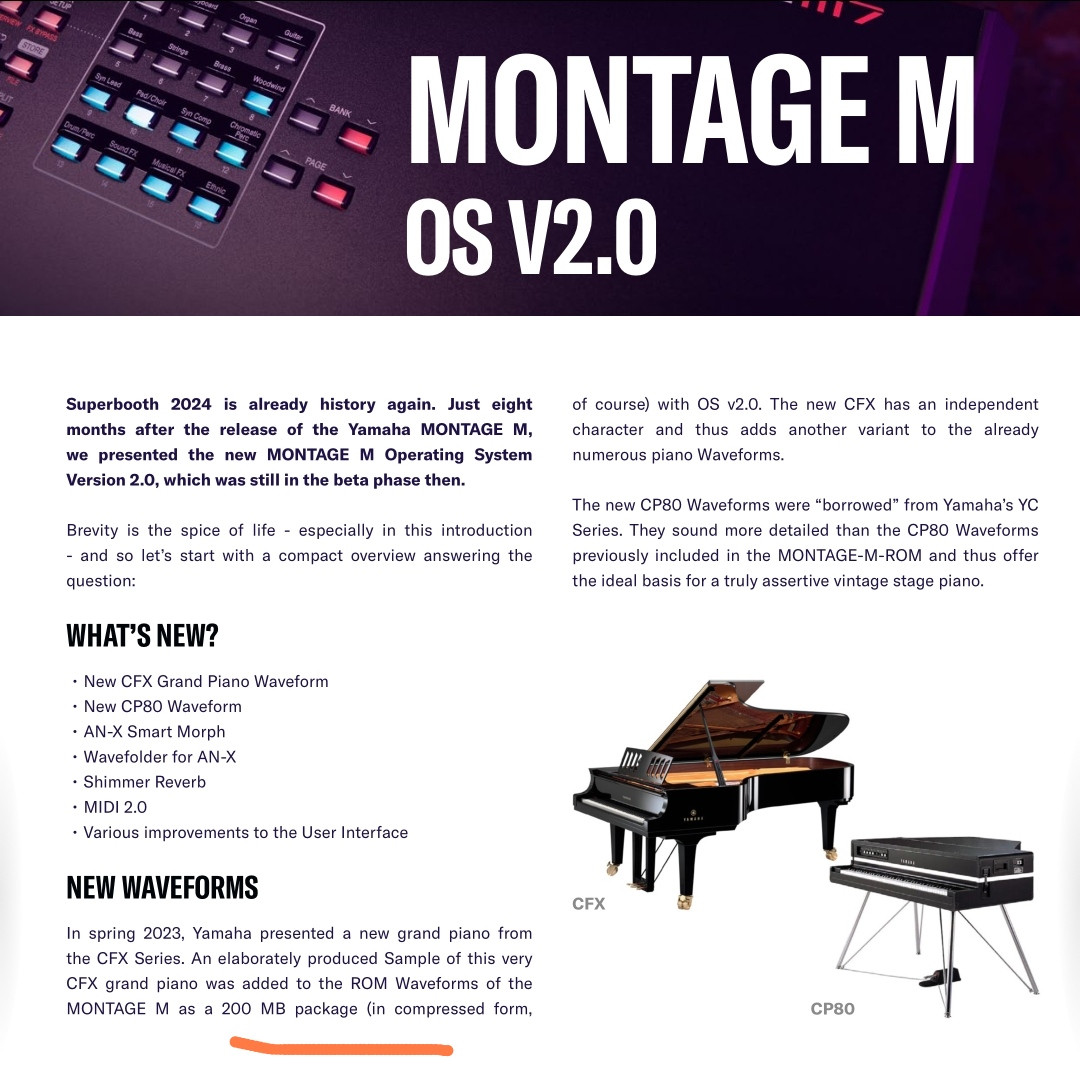
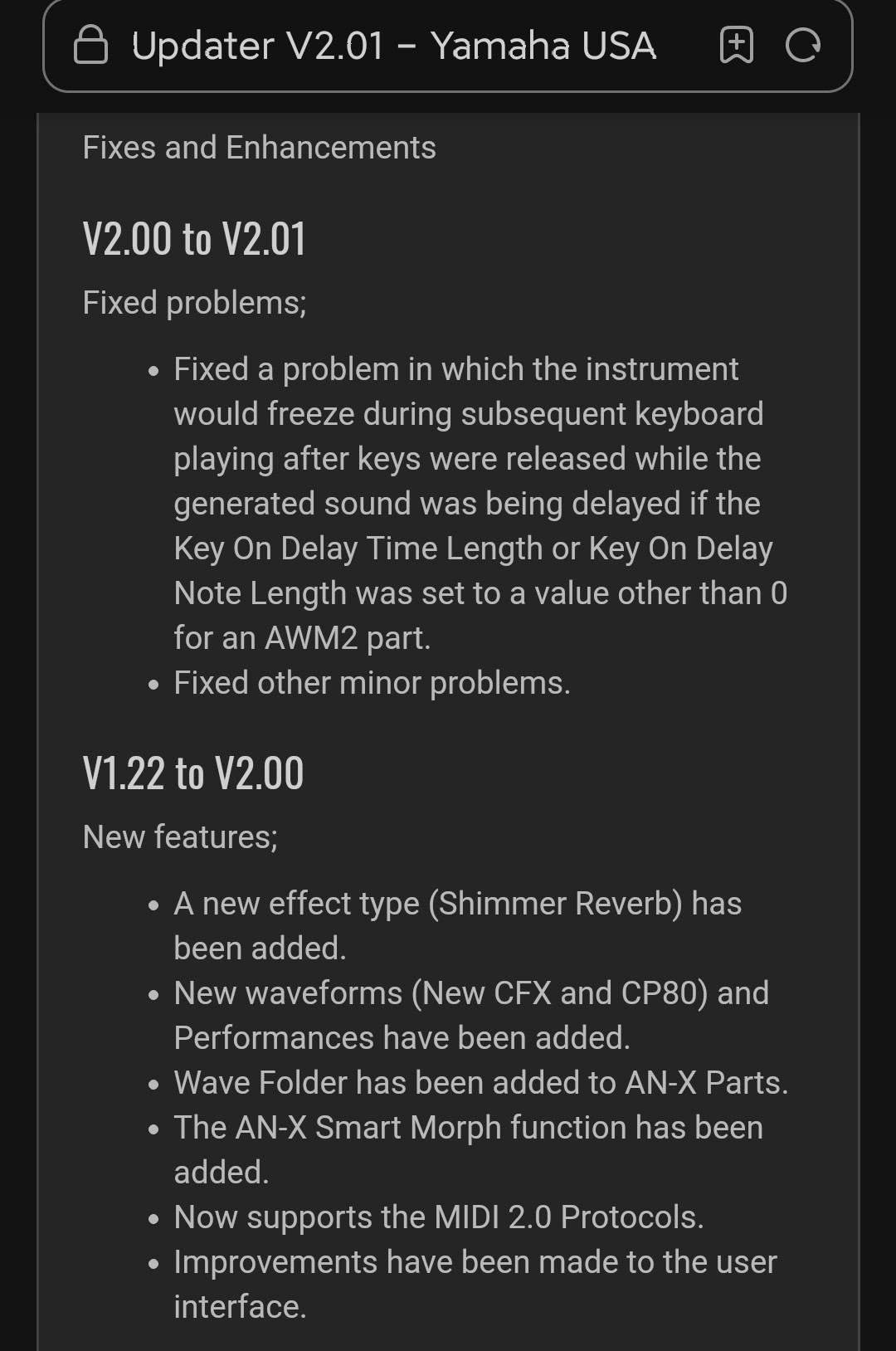
https://usa.yamaha.com/products/music_production/synthesizers/montagem/index.html
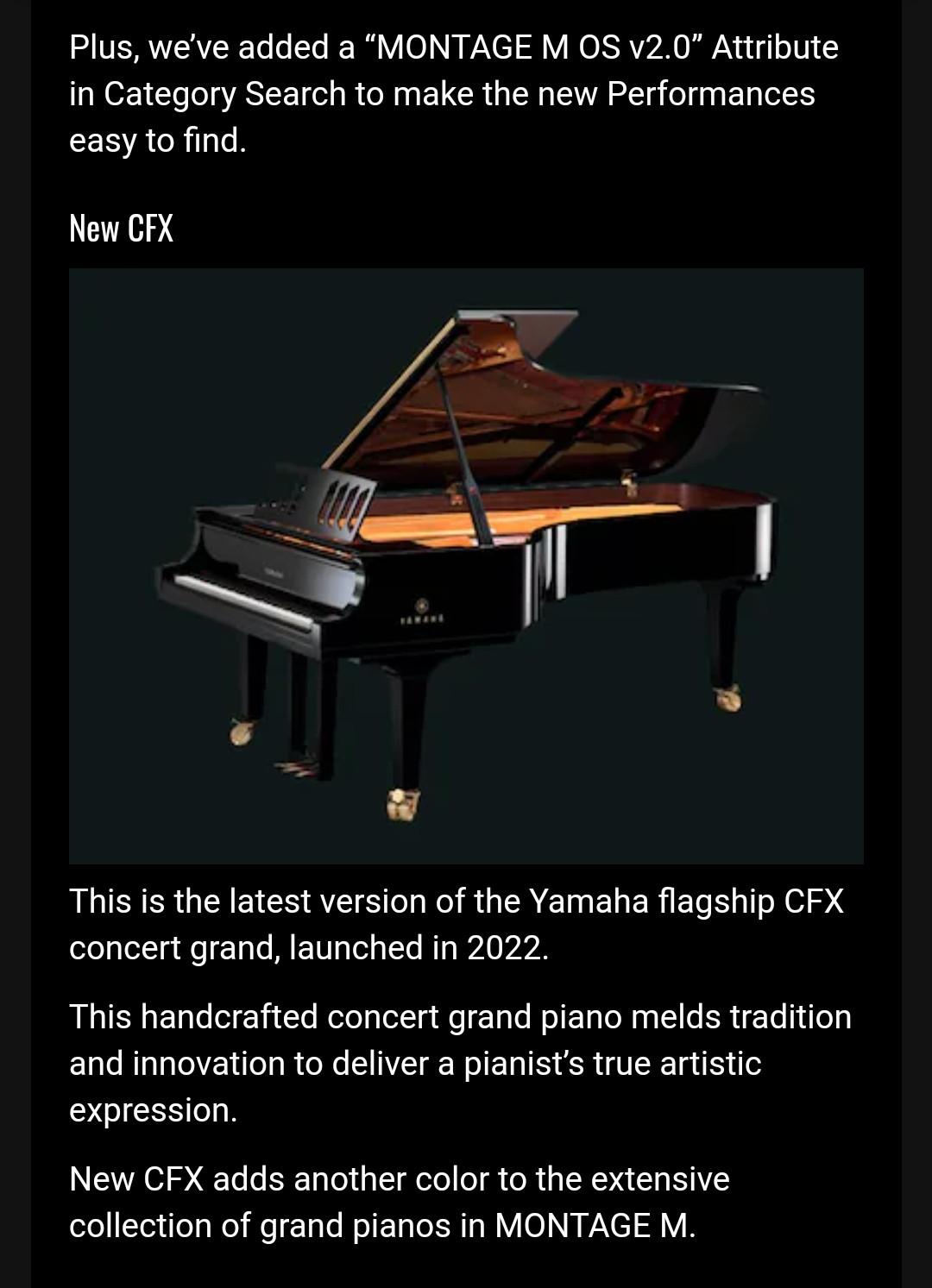
I think this is the first 2022 Yamaha CFX model in software form.
Is the playability of hardware CFX in Montage or P525 better than Noire or Garritan CFX or VSL CFX?
pipAT Cool! The demo however sounds a little so-and-so to my ears. Hopefully we'll se new great sounds in Yamahas future pianos.
pipAT Is the playability of hardware CFX in Montage or P525 better than Noire or Garritan CFX or VSL CFX?
I think one thing that built in sounds do better than software instruments is some per key damper behavior (smooth release and damper position). However, I don't know if one get the same function when those sound engines are used with MIDI. Other than that I think the playability of VSL CFX s just as good as any built in sound. Unfortunately I have no experience with Garritan or Noir.
By the way, I saw from a video and found the CFX Concert Grand in Montage M 1.0 has 8 main layers +1 layer key off; CFX2 in v2.0 has 8 main layers. CFX2 sound is more direct like punch-in-face. The Bosie pack is around 400MB. Is the capability of chip the reason that limits the sizes of hardware sound packs. SSD is now much cheaper now.
To put it bluntly: Piano hardware manufacturers live under the proverbial rock as to what is possible nowadays.
They sure could design and produce excellent, excellent instruments that would make our kind of players super happy.
Unfortunately, so far, they don't. The surface of what is "easily" attainable nowadays is hardly scratched.
Cheers,
HZ
Here are the MIDI files with the Pianoteq Kawai SK-EX, and some in-DAW processing. I used the player preset, removed the limiter, lowered the volume, increased the dynamic range, condition to 0.5.
dikrek @CyberGene curious if you hear the Pianoteq character with the Kawai as I have set it up
I think this is my first post here. I'm doing a lot of comparisons for myself and trying to get a sound that I'm happy with. Here is a recording I did yesterday of a Brahms Intermezzo (116 no. 6 in E):
Brahms 116-6 N1X external (Tascam)
I shared the external recording as a reference. That was what I was hearing when I was playing. I have another piece with the same comparison that I might share soon if this one's useful.
(I couldn't figure out how to upload so I went with soundcloud links)
Pathbreaker you can’t upload files as a newbie, which is a protection against spammers. I made you a regular. You should be able to upload now. You can edit your post now and upload the files directly.
That makes sense, thank you @CyberGene ! They are a bit over 30mb so I will adjust them down and then share when I get a chance.
Here's the new files:
N1X external
v-20241115-130302-es0-15-11-24-15-30-14-429-brahms-116-6-norm.mp3
Mondern D
3253-3739-brahms-116-6-modern-d-11-15-24.mp3
Garritan CFX
3253-3739-brahms-116-6-garritan-cfx-11-15-24.mp3
I think the N1X external recording benefits a lot from the additional compression. There's so much noise in that recording. I could have made it better if I had a clue what I was doing. I took the video recording (there is more than one video version that goes with these), removed the audio into a wav, then normalized that in audacity (the only way I know how to make it somewhat presentable). Then I exported that wav to mp3 in this most recent upload. I think it makes for a good comparison of all 3. The VST versions came from cubase as wav files but I still did a default normalize in audacity for those. Then the same mp3 export to reduce the size.
I'm also reviewing your original post again and will try your garritan midi file in my own preset. Yours sounds amazing so I might want to try it (not sure if you posted it anywhere). Also, I never would have guessed the first one was pianoteq since it sounded way better than I expected.
I would run it through Ivory 3 if I knew how to render the midi file through cubase. Same with Modern D, I don't know how to do that. I only know it in the Aria player for Garritan, so I always record the Modern D performance through cubase as I play it and that's what generates the midi file which I render in Garritan. I previously did it the same with with Ivory 3. Some of the Modern D performances suffer from this since I can't respond to that piano's behavior. The garritan suffers a little less because it's a similar piano behavior to the N1X CFX.
CyberGene curious to hear your opinion on the later files I posted for Kawai and Bösendorfer, I don’t hear the extra ringing on the Kawai one, for example, but we don’t all have the same ears.
dikrek sorry, I’ve been a bit busy these days. I will listen to these files when I have some time for music.