nicknameTaken
I like the first in the poll more. I didn't read any of the spoilers. It goes by feeling.

I like the first in the poll more. I didn't read any of the spoilers. It goes by feeling.
David B Those wavs sound like listening somebody playing Piano rather than to be in front and playing. I cannot imagine using that audio for playing.
David B The D-274 (with the adjusted velocity curve for my N1X) has a sweeter tone, better overall dynamic range with greater playability and expression at lower volumes.
That has been my opinion from day one. In the D-274 the timbre changes from mellow to metallic and aggressive, while the Bosendorfers have beautiful tone but sound "almost" as being one layer - the tone changes in volume rather than in timbre. The CFX is also very interesting: the notes are better separated when playing fast, but the tone is a bit brighter overall and it sounds a bit more distant.
I am also tempted to upgrade the D-274 from standard to full, but really like the offline convenience of the e-Licenser dongle that to me it is useful from time to time; since I have to give that up if I purchase the Full license, I have not made my mind.
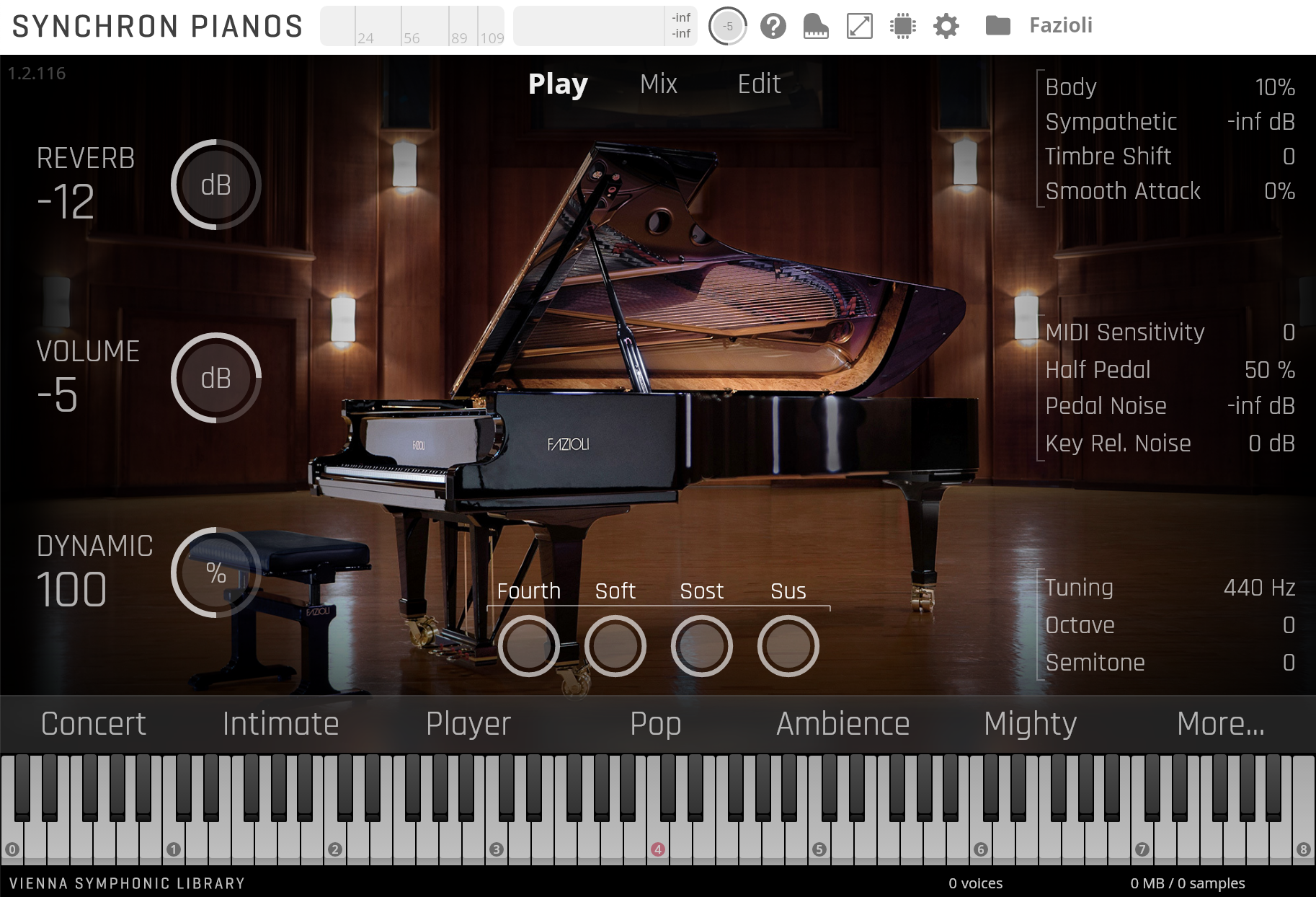
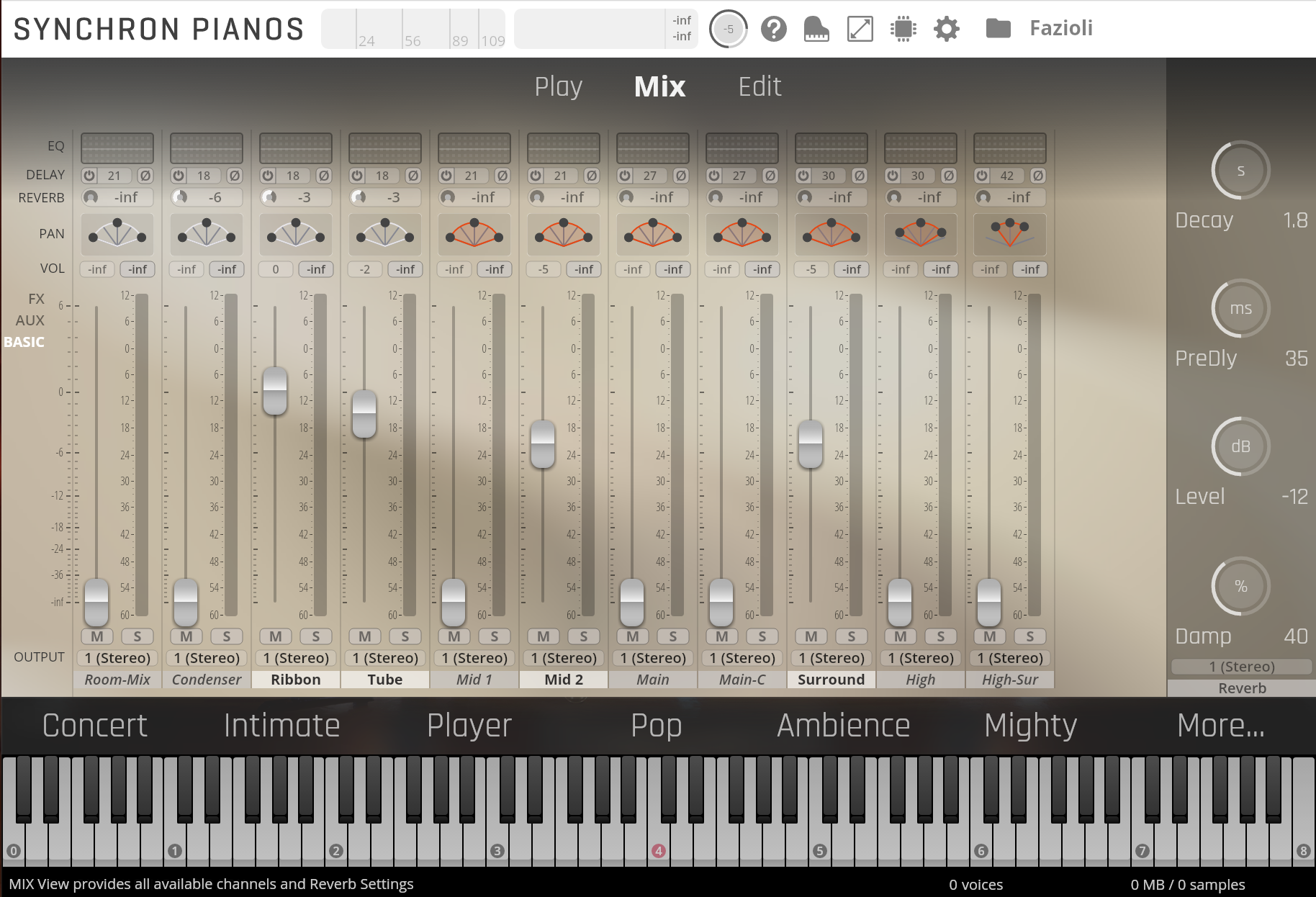
It is not clear from your screenshots if the delay in the Tube and Mid1 mics is activated or not. If it is, try again the preset with the delays set at zero: this way you add complexity to the tone without adding too much spaciousness. I like it that way (and most of the days I prefer the Main mic to the Mid1, but keep changing my opinion on that).
vagfilm In the D-274 the timbre changes from mellow to metallic and aggressive, while the Bosendorfers have beautiful tone but sound "almost" as being one layer - the tone changes in volume rather than in timbre.
Bold supplied.
That's a very good description.
vagfilm I am also tempted to upgrade the D-274 from standard to full, but really like the offline convenience of the e-Licenser dongle that to me it is useful from time to time; since I have to give that up if I purchase the Full license, I have not made my mind.
Of course you can opt for dongle activation with iLok also. I guess that's an additional cost though. I would make the switch since iLok is integral with VSL going forward.
vagfilm It is not clear from your screenshots if the delay in the Tube and Mid1 mics is activated or not. If it is, try again the preset with the delays set at zero: this way you add complexity to the tone without adding too much spaciousness.
I've got no reverb or delay activated. Natural reverb from the ambient mics (mid1/surround) is enough.
God Bless,
David
David B while the Bosendorfers have beautiful tone but sound "almost" as being one layer - the tone changes in volume rather than in timbre.
That's a very good description.
In full disclosure, the description was made by someone else (here? PW?) during the recent VSL discussions, and I fully agree, particularly in the 3 upper octaves in which some of the velocities sound like regular piano engines and not like VSTs.
David B you can opt for dongle activation with iLok also
But the iLok dongle costs almost 3 times the price of the eLicenser. I have to decide between the convenience of the offline vs the additional mics...
David B Natural reverb from the ambient mics (mid1/surround) is enough
Fully agree
vagfilm It is not clear from your screenshots if the delay in the Tube and Mid1 mics is activated or not. If it is, try again the preset with the delays set at zero: this way you add complexity to the tone without adding too much spaciousness.
I just realized why you might have asked that. When I went to listen to File 1 that I uploaded it had a weird delayed sound to it. I thought that doesn't sound right so I refreshed my screen and played it again. It was normal after that. I'm not sure if that happened to you, but it could be a glitch in PianoClack.
God Bless,
David
I've also been demoing all the VSL Synchron pianos this week, and I agree that the Steinway D-274 stands out as being particularly excellent among the modern grands. I find to be very flexible and powerful, and it really responds to what ever I try to convey in terms of expression. Might be the best of the bunch all-around. It does sound a touch hard and aggressive at the higher velocities, and I still think I prefer the warmer tone of the Bosenderfer Imperial overall, but the Steinway is really, really good. I plan to purchase this once the trial period is over.
I also absolutely adore the 1895 Bluthner, which I purchased from David (thanks David!) but that is more of a niche instrument and probably not for everyone.
I didn't care much for the 280VC - it sounds rather hard, flinty and one-dimensional to me. Nothing at all like the Imperial. I would never have guessed these come from the same manufacturer.
Judging from peoples responses on other forums, the CFX seems to be the runaway favorite, but I personally don't find it to be all that special. There's nothing wrong with it, but I don't think it has any standout characteristics either, and just seems somewhat neutral and colorless to me in comparison with the D-274 and the Imperial. But I seem to be in the minority in this opinion.
Both the uprights are very well done, and convey the character of the instruments well, though I personally prefer the Bosendorfer over the new one. Actually the new 1904 German Upright sounds extremely close in tone to another VST I already have (NI Gentleman) which is also sampled from a turn-of-the-century Bechstein upright.
Maybe I'll post some samples later.
Sorry I didn't read all the thread, but I recognized almost immediately the Pianoteq engine in the first file. The metallic feeling is always there, on some octaves more than in others, but I have to say that the reverb algorithm used in the Pianoteq engine does a really good job to enhance the realism, and the richness and details of the sympathetic resonances on Pianoteq is very high (much better than Garritan), almost at acoustic-piano level. Unfortunately it's a little too much bright and metallic on some notes, otherwise it would be very good, better than some Steinway VSTs. Then I hear my digital piano sound and I feel it almost like a toy: 3-4 velocity layers, very short samples, looped sound, lacking in high frequencies, etc... Well, whatever, I'm just a beginner at piano, so I should not complain too much... 😆
The sad thing is that the current DPs are not much better than those of 4-5 years ago. IMHO Pianoteq engine improves faster than most DP engines.
dikrek thanks, you’ve managed to tame down the typical Pianoteq character as much as possible which is a commendable achievement 👍🏻 However, I can still hear it in those up-down scale sequences in the upper-mid region which is exactly why I played that way in the first place: to try to highlight where Pianoteq struggles. Somehow your first file is better than the second one in that regard though.
David B
the timbral quality, the weight, the attack, and the general tonal realism are unbeatable, the MD is a true bext gen virtual piano❤️
dikrek try these, I think a setting was off
Not bad. Where I can hear the Pianoteq character is in the note sustain where it becomes slightly zingy and metallic. Also there's this typical nasal quality that I wonder if it is due to EQ, or due to the Pianoteq engine, or even due to the original piano sound being nasal, since some Steinways are like that. But as I said, you did great at reducing PT artifacts it as much as possible 👍🏻
dikrek A couple more with Logic's new piano and XLN Addictive Keys
I like the Logic one more although the pedal noises are annoying. I have Logic and tested that new piano when it was released and I like its sound. However I remember it was buggy with some unexpected behavior, clicks, noises, cut-offs, etc. Hopefully they will fix it.
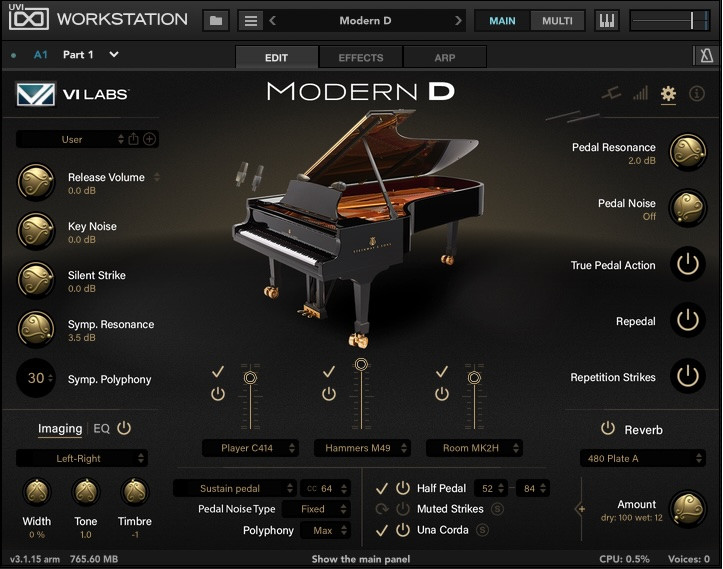
David B Got to have the Modern D in this thread
Wow, that's great! Have you posted your preset somewhere? It's really good, I may use it myself. Enjoyed it a lot. Going back to my very first post in the discussion, I think I still like my original Garritan CFX export (the second file) more but it's just a matter of taste for piano character rather than an issue with the corresponding software (I just seem to like CFX pianos more than Steinways but I love both of them).
CyberGene Wow, that's great! Have you posted your preset somewhere?
Here ya go.
Hi David,
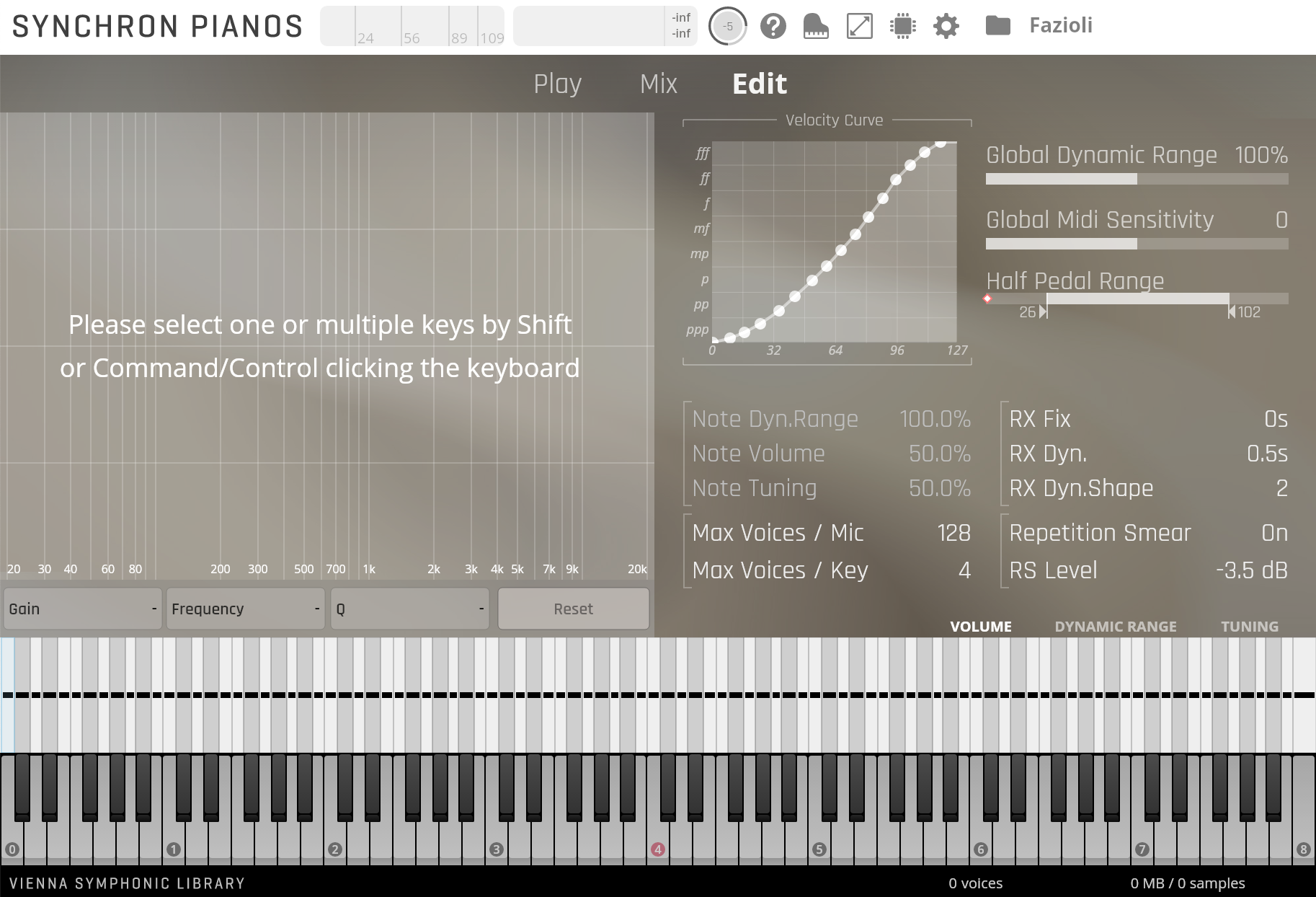
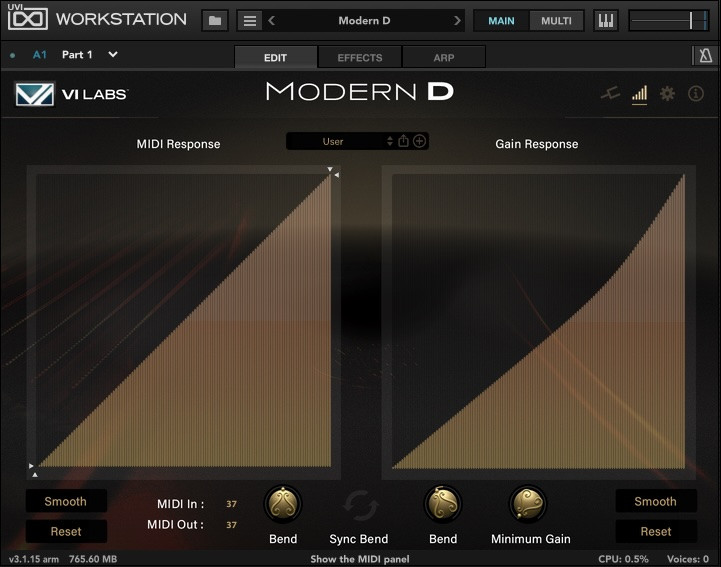
can you please explain about the different MIDI and Gain responses, what is the objective behind this.
_sem_ I can’t speak for David’s patch in particular, however on a general note, the left (velocity) curve would map the incoming MIDI velocity to a particular sample layer. If we imagine that they sampled 127 velocity layers, each of those layers will have a slightly different timbre and a different volume. So, when you map, e.g. incoming MIDI velocity 100 to trigger value 110 instead, you will hear both louder and brighter sample. Here comes the right curve which can apply a separate gain mapping. The default straight diagonal curve means it’s unaffected. However, you can apply a different gain (compared to the embedded one in the samples). In the above case, you can make it so that the incoming MIDI value of 100 will trigger layer 110 but then apply negative gain corresponding to 100, so there will only be a timbral shift and no volume change with the two curves for that value.
_sem_ can you please explain about the different MIDI and Gain responses, what is the objective behind this.
Gene's explanation is spot-on. I decreased the gain response slightly just to make the piano a bit more mellow and intimate sounding. A concert grand can get pretty overwhelming in volume fast.
God Bless,
David