PASHKULI
pianow how microphones are a thing of the past
They are not 'a thing of the past'. Recording acoustic pianos is like recording a harp or any acoustic instrument.
The difference on piano is that by default all of its strings are metal (like on acoustic guitars with metal strings) therefore their vibration could also be captured using pickups, which will give us the direct "dry" sound.
Where microphones fail:
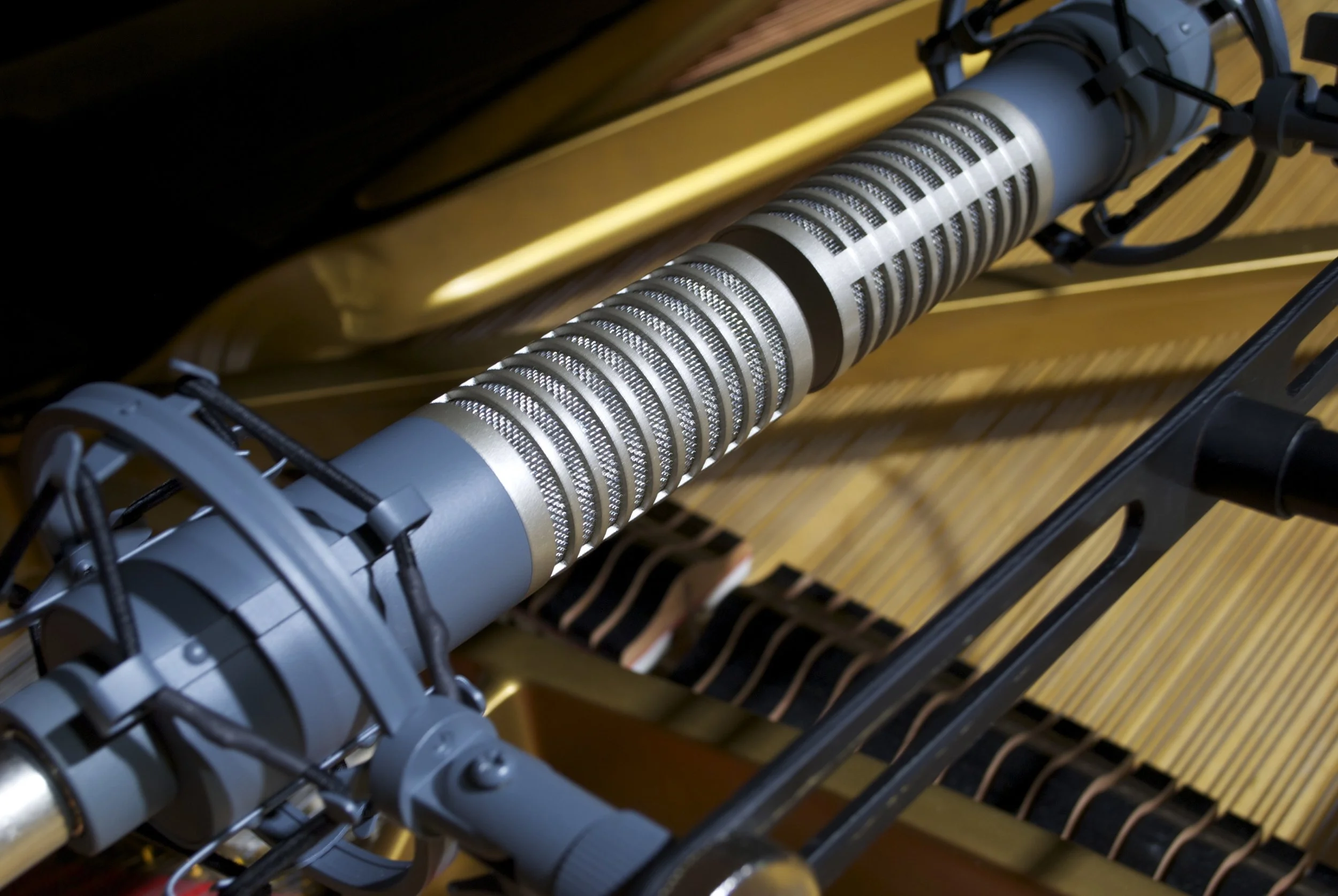
• you need close‑up mics (the ones that try to deliver the direct sound of the strings) but due to microphone's nature the will always be closer to a few strings and further from most of the strings, therefore more microphones are needed, hence the increasing chance of phase issues, how far\close, etc. (should they get closer for lower dynamics pianissimo), each change in position would change phase or will capture more of the surrounding air than the strings
• or you record some few strings, move the mic to the next set and it is painful
• then you have the cabinet (mid) mics directed at the instrument in various angles, lid
• then you have ambient mics, maybe even surround mics
The mess of phase correlation is real. Not that you will employ all mics at once, but those are recorded bloating the final size of the library. You can get more info here:
https://www.vsl.co.at/manuals/synchron-pianos/microphone-positions
I explained in another thread how to properly record a piano but it requires a good amount of money (to by 88 pickups, multiplex board for them, power and special software for the mixing) see here how it was done for a set of 64 such pickups (array) for an 8 string guitar, each string having 8 pickups along its "pickguard" area (typically guitars have only two or three pickups).
Piano won't need more than one per key (strings per note) and two per string will result in 176 pickups (2 × 88). 88 are enough and they must be placed properly → that requires some mod on the piano to accommodate them.
Then we have the piano's soundboard (the actual resonator under the strings):
• piezo pickups should be used for this task along the bridge (again coming from guitar recording)
A is one type piezo, B is the other type piezo and C is with the mic pointed at the strings
• of course for a piano bridge we will need more than one piezo as it is a bigger instrument
Sympathetic resonances can be recorded using sustain bow:
Everything else in terms of player position, ambience room reverb can be done with a set of BRIRs (Binaural Room Impulse responses), including such IRs for the cabinet of the piano (and under the piano if you will). A set of 100 IRs is merely 1 to 3MB (megabytes), plenty can be made but they have to be made properly with the proper environment setup and equipment.
Therefore you get:
• audio recordings of the actual strings (real close up) → big audio data: 88 notes × ideally 10 vel. layers × 2 round‑robins × 2 release
• actual recording of the soundboard (real dry acoustic) → big audio data (same)
• BRIRs for the cabinet (several across the volume would suffice but it is a matter of experimentation) really small audio data (depending on sample rate and duration ms) typically between 100kB to 500kB (kilobytes)
• BRIRs for player's perspective and audience perspective → small audio data in MBs (less than 10MB)
• BRIRs for reverb (most of which already included in Players\Audience perspective) but special ones can be made for studio rooms, stage (inside or open outside), halls, venues → small audio data
That is how I would have done it. Yes, it requires a lot of preparation but that is how I work — proper preparation is at least half of the work done.